GENEVA (AP) — Stripped of U.S. funding, the World Health Organization chief on Monday appealed to member countries to support its “extremely modest” request for a $2.1 billion annual budget by putting that sum into perspective next to outlays for ad campaigns for tobacco or the cost of war.
After nearly 80 years of striving to improve human lives and health –- which critics say it has done poorly or not enough -- the U.N. health agency is fighting for its own after U.S. President Donald Trump in January halted funding from the United States, which has traditionally been WHO’s largest donor.
“Two-point-one billion dollars is the equivalent of global military expenditure every eight hours,” WHO Director-General Tedros Adhanom Ghebreyesus said. “Two-point-one billion dollars is the price of one stealth bomber, to kill people.”
“And $2.1 billion is one-quarter of what the tobacco industry spends on advertising and promotion every single year. Again, a product that kills people,” he told the WHO’s annual assembly. “It seems somebody switched the price tags on what is truly valuable in our world.”
Tedros made no specific reference to the U.S. cuts but has said previously the U.S. pullout was a “mistake” and urged Washington to reconsider.
A State Department spokesperson, in an email, confirmed Monday that “The United States will not field a delegation to participate in the World Health Assembly.”
WHO has presented a budget for the next two years that is 22% less than originally planned, largely in response to U.S. and other Western funding cuts, and says it has landed commitments for about 60% of that. But it still faces a budget gap of $1.7 billion.
“We know that in the current landscape, mobilizing that sum will be a challenge. We are not naive to that challenge," Tedros said.
"But for an organization working on the ground in 150 countries with a vast mission and mandate that member states have given us, $4.2 billion for two years — or $2.1 billion a year — is not ambitious. It’s extremely modest,” he said.
As a result of the cuts, the U.N. health agency this year has seen a plunge in its ability to carry out its sweeping mandate to do everything from recommend reductions in sugar levels in soft drinks to head the global response to pandemics like COVID-19 or outbreaks like polio or Ebola.
Tedros and his team have been grappling with a response to the U.S. cuts as well as reduced outlays from wealthy European countries that are worried about an expansionist Russia and are putting more money toward defense, and less toward humanitarian and development aid.
Matthew Kavanagh, the director of Georgetown University’s Center for Global Health Policy and Politics, said other countries have used the U.S. cut in aid “as cover to do their maneuvering, with many countries in Europe reducing aid.”
“The WHO faces an existential crisis that goes well beyond a budget gap to the question of whether this sort of multilateralism can succeed in addressing global health in this new era of nationalism and misinformation,” he said, alluding to discord between many countries that could cost lives.
“Literally millions will likely die needlessly on the current trajectory and the world’s health ministers do not seem capable of a coherent response,” Kavanagh added.
On tap for the nine-day World Health Assembly are two major advances that are aimed to buttress WHO’s financial strength and bolster the world’s ability to cope with future pandemics.
Member countries are expected to agree to raise annual dues, known as “assessed contributions,” by 20% to support WHO finances and reduce dependency on governments’ voluntary contributions — which change each year and make up over half of the budget.
They are also expected to agree to a hard-wrought “ pandemic treaty ” that was born of a desire to avoid any replay of the patchy, unequal response to COVID-19 when the next — and inevitable, most experts say — pandemic hits.
Among other things, the treaty would guarantee that countries that share critical samples of viruses will receive any resulting tests, medicines and vaccines and give WHO up to 20% of such products to make sure poorer countries can have access to them.
“Every World Health Assembly is significant, but this year’s is especially so," Tedros said. "This is truly a historic moment.”
The treaty’s effectiveness will face doubts when the U.S. — which poured billions into speedy work by pharmaceutical companies to develop COVID-19 vaccines — is sitting out, and because countries face no penalties if they ignore it, a common issue in international law.
Kavanagh said passage of the treaty “could be a significant victory — evidence that the U.S. government may no longer be indispensable in global health” and could offer an opportunity for developing nations in the “global South” over the longer term.
Trump has long derided WHO, including back in his first term when he pulled the United States out over its alleged kowtowing to China and other alleged missteps in the Covid pandemic. President Joe Biden put the U.S. back in.
On his first day back in office in January, Trump signed an executive order to pause future transfers of U.S. government funds to the WHO, recall U.S. government staff working with it, and announce a formal pullout by next January — under a one-year timetable required under U.S. law.
Other opponents continue to lash out at WHO. CitizenGo, an activist group that supports right-to-life and religious liberty issues, protested Monday against the pandemic treaty outside the U.N. compound in Geneva where WHO's meeting was taking place.
The rally included a balloon sculpture in the shape of the world and a banner inveighing against “globalist elites” and showing an image of Tedros and billionaire Microsoft co-founder Bill Gates, a major WHO supporter, shaking hands while surrounded by dollars.
“In the aftermath of Covid, the WHO got together and thought was a good idea to centralize even more power,” said CitizenGo campaigner Sebastian Lukomski, accusing WHO of an effort to "remove more fundamental freedoms and not learn from the mistakes that were taking place during COVID.”
In the run-up to the assembly, WHO has been cleaning house and cutting costs.
At a meeting on its budget last week, Tedros — a former Ethiopian health and foreign minister – announced a shake-up of top management that included the exit of key adviser Dr. Michael Ryan from the job as emergencies chief.
Tedros said last week that the loss of U.S. funds and other assistance have left the WHO with a salary gap of more than $500 million.
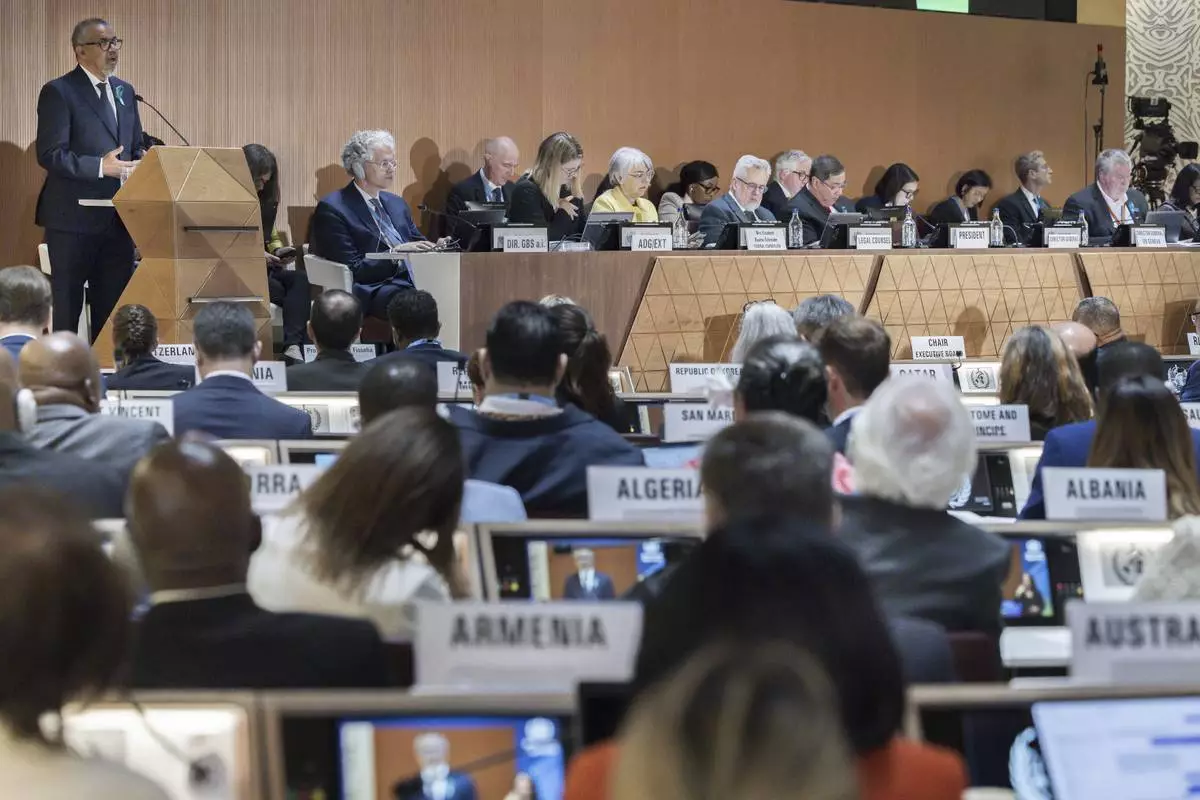
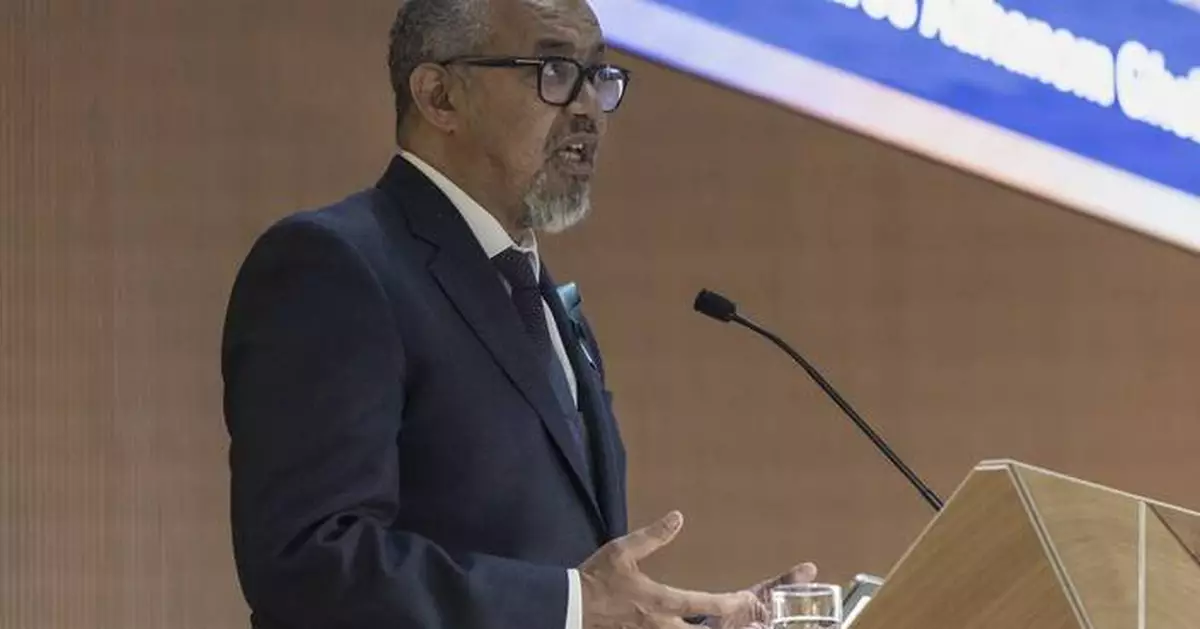
Director General of the World Health Organization (WHO) Tedros Adhanom Ghebreyesus, left, delivers his statement, during the opening of the 78th World Health Assembly at the European headquarters of the United Nations in Geneva, Switzerland, Monday, May 19, 2025. (Magali Girardin/Keystone via AP)
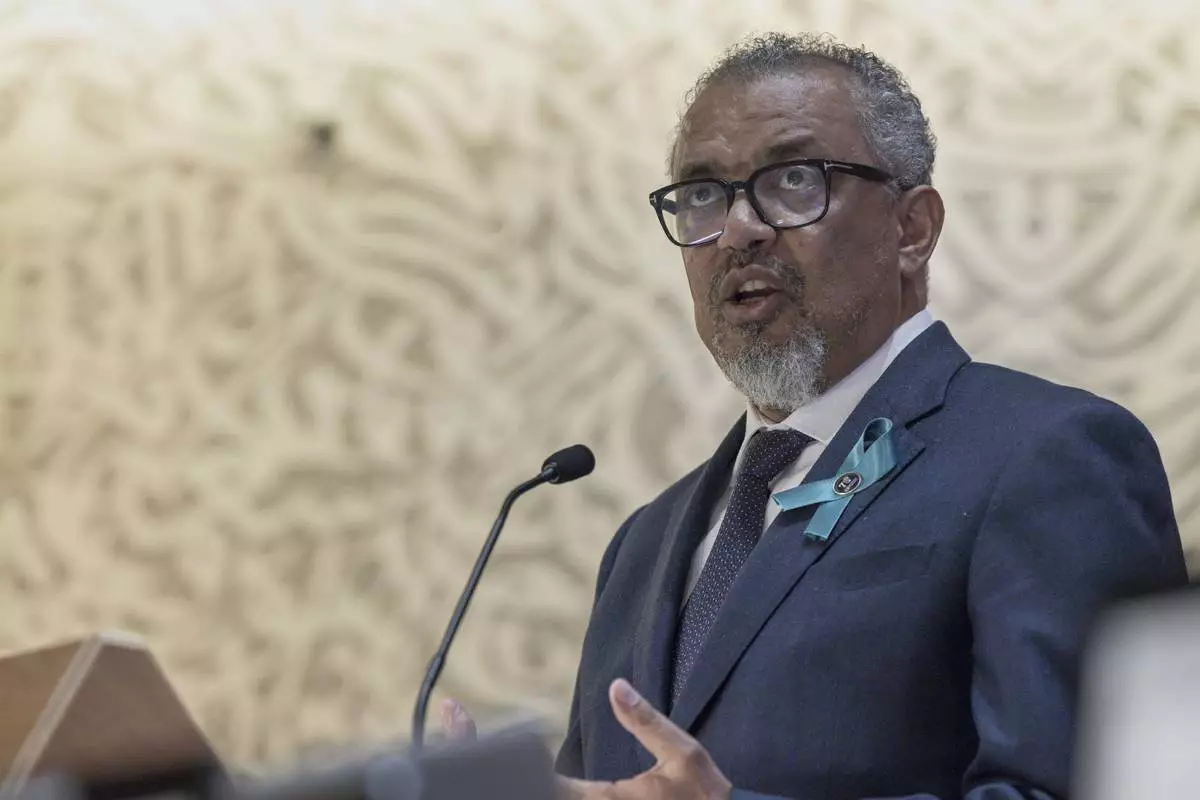
Director General of the World Health Organization (WHO) Tedros Adhanom Ghebreyesus delivers his statement, during the opening of the 78th World Health Assembly at the European headquarters of the United Nations in Geneva, Switzerland, Monday, May 19, 2025. (Magali Girardin/Keystone via AP)
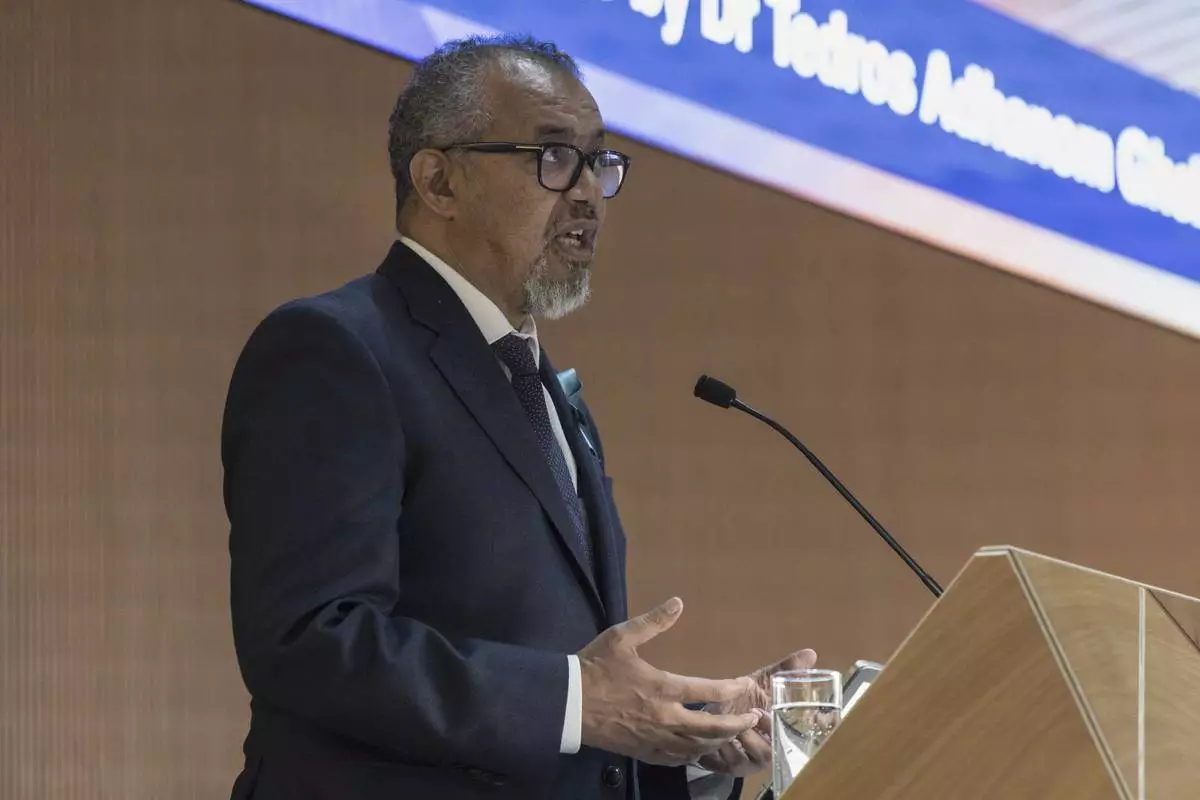
Director General of the World Health Organization (WHO) Tedros Adhanom Ghebreyesus delivers his statement, during the opening of the 78th World Health Assembly at the European headquarters of the United Nations in Geneva, Switzerland, Monday, May 19, 2025. (Magali Girardin/Keystone via AP)
WASHINGTON (AP) — Becky Pepper-Jackson finished third in the discus throw in West Virginia last year though she was in just her first year of high school. Now a 15-year-old sophomore, Pepper-Jackson is aware that her upcoming season could be her last.
West Virginia has banned transgender girls like Pepper-Jackson from competing in girls and women's sports, and is among the more than two dozen states with similar laws. Though the West Virginia law has been blocked by lower courts, the outcome could be different at the conservative-dominated Supreme Court, which has allowed multiple restrictions on transgender people to be enforced in the past year.
The justices are hearing arguments Tuesday in two cases over whether the sports bans violate the Constitution or the landmark federal law known as Title IX that prohibits sex discrimination in education. The second case comes from Idaho, where college student Lindsay Hecox challenged that state's law.
Decisions are expected by early summer.
President Donald Trump's Republican administration has targeted transgender Americans from the first day of his second term, including ousting transgender people from the military and declaring that gender is immutable and determined at birth.
Pepper-Jackson has become the face of the nationwide battle over the participation of transgender girls in athletics that has played out at both the state and federal levels as Republicans have leveraged the issue as a fight for athletic fairness for women and girls.
“I think it’s something that needs to be done,” Pepper-Jackson said in an interview with The Associated Press that was conducted over Zoom. “It’s something I’m here to do because ... this is important to me. I know it’s important to other people. So, like, I’m here for it.”
She sat alongside her mother, Heather Jackson, on a sofa in their home just outside Bridgeport, a rural West Virginia community about 40 miles southwest of Morgantown, to talk about a legal fight that began when she was a middle schooler who finished near the back of the pack in cross-country races.
Pepper-Jackson has grown into a competitive discus and shot put thrower. In addition to the bronze medal in the discus, she finished eighth among shot putters.
She attributes her success to hard work, practicing at school and in her backyard, and lifting weights. Pepper-Jackson has been taking puberty-blocking medication and has publicly identified as a girl since she was in the third grade, though the Supreme Court's decision in June upholding state bans on gender-affirming medical treatment for minors has forced her to go out of state for care.
Her very improvement as an athlete has been cited as a reason she should not be allowed to compete against girls.
“There are immutable physical and biological characteristic differences between men and women that make men bigger, stronger, and faster than women. And if we allow biological males to play sports against biological females, those differences will erode the ability and the places for women in these sports which we have fought so hard for over the last 50 years,” West Virginia's attorney general, JB McCuskey, said in an AP interview. McCuskey said he is not aware of any other transgender athlete in the state who has competed or is trying to compete in girls or women’s sports.
Despite the small numbers of transgender athletes, the issue has taken on outsize importance. The NCAA and the U.S. Olympic and Paralympic Committees banned transgender women from women's sports after Trump signed an executive order aimed at barring their participation.
The public generally is supportive of the limits. An Associated Press-NORC Center for Public Affairs Research poll conducted in October 2025 found that about 6 in 10 U.S. adults “strongly” or “somewhat” favored requiring transgender children and teenagers to only compete on sports teams that match the sex they were assigned at birth, not the gender they identify with, while about 2 in 10 were “strongly” or “somewhat” opposed and about one-quarter did not have an opinion.
About 2.1 million adults, or 0.8%, and 724,000 people age 13 to 17, or 3.3%, identify as transgender in the U.S., according to the Williams Institute at the UCLA School of Law.
Those allied with the administration on the issue paint it in broader terms than just sports, pointing to state laws, Trump administration policies and court rulings against transgender people.
"I think there are cultural, political, legal headwinds all supporting this notion that it’s just a lie that a man can be a woman," said John Bursch, a lawyer with the conservative Christian law firm Alliance Defending Freedom that has led the legal campaign against transgender people. “And if we want a society that respects women and girls, then we need to come to terms with that truth. And the sooner that we do that, the better it will be for women everywhere, whether that be in high school sports teams, high school locker rooms and showers, abused women’s shelters, women’s prisons.”
But Heather Jackson offered different terms to describe the effort to keep her daughter off West Virginia's playing fields.
“Hatred. It’s nothing but hatred,” she said. "This community is the community du jour. We have a long history of isolating marginalized parts of the community.”
Pepper-Jackson has seen some of the uglier side of the debate on display, including when a competitor wore a T-shirt at the championship meet that said, “Men Don't Belong in Women's Sports.”
“I wish these people would educate themselves. Just so they would know that I’m just there to have a good time. That’s it. But it just, it hurts sometimes, like, it gets to me sometimes, but I try to brush it off,” she said.
One schoolmate, identified as A.C. in court papers, said Pepper-Jackson has herself used graphic language in sexually bullying her teammates.
Asked whether she said any of what is alleged, Pepper-Jackson said, “I did not. And the school ruled that there was no evidence to prove that it was true.”
The legal fight will turn on whether the Constitution's equal protection clause or the Title IX anti-discrimination law protects transgender people.
The court ruled in 2020 that workplace discrimination against transgender people is sex discrimination, but refused to extend the logic of that decision to the case over health care for transgender minors.
The court has been deluged by dueling legal briefs from Republican- and Democratic-led states, members of Congress, athletes, doctors, scientists and scholars.
The outcome also could influence separate legal efforts seeking to bar transgender athletes in states that have continued to allow them to compete.
If Pepper-Jackson is forced to stop competing, she said she will still be able to lift weights and continue playing trumpet in the school concert and jazz bands.
“It will hurt a lot, and I know it will, but that’s what I’ll have to do,” she said.
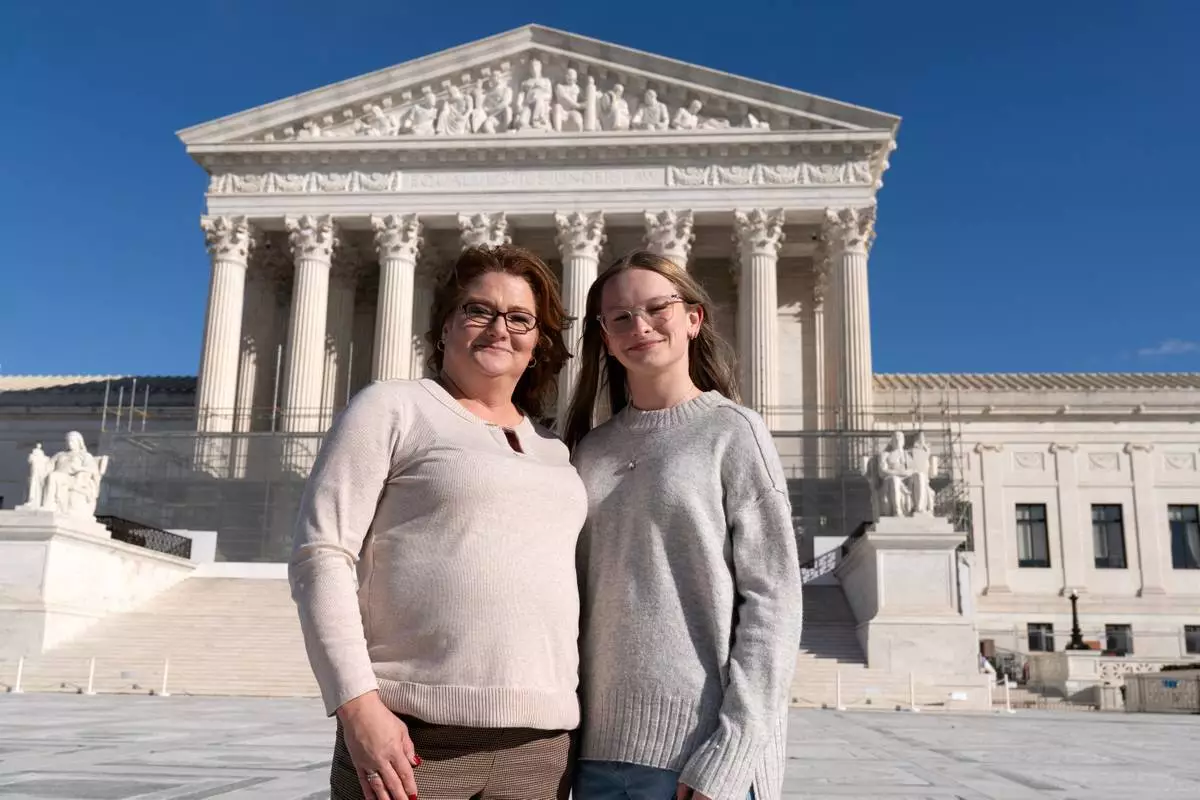
Heather Jackson, left, and Becky Pepper-Jackson pose for a photograph outside of the U.S. Supreme Court in Washington, Sunday, Jan. 11, 2026. (AP Photo/Jose Luis Magana)
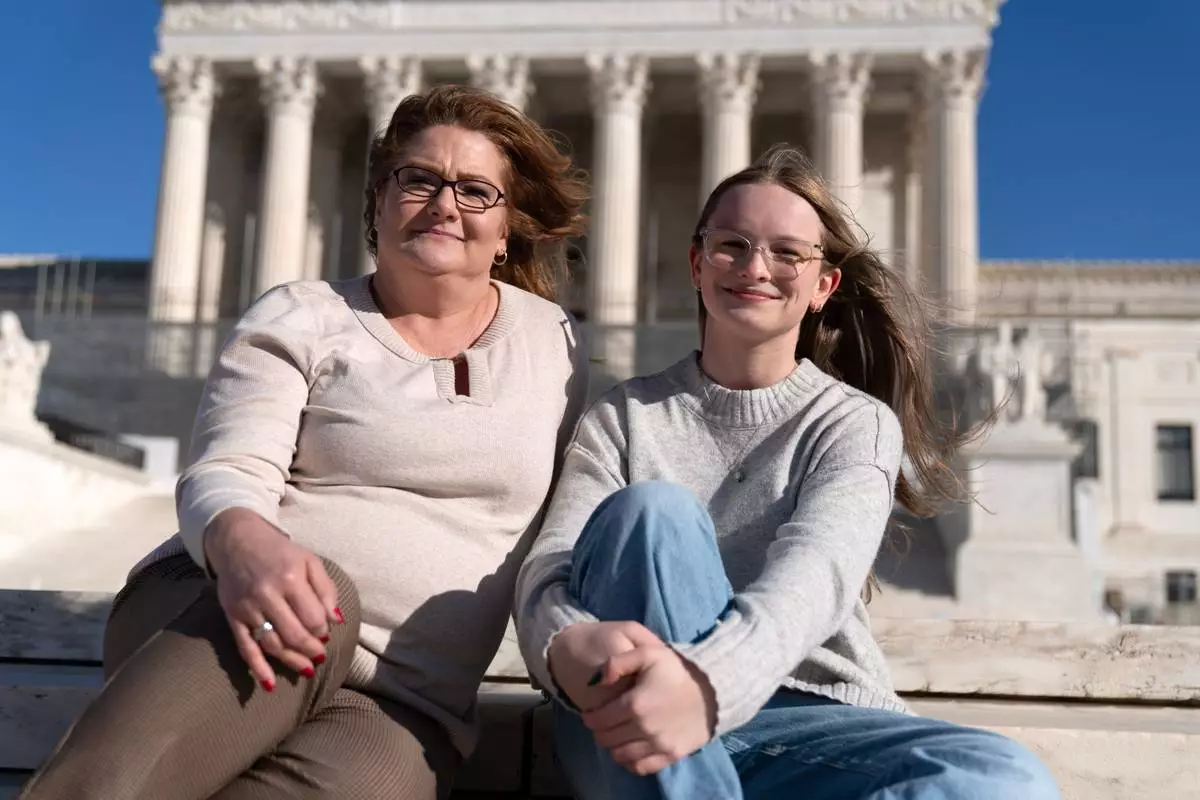
Heather Jackson, left, and Becky Pepper-Jackson pose for a photograph outside of the U.S. Supreme Court in Washington, Sunday, Jan. 11, 2026. (AP Photo/Jose Luis Magana)
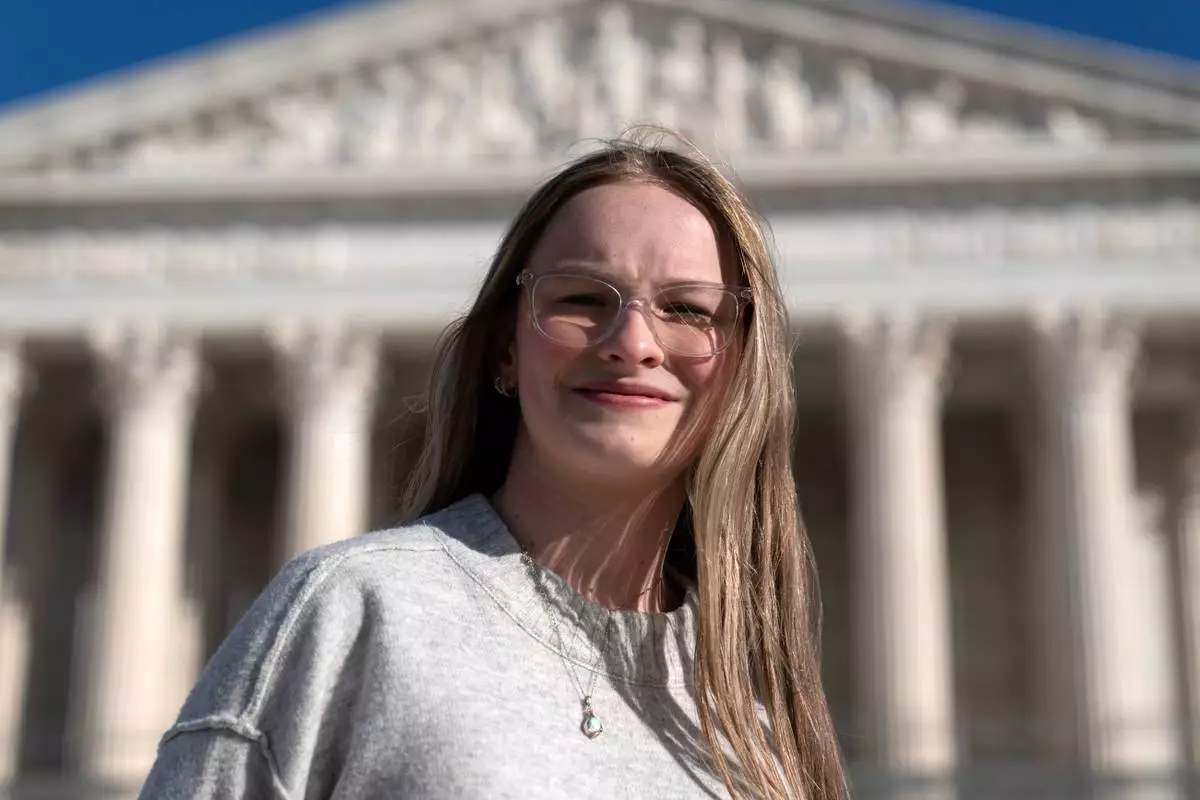
Becky Pepper-Jackson poses for a photograph outside of the U.S. Supreme Court in Washington, Sunday, Jan. 11, 2026. (AP Photo/Jose Luis Magana)
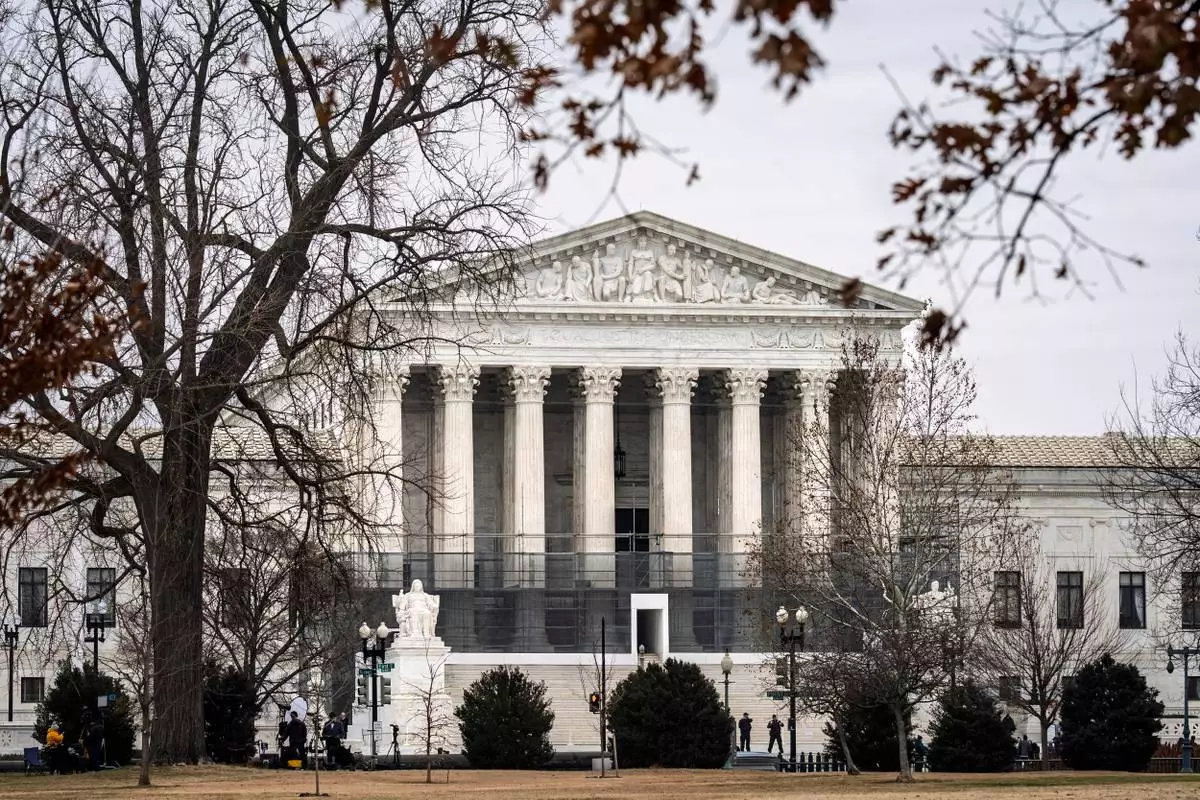
The Supreme Court stands is Washington, Friday, Jan. 9, 2026. (AP Photo/J. Scott Applewhite)
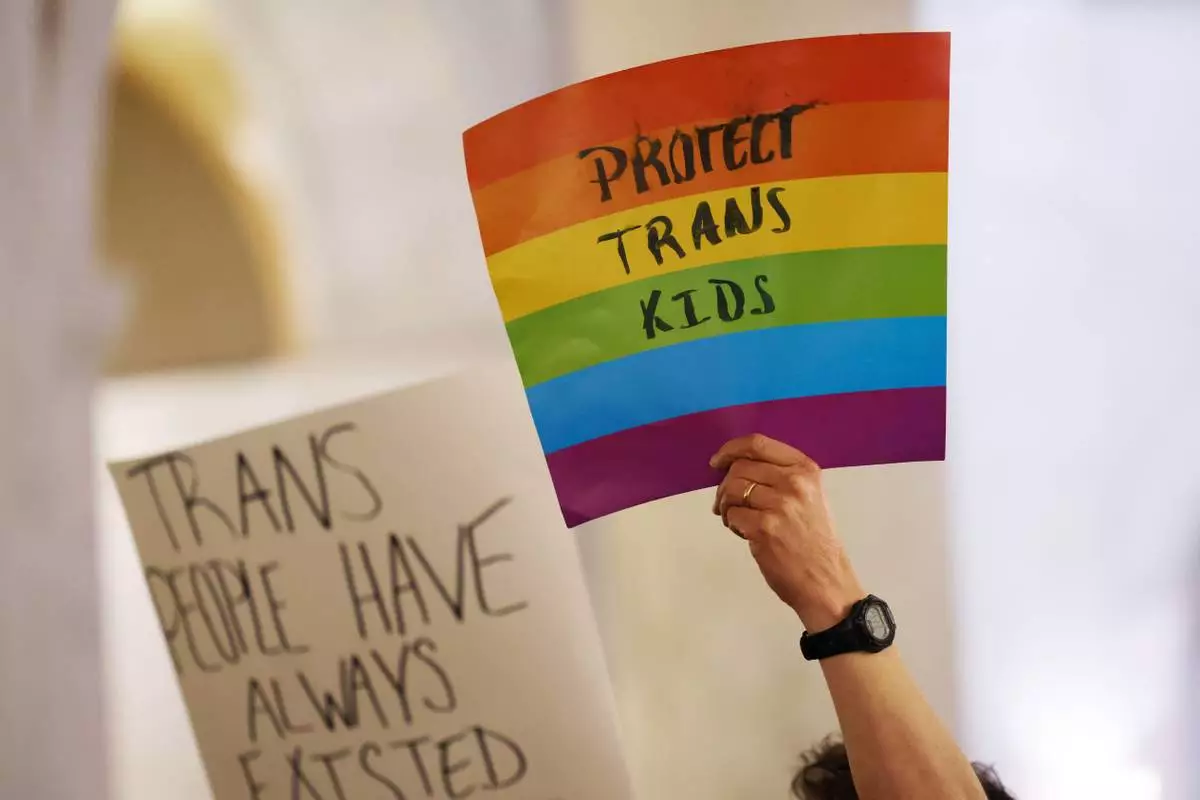
FILE - Protestors hold signs during a rally at the state capitol in Charleston, W.Va., on March 9, 2023. (AP Photo/Chris Jackson, file)