PARIS (AP) — The government of French President Emmanuel Macron covered up decisions over the illegal treatment of mineral water by food industry giant Nestle, including the world-famous Perrier brand, a Senate inquiry commission said Monday.
Its report focused on Nestle's years of use of treatments to avoid bacterial or chemical contamination of water labeled as “natural mineral water” or “spring water” for brands also including Contrex, Vittel and Hépar. Such treatments are prohibited under French and European regulations.
The report concluded that France's government had concealed “illegal practices."
“In addition to Nestle Waters’ lack of transparency, the French government’s lack of transparency must also be highlighted,” it said.
French media reported the banned treatments last year.
The report noted a "deliberate strategy" of concealment since the first government meeting on the issue in October 2021. Months later, authorities agreed to a Nestle plan to replace the banned treatments with microfiltering.
Nestle did not immediately respond to a request for comment. France’s government did not immediately comment.
Last year, the Swiss company publicly acknowledged having used treatments on mineral waters and agreed to pay a 2 million euro fine ($2.2 million) to avoid legal action.
The inquiry commission interviewed more than 120 people including Nestle’s CEO and top managers. One refused to speak to it: Alexis Kohler, then-secretary general of the Elysee presidential palace, who the report said has spoken several times with Nestle executives by phone or in person.
The commission concluded “that the presidency of the republic had known, at least since 2022, that Nestle had been cheating for years.”
Asked about scandal in February, Macron said he was “not aware of these things ... There is no collusion with anyone.”
Alexandre Ouizille, the commission's rapporteur, said the total amount of the fraud has been estimated at over 3 billion euros ($3.38 billion) by France's agency in charge of fraud control.
Natural mineral water is sold about 100 to 400 times the price of tap water, he said, denouncing "misleading of consumers."
Ouizille described a Nestle plant in southern France the commission visited where there were “sliding cabinets behind which illegal treatments were carried out.”
The report said Nestle argued there was a risk of job losses if the government did not authorize some kind of treatment or microfiltration, because its plants would have to close due to spring water being contaminated by bacteria like E. coli that can cause serious illness and death.
Laurent Burgoa, the president of the commission, said there has been no proven harm to the health of people who drank water sold by Nestle.
“Personally, I drank some Perrier ... But I didn’t know what I was drinking, that’s the problem," Burgoa said.
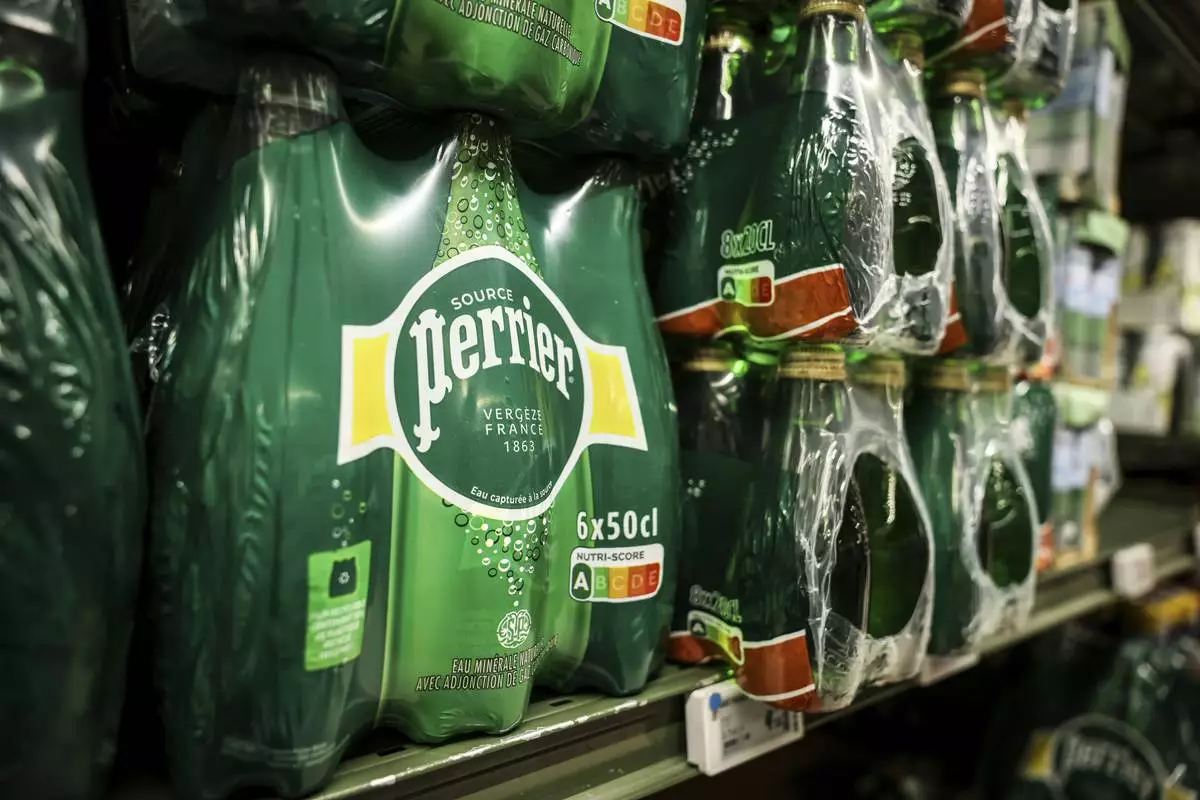
Bottles of Perrier are pictured in a supermarket, as a French Senate inquiry commission said the government of President Emmanuel Macron covered up decisions over the illegal treatment of mineral water by food industry giant Nestle, Monday, May 19, 2025 in Paris. (AP Photo/Thomas Padilla)

A bottle of Perrier stands on a cafe table as a French Senate inquiry commission said the government of President Emmanuel Macron covered up decisions over the illegal treatment of mineral water by food industry giant Nestle, Monday, May 19, 2025 in Paris. (AP Photo/Thomas Padilla)

NEW YORK (AP) — Stocks of credit-card companies are tumbling on Monday after President Donald Trump threatened moves that could eat into their profits. The rest of Wall Street, meanwhile, was showing only modest signals of concern after tensions ramped to a much higher degree between the White House and the Federal Reserve.
The S&P 500 edged down by 0.1% from its all-time high as U.S. stocks drifted through mixed morning trading, while prices for gold and other investments that tend to do well when investors are nervous rose. The value of the U.S. dollar also dipped against the euro and other currencies amid concerns that the Fed may have less independence in setting interest rates to keep inflation under control.
The Dow Jones Industrial Average was down 179 points, or 0.4%, as of 10 a.m. Eastern time, and the Nasdaq composite was nearly unchanged.
Some of the market's sharpest drops came from credit-card companies, as Synchrony Financial, Capital One Financial and American Express all fell between 4% and 7%. They sank after Trump said he wanted to put a 10% cap on credit-card interest rates for a year. Such a move could eat into profits for credit card companies.
But it was a separate move by Trump that was grabbing more attention on Wall Street. Over the weekend, the Federal Reserve's chair, Jerome Powell, said the U.S. Department of Justice subpoenaed the Fed and threatened a criminal indictment over his testimony about renovations underway at its headquarters.
With an unusual video statement released on Sunday, Powell said his testimony and the renovations are “pretexts” for the threat of criminal charges, which is really “a consequence of the Federal Reserve setting interest rates based on our best assessment of what will serve the public, rather than following the preferences of the President.”
The Fed has been locked in a feud with the White House about interest rates. Trump has been loudly calling for lower interest rates, which would make borrowing cheaper for U.S. households and companies and could give the economy a kickstart.
The Fed did cut its main interest rate three times last year and has indicated more cuts may be arriving this year. But it’s been moving slowly enough that Trump has nicknamed Powell “Too Late.”
In a brief interview with NBC News Sunday, President Donald Trump insisted he didn’t know about the investigation into Powell. When asked if the investigation is intended to pressure Powell on rates, Trump said, “No. I wouldn’t even think of doing it that way.”
Powell’s term as chair ends in May, and Trump administration officials have signaled that he could name a potential replacement this month. Trump has also sought to fire Fed governor Lisa Cook.
The Fed has traditionally operated separately from the rest of Washington, making its decisions on interest rates without having to bend to political whims. Such independence, the thinking goes, gives it freedom to make unpopular moves that are necessary for the economy’s long-term health.
Keeping interest rates high, for example, could slow the economy and frustrate politicians looking to please voters. But it could also be the medicine needed to get high inflation under control.
In the bond market, the yield on the 10-year Treasury ticked up to 4.19% from 4.18% late Friday. A less independent Fed and higher inflation in the long term could also erode the value of the U.S. dollar, and it slipped 0.3% against the euro and 0.4% against the Swiss franc.
In stock markets abroad, indexes rose across much of Europe and Asia. Stocks jumped 1.4% in Hong Kong and 1.1% in Shanghai for two of the world’s bigger gains following reports that Chinese leaders were preparing more help for the economy.
AP Business Writers Matt Ott and Elaine Kurtenbach contributed.
Traders work on the floor at the New York Stock Exchange in New York, Friday, Jan. 9, 2026. (AP Photo/Seth Wenig)
James Lamb works on the floor at the New York Stock Exchange in New York, Friday, Jan. 9, 2026. (AP Photo/Seth Wenig)
Specialist Anthony Matesic works on the floor of the New York Stock Exchange, Thursday, Jan. 8, 2026. (AP Photo/Richard Drew)
Daniel Kryger works on the floor at the New York Stock Exchange in New York, Friday, Jan. 9, 2026. (AP Photo/Seth Wenig)
Dealers watch computer monitors near the screens showing the foreign exchange rate between U.S. dollar and South Korean won at a dealing room of Hana Bank in Seoul, South Korea, Monday, Jan. 12, 2026. (AP Photo/Lee Jin-man)
A dealer walks near the screens showing the foreign exchange rate between U.S. dollar and South Korean won and the Korean Securities Dealers Automated Quotations (KOSDAQ) at a dealing room of Hana Bank in Seoul, South Korea, Monday, Jan. 12, 2026. (AP Photo/Lee Jin-man)
Dealers talk near the screens showing the Korea Composite Stock Price Index (KOSPI), left, and the foreign exchange rate between U.S. dollar and South Korean won at a dealing room of Hana Bank in Seoul, South Korea, Monday, Jan. 12, 2026. (AP Photo/Lee Jin-man)
A dealer walks near the screens showing the foreign exchange rates at a dealing room of Hana Bank in Seoul, South Korea, Monday, Jan. 12, 2026. (AP Photo/Lee Jin-man)