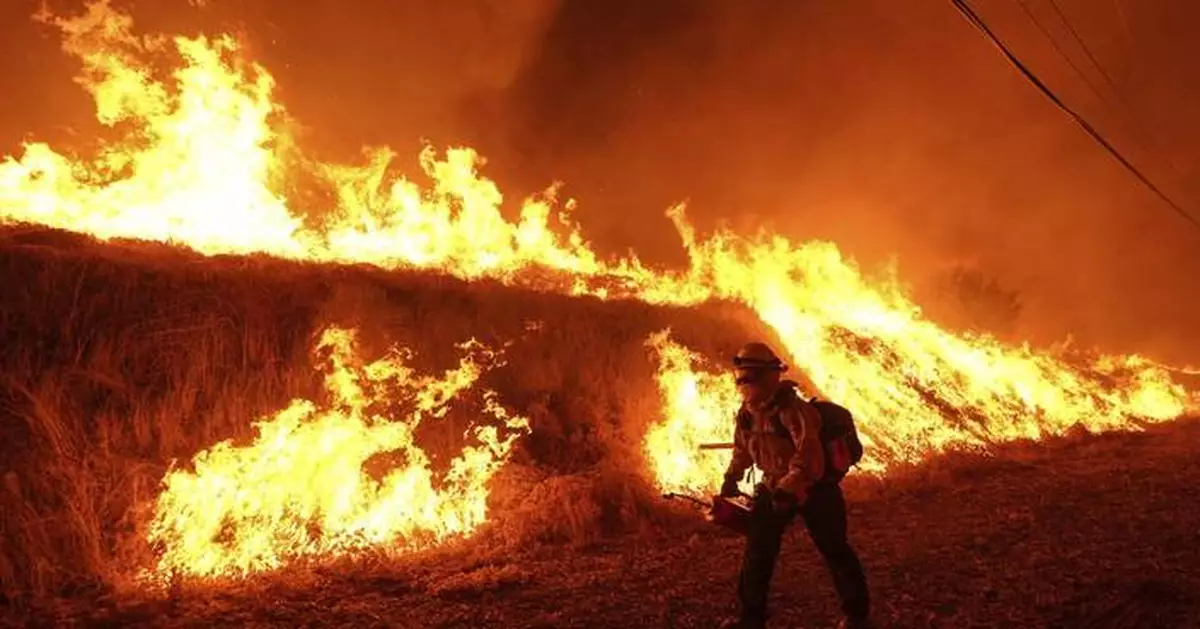
BILLINGS, Mont. (AP) — President Donald Trump’s administration is trying to merge the government’s wildland firefighting efforts into a single agency, a move some former federal officials warn could increase the risk of catastrophic blazes and ultimately cost billions of dollars.
Trump's budget would centralize firefighting efforts now split among five agencies and two Cabinet departments into a single Federal Wildland Fire Service under the U.S. Interior Department.
That would mean shifting thousands of personnel from the U.S. Forest Service — where most federal firefighters now work — into the new agency with fire season already underway. Budget documents do not disclose how much the change could cost or save.
The Trump administration in its first months temporarily cut off money for wildfire mitigation work and sharply reduced the ranks of federal government firefighters through layoffs and retirement. That resulted in the loss of more than 1,600 qualified firefighters in the Forest Service — an arm of the U.S. Department of Agriculture — and hundreds of people at Interior, according to the National Association of Forest Service Retirees and Democratic lawmakers.
The personnel declines and proposed agency reshuffling come as climate change makes fires more severe by warming and drying the landscape. More than 65,000 wildfires across the U.S. burned almost 9 million acres last year.
Interior Secretary Doug Burgum said Tuesday during testimony before the House Appropriations Committee that the new fire service would streamline work to stamp out blazes.
“We want more firefighters on the front lines and less people trying to make manual decisions on how to allocate resources and personnel," Burgum said. “We’ve got duplicative and ineffective structures that could be improved."
But organizations representing firefighters and former Forest Service officials say it would be costly to restructure firefighting efforts and cause major disruptions in the midst of fire season. Over the long term, they said, it would shift the focus from preventing fires through forest thinning and controlled burns, to extinguishing them even in cases where fire could have beneficial effects.
“You will not suppress your way to success in dealing with catastrophic fires. It’s going to create greater risk and it’s going to be particularly chaotic if you implement it going into fire season," said Steve Ellis, the chairman of the forest service retirees group and a former wildfire incident commander.
The group, which includes several former Forest Service chiefs, said in a letter to lawmakers that consolidation of firefighting work could “actually increase the likelihood of more large catastrophic fires, putting more communities, firefighters and resources at risk.”
Cleaving the Forest Service’s firefighting duties from its role as a land manager would be “like separating cojoined twins — it would basically kill the agency” said Timothy Ingalsbee with Firefighters United for Safety, Ethics and Ecology, a Eugene, Oregon-based advocacy group.
Another destructive fire season is expected this year, driven by above normal temperatures for most of the country, according to federal officials.
More than 1 million acres have burned in 2025, including in Arizona, Minnesota, California, Colorado, Nebraska, New Jersey and other states.
The Trump administration proposal has some bipartisan support, with California Democratic Sen. Alex Padilla and Montana Republican Sen. Tim Sheehy sponsoring legislation that's similar. Before his election last year, Sheehy founded an aerial firefighting company that relies heavily on federal contracts.
A prior proposal to merge the Forest Service and Interior to improve firefighting was found to have significant drawbacks by the Congressional Research Service in a 2008 report.
“A wildfire agency would likely focus on fire control, largely because acres burned are the most readily measurable performance standard," the report said. “Wildfire management activities that seek to reduce damages, such as protecting individual structures and reducing biomass fuels, are less likely to be emphasized.”
Burgum indicated the administration was not waiting for the bill to pass and he would work with Agriculture Sec. Brooke Rollins to begin coordinating operations for the current fire season.
The Forest Service workforce was initially cut in February during billionaire Elon Musk’s push to reduce federal spending, and at least 1,000 National Park Service workers also were let go. A court order to rehire fired workers along with a public outcry brought many workers back to their jobs but Democratic lawmakers have said it’s not enough.
The Forest Service had about 9,450 wildland firefighters as of May 3, with a goal of 11,300 by mid-July.
Interior employs about 6,700 wildland firefighters, spread between the National Park Service, Fish and Wildlife Service, Bureau of Indian Affairs and Bureau of Land Management.
State officials in Washington and Oregon said this month that a loss of federal workers who help support wildland firefighting is making planning for the upcoming wildfire season a challenge. The administration has not released the exact number of fired and rehired workers.
In a separate action aimed at wildfires, the Trump administration last month rolled back environmental safeguards around future logging projects on more than half of U.S. national forests.
The emergency designation covers 176,000 square miles (455,000 square kilometers) of terrain primarily in the West but also in the South, around the Great Lakes and in New England.
Most of those forests are considered to have high wildfire risk, and many are in decline because of insects and disease.
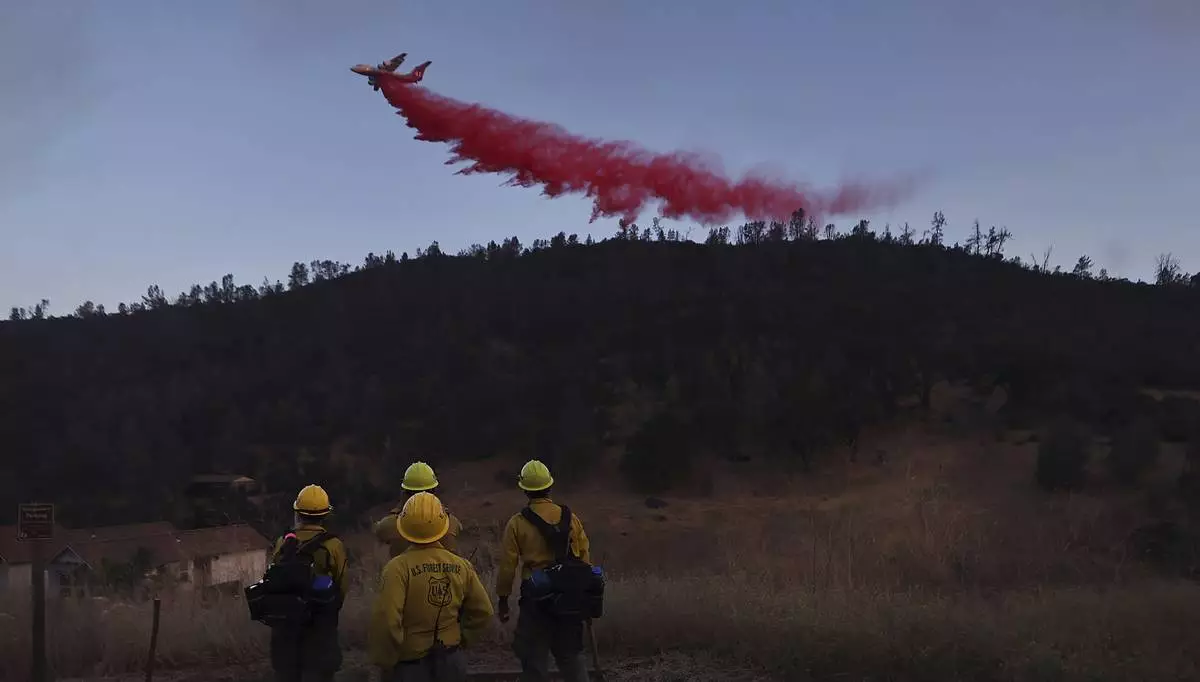
FILE - U,S. Forest Service firefighters from Stonyford, Calif., from left, Vivian Perez, Emma Nieforth, Jonny Connelly and Nick Bonnie watch as a BAe-146 air tanker is used to go indirect on the Ridge Fire, as a secondary contingency line, July 20, 2024, east of Clearlake, Calif. (Kent Porter/The Press Democrat via AP, File)
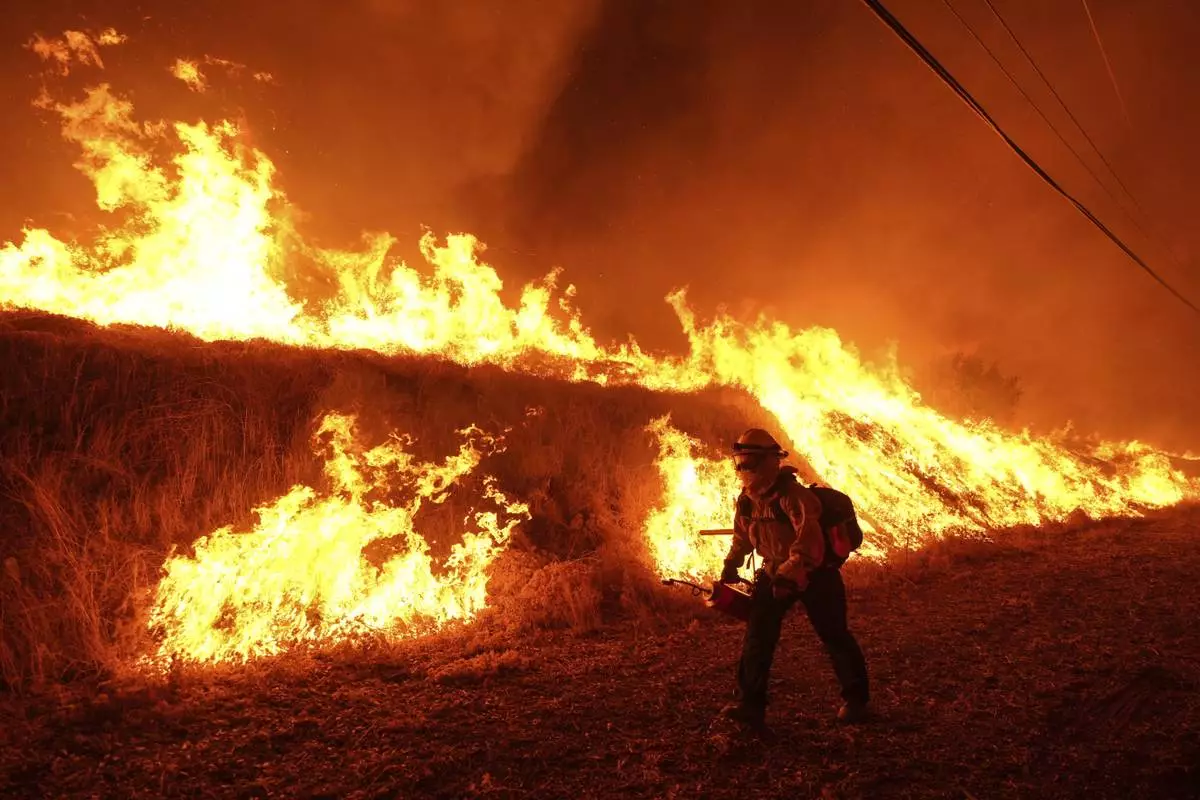
FILE - A firefighter carries a drip torch as he ignites a backfire against the Hughes Fire burning along a hillside in Castaic, Calif., Jan. 22, 2025. (AP Photo/Jae C. Hong, File)
Federal Reserve Chair Jerome Powellsaid Sunday the Department of Justice has served the central bank with subpoenas and threatened it with a criminal indictment over his testimony this summer about the Fed’s building renovations.
The move represents an unprecedented escalation in President Donald Trump’s battle with the Fed, an independent agency he's repeatedly attacked for not cutting its key interest rate as sharply as he prefers. The renewed fight will likely rattle financial markets Monday and could over time escalate borrowing costs for mortgages and other loans.
The subpoenas relate to Powell’s testimony before the Senate Banking Committee in June, the Fed chair said, regarding the Fed’s $2.5 billion renovation of two office buildings, a project Trump has criticized as excessive.
Here's the latest:
Stocks are falling on Wall Street after Federal Reserve Chair Jerome Powell said the Department of Justice had served the central bank with subpoenas and threatened it with a criminal indictment over his testimony about the Fed’s building renovations.
The S&P 500 fell 0.3% in early trading Monday. The Dow Jones Industrial Average lost 384 points, or 0.8%, and the Nasdaq composite fell 0.2%.
Powell characterized the threat of criminal charges as pretexts to undermine the Fed’s independence in setting interest rates, its main tool for fighting inflation. The threat is the latest escalation in President Trump’s feud with the Fed.
▶ Read more about the financial markets
She says she had “a very good conversation” with Trump on Monday morning about topics including “security with respect to our sovereignties.”
Last week, Sheinbaum had said she was seeking a conversation with Trump or U.S. Secretary of State Marco Rubio after the U.S. president made comments in an interview that he was ready to confront drug cartels on the ground and repeated the accusation that cartels were running Mexico.
Trump’s offers of using U.S. forces against Mexican cartels took on a new weight after the Trump administration deposed Venezuelan President Nicolás Maduro. Sheinbaum was expected to share more about their conversation later Monday.
A leader of the Canadian government is visiting China this week for the first time in nearly a decade, a bid to rebuild his country’s fractured relations with the world’s second-largest economy — and reduce Canada’s dependence on the United States, its neighbor and until recently one of its most supportive and unswerving allies.
The push by Prime Minster Mark Carney, who arrives Wednesday, is part of a major rethink as ties sour with the United States — the world’s No. 1 economy and long the largest trading partner for Canada by far.
Carney aims to double Canada’s non-U.S. exports in the next decade in the face of President Trump’s tariffs and the American leader’s musing that Canada could become “the 51st state.”
▶ Read more about relations between Canada and China
The comment by a Chinese Foreign Ministry spokesperson came in response to a question at a regular daily briefing. President Trump has said he would like to make a deal to acquire Greenland, a semiautonomous region of NATO ally Denmark, to prevent Russia or China from taking it over.
Tensions have grown between Washington, Denmark and Greenland this month as Trump and his administration push the issue and the White House considers a range of options, including military force, to acquire the vast Arctic island.
Danish Prime Minister Mette Frederiksen has warned that an American takeover of Greenland would mark the end of NATO.
▶ Read more about the U.S. and Greenland
Trump said Sunday that he is “inclined” to keep ExxonMobil out of Venezuela after its top executive was skeptical about oil investment efforts in the country after the toppling of former President Nicolás Maduro.
“I didn’t like Exxon’s response,” Trump said to reporters on Air Force One as he departed West Palm Beach, Florida. “They’re playing too cute.”
During a meeting Friday with oil executives, Trump tried to assuage the concerns of the companies and said they would be dealing directly with the U.S., rather than the Venezuelan government.
Some, however, weren’t convinced.
“If we look at the commercial constructs and frameworks in place today in Venezuela, today it’s uninvestable,” said Darren Woods, CEO of ExxonMobil, the largest U.S. oil company.
An ExxonMobil spokesperson did not immediately respond Sunday to a request for comment.
▶ Read more about Trump’s comments on ExxonMobil
Trump’s motorcade took a different route than usual to the airport as he was departing Florida on Sunday due to a “suspicious object,” according to the White House.
The object, which the White House did not describe, was discovered during security sweeps in advance of Trump’s arrival at Palm Beach International Airport.
“A further investigation was warranted and the presidential motorcade route was adjusted accordingly,” White House press secretary Karoline Leavitt said in a statement Sunday.
The president, when asked about the package by reporters, said, “I know nothing about it.”
Anthony Guglielmi, the spokesman for U.S. Secret Service, said the secondary route was taken just as a precaution and that “that is standard protocol.”
▶ Read more about the “suspicious object”
Trump said Iran wants to negotiate with Washington after his threat to strike the Islamic Republic over its bloody crackdown on protesters, a move coming as activists said Monday the death toll in the nationwide demonstrations rose to at least 544.
Iran had no direct reaction to Trump’s comments, which came after the foreign minister of Oman — long an interlocutor between Washington and Tehran — traveled to Iran this weekend. It also remains unclear just what Iran could promise, particularly as Trump has set strict demands over its nuclear program and its ballistic missile arsenal, which Tehran insists is crucial for its national defense.
Iranian Foreign Minister Abbas Araghchi, speaking to foreign diplomats in Tehran, insisted “the situation has come under total control” in fiery remarks that blamed Israel and the U.S. for the violence, without offering evidence.
▶ Read more about the possible negotiations and follow live updates
Fed Chair Powell said Sunday the DOJ has served the central bank with subpoenas and threatened it with a criminal indictment over his testimony this summer about the Fed’s building renovations.
The move represents an unprecedented escalation in Trump’s battle with the Fed, an independent agency he has repeatedly attacked for not cutting its key interest rate as sharply as he prefers. The renewed fight will likely rattle financial markets Monday and could over time escalate borrowing costs for mortgages and other loans.
The subpoenas relate to Powell’s testimony before the Senate Banking Committee in June, the Fed chair said, regarding the Fed’s $2.5 billion renovation of two office buildings, a project that Trump has criticized as excessive.
Powell on Sunday cast off what has up to this point been a restrained approach to Trump’s criticisms and personal insults, which he has mostly ignored. Instead, Powell issued a video statement in which he bluntly characterized the threat of criminal charges as simple “pretexts” to undermine the Fed’s independence when it comes to setting interest rates.
▶ Read more about the subpoenas
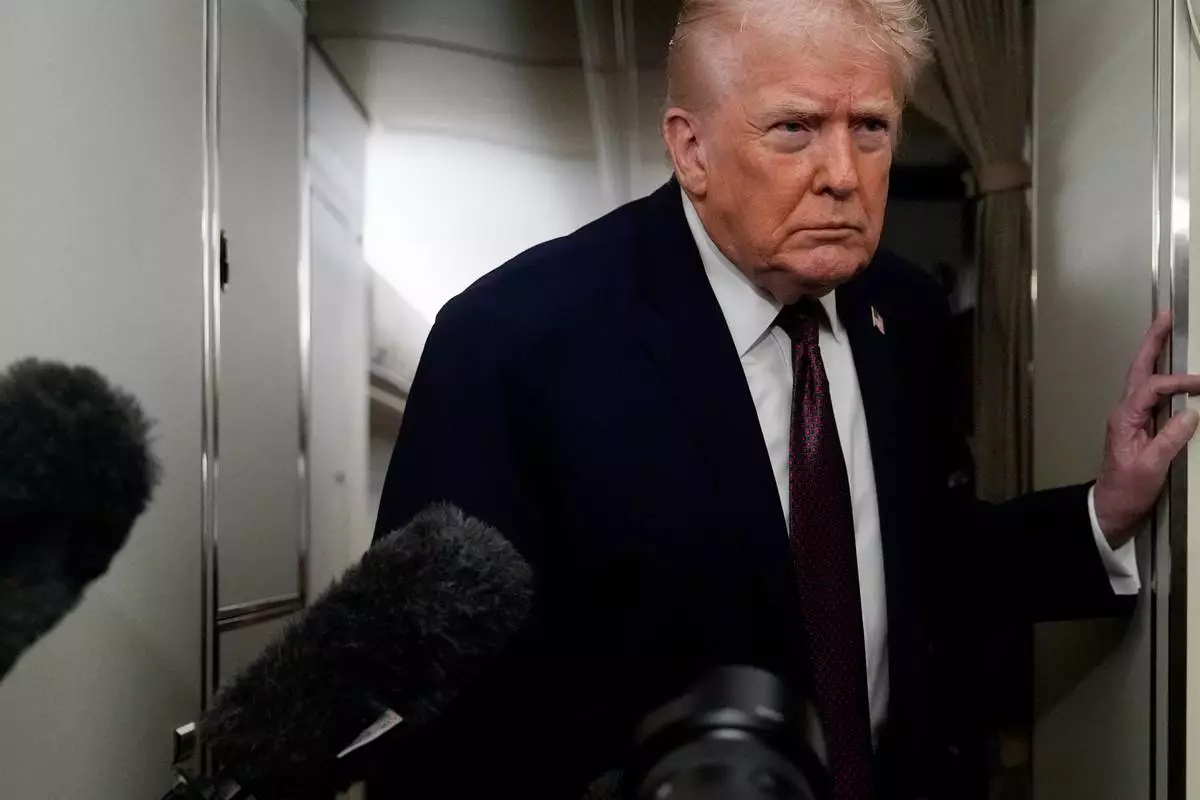
President Donald Trump speaks to reporters while in flight on Air Force One to Joint Base Andrews, Md., Sunday, Jan. 11, 2026. (AP Photo/Julia Demaree Nikhinson)
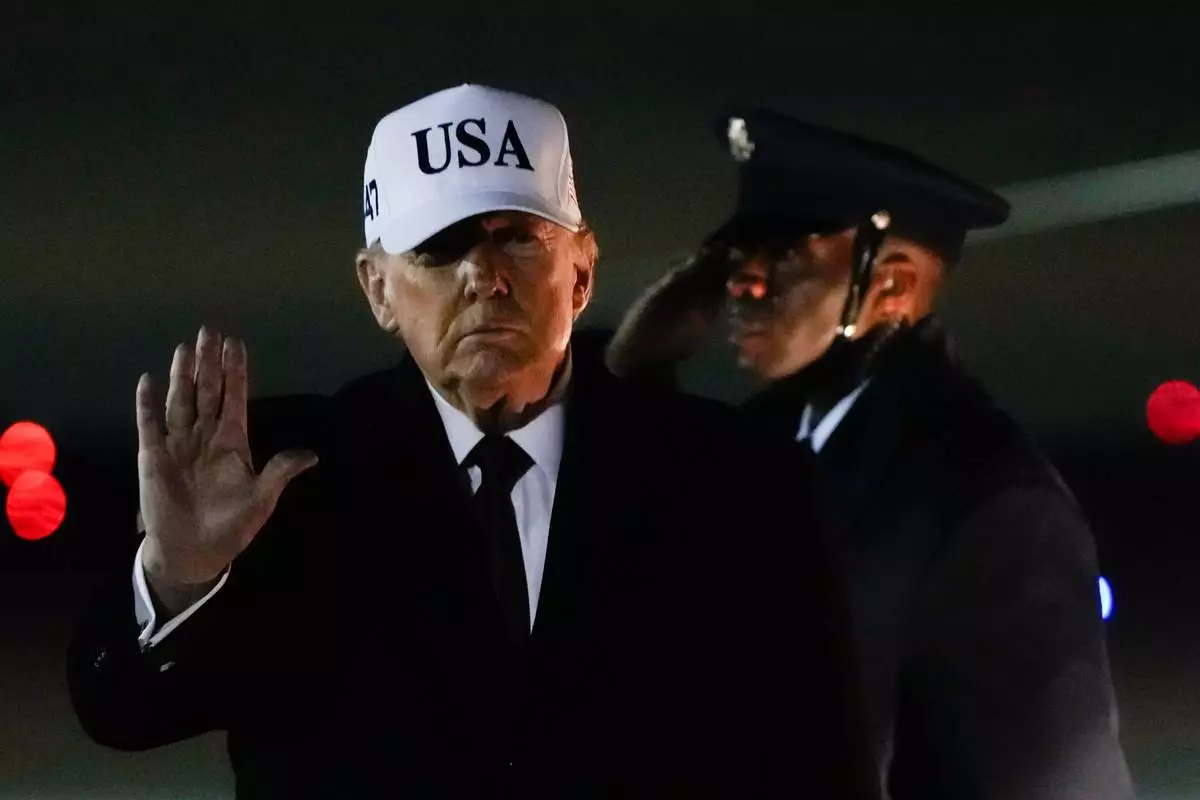
President Donald Trump waves after arriving on Air Force One from Florida, Sunday, Jan. 11, 2026, at Joint Base Andrews, Md. (AP Photo/Julia Demaree Nikhinson)