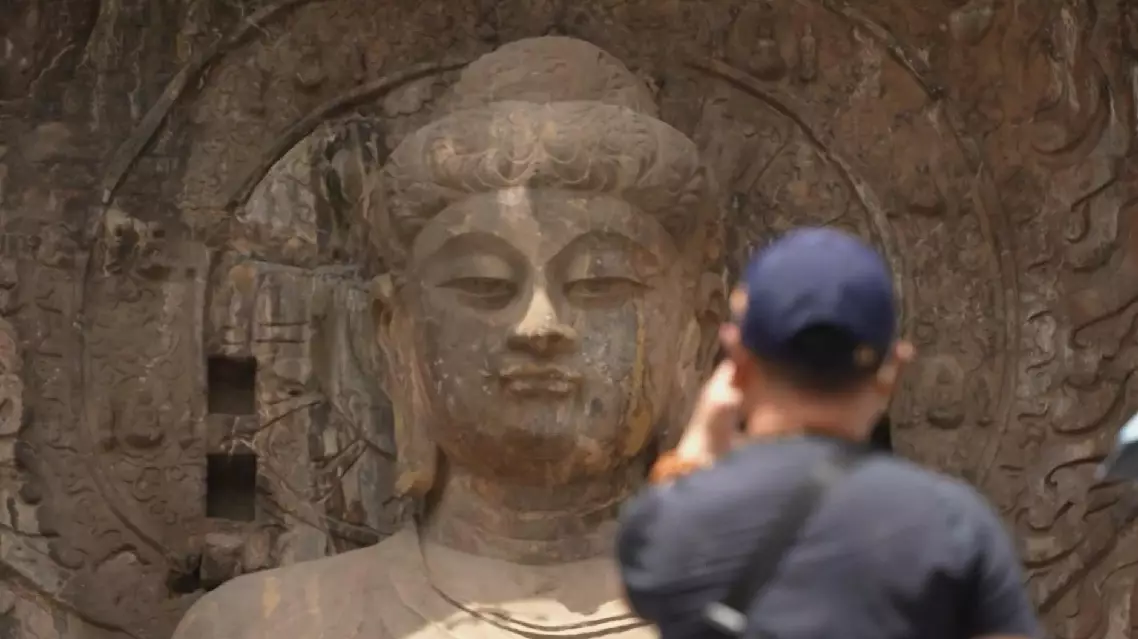
Generations of archaeologists in central China's city of Luoyang have devoted themselves to restoring the grandeur of the Longmen Grottoes, one of China's four most famous grottoes.
Chinese President Xi Jinping visited the Longmen Grottoes on Monday during his inspection trip to Henan Province.
Xi learned about the local efforts to enhance the protection and utilization of historical and cultural heritage and promote the high-quality development of the cultural and tourism sector. He urged further efforts to protect, pass on and disseminate these treasures of Chinese culture.
A UNESCO World Heritage site with a history of over 1,500 years, Longmen Grottoes' construction began during the reign of Emperor Xiaowen of the Northern Wei Dynasty (386-534) and lasted for as many as 400 years. It now boasts 2,345 caves and niches, housing nearly 110,000 Buddhist stone statues, making the grottoes stand out in a city famous for rich cultural relics.
"Doing archaeology in Luoyang is a blessing of a lifetime for me, as major archaeological discoveries are commonly made in Luoyang," said Shi Jiazhen, a veteran archaeologist and former director of the Longmen Grottoes Academy.
In 2020, Shi, who had spent over three decades doing archaeology work in Luoyang, was appointed as the director of the Longmen Grottoes Academy. When shifting his focus to the grottoes, Shi realized that the caves and statues contained more cultural and historical treasures than even an archaeologist like him could have imagined.
When seeing visitors standing in awe in front of the ancient Buddhist statues, Shi wondered what if people could see the statues when they were first completed, with their faces coated in real gold, their body painted with various colors, as archaeological evidence suggest.
"This is what it looks like after over 1,000 years, time did its work. Suppose if you could restore it to its original beauty, can you imagine how great that would be?" Shi said.
At his post as the director, Shi led great efforts in recording and promoting the cultural value of the Longmen Grottoes.
Shi also promoted the restoration of artifacts through technology. Today archaeologists are still working to construct a 3D digital collection of the relics to provide the world an easy access of the grottoes' beauty.
"This 3D digital scanning is to create a high-precision data archive for the saves. For sculptures like these, after I perform the digital scanning, they can be 3D printed, allowing these cultural relics to be seen by more people," said a technician working in the grottoes.
Technology also helps restore relics damaged in history. The 'empress procession', a large relief in the grottoes that was removed by chipping from the cave walls in the 1930s, was digitally restored under Shi's watch. The academy, along with other institutions, carefully analyzed thousands of chipped pieces to truthfully piece them together on a 3D model after three years of efforts.
"This is about our ancestors and also our future generations. So you really need a sense of reverence towards these cultural relics left by our ancestors, so that you are focused on how to do this job well," Shi said of the relief restoration project.
Today, Shi is pleased to see an increasing number of visitors to the grottoes each year, as well as the younger generation of the city showing a growing interest in Luoyang's cultural heritage and historical treasures.
Archaeologists devoted to restoring Longmen Grottoes' former glory