WASHINGTON (AP) — House Republicans are getting closer to passing President Donald Trump's tax breaks, spending cuts and beefed-up border security as Speaker Mike Johnson attempts to pass the package over unified Democratic opposition by Memorial Day.
House committees have labored for months on the legislation, which exceeds 1,000 pages and is titled the “One Big Beautiful Bill Act,” a nod to Trump himself.
GOP divisions have narrowed but continue as fiscal conservatives worry the bill doesn’t do enough to curb Medicaid spending, while Republicans from competitive swing districts have expressed concerns about the prospect of their constituents losing access to health coverage and food assistance for constituents.
Democrats say they will fight what House party leader Hakeem Jeffries calls “this extreme and toxic bill.”
Here's a look at what's in and out of the legislative package so far:
Republicans look to make permanent the individual income and estate tax cuts passed in Trump’s first term, in 2017, plus enact promises he made on the 2024 campaign trail to not tax tips, overtime and interest on some auto loans.
To partially offset the lost revenue, Republicans propose repealing or phasing out more quickly the clean energy tax credits passed during Joe Biden's presidency, helping to bring down the overall cost of the tax portion to about $3.8 trillion.
The bill includes a temporary boost in the standard deduction — a $1,000 increase for individuals, bringing it to $16,000 for individual filers, and a $2,000 boost for joint filers, bringing it to $32,000. The deduction reduces the amount of income that is actually subject to income tax.
There is also a temporary $500 increase in the child tax credit, bringing it to $2,500 for 2025 through 2028. It then returns to $2,000 and will increase to account for inflation.
The estate tax exemption rises to $15 million and is adjusted for inflation going forward.
One of the thorniest issues in negotiations has been how much to raise the state and local tax deduction, now capped at $10,000. That's been a priority of New York lawmakers. A tentative agreement has been reached to increase that “SALT” cap to $40,000 for incomes up to $500,000, with the cap phasing downward for those with higher incomes.
Several of the provisions Trump promised in the campaign would be temporary, lasting roughly through his term in office. The tax breaks for tips, overtime and car loan interest expire at the end of 2028. That's also the case for a $4,000 increase in the standard deduction for seniors.
Among the various business tax provisions, small businesses, including partnerships and S corporations, will be able to subtract 23% of their qualified business income from their taxes. The deduction has been 20%
Businesses will temporarily be allowed to fully expense domestic research and development costs in the year they occur and the cost of machinery, equipment and other qualifying assets. This encourages businesses to invest in ways that enhances their productivity.
House Republicans would reduce spending on food aid, what is known as the Supplemental Nutrition and Assistance Program, by about $267 billion over 10 years.
States would shoulder 5% of benefit costs, beginning in fiscal 2028, and 75% of the administrative costs. Currently, states pay none of the benefit and half of the administration costs.
Republicans also are expanding the work requirements to receive food aid. Under current law, able-bodied adults without dependents must fulfill work requirements until they are 54, and that would change under the bill to age 64.
Also, some parents are currently exempt from work requirements until their children are 18; that would change so only those caring for a dependent child under the age of 7 are exempt.
A focal point of the package is nearly $700 billion in reduced spending in the Medicaid program, according to CBO.
To be eligible for Medicaid, there would be new “community engagement requirements” of at least 80 hours per month of work, education or service for able-bodied adults without dependents. The new requirement would not kick in until Jan. 1, 2029, after Trump leaves office. People would also have to verify their eligibility for the program twice a year, rather than just once.
Republicans are looking to generate savings with new work requirements. But Democrats warn that millions of Americans will lose coverage.
An estimate from the nonpartisan Congressional Budget Office said the proposals would reduce the number of people with health care by at least 7.6 million from the Medicaid changes, and possibly more with other changes to the Affordable Care Act.
Republicans are also using the package to reward allies and disadvantage political foes.
The package would eliminate a $200 tax on gun silencers that has existed since Congress passed the National Firearms Act in 1934. The elimination of the tax is supported by the NRA.
The group Giffords, which works to reduce gun violence, said silencers make it more difficult to recognize the sound of gunfire and locate the source of gunshots, impairing the ability of law enforcement to respond to active shooters.
Republicans are also looking to prohibit Medicaid funds from going to Planned Parenthood, which provides abortion care. Democrats say defunding the organization would make it harder for millions of patients to get cancer screenings, pap tests and birth control.
“MAGA” is shorthand for Trump's signature line, “Make America Great Again.” But in this case, it means “Money Accounts for Growth and Advancement.”
For parents or guardians who open new “MAGA” accounts for their children, the federal government will contribute $1,000 for babies born between Jan. 1, 2024 and Dec. 31, 2028.
Families could add $5,000 a year, with the account holders unable to take distributions before age 18. Then, they could access up to 50% of the money to pay for higher education, training and first-time home purchases. At age 30, account holders have access to the full balance of the account for any purpose.
The legislation would provide $46.5 billion to revive construction of Trump’s wall along the U.S.-Mexico border, and more money for the deportation agenda.
There's $4 billion to hire an additional 3,000 new Border Patrol agents as well as 5,000 new customs officers, and $2.1 billion for signing and retention bonuses. There's also funds for 10,000 more Immigration and Customs Enforcement officers and investigators.
It includes major changes to immigration policy, imposing a $1,000 fee on migrants seeking asylum — something the nation has never done, putting it on par with few others, including Australia and Iran.
Overall, the plan is to remove 1 million immigrants annually and house 100,000 people in detention centers.
There's also nearly with $150 billion in new money for the Defense Department and national security.
It would provide $25 billion for Trump's “Golden Dome for America,” a long-envisioned missile defense shield, $21 billion to restock the nation's ammunition arsenal, $34 billion to expand the naval fleet with more shipbuilding and some $5 billion for border security.
It also includes $9 billion for servicemember quality of life-related issues, including housing, health care and special pay.
A wholesale revamping of the student loan program is key to the legislation, providing $330 billion in budget cuts and savings.
The proposal would replace all existing student loan repayment plans with just two: a standard option with monthly payments spread out over 10 to 25 years and a “repayment assistance” plan that is generally less generous than those it would replace.
Among other changes, the bill would repeal Biden-era regulations that made it easier for borrowers to get loans canceled if their colleges defrauded them or closed suddenly.
There would be a tax increase, up to 21%, on some university endowments.
To generate revenue, one section would allow increased leasing of public lands for drilling, mining and logging while clearing the path for more development by speeding up government approvals.
Royalty rates paid by companies to extract oil, gas and coal would be cut, reversing Biden’s attempts to curb fossil fuels to help address climate change.
In a last-minute add, Republicans also included a provision authorizing sales of hundreds of thousands of acres of public lands in Nevada and Utah, prompting outrage from Democrats and environmentalists.
Associated Press writers Collin Binkley and Mary Clare Jalonick in Washington and Matthew Brown in Billings, Montana, contributed to this report.
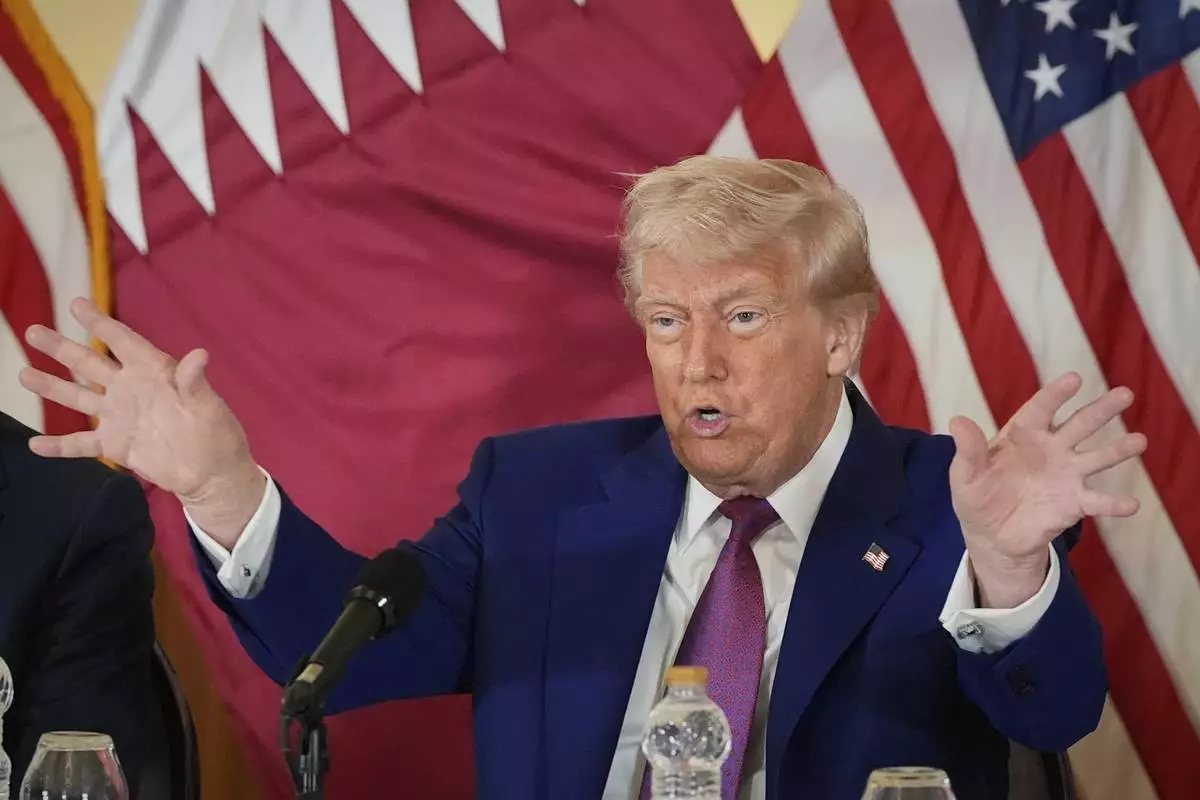
President Donald Trump gestures during a business roundtable, Thursday, May 15, 2025, in Doha, Qatar. (AP Photo/Alex Brandon)