INDIANAPOLIS (AP) — As an Indiana native, Eric Shanks can’t remember exactly when the rite of passage began of traveling to Indianapolis Motor Speedway. His first Indianapolis 500 memory is of the 1985 race, Danny Sullivan’s “Spin and Win” 1985 victory, when Shanks was around 14 and had fully embraced the way his home state played such a role in American culture.
“I think everybody takes pride in there being a spotlight on this part of the country,” Shanks said. “The Pacers are only in the playoffs when they are in the playoffs, the Colts aren’t always in. But this is a guarantee every year.”
When he became CEO of Fox Sports in 2010, Shanks had a wish list of events he wanted for the network. Always at the top was the Indianapolis 500, a property Fox Sports finally landed this year. The network is in its first year of a new broadcast deal with IndyCar and on Sunday televises its first Indy 500.
Shanks from the start has vowed the production will be the biggest of the year for Fox Sports — a lofty promise for a network that also carries the Super Bowl and the World Series, among other major sporting events.
“We are going to blow the doors off of Indy. We’re going to bring everything that Fox has to bear,” he said.
He’s been relentless in pursuing his promise and has spent the first five IndyCar races of the year working out early-season glitches that ranged from an unstable graphics package, issues delivering timing and scoring, a mid-race loss of transmission, and enough bumps to drive Shanks nuts as he strives for a perfect production. The work has gone on at the same time Fox Sports televised the first 16 races of the NASCAR season, a run that culminated last Sunday night with the All-Star race.
Only four of the NASCAR races were on Fox, and even with the rain-effected season-opening Daytona 500, that quartet averaged 4,986,000 viewers.
Fox promised IndyCar its entire 17-race slate will be aired on broadcast — including both days of last weekend’s qualifying — but the numbers have been sporadic and unable to keep pace with NASCAR.
The IndyCar ratings don’t bother Shanks.
“I think you just want to be constantly showing growth in a lot of areas,” he said. “You want to be showing growth in attendance. I’m happy to hear merchandise sales are up — you’ve got new sponsors coming in — you just want to show growth.”
Fox Sports last week made several changes to races later this season (mainly start times) to ensure IndyCar and NASCAR do not go directly head-to-hear, something that happened several times earlier this year when the network juggled both racing series. But Shanks told The Associated Press he is not considering moving IndyCar off of Fox to Fox Sports or another property if the ratings don’t improve over the next few weeks.
Instead, his focus is on ensuring the glitches through the first five races don’t happen during the 109th running of “The Greatest Spectacle in Racing” or the rest of the season.
“In each race, it actually has been something different,” Shanks said. “You fix one thing and then there’s something else to fix. There’s a lot of different systems talking to each other and we’re on the receiving end of a lot of it. So we’re figure it out and we’re trying to do more.”
Fox Sports is compensating through new innovation, including the image of a “ghost car” graphic used in qualifying that showed how a car making a run tracked against the current leader. And he’s bringing in major talent for Sunday, including Tom Brady for the ceremonial “Fastest Seat in Sports” car, which will be driven by Jimmie Johnson; Michael Strahan, Danica Patrick, Tony Stewart and Super Bowl-winning tight end Rob Gronkowski as the Snake Pit grand marshal.
Fox Sports has a ton of material to work with, including a race-consuming cheating scandal involving Team Penske, the marquee team in IndyCar. It involves two-time defending winner Josef Newgarden, who is seeking to become the first driver in history to win three consecutive 500s.
The first Israeli is in the field as Robert Shwartzman stunned 33 other drivers by becoming the first rookie since 1983 to win the pole. Kyle Larson is attempting to complete the Indy 500 and the Coca-Cola 600 for 1,100-miles of racing in one day. Two-time reigning series champion Alex Palou, who has won four of the first five races this season, is trying to finally add the 500 to his resume and Pato O'Ward, the most popular driver in the series, is trying to bounce back from last year's heartbreaking last-lap defeat.
Shanks has used crossover since the start of the year — Fox produced three movie-production-quality commercials to introduce three IndyCar stars and all aired during the Super Bowl, one with a Brady cameo — and is using most of its network programming to promote Sunday's race.
He also achieved a goal in adding a gambling element to Sunday, something he's wanted to do for months.
“I really want to turn the Indy 500 into more of a Kentucky Derby day from a wagering standpoint. It’s hard to understand how to wager on motorsports,” he said. “On Kentucky Derby day, even if you don’t know anything about horse racing, you put down an exacta or a trifecta, you got win, place, show. How can we figure out how to get that type of broad attention around an event that honestly kind of feels a lot like horse racing that day?”
The solution was a partnership with DraftKings, which will have 20 or more trifectas that people can pick from. Fox Sports analyst James Hinchcliffe will pick one trifecta that will be promoted by Fox.
“I think that's element to this event, and motorsports in general, that if we can start to kind of like add that layer of interest for people, I think it can only be helpful to viewership,” Shanks said."
AP auto racing: https://apnews.com/hub/auto-racing

FOX Sports CEO & Executive Producer Eric Shanks poses in a T-shirt he designed to promote the IndyCar auto racing season on March 4, 2025, in St. Petersburg, Fla. (AP Photo/Jenna Fryer)
WASHINGTON (AP) — Becky Pepper-Jackson finished third in the discus throw in West Virginia last year though she was in just her first year of high school. Now a 15-year-old sophomore, Pepper-Jackson is aware that her upcoming season could be her last.
West Virginia has banned transgender girls like Pepper-Jackson from competing in girls and women's sports, and is among the more than two dozen states with similar laws. Though the West Virginia law has been blocked by lower courts, the outcome could be different at the conservative-dominated Supreme Court, which has allowed multiple restrictions on transgender people to be enforced in the past year.
The justices are hearing arguments Tuesday in two cases over whether the sports bans violate the Constitution or the landmark federal law known as Title IX that prohibits sex discrimination in education. The second case comes from Idaho, where college student Lindsay Hecox challenged that state's law.
Decisions are expected by early summer.
President Donald Trump's Republican administration has targeted transgender Americans from the first day of his second term, including ousting transgender people from the military and declaring that gender is immutable and determined at birth.
Pepper-Jackson has become the face of the nationwide battle over the participation of transgender girls in athletics that has played out at both the state and federal levels as Republicans have leveraged the issue as a fight for athletic fairness for women and girls.
“I think it’s something that needs to be done,” Pepper-Jackson said in an interview with The Associated Press that was conducted over Zoom. “It’s something I’m here to do because ... this is important to me. I know it’s important to other people. So, like, I’m here for it.”
She sat alongside her mother, Heather Jackson, on a sofa in their home just outside Bridgeport, a rural West Virginia community about 40 miles southwest of Morgantown, to talk about a legal fight that began when she was a middle schooler who finished near the back of the pack in cross-country races.
Pepper-Jackson has grown into a competitive discus and shot put thrower. In addition to the bronze medal in the discus, she finished eighth among shot putters.
She attributes her success to hard work, practicing at school and in her backyard, and lifting weights. Pepper-Jackson has been taking puberty-blocking medication and has publicly identified as a girl since she was in the third grade, though the Supreme Court's decision in June upholding state bans on gender-affirming medical treatment for minors has forced her to go out of state for care.
Her very improvement as an athlete has been cited as a reason she should not be allowed to compete against girls.
“There are immutable physical and biological characteristic differences between men and women that make men bigger, stronger, and faster than women. And if we allow biological males to play sports against biological females, those differences will erode the ability and the places for women in these sports which we have fought so hard for over the last 50 years,” West Virginia's attorney general, JB McCuskey, said in an AP interview. McCuskey said he is not aware of any other transgender athlete in the state who has competed or is trying to compete in girls or women’s sports.
Despite the small numbers of transgender athletes, the issue has taken on outsize importance. The NCAA and the U.S. Olympic and Paralympic Committees banned transgender women from women's sports after Trump signed an executive order aimed at barring their participation.
The public generally is supportive of the limits. An Associated Press-NORC Center for Public Affairs Research poll conducted in October 2025 found that about 6 in 10 U.S. adults “strongly” or “somewhat” favored requiring transgender children and teenagers to only compete on sports teams that match the sex they were assigned at birth, not the gender they identify with, while about 2 in 10 were “strongly” or “somewhat” opposed and about one-quarter did not have an opinion.
About 2.1 million adults, or 0.8%, and 724,000 people age 13 to 17, or 3.3%, identify as transgender in the U.S., according to the Williams Institute at the UCLA School of Law.
Those allied with the administration on the issue paint it in broader terms than just sports, pointing to state laws, Trump administration policies and court rulings against transgender people.
"I think there are cultural, political, legal headwinds all supporting this notion that it’s just a lie that a man can be a woman," said John Bursch, a lawyer with the conservative Christian law firm Alliance Defending Freedom that has led the legal campaign against transgender people. “And if we want a society that respects women and girls, then we need to come to terms with that truth. And the sooner that we do that, the better it will be for women everywhere, whether that be in high school sports teams, high school locker rooms and showers, abused women’s shelters, women’s prisons.”
But Heather Jackson offered different terms to describe the effort to keep her daughter off West Virginia's playing fields.
“Hatred. It’s nothing but hatred,” she said. "This community is the community du jour. We have a long history of isolating marginalized parts of the community.”
Pepper-Jackson has seen some of the uglier side of the debate on display, including when a competitor wore a T-shirt at the championship meet that said, “Men Don't Belong in Women's Sports.”
“I wish these people would educate themselves. Just so they would know that I’m just there to have a good time. That’s it. But it just, it hurts sometimes, like, it gets to me sometimes, but I try to brush it off,” she said.
One schoolmate, identified as A.C. in court papers, said Pepper-Jackson has herself used graphic language in sexually bullying her teammates.
Asked whether she said any of what is alleged, Pepper-Jackson said, “I did not. And the school ruled that there was no evidence to prove that it was true.”
The legal fight will turn on whether the Constitution's equal protection clause or the Title IX anti-discrimination law protects transgender people.
The court ruled in 2020 that workplace discrimination against transgender people is sex discrimination, but refused to extend the logic of that decision to the case over health care for transgender minors.
The court has been deluged by dueling legal briefs from Republican- and Democratic-led states, members of Congress, athletes, doctors, scientists and scholars.
The outcome also could influence separate legal efforts seeking to bar transgender athletes in states that have continued to allow them to compete.
If Pepper-Jackson is forced to stop competing, she said she will still be able to lift weights and continue playing trumpet in the school concert and jazz bands.
“It will hurt a lot, and I know it will, but that’s what I’ll have to do,” she said.

Heather Jackson, left, and Becky Pepper-Jackson pose for a photograph outside of the U.S. Supreme Court in Washington, Sunday, Jan. 11, 2026. (AP Photo/Jose Luis Magana)
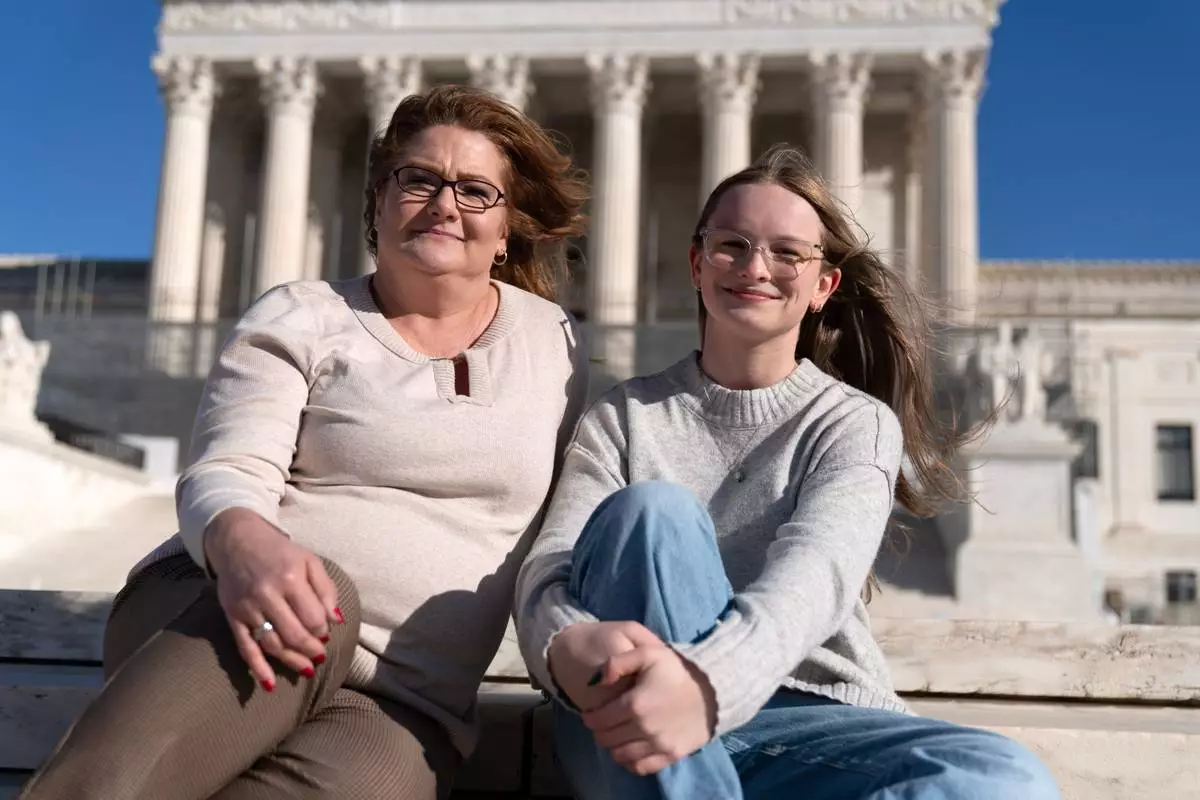
Heather Jackson, left, and Becky Pepper-Jackson pose for a photograph outside of the U.S. Supreme Court in Washington, Sunday, Jan. 11, 2026. (AP Photo/Jose Luis Magana)

Becky Pepper-Jackson poses for a photograph outside of the U.S. Supreme Court in Washington, Sunday, Jan. 11, 2026. (AP Photo/Jose Luis Magana)
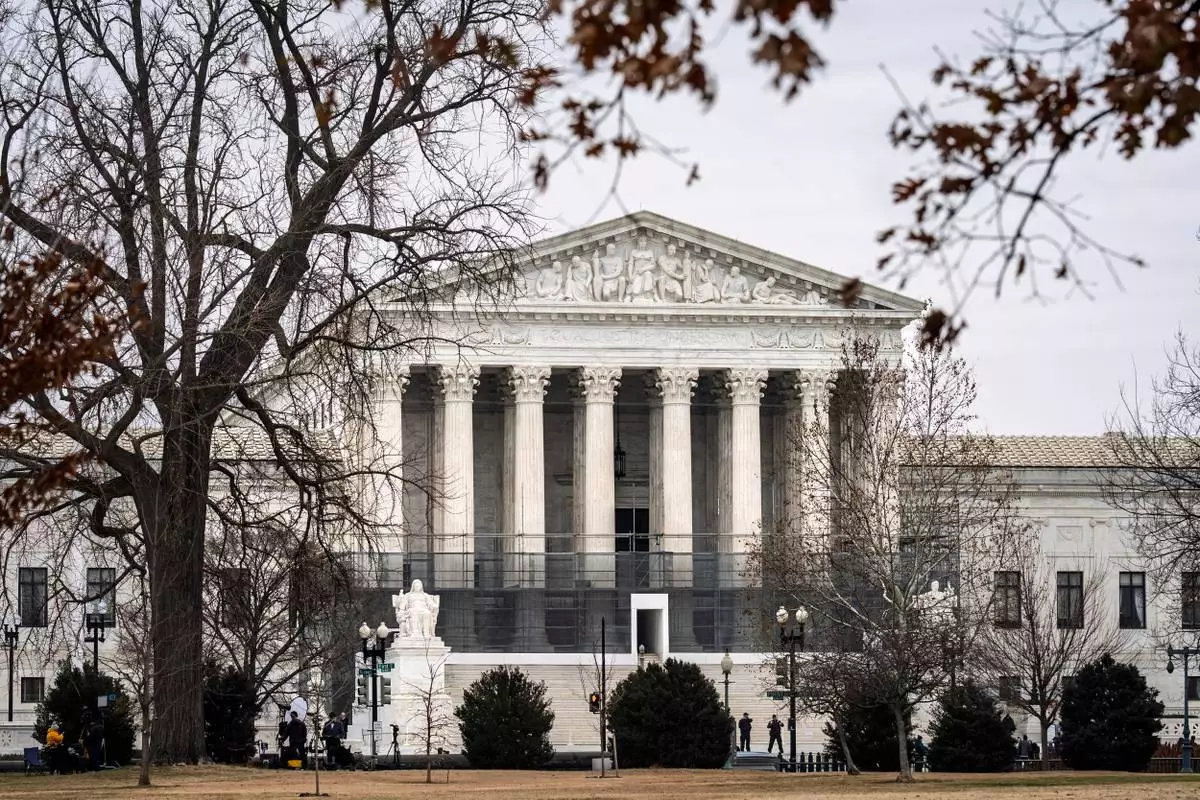
The Supreme Court stands is Washington, Friday, Jan. 9, 2026. (AP Photo/J. Scott Applewhite)
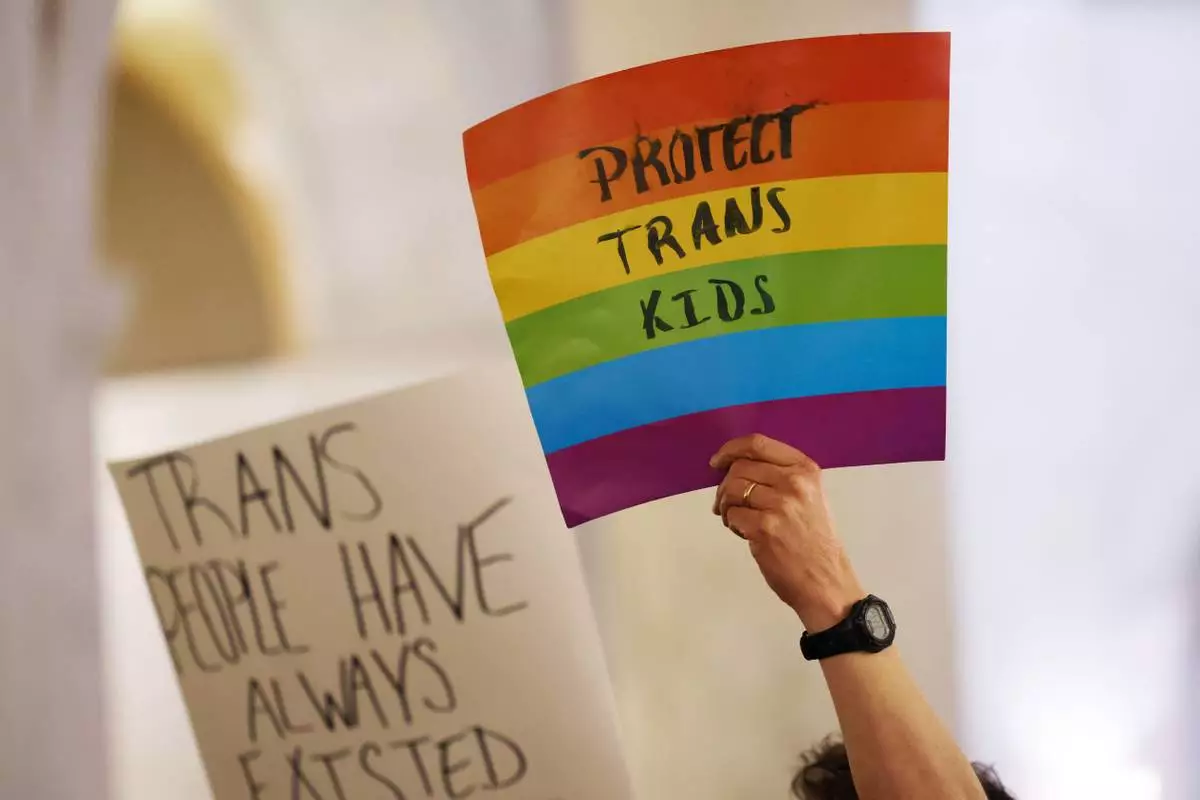
FILE - Protestors hold signs during a rally at the state capitol in Charleston, W.Va., on March 9, 2023. (AP Photo/Chris Jackson, file)