Experts explained the success of the Shenzhou-20 crew's first spacewalk on Thursday afternoon (Beijing time), attributing it to scientists' thorough plans and crew members' seamless coordination.
The Shenzhou-20 crew on board China's orbiting Tiangong space station completed the first of a series of extravehicular activities (EVAs) at 16:49 Beijing Time (08:49 GMT) on Thursday, according to the China Manned Space Agency (CMSA).
Assisted by the space station's robotic arm and a ground team in Beijing, astronauts Chen Dong, Chen Zhongrui and Wang Jie worked around eight hours to complete the EVAs.
Chen Dong and Chen Zhongrui were assigned the EVA duty, while Wang assisted the pair throughout the mission inside the Tiangong space station.
At 08:50, Chen Dong opened the hatch of Tianhe core module's node cabin and exited the Tiangong space station complex.
After attaching himself to the robotic arm, Chen Dong took over equipment from Chen Zhongrui inside the cabin. Then, Chen Zhongrui exited at 12:12 to work alongside Chen Dong.
This is the first time since the space station entered its application and development phase on December 31, 2022 that astronauts exited the complex through the node cabin of the Tianhe core module.
"We have two airlock sections that serve as mutual backups. For this mission, which was designated to be conducted at the position close to the tail of the Mengtian lab module, we chose to exit through the node cabin. This could guarantee the best efficiency for both the robotic arm and astronauts' operations," said Zhang Qiao, an engineer with the China Aerospace Science and Technology Corporation.
The three astronauts completed multiple tasks, including the installation of space debris protection devices that had earlier been deployed through the cargo airlock cabin and transferred to an intermediate position by the robotic arm, and the inspection of extravehicular equipment and facilities.
Chen Dong and Chen Zhongrui returned to the Tianhe core module and closed the hatch at 16:49, marking a complete success of the mission's first round of EVAs.
The spacewalk took place less than a month after the crew entered the space station, setting a record for the shortest interval between a crew's arrival in orbit and their first spacewalk since the full completion of the space station.
"The astronauts performed excellently throughout the spacewalk. If I were to give them a score, I would give them full marks, a perfect one. The crew's operations were highly precise, and their teamwork was seamless," said Zou Pengfei, an engineer with the Astronaut Center of China.
It is also the first time that astronauts' extravehicular activities and cargo deployment were coupled and implemented in conjunction with each other.
Astronaut Chen Dong conducted his second spacewalk as he performed his first one two years ago, while Chen Zhongrui performed his first extravehicular mission.
Since entering the Tiangong space station on April 25, the three astronauts have completed a series of tasks in orbit, including the rotation with their predecessors Shenzhou-19 crew, the maintenance and upkeep of the space station platform, inspections and tests of EVA suits, and medical rescue exercises.
During their stay in orbit, the crew will have more tasks to perform, including 59 space science experiments and technology tests, further EVAs and cargo transfer in and out of the station.
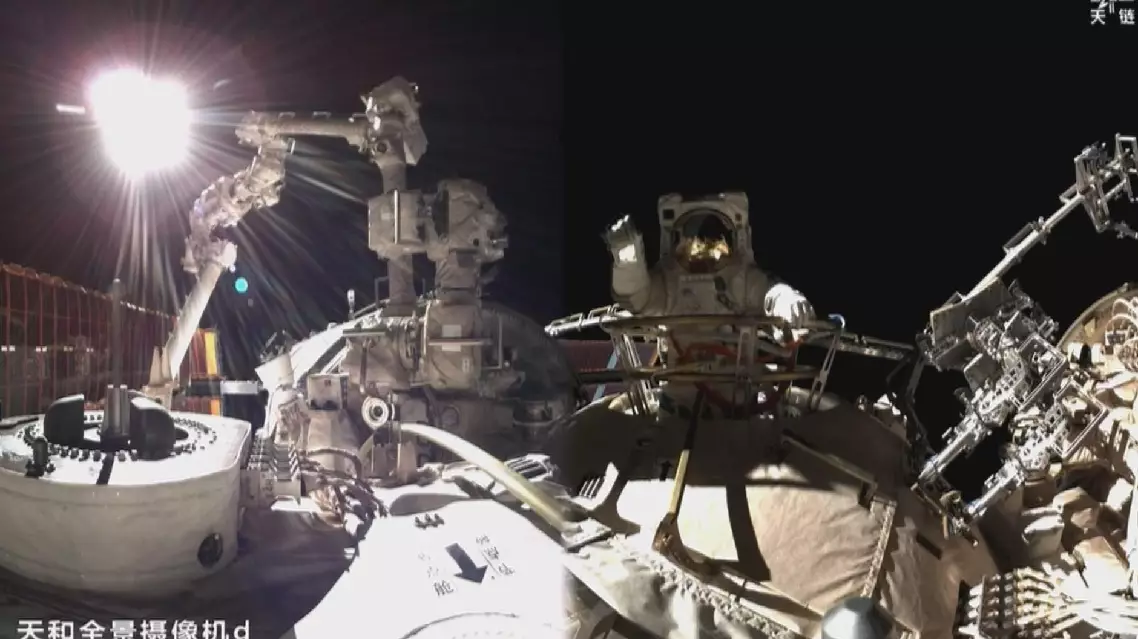
Expert on success of Shenzhou-20 crew's first spacewalk
Expert on success of Shenzhou-20 crew's first spacewalk