Skip to Content Facebook Feature Image

Hong Kong Updates Merchant Shipping Regulations to Align with International Maritime Safety Standards

HK

Hong Kong Updates Merchant Shipping Regulations to Align with International Maritime Safety Standards
HK

HK

Hong Kong Updates Merchant Shipping Regulations to Align with International Maritime Safety Standards

2025-05-23 11:30 Last Updated At:11:38

Government proposes amendments to update regulations on merchant shipping for compliance with international standards

​The Government gazetted today (May 23) nine amendment regulations to amend relevant regulations under the Merchant Shipping (Safety) Ordinance (Cap. 369), the Merchant Shipping (Prevention and Control of Pollution) Ordinance (Cap. 413), and the Merchant Shipping (Local Vessels) Ordinance (Cap. 548), to incorporate into local legislation the latest relevant requirements of the International Convention for the Safety of Life at Sea, 1974; the International Convention for the Control and Management of Ships’ Ballast Water and Sediments, 2004; and the International Convention for the Prevention of Pollution from Ships, 1973 of the International Maritime Organization (IMO).

The nine regulations to be amended are:

(a) Merchant Shipping (Safety) (Grain) Regulations (Cap. 369AA);

(b) Merchant Shipping (Safety) (Navigational Equipment and Safety of Navigation) Regulation (Cap. 369BA);

(c) Merchant Shipping (Safety) (Construction and Survey) Regulation (Cap. 369BD);

(d) Merchant Shipping (Safety) (Fire-fighting Appliances and Fire Protection) Regulation (Cap. 369BE);

(e) Merchant Shipping (Safety) (Ships Operating in Polar Waters) Regulation (Cap. 369BF);

(f) Merchant Shipping (Local Vessels) (General) Regulation (Cap. 548F);

(g) Merchant Shipping (Reporting of Pollution Incidents) Regulations (Cap. 413C);

(h) Merchant Shipping (Prevention of Air Pollution) Regulation (Cap. 413P); and

(i) Merchant Shipping (Control of Ballast Water and Sediments) Regulation (Cap. 413Q).

The proposed amendments include new requirements related to the safe carriage of bulk grains in specially suitable compartments; reporting of loss of freight container(s), including those containing harmful substances in packaged form, from a ship or observation of freight container(s) drifting at sea; design, construction, installation and testing etc of shipboard lifting appliances, anchor handling winches and their utilised loose gear; prevention of fire and explosion, suppression of fire and special requirements for the protection of specific spaces; safe navigation and voyage planning for specific types of vessels when operating in polar waters; classification, labelling, packing and documentation of dangerous goods in packaged form carried by sea; provision of bunker delivery notes for the bunkering of low-flashpoint fuels and gas fuels, and approval of electronic Ballast Water Record Boots and verification of the entries therein, etc.

A spokesman for the Transport and Logistics Bureau said, "As an Associate Member of the IMO, Hong Kong is committed to fulfilling our responsibilities to support the protection of the marine environment and the prevention of pollution, as well as to promote safe navigation. The proposed legislative amendments will keep our local laws up to date and in line with international standards on those fronts."

The Panel on Economic Development of the Legislative Council, the Hong Kong Fleet Operation Advisory Committee and the Local Vessels Advisory Committee of the Marine Department, as well as local fuel oil suppliers, have been consulted on the legislative proposals. The amendments were supported.

The proposed amendment regulations will be tabled at the Legislative Council for negative vetting on May 28.

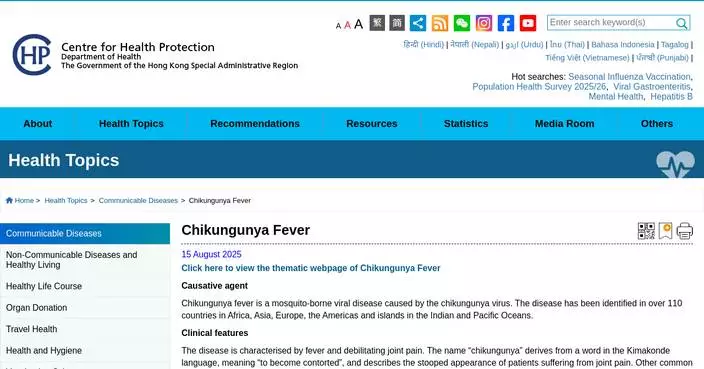
Update on chikungunya fever

The Centre for Health Protection (CHP) of the Department of Health announced that, as of 5pm today (January 11), no new cases of chikungunya fever (CF) had been recorded.

Latest surveillance data

------------------------------

Hong Kong has recorded a total of 82 confirmed CF cases last year. Among them, 11 were local cases, and the rest were imported cases.

Since the beginning of 2025, and as of December 10, 2025, a total of 502 264 CF cases and 186 CF-related deaths have been reported in over 40 countries/territories. Cases have been reported in the Americas, Africa, Asia, and Europe. Although the northern hemisphere has entered the winter season, temperatures in subtropical and some temperate regions remain elevated due to climate change, creating favourable conditions for mosquito breeding. In addition, CF outbreaks continue to occur in many countries worldwide. The risk of imported cases persists. Members of the public should check the situation of the destinations before travelling abroad, especially when travelling to Southeast Asian countries.

Government's comprehensive follow-up actions

-----------------------------------------------------

Given that some local cases of CF have visited the Tsing Yi Nature Trails or the surrounding area in November last year, the trails are currently closed until further notice. Relevant government departments continue to conduct large-scale mosquito control and prevention efforts along the trails, and the CHP appeals to the public not to enter the area in order to reduce the risk of contracting CF and to avoid exposure to chemicals or interfering with the mosquito control operations. Since the confirmation on December 10, 2025, of a case involving a person who had visited the Tsing Yi Nature Trails on November 30, 2025, no further local cases have been recorded to date. The CHP continues to urge individuals who have recently hiked along the Tsing Yi Nature Trails to seek medical attention as soon as possible if they develop relevant symptoms and to call the enquiry hotline (Tel: 2125 2373), which operates from 9am to 6pm.

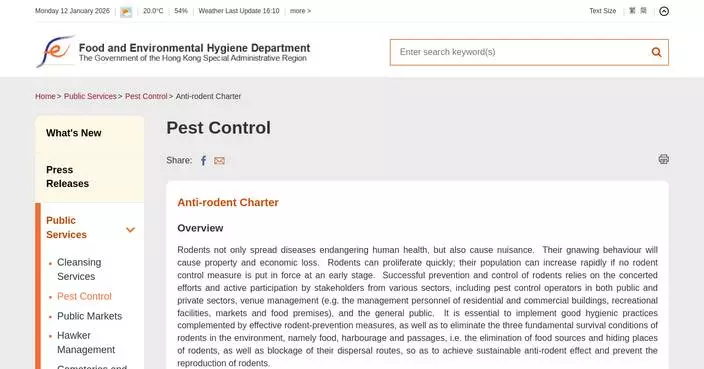
The Food and Environmental Hygiene Department (FEHD) has been continuously conducting intensive fogging operations to eliminate adult mosquitoes along the Tsing Yi Nature Trails and the surrounding area. At suitable locations, large ultra-low volume foggers have been deployed, and a robot dog is being put on trial to enhance operational effectiveness. The FEHD has also set up new mosquito trapping devices, cleared discarded containers and garbage that could cause stagnant water, and applied larvicide oil or larvicides in areas with stagnant water that cannot be removed immediately. The FEHD has been collaborating with the Kwai Tsing District Office, the Lands Department and the Drainage Services Department to strengthen efforts in eliminating potential mosquito breeding sites along the Tsing Yi Nature Trails. Pamphlets have been distributed to hikers in the area, urging citizens to be vigilant against mosquito infestations and take personal protective measures. The FEHD has also held meetings of the interdepartmental task forces on anti-mosquito work across districts to discuss the latest developments regarding the situation and plan accordingly to co-ordinate relevant departments and stakeholders in strengthening mosquito prevention and control measures in areas under their purview.

Continuously strengthening prevention and control

---------------------------------------------------------

The FEHD and relevant departments have comprehensively enhanced the mosquito control operations in Hong Kong since July last year, and this has continued. Among these, the FEHD has conducted vector investigations and targeted mosquito control operations against the imported and local cases. In light of the local case, the FEHD has immediately conducted follow-up actions, including:

  • carrying out intensive fogging in scrubby areas within a 250-metre radius of the relevant locations to kill adult mosquitoes;
  • carrying out inspections of the locations, removing stagnant water, applying insecticides and disposing of abandoned water containers every week with a view to preventing mosquito breeding; and
  • enhancing public education efforts through organising health talks, setting up mobile education stations, and distributing publicity leaflets.
  • The abovementioned measures will be continued. Furthermore, the Government will further enhance the mosquito control efforts in addition to the existing measures.

    Preventive measures to be taken by the public

    ----------------------------------------------------

    Members of the public should use DEET-containing insect repellents or other effective active ingredients properly to prevent mosquito bites, but the following precautions should be taken when using them:

  • read the label instructions carefully first;
  • apply right before entering an area with a risk of mosquito bites;
  • apply on exposed skin and clothing;
  • use DEET of up to 30 per cent for pregnant women and up to 10 per cent for children (for children who travel to countries or areas where mosquito-borne diseases are endemic or epidemic and where exposure is likely, those aged 2 months or above can use DEET-containing insect repellents with a DEET concentration of up to 30 per cent);
  • apply sunscreen first, then insect repellent;
  • reapply only when needed and follow the instructions; and
  • in addition to DEET, there are other insect repellents available on the market containing different active ingredients, such as IR3535 and picaridin. When using any insect repellent, the public should follow the usage instructions and precautions on the product label.
  • The FEHD also appeals to members of the public to continue to stay alert and work together to carry out mosquito prevention and control measures early, including inspecting their homes and surroundings to remove potential breeding grounds, changing water in vases and scrubbing their inner surfaces, removing water in saucers under potted plants at least once a week, and properly disposing of containers such as empty cans and lunch boxes. The FEHD also advises members of the public and property management agencies to keep drains free of blockage and level all defective ground surfaces to prevent the accumulation of water. They should also scrub all drains and surface sewers with an alkaline detergent at least once a week to remove any mosquito eggs.

    The public should call 1823 in case of mosquito problems, and may visit the following pages for more information: the CF page of theCHPand theTravel Health Service, the latestTravel Health News,tips for using insect repellents, and the CHPFacebook Page,Instagram AccountandYouTube Channel, and also theMosquito Prevention and Control dedicated pageof the FEHD.

    Source: AI-found images

    Source: AI-found images

    Recommended Articles