The upcoming humanoid robot boxing competition will set an extreme condition to test not only the capabilities of the contestants but also help programmers enhance these robots to better integrate into people's daily lives.
The event, titled "China Media Group (CMG) World Robot Contest: Mech Combat Arena Competition," will be livestreamed globally from Hangzhou City of east China's Zhejiang Province on Sunday.
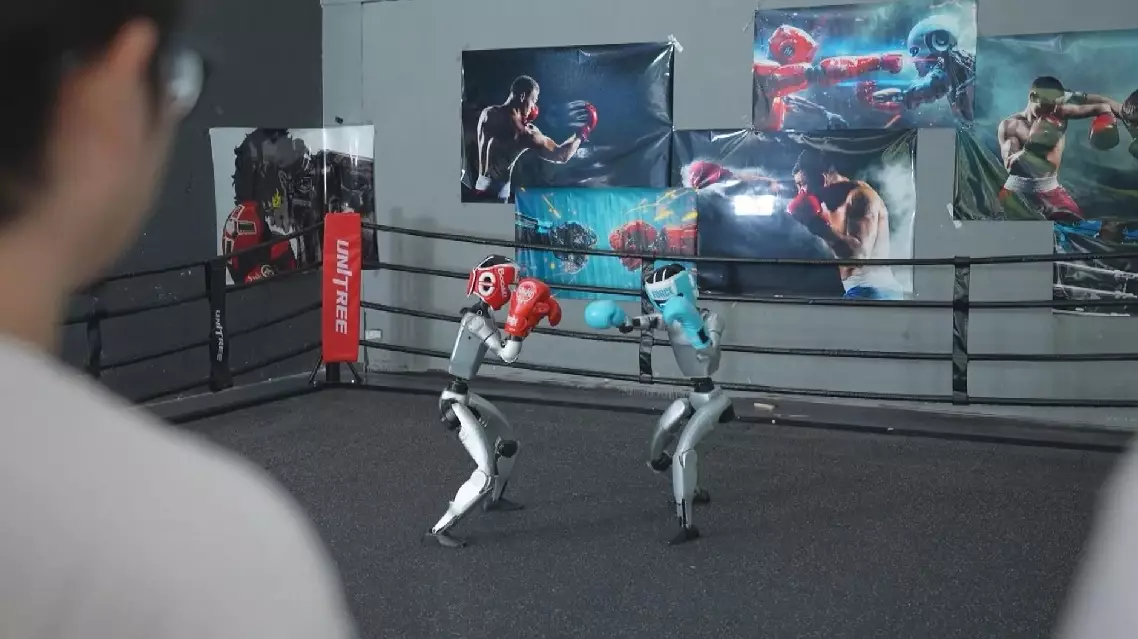
As part of a series of robot competitions co-sponsored by the CMG and other institutions, the boxing event will feature two humanoid robots developed by the Hangzhou-based tech startup Unitree Robotics, which will face off in a boxing ring.
These humanoid robots, subjected to daily high-intensity training, have sustained some minor scratches and dents, but these "injuries" will not affect their performance, according to Sun Baoyan, marketing manager of Unitree Robotics.
The robots are designed to withstand the intense impacts of boxing, a physically demanding sport.
"Each time the robot attacks, the force can be quite strong. We test the robot's stability by subjecting it to harsh impacts. And we have designed programs to protect the key components like the skeleton and structural parts. While the scratches may appear, the functionality and operation remain intact," Sun said.
In the competition, the robots will demonstrate eight basic boxing moves and several combinations, including jabs, hooks and kicks.
Sun added that the process of teaching the robots their movements is similar to motion capture technology used in film production.
"We initially worked with professional human boxers, placing sensors on their bodies to track movements. They performed specialized boxing moves, such as the left hook and uppercut. We captured the key movement trajectories, including how the wrist, waist, and legs move. This data were then programed into the robots, allowing them to use AI reinforcement learning to improve how they execute the actions," Sun said.
According to organizers, the competition is intended to push these robots to their limits, which is helpful to refine the algorithms and enhance their capabilities for future real-world scenarios.
Gao Yuan, a technician, highlighted the importance of hardware stability for humanoid robots to play a significant role in future daily life and production.
"As long as the robot's balance is strong enough, and its mobility and movements are precise and smooth enough, we can consider how it might assist us in our daily life. I think the boxing competition provides an extreme testing environment, which helps us refine these aspects. On the basis of these efforts, we can transfer the balance techniques newly learned from the competition to the operation of common robot types or future machines, enabling them to perform better in both industrial and domestic environments," Gao said.
Humanoid robots boxing contest touchstone for future roles: testers