Foreign ministers of ASEAN (Association of Southeast Asian Nations) convened in Kuala Lumpur on Sunday to address pressing regional and international challenges.
The meeting took place ahead of the 46th ASEAN Summit, the 2nd ASEAN-Gulf Cooperation Council (GCC) Summit, and the ASEAN-GCC-China Summit, all of which will also be held in Kuala Lumpur starting May 26.
Chairing the meeting, Malaysian Foreign Minister Mohamad Hasan raised concerns over global economic uncertainty triggered by U.S. tariff threats and its trade tensions with China, ASEAN's largest trading partner.
"We must respond to the potential fallout from global trade disruptions together, with cohesion and solidarity, and strategic autonomy as one ASEAN community. This collective effort will enable ASEAN to weather challenges and minimize impact on our people," he said.
Unlike the European Union, ASEAN will not be able to negotiate as a bloc, with proposed U.S. tariff rates ranging from just 10 percent for Singapore to more than 40 percent for Laos, Vietnam, and Cambodia.
Emphasizing ASEAN’s solidarity, Malaysian Minister of Investment, Trade and Industry Tengku Zafrul Aziz underscored the bloc’s support for its member states in navigating global trade challenges and pursuing bilateral negotiations.
"Every country is a sovereign nation, therefore, we will definitely support each other in ASEAN to continue their bilateral negotiations. We continue to stand behind the principles of multilateralism, where we believe in the rule-based multilateral trading order, with WTO at its core," the minister said at a press conference following the conclusion of the meeting.
Myanmar also loomed large over the meetings, as the country remains mired in civil war, with even a massive earthquake failing to bring about a meaningful pause in the conflict.
ASEAN reiterated its commitment to seeing Myanmar’s military leadership make tangible progress on the five-point consensus peace plan agreed upon with fellow member states.
"We want to see a long-term ceasefire, non-violence, at the same time to have an inclusive political dialogue and, of course, to scale up humanitarian assistance to assist the people of Myanmar," ASEAN Secretary-General Kao Kim Hourn said.
As in previous instances, ASEAN has not allowed any representative of Myanmar’s military to attend the meetings. However, the country may send a non-political civilian technocrat, as it did at last year’s ASEAN meetings.
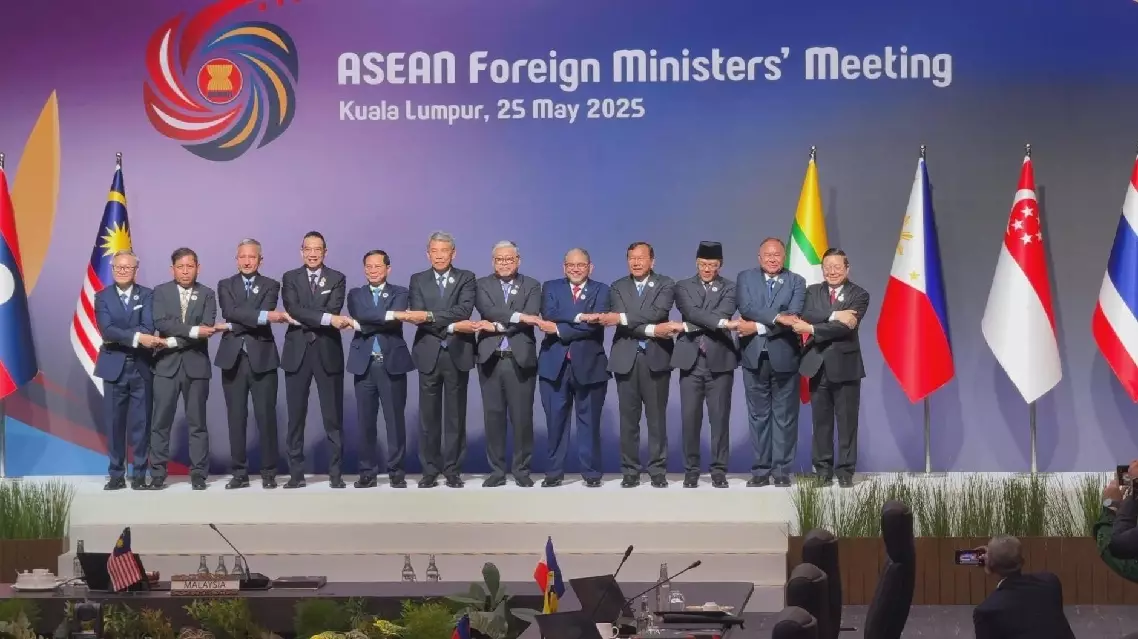
ASEAN foreign ministers meet in Kuala Lumpur to address key regional, global issues