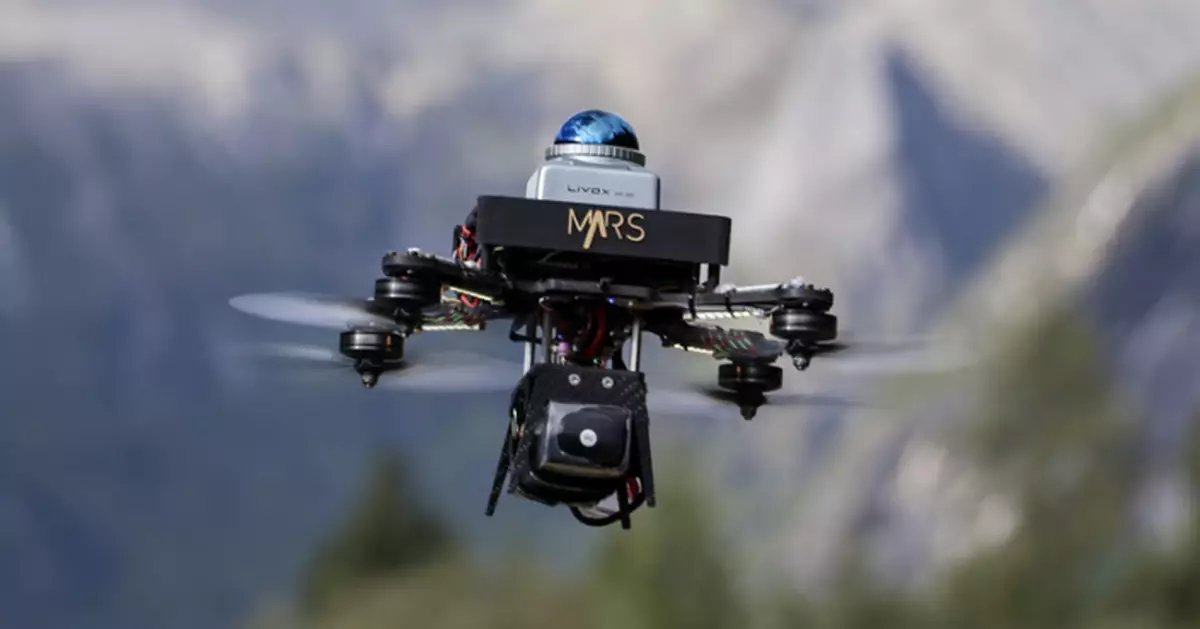
Unlike birds, which navigate unknown environments with remarkable speed and agility, drones typically rely on external guidance or pre-mapped routes. However, a groundbreaking development by Professor Fu Zhang and researchers from the Department of Mechanical Engineering of Faculty of Engineering at the University of Hong Kong (HKU), has enabled drones and micro air vehicles (MAVs) to emulate the flight capabilities of birds more closely than ever before.
The team has developed the Safety-Assured High-Speed Aerial Robot (SUPER), capable of flying at speeds exceeding 20 meters per second and avoiding obstacles as thin as 2.5 millimetres – such as power lines or twigs – using solely on onboard sensors and computing power. With a compact design featuring a wheelbase of just 280 mm and a takeoff weight of 1.5 kg, SUPER demonstrates exceptional agility, navigating dense forests at night and skilfully avoiding thin wires.

SUPER can navigate complex environments at high speeds with a level of safety previously unattainable.

SUPER has undergone testing in a variety of real-world applications, including situations with complete darkness and cluttered environments.

System overview of SUPER
Professor Zhang describes this invention as a game-changer in the field of drone technology, “Picture a 'Robot Bird' swiftly maneuvering through the forest, effortlessly dodging branches and obstacles at high speeds. This is a significant step forward in autonomous flight technology. Our system allows MAVs to navigate complex environments at high speeds with a level of safety previously unattainable. It’s like giving the drone the reflexes of a bird, enabling it to dodge obstacles in real-time while racing toward its goal.”
The breakthrough lies in the sophisticated integration of hardware and software. SUPER utilises a lightweight 3D light detection and ranging (LIDAR) sensor capable of detecting obstacles up to 70 metres away with pinpoint accuracy. This is paired with an advanced planning framework that generates two trajectories during flight: one that optimising speed by venturing into unknown spaces and another prioritising safety by remaining within known, obstacle-free zones.
By processing LIDAR data directly as point clouds, the system significantly reduces computation time, enabling rapid decision-making even at high velocities. The technology has been tested in various real-life applications, such as the autonomous exploration of ancient sites, and has demonstrated seamless navigation in both indoor and outdoor environments.
“The ability to avoid thin obstacles and navigate tight spaces opens up new possibilities for applications like search and rescue, where every second counts. SUPER’s robustness in various lighting conditions, including nighttime, makes it a reliable tool for round-the-clock operations.” said Mr Yunfan Ren, the lead author of the research paper.
The research team envisions a wide range of applications for this innovative technology, including autonomous delivery, power line inspection, forest monitoring, autonomous exploration, and mapping. In search and rescue missions, MAVs equipped with SUPER technology could swiftly navigate disaster zones – such as collapsed buildings or dense forests – day and night, locating survivors or assessing hazards more efficiently than current drones. Moreover, in disaster relief scenarios, they could deliver crucial supplies to remote and inaccessible areas.
The research has been published in Science Robotics, titled as “Safety-assured high-speed navigation for MAVs”.
For details about the research article, please visit: https://www.science.org/doi/10.1126/scirobotics.ado6187.
Link to the video demo: https://youtu.be/GPHuzG0ANmI?si=hfIFcMye0XX708OX
About Professor Fu Zhang
Professor Fu Zhang is an Associate Professor of Department of Mechanical Engineering of Faculty of Engineering at HKU, and serves as the director of the HKU Mechatronics and Robotic Systems Lab (MaRS LAB). Professor Zhang received his B.E. degree in Automation from the University of Science and Technology of China (USTC) in 2011, and the Ph.D. degree in Controls from the University of California, Berkeley in 2015. His Ph.D. work focused on self-calibration and control of micro rate-integrating gyro sensors. In 2016, Professor Zhang shifted his research to the design and control of Unmanned Aerial Vehicles (UAVs) as a Research Assistant Professor in the Robotics Institute of the Hong Kong University of Science and Technology (HKUST). He joined the Faculty of Engineering at HKU as an Assistant Professor in the Department of Mechanical Engineering in August 2018. His research interests lie in robotics and controls, with a focus on UAV design, navigation, control, and lidar-based simultaneous localization and mapping.
About the research team
The HKU Mechatronics and Robotic Systems Lab (MaRS LAB) is dedicated to the study of general mechatronic systems and robotics, with a particular emphasis on their practical applications in real-world human environments and industries. Research areas include the design, planning, and control of aerial robots, as well as LiDAR-based simultaneous localization and mapping (SLAM) techniques. Mr Yunfan Ren is a PhD candidate at HKU, and a member of the MaRS LAB, focuses his research on autonomous navigation and swarm intelligence for aerial robots.