Three vibrant economies—ASEAN (Association of Southeast Asian Nations), GCC (Gulf Cooperation Council), and China—renowned for their commitment to free trade and multilateral cooperation, convened in Malaysia for their first-ever summit on Tuesday.
The three parties are expected to deepen practical cooperation in various fields, such as trade, investment and supply chain, creating new opportunities in clean and renewable energy, digital economy, electric vehicles, financial markets and infrastructure development among other areas.
The trilateral gathering of the leaders of 17 countries also marks an innovative step in cross-regional South-South cooperation among complementary economies to ride out trade disruptions caused by U.S. tariffs.
ASEAN, a group of 10 Southeast Asian countries - Brunei, Cambodia, Indonesia, Laos, Malaysia, Myanmar, the Philippines, Singapore, Thailand and Vietnam, is the fifth-largest economy after the United States, China, the EU and Japan. It has produced a model mechanism to boost regional cooperation among its member states, and has been a major global manufacturer and agricultural product exporter, integrating the supply chains in the Asia-Pacific region through agreements.
Intra-ASEAN trade continues to strengthen, with steady growth of inward foreign direct investment flows into the bloc in the past decade.
The collaborative approach of ASEAN has enabled the bloc to navigate complex geopolitical challenges, foster dialogue and drive growth.
"The ASEAN way has always adhered to multilateralism, openness and balancing the dynamic relations among major countries. But ASEAN is now facing greater geopolitical pressure to take sides than before and emphasizing resilience, cohesion and community building," said Ge Hongliang, vice dean of the College of ASEAN Studies at Guangxi Minzu University.
The GCC economies, including Bahrain, Kuwait, Oman, Qatar, Saudi Arabia and the United Arab Emirates (UAE), are expected to double its economic growth rate from 2.1 percent in 2024 to 4.2 percent in 2025, the First Abu Dhabi Bank, the largest bank in the UAE, said in a report released in February.
Therefore, the bloc holds significant geopolitical influence due to its six member states' vast oil and gas reserves, which are the core of the global energy supply chain.
Thus, their investment matters a lot to the global financial market. For instance, when uncertainties such as the tariffs war, or the regional conflicts emerged, the bloc had to adjust its oil production, with the fluctuation intensified in the global commodity market.
"In recent years, GCC countries are looking for a new model of sustainable development, including digital economy and green economy. They also seek more potential cooperation with China and ASEAN countries. They have complementary advantage for each side," said Tian Wei, assistant professor from School of Economics of Peking University.
In Riyadh, Saudi Arabia where the ASEAN-GCC summit first took place in 2023, the two blocs rolled out a cooperation plan to facilitate political and security dialogue, trade and investment flows.
And negotiations for a free trade agreement, or FTA, to boost trade between the two regions, could see a breakthrough at the upcoming summit.
Now, China is on board, definitely not a new partner, but a catalyst support.
In 2022, ASEAN became China's largest trading partner, surpassing both the U.S. and the EU, which has expedited negotiations for the China-ASEAN FTA since then.
Just a week ahead of this summit, China and ASEAN completed the negotiations of an upgraded free trade agreement, heralding a China-ASEAN mega market in a 3.0-regional cooperation.
"Given the rising protectionism, particularly the U.S.'s additional tariffs, the stability and security of industrial, value and labour chains in the region are concerning to China and ASEAN. The new version of the China-ASEAN FTA precisely focuses on emerging economic fields and trading rules and resilience, playing a significant and exemplary role in deepening trilateral cooperation of trade and investment," said Ge.
As the world's largest energy importer, China seeks stable oil and gas supplies from GCC nations who view China as a stable market in turn.
Both have pursued an FTA to reduce tariffs and streamline energy and non-oil trade over the last two decades.
The two sides at the summit are hoping to accelerate the FTA discussion.
"There are also large capital flows between China and GCC countries in renewable energy fields. They are very happy to have more Chinese firms to invest in those countries," said Tian.
Amid promising trade deals, U.S. President Donald Trump's targeted campaign against imports has escalated into a full-blown economic confrontation, shattering long-held assumptions about the stability of global trade. Trump believes tariffs on China and other nations would force them to make compromises on the re-negotiating table.
Yet, Beijing disagrees. That hasn't been the way China and ASEAN achieved the landmark trade deal, as well as with GCC nations potentially.
This mutually beneficial and pragmatic cooperation sends a clear and important signal to the world that free trade and multilateralism are always the key to global development.
"Countries across the two regions are strategically pivotal to the U.S. Washington also expects Southeast Asia to exert pressure on Beijing. However, ASEAN is fully aware of China's role in economic stability and certainty in the region. I believe the summit is undoubtedly a setback in the United States' diplomatic strategy," said Ge.
The currency of diplomacy could be the trading partnership, as long as it is fair, just and sustainable. And the ASEAN-GCC-China summit is more than diplomacy, it could reshape the landscape of global governance that will determine the long-term security and prosperity of the regions.
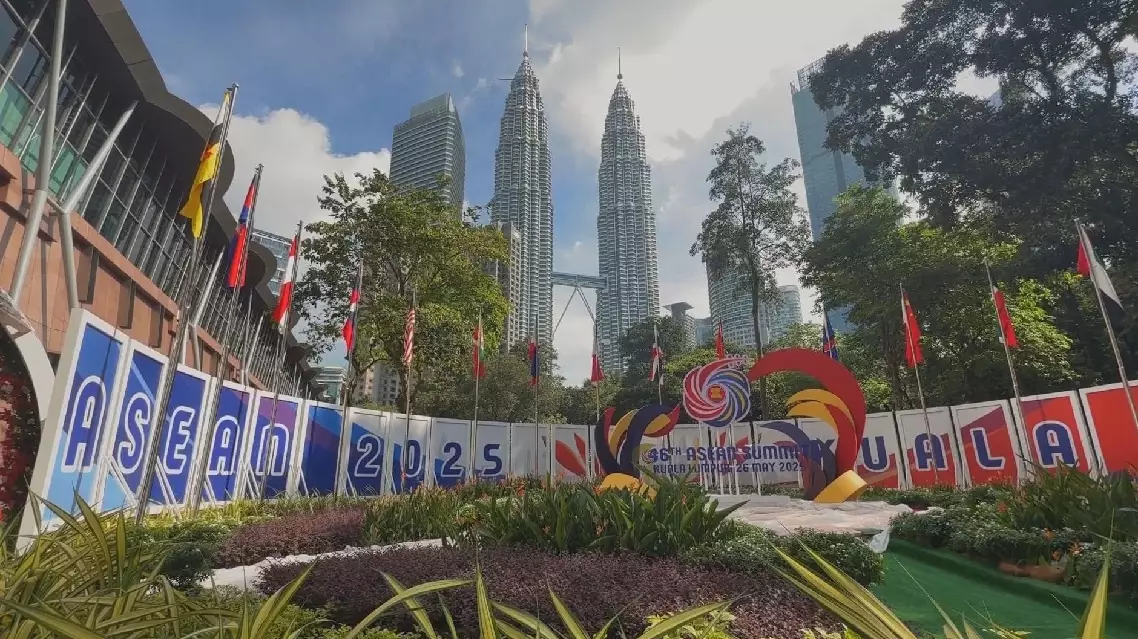
1st ASEAN-GCC-China summit to champion free trade, multilateral cooperation