OXON HILL, Md. (AP) — Rudveep Randhawa's three kids competed in eight consecutive Scripps National Spelling Bees from 2016 to 2024, with four appearances by daughter Aisha and two each by daughter Lara and son Avi. Yet when Avi's spelling journey concluded in last year's semifinals, Randhawa, a pediatric endocrinologist who goes by “Dr. Happy,” was decidedly grumpy.
His gripe? At unexpected and critical moments, the spelling bee transforms into a geography bee.
Scripps has begun relying on obscure geographical terms to winnow down the field of spellers in the later rounds. While the words are included in the Merriam-Webster Unabridged dictionary, they often don't follow familiar roots or language patterns, denying accomplished spellers of the tools they use to figure out which letters form the sounds of words they've never seen before.
Along with SAT-style, multiple-choice vocabulary questions, geographical terms have altered the way spellers prepare for the bee, which began Tuesday and concludes Thursday at a convention center outside Washington. Mastering them can require an out-of-fashion skill: rote memorization.
“Geographical words can be super hard sometimes because there's no roots to break it down or sometimes you don't get a language of origin. It will say ‘unknown origin’ or the dictionary doesn't say,” said Avinav Prem Anand, a 14-year-old from Columbus, Ohio, who's competing this year for the fourth and final time. “Basically, you have to memorize them because that's the only thing you can do.”
Avinav put his preparation to use in Tuesday's preliminary rounds when he breezed through Sapporo, the capital of the northern Japanese island of Hokkaido. Others were not so fortunate: 12-year-old Eli Schlosser of Fergus Falls, Minnesota, heard the dreaded bell because he was unfamiliar with Terre Haute, the western Indiana city. He went with “terrahote.”
Last year, the Randhawa family of Corona, California, saw its decade-long spelling journey end when Avi misspelled Abitibi, the name of a shallow lake in northeastern Ontario and western Quebec.
“It's beyond the pale of what anybody would consider a reasonable geographical word, a small lake in Canada that not even my Canadian friends had heard of. Not even a top-50 size lake in Canada,” Rudveep Randhawa said. “It's just bizarre. In all the years with geographical words, we had seen words of some significance, they may be capitals of smaller countries, or they may be some port city that had significance, things of that nature.”
Yet for those who might find geographical terms unfair, Scripps has a message: Study harder.
“Per our contest rules, all words listed in Merriam-Webster Unabridged Online, except those that are labeled ‘archaic’ or ‘obsolete,’ are fair,” said Molly Becker, the editorial director at Cincinnati-based Scripps and a member of the panel that selects words for the competition.
Scripps considers encouraging intellectual curiosity as part of the bee's mission, and if kids with designs on the trophy have to learn more geography in order to prepare, that's arguably a good thing.
“You never know what word will stand out to a speller and spark a lifelong interest or introduce them to a new concept,” Becker said.
Longtime spelling coach Grace Walters, a graduate student in linguistics at the University of Kentucky, cringed at the memory of Abitibi.
“Geo is definitely something that is feared by spellers,” Walters said, calling it “a daunting task to study.”
“But if geo is unfair because it doesn't have patterns, that would mean other categories like trademarks and personal eponyms and words of unknown origin would also be unfair,” she said.
Some spellers embrace the challenge. Faizan Zaki, last year's runner-up who's competing again this year, was thrilled to hear Abitibi and Hoofddorp — a town in the Netherlands — in 2024 because he had seen those words before.
“There's actually a section in Merriam-Webster that is dedicated to just geographical words, so sometimes when I'm tired from studying normal words, I take a break and I browse through that list of geographical words that they have,” said Faizan, a 13-year-old from Allen, Texas.
You heard that right: When Faizan gets tired of studying, he “takes a break” by studying more.
“Pretty much, that’s my life,” he said. “But yeah, it’s definitely enjoyable. I don't hate it or anything.”
Ben Nuckols has covered the Scripps National Spelling Bee since 2012. Follow his work here.
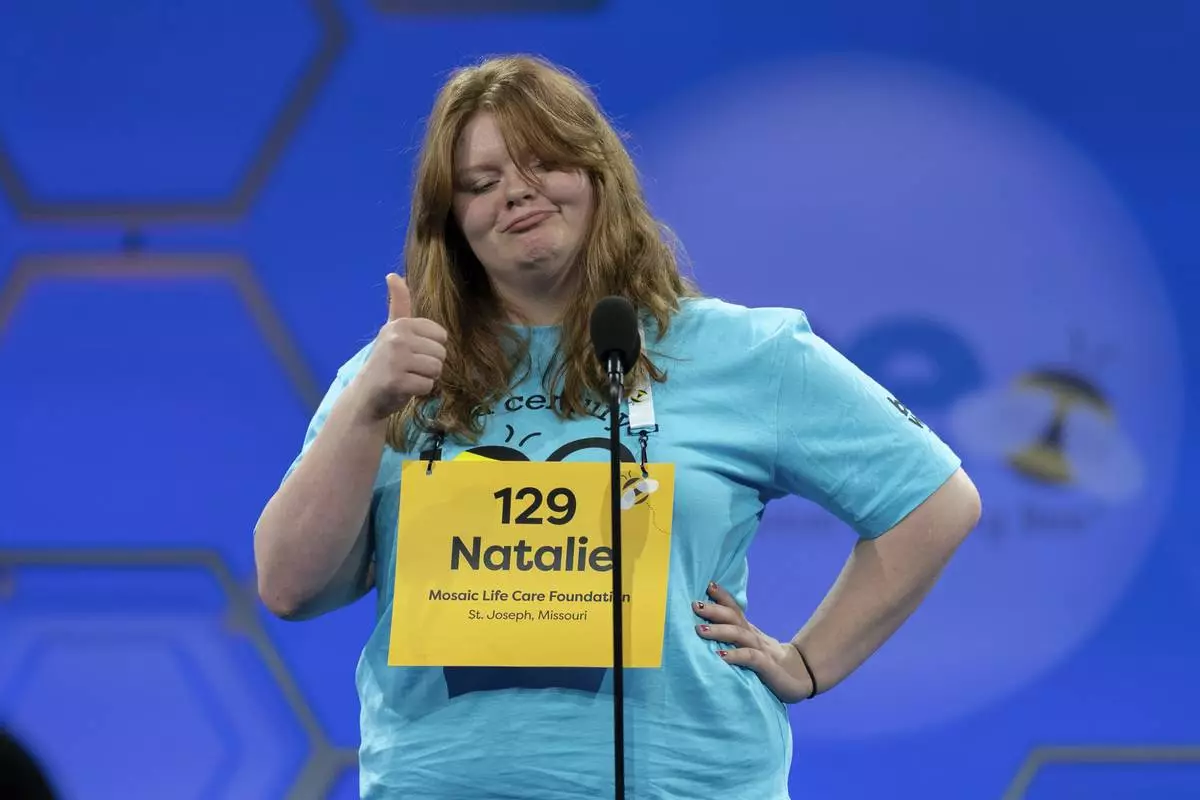
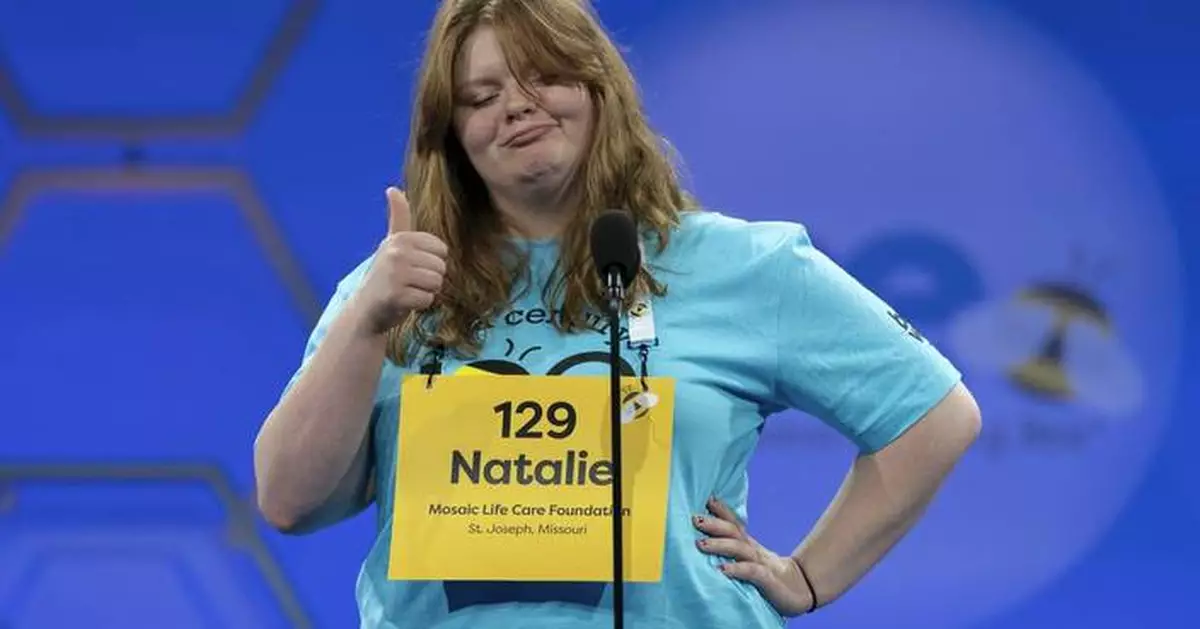
Natalie Mae Linthicum, 13, of St. Joseph, Mo., gestures as she spells her word during the first preliminary round of the Scripps National Spelling Bee at the Gaylord National Resort & Convention Center, Tuesday, May 27, 2025, in Oxon Hill, Md. (AP Photo/Jose Luis Magana)
CAIRO (AP) — Pakistan’s interior minister was in Tehran on Sunday in a fresh bid to restart negotiations between Iran and the U.S., as the American military said it shot down two more Iranian drones over the Strait of Hormuz that threatened international maritime traffic.
The latest action came as the U.S. administration presses Iran to make a deal to end the war in the Middle East, which has strained the global economy and threatened a hunger crisis in some of the world’s most vulnerable countries.
The heaviest fighting ended with a preliminary ceasefire on April 8, but the sides have not been able to agree on a long-term end to the war.
Fighting between Israel and the Lebanese militant group Hezbollah continued, meanwhile, despite last week's announcement that a U.S.-brokered ceasefire had been extended.
Pakistani Interior Minister Mohsin Naqvi is in Tehran to deliver a message to Iranian Supreme Leader Ayatollah Mojtaba Khamenei from Pakistan's army chief Field Marshal Asim Munir, according to Iranian state-run IRNA news agency.
Khamenei has not been seen in public since he was named the Islamic Republic’s ruler after his father was killed on the first day of the war on Feb. 28 when the U.S. and Israel lauched a bombardment campaign against Iran.
Naqvi met with Iranian Interior Minister Eskandar Momeni late Saturday, and held talks Sunday morning with Foreign Minister Abbas Araghchi, according to official Iranian media.
There were no details on the contents of the message. Pakistani authorities have said Islamabad, with support from regional countries including Qatar, Turkey and Egypt, has been working to help bridge differences between the United States and Iran and encourage efforts aimed at reducing tensions and ensuring the reopening of the Strait of Hormuz.
Meanwhile, the new ceasefire in Lebanon, which was announced during U.S-brokered talks between Israel and Lebanon in Washington last week, did not appear to be holding.
The Iranian-backed Hezbollah has rejected the U.S.-brokered deal and instead endorsed Iran’s demand that ending the war in Lebanon be part of the negotiations with the U.S.
Israel struck what it said were over 150 Hezbollah military sites over the weekend, including rocket launchers and command centers, across southern Lebanon.
Early Sunday, Israel identified at least five projectiles launched from Lebanon toward northern Israel, which were intercepted or fell in open areas. Hezbollah did not immediately claim to have fired projectiles at Israel. However, the militant group acknowledged it attacked Israeli troops in southern Lebanon.
Two Israeli soldiers were killed in fighting in southern Lebanon on Saturday, the Israeli military said.
The fighting in Lebanon, where Israeli forces have seized large swaths of the south in its latest ground invasion, threatens efforts to end the Iran war and reopen the Strait of Hormuz, a key transit point for oil and gas. Its closure has jolted the world economy.
Iran has demanded that any lasting truce extend to Lebanon. Israeli Prime Minister Benjamin Netanyahu, who faces elections later this year, wants to press ahead with Israel’s offensive until he considers Hezbollah no longer poses a threat.
Lebanon’s army commander, Gen. Rodolphe Haikal, headed to Pakistan Saturday at the invitation of Pakistan’s army chief. The Lebanese army gave no further details and did not say whether it is related to Pakistan’s mediation between Iran and the U.S.
The U.S. military said Saturday that it had shot down several Iranian missiles and drones launched toward the Strait of Hormuz and Gulf Arab allies, and struck some of the Islamic Republic’s coastal surveillance radar sites in response.
“The attack drones posed an immediate threat to regional maritime traffic,” U.S. Central Command said.
Iran’s Revolutionary Guard said it had targeted the Ali Al Salem air base, which hosts U.S. forces in Kuwait, and the U.S. Navy’s 5th Fleet in Bahrain, according to the state-run IRNA news agency.
The U.S. military said there were no reports of harm to U.S. personnel.
Earlier in the month, Iranian drones heavily damaged a passenger terminal at Kuwait’s main airport, killing one person and wounding dozens.
The U.S. military has kept up its blockade on Iranian ports in response to Tehran’s grip on the strait, a crucial corridor for global oil and natural gas shipments.
Energy prices have spiked, posing political problems for U.S. President Donald Trump’s Republican Party ahead of midterm congressional elections in November.
Chehayeb reported from Beirut and Lidman from Tel Aviv, Israel.
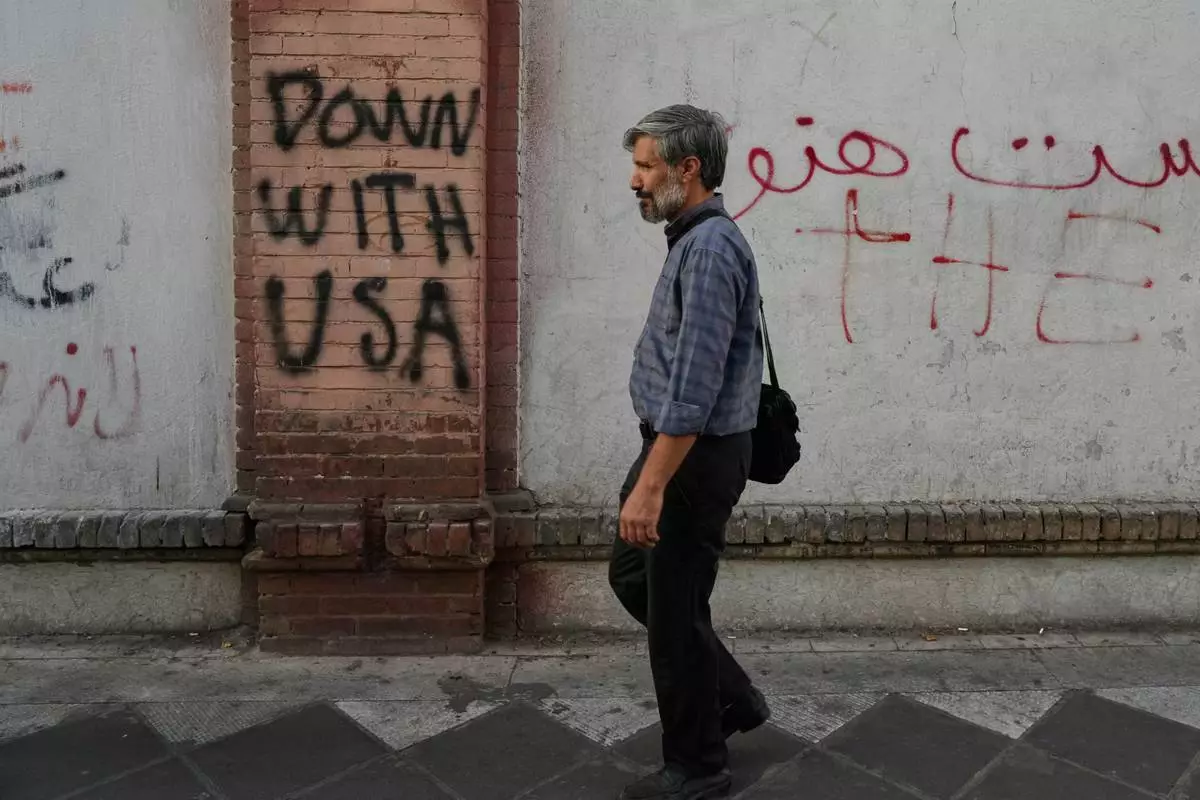
A man walks past anti-U.S. graffiti painted on the wall of the British Embassy in Tehran, Iran, Saturday, June 6, 2026. (AP Photo/Vahid Salemi)
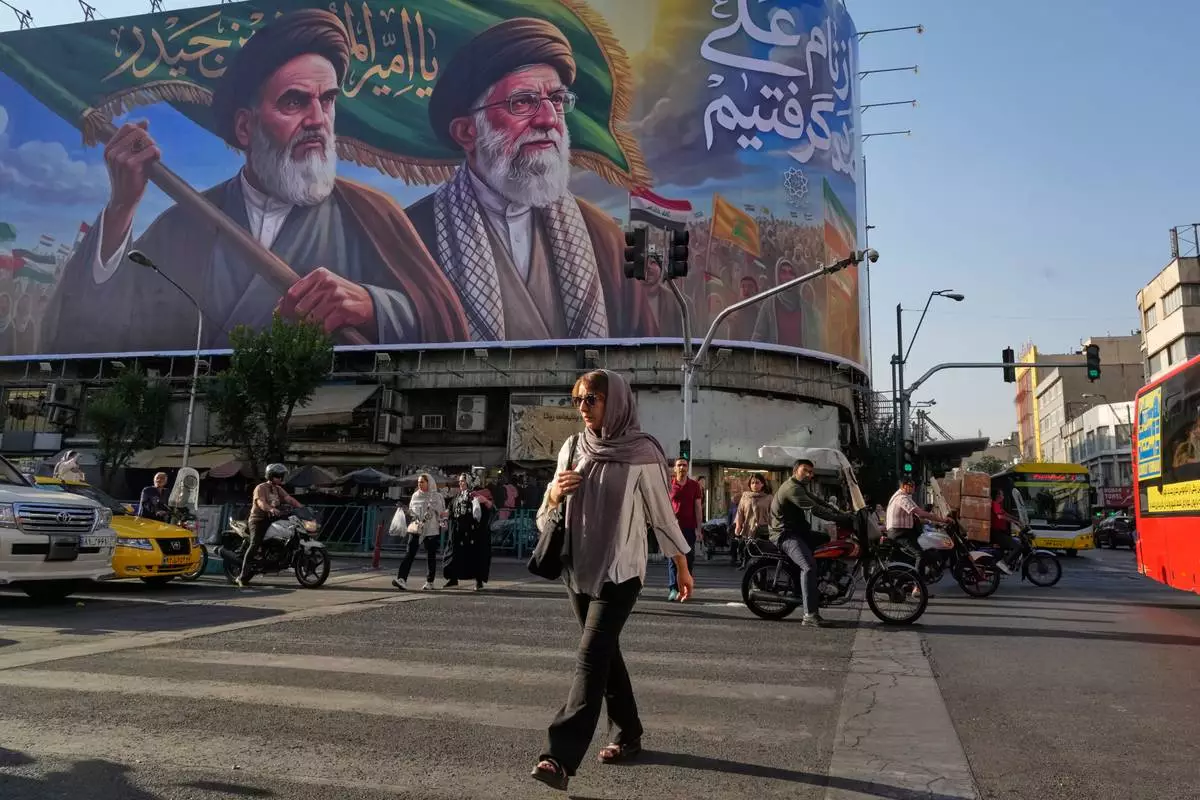
People walk under a banner showing portraits of the late revolutionary founder Ayatollah Khomeini, left, and the slain Supreme Leader Ayatollah Ali Khamenei, who was killed in U.S. and Israeli strikes on Feb. 28, in Tehran, Iran, Saturday, June 6, 2026. (AP Photo/Vahid Salemi)