Jordan's ambassador Mahmoud Daifallah Hmoud to the United Nations was elected a judge of the International Court of Justice (ICJ) on Tuesday to replace Nawaf Salam, who resigned in January following his appointment as Lebanese prime minister.
Hmoud will serve the remainder of Salam's term at the ICJ, which lasts until Feb 5, 2027.
Hmoud, who was the sole candidate, won all the 15 votes in the Security Council and 178 votes at the General Assembly, with three of abstention.
Hmoud has been Jordan's UN ambassador since September 2021. He was Jordanian ambassador to Singapore between 2018 and 2021.
He was a member of the International Law Commission between 2007 and 2022, being chair of the commission during its 72nd session in 2021 and chair of the Drafting Committee in 2012.
Hmoud held several terms as legal advisor and director of the Legal Department of Jordan's Foreign Ministry between 1999 and 2018.
Under the Statute of the International Court of Justice, the principal judicial organ of the United Nations, the election of ICJ judges is through secret balloting at the Security Council and the General Assembly. A candidate has to obtain absolute majority in both chambers to get elected. Voting in the two chambers must be held concurrently but separately.
The Hague-based ICJ has 15 judges elected to nine-year terms of office. Judges are eligible for re-election. Should a judge die or resign during his or her term of office, a special election is held to choose a judge to fill the unexpired part of the term.
The 15 judges must come from 15 different countries. The court as a whole must represent the main forms of civilization and the principal legal systems of the world.
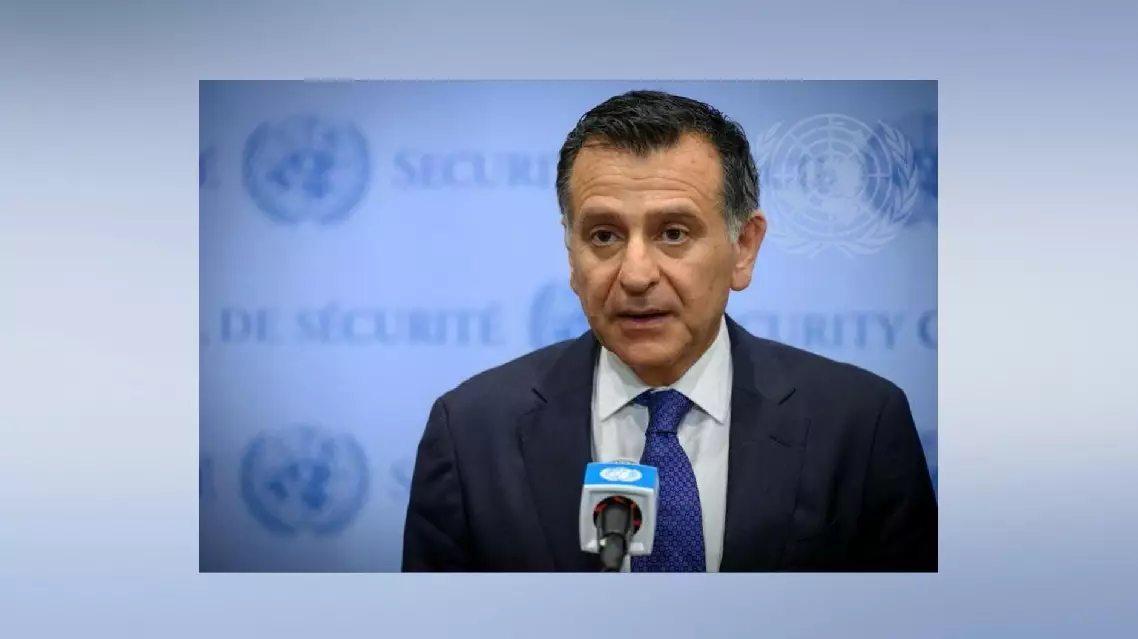
Jordanian diplomat elected judge of Int'l Court of Justice
The United States cannot legitimize an operation that attacked Venezuela and captured its president, a Chinese scholar said Sunday.
On Saturday, the United States launched a large-scale strike on Venezuela, during which Venezuelan President Nicolas Maduro and his wife were 'captured and flown out of Venezuela' according to a post by U.S. President Donald Trump on his Truth Social account.
Teng Jianqun, director of the Center for Diplomatic Studies at Hunan Normal University, said in an interview with China Global Television Network (CGTN) that the aim of this operation is to take full control of Venezuela’s natural resources.
"I don't think the United States can legitimize this operation to take custody of the president of Venezuela. And also I don't think the United States can legitimize its any action in taking the oil reserves of that country. This is actually a very dangerous game played by the Trump administration. And of course, the United States would like to take full control of that country and to take full control of the natural resources, especially the large reserve of oil in Venezuela," said Teng.
Teng said Venezuela is not an isolated case but a common practice by the United States. The United States launched an invasion of Panama on Dec. 20, 1989, which continued until January 1990, with the stated objective of capturing Panamanian strongman Manuel Noriega on charges of drug trafficking and organized crime.
"We still remember the so-called sentence of the former president of Panama in the late 1980s. And this time, the president of Venezuela will be under some judicial condition (judicial proceedings) for the so-called drug trafficking and some other crimes. So I think this is not a single case for the Venezuela country, but also this is actually a practice by the United States -- to use force, to use so-called justice under law against any leaders in Latin America and the Caribbean waters," he said.
US cannot legitimize operation against Venezuela: Chinese scholar