MIRAMAR BEACH, Fla. (AP) — Nothing less than the future of college sports is being hashed this week out in conference rooms spread throughout a sprawling seaside resort in Florida.
These are the Southeastern Conference's annual spring meetings — a gathering of school presidents, athletic directors and coaches. It might be argued that the 2025 affair carries more weight than it ever has.
Among the topics are the future of the College Football Playoff, the SEC's own schedule, the transfer portal and the NCAA itself. All are influenced by the fate of a multibillion-dollar lawsuit settlement that hovers over almost every corner of college athletics.
As a reminder of what's at stake, a handful of football coaches detailed the uncertainties they faced with the start of practice closing in, one of which is still not knowing how many players they'll be able to suit up for the upcoming season.
“It's challenging when you're trying to figure out what you can do for football camp on July 30th, when we really don't have much of a resolution of what that's going to look like,” Texas A&M coach Mike Elko said.
Some of the topics being discussed this week and the SEC's role in sorting them out:
The SEC and Big Ten will decide whether to expand the CFP from 12 to 14 or 16 teams, and will ultimately have the final say on how many automatic bids they and other conferences will receive. Among the proposals is one in which those two conferences would receive four automatic bid, and another that allots one automatic bid to five conferences and 11 at-large slots.
“The best system with 16 should be the 16 best,” said Ole Miss coach Lane Kiffin, a critic of the system last year when his team was left out of the first 12-team field. “I don't know exactly how that's figured out”
The Big 12 and Atlantic Coast conferences, which are the other two members of the Power Four, will be able to offer their input — but that's all it is — along with the rest of the smaller conferences who are involved in the CFP structure.
Asked about the relationship with his fellow commissioners, the SEC's Greg Sankey relayed a recent conversation he had with one of his predecessors, Roy Kramer, who had his share of contentious arguments with leaders of other conferences.
“He said, ‘We’d walk out of some of those rooms, and we weren't going to talk to each other for a year. We hated each other, but we always figured a way out,'" Sankey said. “I take great comfort in that. And I take the responsibility to figure that out.”
At stake is not only what the six seasons starting in 2026 will look like, but — if the SEC and Big Ten create an unrepairable rift with the other Power Four leagues — what college football might become once ESPN's $7.8 billion contract to televise the games ends after the 2031 season.
The SEC's decision on whether to add a ninth league game and a possible shift from a conference title game to a series of “play-in” games for newly created automatic qualifying spots are also related to the CFP's next format.
If only there weren't that little problem of the “student” in “student-athlete,” some of the decisions about the transfer portal would be so much simpler.
Because schools try to sync the timing of the window when players can leave one school for another with the academic calendar, football finds itself having to choose between a window that opens during the playoff — around the time the spring semester kicks off — or one that opens in the spring and predates the fall semester.
The playoff option might be more convenient for some coaches, who could build their roster and do offseason workouts with those players from January through the spring. But that could lead to a repeat of some of the awkward moves from last season, with players on teams contending for a title leaving for better offers.
“It's really hard to be playing in a championship setting and have to be dealing with that,” Georgia coach Kirby Smart said. “When I brought that up as a complaint or a problem, it was told to me, ‘There’s no crying from a yacht.'”
Ultimately, members of the American Football Coaches Association agreed that January is the way to go. The NCAA will ultimately make this decision, likely with heavy input from the new entity being formed by the Power Four conferences that will run key aspects of college sports.
Most people at these meetings agree that the SEC isn't looking to break away from the NCAA completely.
Then again, Sankey said, "I’ve shared with the decision-making working group (at the NCAA) that I have people in my room asking, ‘Why are we still in the NCAA?’”
This has lent urgency to the proposals being considered for even more autonomy for the Power Four, who are looking to streamline decision-making and put the most important topics — finances, litigation and infractions not related to the settlement — in their hands.
The current proposal for a slimmed-down board of directors would give the four biggest conferences enough voting power to total 65% of the vote even if the other nine board members all disagreed. It does not give the Power Four enough voting power to pass a measure if one of the four dissents.
That might not be enough.
“I think 68% is a number that's been on our mind, because you can't just have someone walk away at that level among four and everything stops,” Sankey said of a formula that would give three of four conferences the voting power to pass legislation. “We need to talk through those things in depth."
AP college sports: https://apnews.com/hub/college-sports
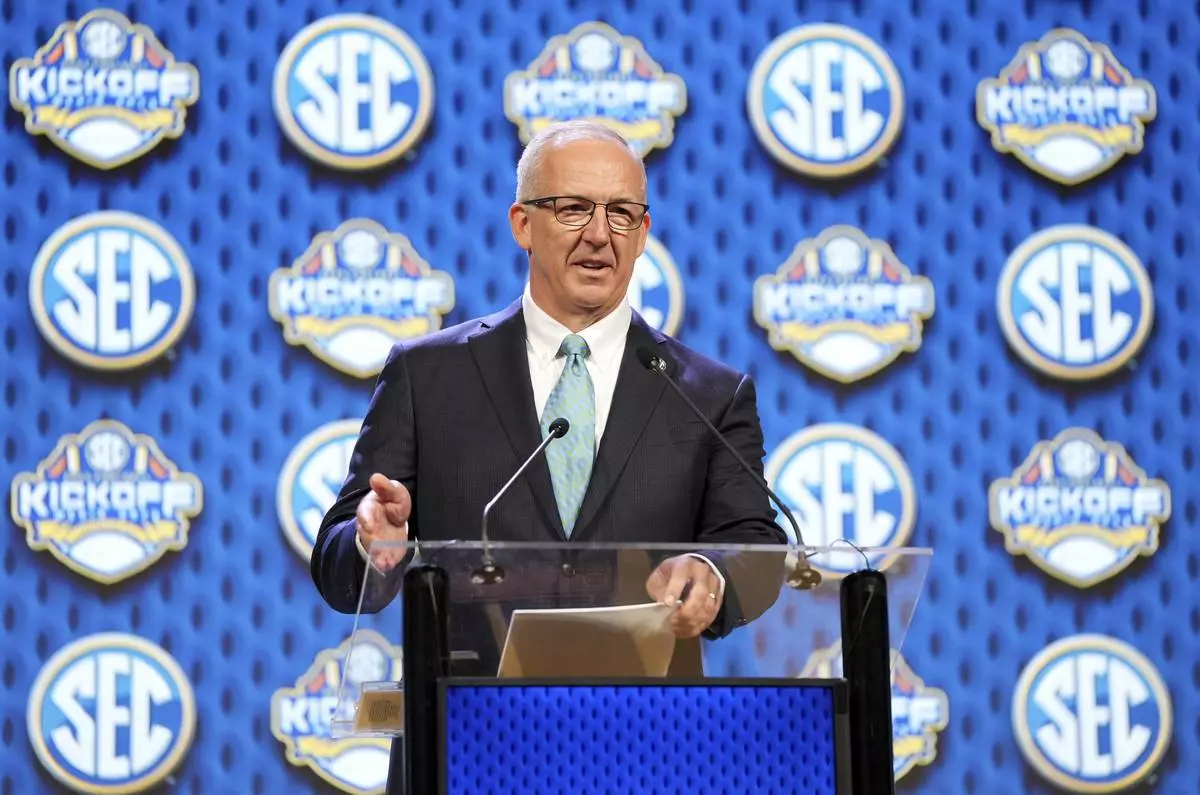
FILE - Southeastern Conference commissioner Greg Sankey speaks during SEC NCAA college football media days, July 15, 2024, in Dallas. (AP Photo/Jeffrey McWhorter, File)
Federal Reserve Chair Jerome Powellsaid Sunday the Department of Justice has served the central bank with subpoenas and threatened it with a criminal indictment over his testimony this summer about the Fed’s building renovations.
The move represents an unprecedented escalation in President Donald Trump’s battle with the Fed, an independent agency he's repeatedly attacked for not cutting its key interest rate as sharply as he prefers. The renewed fight will likely rattle financial markets Monday and could over time escalate borrowing costs for mortgages and other loans.
The subpoenas relate to Powell’s testimony before the Senate Banking Committee in June, the Fed chair said, regarding the Fed’s $2.5 billion renovation of two office buildings, a project Trump has criticized as excessive.
Here's the latest:
Stocks are falling on Wall Street after Federal Reserve Chair Jerome Powell said the Department of Justice had served the central bank with subpoenas and threatened it with a criminal indictment over his testimony about the Fed’s building renovations.
The S&P 500 fell 0.3% in early trading Monday. The Dow Jones Industrial Average lost 384 points, or 0.8%, and the Nasdaq composite fell 0.2%.
Powell characterized the threat of criminal charges as pretexts to undermine the Fed’s independence in setting interest rates, its main tool for fighting inflation. The threat is the latest escalation in President Trump’s feud with the Fed.
▶ Read more about the financial markets
She says she had “a very good conversation” with Trump on Monday morning about topics including “security with respect to our sovereignties.”
Last week, Sheinbaum had said she was seeking a conversation with Trump or U.S. Secretary of State Marco Rubio after the U.S. president made comments in an interview that he was ready to confront drug cartels on the ground and repeated the accusation that cartels were running Mexico.
Trump’s offers of using U.S. forces against Mexican cartels took on a new weight after the Trump administration deposed Venezuelan President Nicolás Maduro. Sheinbaum was expected to share more about their conversation later Monday.
A leader of the Canadian government is visiting China this week for the first time in nearly a decade, a bid to rebuild his country’s fractured relations with the world’s second-largest economy — and reduce Canada’s dependence on the United States, its neighbor and until recently one of its most supportive and unswerving allies.
The push by Prime Minster Mark Carney, who arrives Wednesday, is part of a major rethink as ties sour with the United States — the world’s No. 1 economy and long the largest trading partner for Canada by far.
Carney aims to double Canada’s non-U.S. exports in the next decade in the face of President Trump’s tariffs and the American leader’s musing that Canada could become “the 51st state.”
▶ Read more about relations between Canada and China
The comment by a Chinese Foreign Ministry spokesperson came in response to a question at a regular daily briefing. President Trump has said he would like to make a deal to acquire Greenland, a semiautonomous region of NATO ally Denmark, to prevent Russia or China from taking it over.
Tensions have grown between Washington, Denmark and Greenland this month as Trump and his administration push the issue and the White House considers a range of options, including military force, to acquire the vast Arctic island.
Danish Prime Minister Mette Frederiksen has warned that an American takeover of Greenland would mark the end of NATO.
▶ Read more about the U.S. and Greenland
Trump said Sunday that he is “inclined” to keep ExxonMobil out of Venezuela after its top executive was skeptical about oil investment efforts in the country after the toppling of former President Nicolás Maduro.
“I didn’t like Exxon’s response,” Trump said to reporters on Air Force One as he departed West Palm Beach, Florida. “They’re playing too cute.”
During a meeting Friday with oil executives, Trump tried to assuage the concerns of the companies and said they would be dealing directly with the U.S., rather than the Venezuelan government.
Some, however, weren’t convinced.
“If we look at the commercial constructs and frameworks in place today in Venezuela, today it’s uninvestable,” said Darren Woods, CEO of ExxonMobil, the largest U.S. oil company.
An ExxonMobil spokesperson did not immediately respond Sunday to a request for comment.
▶ Read more about Trump’s comments on ExxonMobil
Trump’s motorcade took a different route than usual to the airport as he was departing Florida on Sunday due to a “suspicious object,” according to the White House.
The object, which the White House did not describe, was discovered during security sweeps in advance of Trump’s arrival at Palm Beach International Airport.
“A further investigation was warranted and the presidential motorcade route was adjusted accordingly,” White House press secretary Karoline Leavitt said in a statement Sunday.
The president, when asked about the package by reporters, said, “I know nothing about it.”
Anthony Guglielmi, the spokesman for U.S. Secret Service, said the secondary route was taken just as a precaution and that “that is standard protocol.”
▶ Read more about the “suspicious object”
Trump said Iran wants to negotiate with Washington after his threat to strike the Islamic Republic over its bloody crackdown on protesters, a move coming as activists said Monday the death toll in the nationwide demonstrations rose to at least 544.
Iran had no direct reaction to Trump’s comments, which came after the foreign minister of Oman — long an interlocutor between Washington and Tehran — traveled to Iran this weekend. It also remains unclear just what Iran could promise, particularly as Trump has set strict demands over its nuclear program and its ballistic missile arsenal, which Tehran insists is crucial for its national defense.
Iranian Foreign Minister Abbas Araghchi, speaking to foreign diplomats in Tehran, insisted “the situation has come under total control” in fiery remarks that blamed Israel and the U.S. for the violence, without offering evidence.
▶ Read more about the possible negotiations and follow live updates
Fed Chair Powell said Sunday the DOJ has served the central bank with subpoenas and threatened it with a criminal indictment over his testimony this summer about the Fed’s building renovations.
The move represents an unprecedented escalation in Trump’s battle with the Fed, an independent agency he has repeatedly attacked for not cutting its key interest rate as sharply as he prefers. The renewed fight will likely rattle financial markets Monday and could over time escalate borrowing costs for mortgages and other loans.
The subpoenas relate to Powell’s testimony before the Senate Banking Committee in June, the Fed chair said, regarding the Fed’s $2.5 billion renovation of two office buildings, a project that Trump has criticized as excessive.
Powell on Sunday cast off what has up to this point been a restrained approach to Trump’s criticisms and personal insults, which he has mostly ignored. Instead, Powell issued a video statement in which he bluntly characterized the threat of criminal charges as simple “pretexts” to undermine the Fed’s independence when it comes to setting interest rates.
▶ Read more about the subpoenas
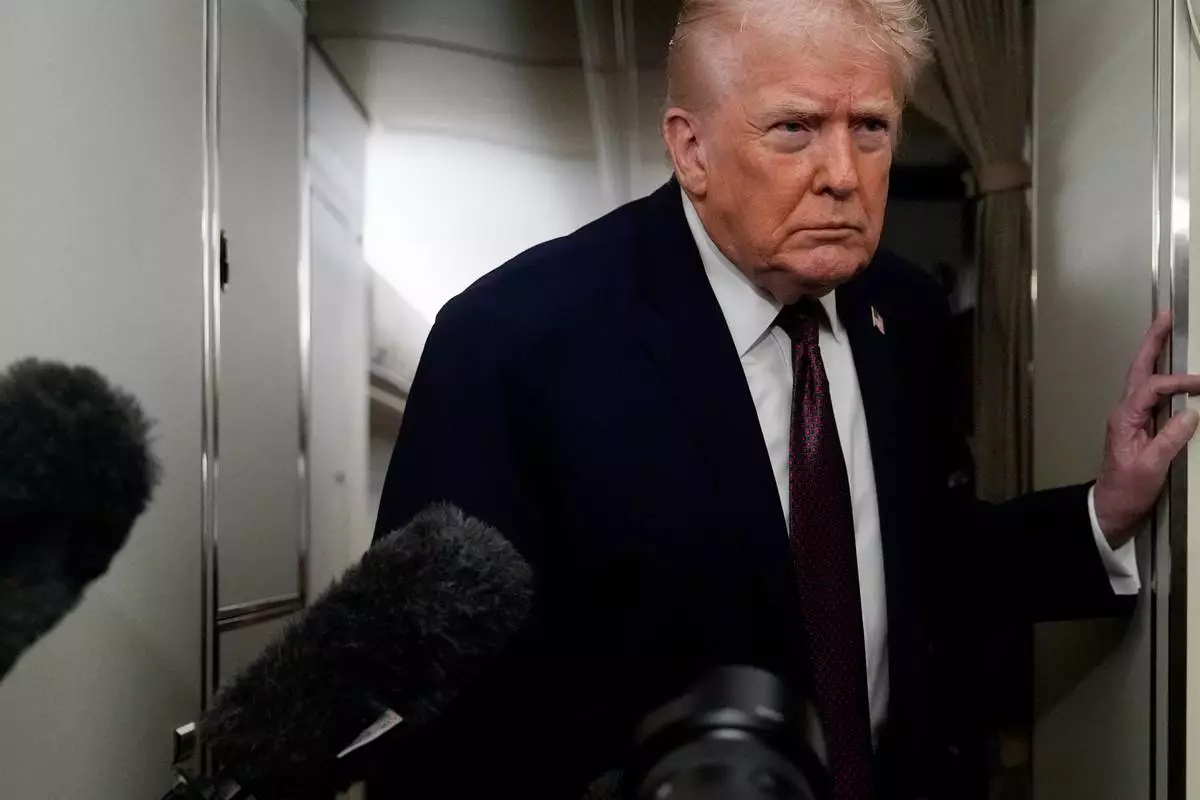
President Donald Trump speaks to reporters while in flight on Air Force One to Joint Base Andrews, Md., Sunday, Jan. 11, 2026. (AP Photo/Julia Demaree Nikhinson)
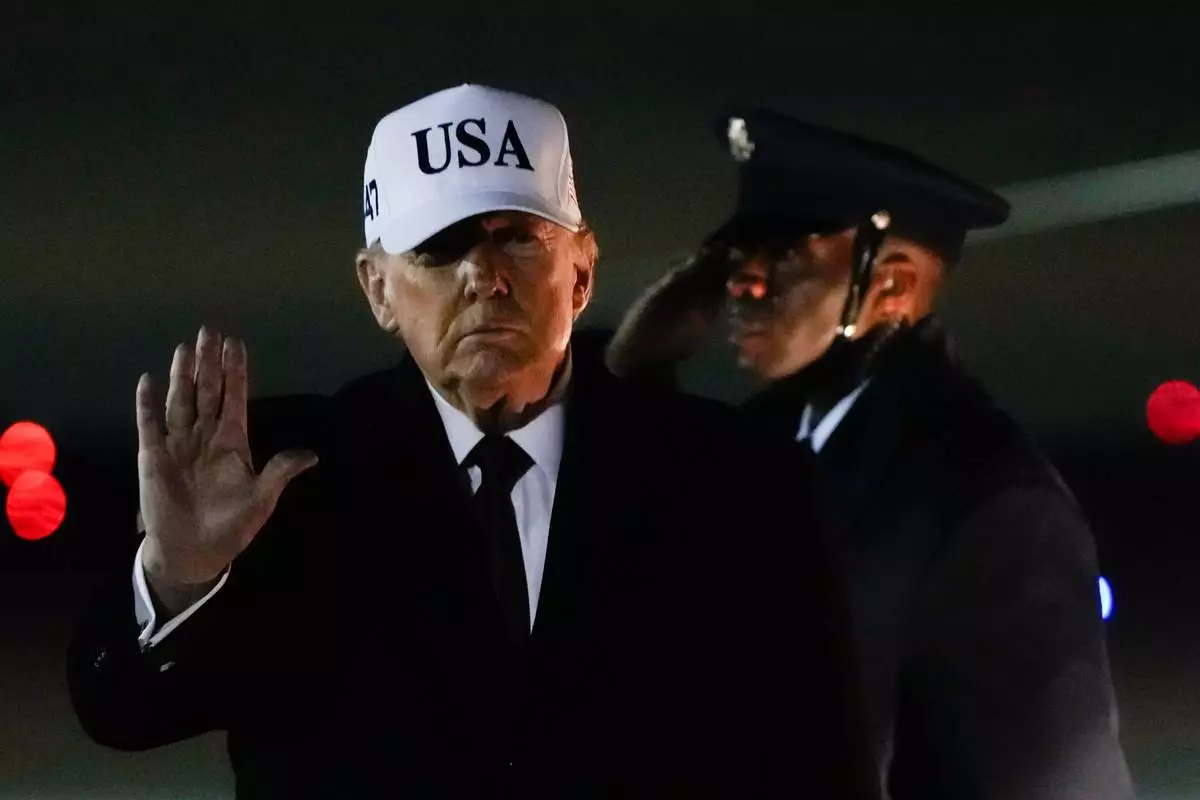
President Donald Trump waves after arriving on Air Force One from Florida, Sunday, Jan. 11, 2026, at Joint Base Andrews, Md. (AP Photo/Julia Demaree Nikhinson)