Skip to Content Facebook Feature Image

Michael Cera and Wes Anderson were destined to make a movie together

ENT

Michael Cera and Wes Anderson were destined to make a movie together
ENT

ENT

Michael Cera and Wes Anderson were destined to make a movie together

2025-05-29 00:15 Last Updated At:00:21

CANNES, France (AP) — When Michael Cera was announced as joining the cast of a Wes Anderson movie for the first time, the prevailing response was: Hadn’t he already been in a Wes Anderson movie?

So seemingly aligned in sensibility and style are Cera and Anderson that you could easily imagine a whole fake filmography. It is, for a slightly more corduroyed corner of the movie world, an actor-director pairing as destined as Scorsese and De Niro — even if “The Phoenician Scheme” is (checks notes one last time) their first movie together.

More Images
Director Wes Anderson poses for portrait photographs for the film 'The Phoenician Scheme' at the 78th international film festival, Cannes, southern France, Saturday, May 17, 2025. (Photo by Scott A Garfitt/Invision/AP)

Director Wes Anderson poses for portrait photographs for the film 'The Phoenician Scheme' at the 78th international film festival, Cannes, southern France, Saturday, May 17, 2025. (Photo by Scott A Garfitt/Invision/AP)

Michael Cera, from the film 'The Phoenician Scheme' poses during the 78th international film festival, Cannes, southern France on Sunday, May 18, 2025. (Photo by Scott A Garfitt/Invision/AP)

Michael Cera, from the film 'The Phoenician Scheme' poses during the 78th international film festival, Cannes, southern France on Sunday, May 18, 2025. (Photo by Scott A Garfitt/Invision/AP)

Michael Cera poses for photographers at the photo call for the film 'The Phoenician Scheme' at the 78th international film festival, Cannes, southern France, Monday, May 19, 2025. (Photo by Scott A Garfitt/Invision/AP)
Michael Cera poses for photographers at the photo call for the film 'The Phoenician Scheme' at the 78th international film festival, Cannes, southern France, Monday, May 19, 2025. (Photo by Scott A Garfitt/Invision/AP)

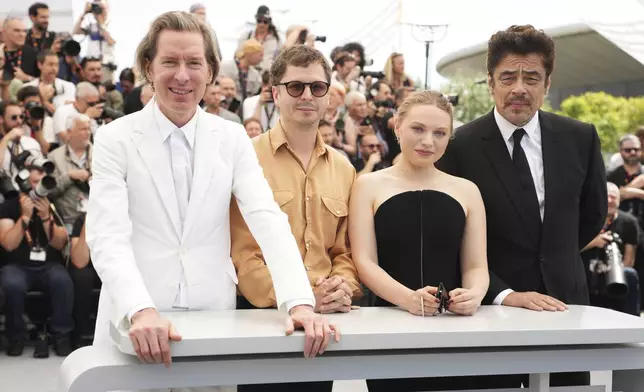
Director Wes Anderson, from left, Michael Cera, Mia Threapleton and Benicio del Toro pose for photographers at the photo call for the film 'The Phoenician Scheme' at the 78th international film festival, Cannes, southern France, Monday, May 19, 2025. (Photo by Scott A Garfitt/Invision/AP)

Director Wes Anderson, from left, Michael Cera, Mia Threapleton and Benicio del Toro pose for photographers at the photo call for the film 'The Phoenician Scheme' at the 78th international film festival, Cannes, southern France, Monday, May 19, 2025. (Photo by Scott A Garfitt/Invision/AP)

Michael Cera, from the film 'The Phoenician Scheme' poses during the 78th international film festival, Cannes, southern France on Sunday, May 18, 2025. (Photo by Scott A Garfitt/Invision/AP)

Michael Cera, from the film 'The Phoenician Scheme' poses during the 78th international film festival, Cannes, southern France on Sunday, May 18, 2025. (Photo by Scott A Garfitt/Invision/AP)

“I would remember,” Cera deadpans. “I would never have passed up the opportunity.”

“The Phoenician Scheme,” which Focus Features releases Friday in theaters, stars Benicio del Toro as the international tycoon Zsa-zsa Korda, who after a lifetime of swindling and exploiting has decided to make his daughter, a novitiate named Liesl (Mia Threapleton), the heir to his estate.

Cera plays Liesl’s Norwegian tutor Bjørn Lund. And because of the strong leading performances, you couldn’t quite say Cera steals the show, he’s certainly one of the very best things about “The Phoenician Scheme" — and that's something for a movie that includes Tom Hanks and Bryan Cranston playing a game of HORSE. Bjørn is an entomologist, which means Cera spends a sizable portion of the movie in a bow tie with an insect gently poised on his finger.

“He is sort of a bug, himself,” Cera, speaking in an interview at the Cannes Film Festival shortly before the premiere of “The Phoenician Scheme,” says with a wry smile. “And he sheds his skin and becomes his truth self.”

If Cera’s role in “The Phoenician Scheme” feels like a long time coming, it is. He and Anderson first met more than 15 years ago. Cera, 36, was then coming off his early breakthroughs in “Arrested Development,” “Superbad” and “Juno.” A comic wunderkind from Ontario who stood out even among the “Arrested Development” cast as a teenager, Cera had caught Anderson’s attention.

“It was something arranged by an agent in New York and we went to a kind of cocktail party,” Anderson recalls by phone. “We were with Harvey Keitel, too. So it was me and Harvey and Michael Cera — a totally unexpected combination. But I loved him. For years I’ve kind of felt like: Why haven’t we already done something together?”

For Cera, the meeting was even more memorable.

“I remember being very excited to meet him," Cera says. "I remember him being very disarming. Obviously, he was like a luminary inspiration. He has had a huge impact on my general sense of taste. I discovered his movies when I was a teenager and watched them over and over.”

They nearly did come together on a movie before “The Phoenician Scheme.” Anderson had a small role for Cera in “Asteroid City,” but when its production schedule got pushed, Cera had to drop out because of the coming due date for his first son with his wife Nadine.

“I was kind of worried that I blew it," says Cera, “that I missed the chance to sneak in.”

But even though Anderson and Cera didn’t work together until “The Phoenician Scheme,” they developed a relationship. Cera, who aspires to write and direct his own films, would send Anderson scripts for feedback. “We became friends,” says Cera.

“In the case of this movie, it was everything short of written for him,” Anderson says. “As soon as we had the idea of the character, he was the guy who (cowriter Roman Coppola) and I started talking about. I think we talked to him about it before there was a script or anything.”

“It seemed like it had already happened,” adds Anderson. “And it was a very good fit, a natural thing.”

Cera quickly adapted to Anderson’s unique style of moviemaking, in which the cast collectively stay at a hotel, begin the morning in makeup together and remain on set without trailers to retreat to. “At first, you’re kind of exhausted,” says Cera. “At the end of the first day, you go: OK, I need to eat a bigger breakfast.” As the production went along, Cera often sat right next to Anderson to watch him work.

One very notable characteristic of Bjørn is a Norwegian accent. If there’s anything more fitting than Michael Cera being a Wes Anderson movie, it might be Michael Cera doing a Norwegian accent in a Wes Anderson movie. It’s also a bit that, in “The Phoenician Scheme,” has a touch of spoiler to it. Cera calls it “sort of a jaunty, playful representation of an accent, not purporting to be a home run.”

“When I brought up the accent to Wes, I said, ‘How should we go about this accent?’” Cera say. “He was kind of caught of guard. I think he hears the movie in his head and maybe hadn’t figured that in. It was something Wes had to compute.”

As Anderson describes it, Cera was determined. “I, at a certain point, was a little reluctant, like, I don’t know if we need it,” says Anderson. “He was like: ‘No, let me show you what I’m going to do.’”

A determination in absurdism has long marked Cera's best performances. Though a private person who has resisted all urges to get a smartphone, Cera is remarkably fearless when it comes to the most awkward moments. It’s a seriousness of purpose that, whether singing “These Eyes” in “Superbad” or waving hello as Allen in “Barbie,” that's made Cera a favorite of successive generations. Even in a billion-dollar blockbuster, Cera can be unassumingly hilarious.

“I feel like most people don’t know I’m in that movie. I mean, not a in a bad way. It was great for my personal disposition to get to be part of it,” Cera says. “I can say I’m in it, but I can walk around. I’m nowhere near the center of the movie. I’m not on the poster, put it that way. (Laughs) My nephew went and saw the movie with my sister. Afterwards he was like, ‘I thought Uncle Michael was going to be in this movie.’ It was a nice lane for me.”

Just before the premiere of “The Phoenician Scheme” in Cannes, it was announced that Cera, after writing a handful of scripts including an adaptation of Charles Portis’ “Masters of Atlantis,” will make his directorial debut with “Love Is Not the Answer,” a film he wrote that has a cast including Pamela Anderson and Steve Coogan.

“You have a little more control over your destiny if you try to create something, even though it’s hard to get it off the ground,” Cera says. “But it’s better than sitting around. You’re like a hired contractor as an actor, and it’s a great thing about it. But I think a lot of actors end up becoming frustrated directors because of how many opinions you have about the proceedings.”

It may have taken many years for Cera and Anderson to finally team up, but it could have come at the right time, just as Cera is — ahem — shedding a skin. In any case, theirs remains an ongoing collaboration. Anderson tapped Cera for an ad they recently shot for Mont Blanc. Does that mean he's officially part of the troupe?

“That’s up to him," says Cera. “I would never say no.”

Director Wes Anderson poses for portrait photographs for the film 'The Phoenician Scheme' at the 78th international film festival, Cannes, southern France, Saturday, May 17, 2025. (Photo by Scott A Garfitt/Invision/AP)

Director Wes Anderson poses for portrait photographs for the film 'The Phoenician Scheme' at the 78th international film festival, Cannes, southern France, Saturday, May 17, 2025. (Photo by Scott A Garfitt/Invision/AP)

Michael Cera, from the film 'The Phoenician Scheme' poses during the 78th international film festival, Cannes, southern France on Sunday, May 18, 2025. (Photo by Scott A Garfitt/Invision/AP)

Michael Cera, from the film 'The Phoenician Scheme' poses during the 78th international film festival, Cannes, southern France on Sunday, May 18, 2025. (Photo by Scott A Garfitt/Invision/AP)

Michael Cera poses for photographers at the photo call for the film 'The Phoenician Scheme' at the 78th international film festival, Cannes, southern France, Monday, May 19, 2025. (Photo by Scott A Garfitt/Invision/AP)

Michael Cera poses for photographers at the photo call for the film 'The Phoenician Scheme' at the 78th international film festival, Cannes, southern France, Monday, May 19, 2025. (Photo by Scott A Garfitt/Invision/AP)

Director Wes Anderson, from left, Michael Cera, Mia Threapleton and Benicio del Toro pose for photographers at the photo call for the film 'The Phoenician Scheme' at the 78th international film festival, Cannes, southern France, Monday, May 19, 2025. (Photo by Scott A Garfitt/Invision/AP)

Director Wes Anderson, from left, Michael Cera, Mia Threapleton and Benicio del Toro pose for photographers at the photo call for the film 'The Phoenician Scheme' at the 78th international film festival, Cannes, southern France, Monday, May 19, 2025. (Photo by Scott A Garfitt/Invision/AP)

Michael Cera, from the film 'The Phoenician Scheme' poses during the 78th international film festival, Cannes, southern France on Sunday, May 18, 2025. (Photo by Scott A Garfitt/Invision/AP)

Michael Cera, from the film 'The Phoenician Scheme' poses during the 78th international film festival, Cannes, southern France on Sunday, May 18, 2025. (Photo by Scott A Garfitt/Invision/AP)

NEW YORK (AP) — Reviving a campaign pledge, President Donald Trump wants a one-year, 10% cap on credit card interest rates, a move that could save Americans tens of billions of dollars but drew immediate opposition from an industry that has been in his corner.

Trump was not clear in his social media post Friday night whether a cap might take effect through executive action or legislation, though one Republican senator said he had spoken with the president and would work on a bill with his “full support.” Trump said he hoped it would be in place Jan. 20, one year after he took office.

Strong opposition is certain from Wall Street in addition to the credit card companies, which donated heavily to his 2024 campaign and have supported Trump's second-term agenda. Banks are making the argument that such a plan would most hurt poor people, at a time of economic concern, by curtailing or eliminating credit lines, driving them to high-cost alternatives like payday loans or pawnshops.

“We will no longer let the American Public be ripped off by Credit Card Companies that are charging Interest Rates of 20 to 30%,” Trump wrote on his Truth Social platform.

Researchers who studied Trump’s campaign pledge after it was first announced found that Americans would save roughly $100 billion in interest a year if credit card rates were capped at 10%. The same researchers found that while the credit card industry would take a major hit, it would still be profitable, although credit card rewards and other perks might be scaled back.

About 195 million people in the United States had credit cards in 2024 and were assessed $160 billion in interest charges, the Consumer Financial Protection Bureau says. Americans are now carrying more credit card debt than ever, to the tune of about $1.23 trillion, according to figures from the New York Federal Reserve for the third quarter last year.

Further, Americans are paying, on average, between 19.65% and 21.5% in interest on credit cards according to the Federal Reserve and other industry tracking sources. That has come down in the past year as the central bank lowered benchmark rates, but is near the highs since federal regulators started tracking credit card rates in the mid-1990s. That’s significantly higher than a decade ago, when the average credit card interest rate was roughly 12%.

The Republican administration has proved particularly friendly until now to the credit card industry.

Capital One got little resistance from the White House when it finalized its purchase and merger with Discover Financial in early 2025, a deal that created the nation’s largest credit card company. The Consumer Financial Protection Bureau, which is largely tasked with going after credit card companies for alleged wrongdoing, has been largely nonfunctional since Trump took office.

In a joint statement, the banking industry was opposed to Trump's proposal.

“If enacted, this cap would only drive consumers toward less regulated, more costly alternatives," the American Bankers Association and allied groups said.

Bank lobbyists have long argued that lowering interest rates on their credit card products would require the banks to lend less to high-risk borrowers. When Congress enacted a cap on the fee that stores pay large banks when customers use a debit card, banks responded by removing all rewards and perks from those cards. Debit card rewards only recently have trickled back into consumers' hands. For example, United Airlines now has a debit card that gives miles with purchases.

The U.S. already places interest rate caps on some financial products and for some demographics. The Military Lending Act makes it illegal to charge active-duty service members more than 36% for any financial product. The national regulator for credit unions has capped interest rates on credit union credit cards at 18%.

Credit card companies earn three streams of revenue from their products: fees charged to merchants, fees charged to customers and the interest charged on balances. The argument from some researchers and left-leaning policymakers is that the banks earn enough revenue from merchants to keep them profitable if interest rates were capped.

"A 10% credit card interest cap would save Americans $100 billion a year without causing massive account closures, as banks claim. That’s because the few large banks that dominate the credit card market are making absolutely massive profits on customers at all income levels," said Brian Shearer, director of competition and regulatory policy at the Vanderbilt Policy Accelerator, who wrote the research on the industry's impact of Trump's proposal last year.

There are some historic examples that interest rate caps do cut off the less creditworthy to financial products because banks are not able to price risk correctly. Arkansas has a strictly enforced interest rate cap of 17% and evidence points to the poor and less creditworthy being cut out of consumer credit markets in the state. Shearer's research showed that an interest rate cap of 10% would likely result in banks lending less to those with credit scores below 600.

The White House did not respond to questions about how the president seeks to cap the rate or whether he has spoken with credit card companies about the idea.

Sen. Roger Marshall, R-Kan., who said he talked with Trump on Friday night, said the effort is meant to “lower costs for American families and to reign in greedy credit card companies who have been ripping off hardworking Americans for too long."

Legislation in both the House and the Senate would do what Trump is seeking.

Sens. Bernie Sanders, I-Vt., and Josh Hawley, R-Mo., released a plan in February that would immediately cap interest rates at 10% for five years, hoping to use Trump’s campaign promise to build momentum for their measure.

Hours before Trump's post, Sanders said that the president, rather than working to cap interest rates, had taken steps to deregulate big banks that allowed them to charge much higher credit card fees.

Reps. Alexandria Ocasio-Cortez, D-N.Y., and Anna Paulina Luna, R-Fla., have proposed similar legislation. Ocasio-Cortez is a frequent political target of Trump, while Luna is a close ally of the president.

Seung Min Kim reported from West Palm Beach, Fla.

President Donald Trump arrives on Air Force One at Palm Beach International Airport, Friday, Jan. 9, 2025, in West Palm Beach, Fla. (AP Photo/Julia Demaree Nikhinson)

President Donald Trump arrives on Air Force One at Palm Beach International Airport, Friday, Jan. 9, 2025, in West Palm Beach, Fla. (AP Photo/Julia Demaree Nikhinson)

FILE - Visa and Mastercard credit cards are shown in Buffalo Grove, Ill., Feb. 8, 2024. (AP Photo/Nam Y. Huh, File)

FILE - Visa and Mastercard credit cards are shown in Buffalo Grove, Ill., Feb. 8, 2024. (AP Photo/Nam Y. Huh, File)

Recommended Articles