ROYAL PALM BEACH, Fla. (AP) — Legislation signed into law Wednesday by Florida Gov. Ron DeSantis will impose tougher penalties on people who abandon pets during natural disasters, a measure inspired by the rescue of a dog left in floodwaters during Hurricane Milton.
With the 2025 hurricane season starting next week, the governor also signed a bill that enhances criminal penalties for severe cruelty to dogs and other pets.
The bull terrier found during Hurricane Milton was left chained to a fence along Interstate 75 near Tampa. A state trooper rescued the dog — now named Trooper — and he was adopted by a couple in Broward County, DeSantis said during an event at Big Dog Ranch Rescue outside Royal Palm Beach.
The owner of that dog was charged with animal cruelty. Under the new law taking effect Oct. 1, violations taking place during hurricanes or other disasters will be punishable by up to five years in prison and a $10,000 fine.
“Florida will not tolerate cruelty toward animals, especially in times of crisis," said the governor, who signed the bills while cradling a puppy.
The second measure was inspired by a St. Petersburg-area case involving a dog named Dexter that was found decapitated at a park. This bill taking effect July 1 allows for a range of enhanced penalties in cases of severe animal abuse.

FILE - Florida Gov. Ron DeSantis holds a news conference at a fuel depot in Plant City, Fla., Oct. 12, 2024, accompanied by Florida Attorney General Ashley Moody, right. (AP Photo/Chris O'Meara, file)

FILE - This undated photo provided by Florida Department of Highway Safety and Motor Vehicles shows a dog nicknamed Trooper, who was found abandoned along Interstate 75 in Tampa, Fla., as residents evacuated Florida's Gulf Coast last week shortly before Hurricane Milton made landfall. (Florida Department of Highway Safety and Motor Vehicles via AP)
NEW YORK (AP) — U.S. flu infections showed signs of a slight decline last week, but health officials say it is not clear that this severe flu season has peaked.
New government data posted Friday — for flu activity through last week — showed declines in medical office visits due to flu-like illness and in the number of states reporting high flu activity.
However, some measures show this season is already surpassing the flu epidemic of last winter, one of the harshest in recent history. And experts believe there is more suffering ahead.
“This is going to be a long, hard flu season,” New York State Health Commissioner Dr. James McDonald said, in a statement Friday.
One type of flu virus, called A H3N2, historically has caused the most hospitalizations and deaths in older people. So far this season, that is the type most frequently reported. Even more concerning, more than 91% of the H3N2 infections analyzed were a new version — known as the subclade K variant — that differs from the strain in this year’s flu shots.
The last flu season saw the highest overall flu hospitalization rate since the H1N1 flu pandemic 15 years ago. And child flu deaths reached 289, the worst recorded for any U.S. flu season this century — including that H1N1 “swine flu” pandemic of 2009-2010.
So far this season, there have been at least 15 million flu illnesses and 180,000 hospitalizations, the U.S. Centers for Disease Control and Prevention estimates. It also estimates there have been 7,400 deaths, including the deaths of at least 17 children.
Last week, 44 states reported high flu activity, down slightly from the week before. However, flu deaths and hospitalizations rose.
Determining exactly how flu season is going can be particularly tricky around the holidays. Schools are closed, and many people are traveling. Some people may be less likely to see a doctor, deciding to just suffer at home. Others may be more likely to go.
Also, some seasons see a surge in cases, then a decline, and then a second surge.
For years, federal health officials joined doctors' groups in recommending that everyone 6 months and older get an annual influenza vaccine. The shots may not prevent all symptoms but can prevent many infections from becoming severe, experts say.
But federal health officials on Monday announced they will no longer recommend flu vaccinations for U.S. children, saying it is a decision parents and patients should make in consultation with their doctors.
“I can’t begin to express how concerned we are about the future health of the children in this country, who already have been unnecessarily dying from the flu — a vaccine preventable disease,” said Michele Slafkosky, executive director of an advocacy organization called Families Fighting Flu.
“Now, with added confusion for parents and health care providers about childhood vaccines, I fear that flu seasons to come could be even more deadly for our youngest and most vulnerable," she said in a statement.
Flu is just one of a group of viruses that tend to strike more often in the winter. Hospitalizations from COVID-19 and RSV, or respiratory syncytial virus, also have been rising in recent weeks — though were not diagnosed nearly as often as flu infections, according to other federal data.
The Associated Press Health and Science Department receives support from the Howard Hughes Medical Institute’s Department of Science Education and the Robert Wood Johnson Foundation. The AP is solely responsible for all content.
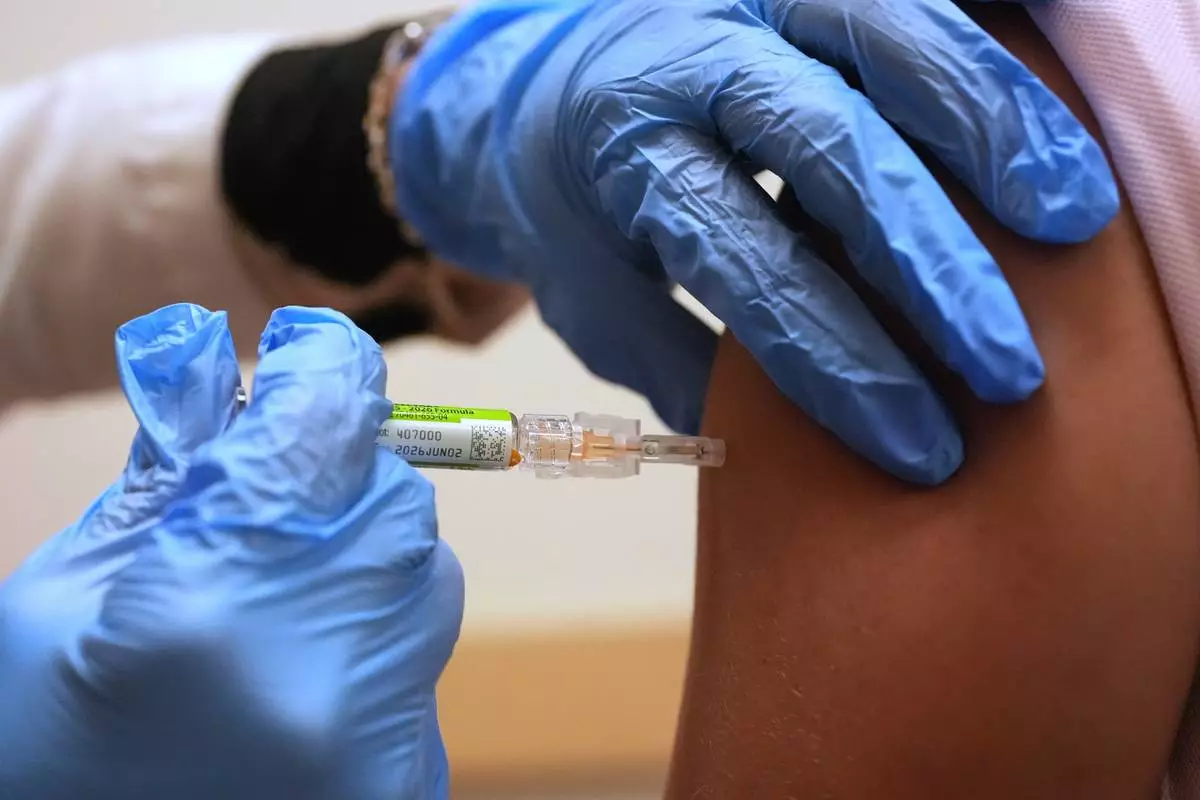
FILE - Pharmacy manager Aylen Amestoy administers a patient with a seasonal flu vaccine at a CVS Pharmacy in Miami, Tuesday, Sept. 9, 2025. (AP Photo/Rebecca Blackwell, File)