WASHINGTON (AP) — President Donald Trump has audaciously claimed virtually unlimited power to bypass Congress and impose sweeping taxes on foreign products.
Now a federal court has thrown a roadblock in his path.
A three-judge panel of the U.S. Court of International Trade ruled Wednesday that Trump overstepped his authority when he invoked the 1977 International Emergency Economic Powers Act to declare a national emergency and plaster taxes – tariffs – on imports from almost every country in the world.
The ruling was a big setback for Trump, whose erratic trade policies have rocked financial markets, paralyzed businesses with uncertainty and raised fears of higher prices and slower economic growth. On his Truth Social platform Thursday, he wrote: “The ruling by the U.S. Court of International Trade is so wrong, and so political! Hopefully, the Supreme Court will reverse this horrible, Country threatening decision, QUICKLY and DECISIVELY.”
Trump’s trade wars are far from over. The Court of Appeals for the Federal Circuit on Thursday allowed the president to temporarily continue collecting the tariffs under the emergency powers law while he appeals the trade court's decision.
Jeffrey Schwab, senior counsel at the nonprofit Liberty Justice Center who represented the five small businesses that sued, called the appeals court order a mere "procedural step.'' He expressed confidence that courts would block the tariffs, which represent “a direct threat'' to his clients' livelihoods.
The administration has other ways to pursue the president's goal of using tariffs to lure factories back to America, raise money for the U.S. Treasury and pressure other countries into bending to his will.
Financial markets, which would welcome an end to Trump’s tariffs, had a muted response to the news Thursday; stocks rose modestly.
“Investors are not getting too carried away, presumably in the expectation that the White House will find a workaround that allows them to continue to pursue their trade agenda,’’ said Matthew Ryan, head of market strategy at the financial services firm Ebury.
Trump’s IEEPA tariffs are being challenged in at least seven lawsuits. In the ruling Wednesday, the trade court combined two of the cases — one brought by five small businesses and another by 12 U.S. states.
The U.S. Court of International Trade has jurisdiction over civil cases involving trade. The legal challenge to Trump's tariff is widely expected to end up at the U.S. Supreme Court.
The court’s decision blocks the tariffs Trump slapped last month on almost all U.S. trading partners and levies he imposed before that on China, Mexico and Canada.
Trump on April 2 — Liberation Day, he called it — imposed so-called reciprocal tariffs of up to 50% on countries with which the United States runs a trade deficit and 10% baseline tariffs on almost everybody else. He later suspended the reciprocal tariffs for 90 days to give countries time to negotiate trade agreements with the United States — and reduce their barriers to American exports. But he kept the baseline tariffs in place.
Claiming extraordinary power to act without congressional approval, he justified the taxes under IEEPA by declaring the United States' longstanding trade deficits “a national emergency.”
“The reason that he chose IEEPA was he thought he could do this unilaterally without much oversight by Congress,” Schwab said.
In February, he'd invoked the law to impose tariffs on Canada, Mexico and China, saying that the illegal flow of immigrants and drugs across the U.S. border amounted to a national emergency and that the three countries needed to do more to stop it.
The U.S. Constitution gives Congress the power to set taxes, including tariffs. But lawmakers have gradually let presidents assume more power over tariffs — and Trump has made the most of it.
The administration had argued that courts had approved then-President Richard Nixon’s emergency use of tariffs in the economic chaos that followed his decision to end a policy that linked the U.S. dollar to the price of gold. The Nixon administration successfully cited its authority under the 1917 Trading With Enemy Act, which preceded and supplied some of the legal language later used in IEEPA.
The court rejected the administration's argument this time, deciding that Trump’s sweeping tariffs exceeded his authority to regulate imports under IEEPA. It also said the tariffs did nothing to deal with problems they were supposed to address. In their case, the states noted that America's trade deficits hardly amount to a sudden emergency. The United States has racked them up for 49 straight years in good times and bad.
Another federal judge also blocked Trump’s use of an emergency powers law to impose tariffs on Thursday. The ruling from U.S. District Judge Rudolph Contreras came in a lawsuit from two Illinois-based educational toy companies. The ruling only blocks the collection of tariffs from the companies that sued, and was handed down the day after the trade court’s broader finding.
Wendy Cutler, a former U.S. trade official who is now vice president at the Asia Society Policy Institute, says Wednesday’s decision “throws the president’s trade policy into turmoil.”
Other countries may be reluctant to make concessions during Trump's 90-day pause if there's a chance the courts will uphold the decision striking down the IEEPA tariffs. "Can those negotiations move forward?'' said Antonio Rivera, a partner at ArentFox Schiff and a former Customs and Border Protection attorney.
Likewise, companies will have to reassess the way they run their supply chains, perhaps speeding up shipments to the United States to offset the risk that the tariffs will be reinstated on appeal.
Still, the ruling leaves in place other Trump tariffs, including those on foreign steel, aluminum and autos. Those levies were invoked under a different legal authority — Section 232 of the Trade Expansion Act of 1962 — that requires a Commerce Department investigation and cannot simply be imposed at the president’s own discretion.
Trump still has the authority to raise those Section 232 tariffs. He can also pursue new ones. The Commerce Department, for instance, last month launched a Section 232 investigation into the national security implications of pharmaceutical imports.
The court also left in place tariffs Trump imposed on China in his first term— and President Joe Biden kept — in a dispute over Beijing's use of hard-nose tactics to give Chinese companies an edge in advanced technology. The U.S. alleged that China unfairly subsidized its own firms, forced companies from the U.S. and other foreign countries to hand over trade secrets and even engaged in cybertheft. Trump has leeway to expand those tariffs if he wants to put more pressure on China.
The trade court also noted Wednesday that Trump retains more limited power to impose tariffs to address trade deficits under another statute, the Trade Act of 1974. But that law restricts tariffs to 15% and to just 150 days on countries with which the United States runs big trade deficits.
When the IEEPA tariffs were in place, America's average tariff rate was 15%, the highest in decades and up from 2.5% before Trump's tariff onslaught began this year. Without them, the U.S. tariff rate is still a hefty 6.5%, according to economists Stephen Brown and Jennifer McKeown of Capital Economics.
They say the U.S. economy would grow faster in the second half of 2025 — at a 2% annual rate, up from the 1.5% they'd been forecasting — without the weight of the IEEPA tariffs. Prices also wouldn't rise as fast.
Importers may get relief. Posting on X, formerly known as Twitter, on Thursday, lawyer Peter Harrell, a fellow at the Carnegie Endowment for International Peace, wrote that if the trade court’s decision “is upheld, importers should eventually be able to get a refund of (IEEPA) tariffs paid to date. But the government will probably seek to avoid paying refunds until appeals are exhausted.″
AP Economics Writer Christopher Rugaber contributed to this story.
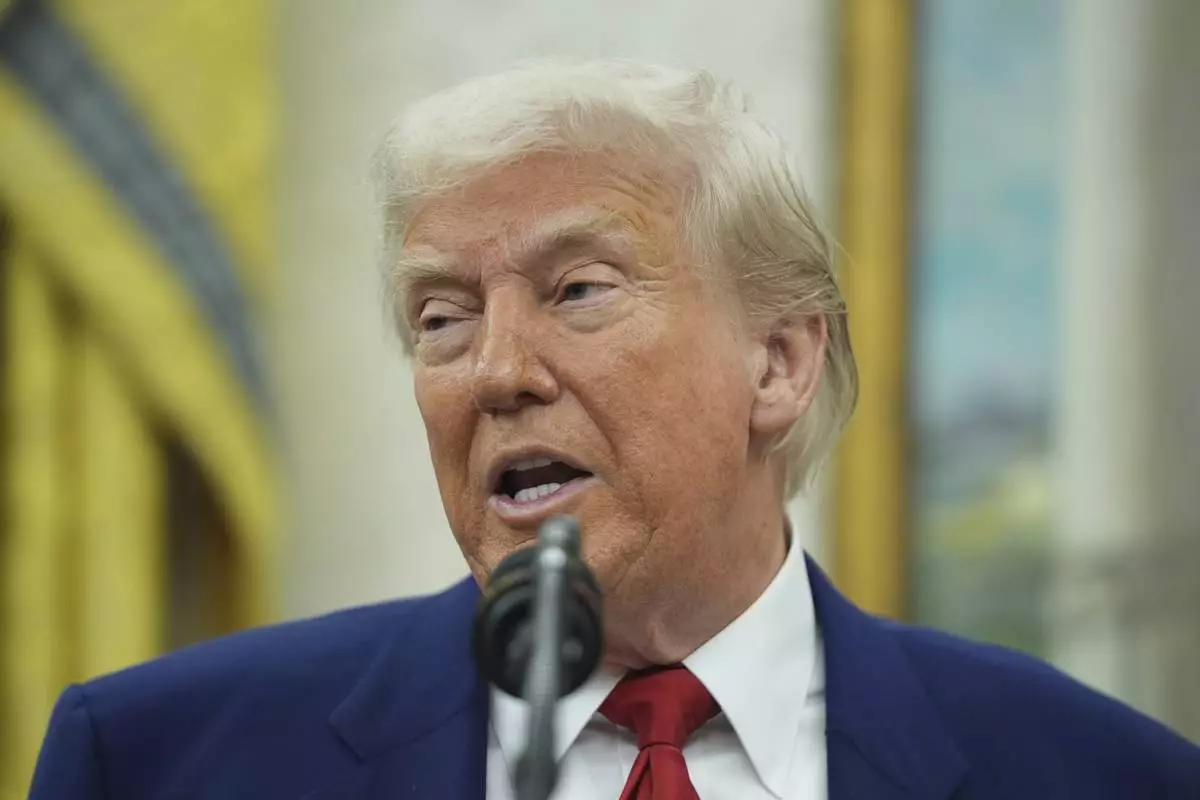
President Donald Trump speaks during a swearing in ceremony for interim U.S. Attorney General for the District of Columbia Jeanine Pirro, Wednesday, May 28, 2025, in Washington. (AP Photo/Evan Vucci)