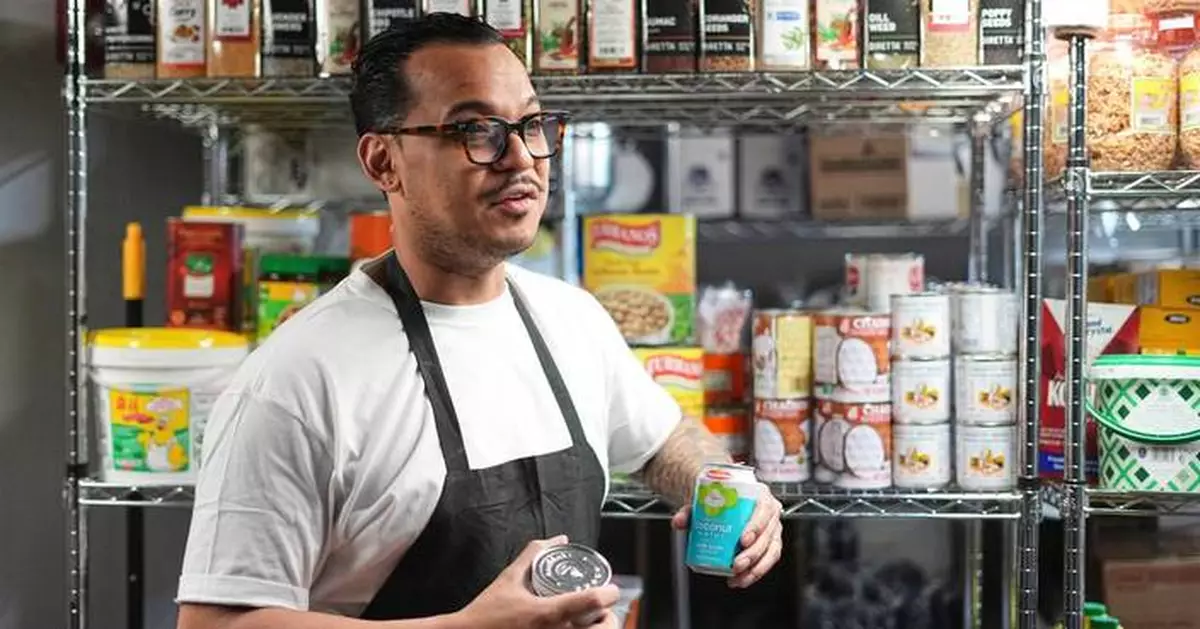
Chef Phila Lorn was not necessarily aiming for “quote-unquote authentic” Cambodian food when he opened Mawn in his native Philadelphia two years ago. So when he approached some Cambodian teen patrons, he braced himself for questioning.
“Someone’s going to say something like, ‘That’s not how my mom makes her oxtail soup,'” Lorn said. "So I walk up to the table. I’m like, ‘How is everything?’ And the kid looks up to me and he goes, ‘It doesn’t even matter, dude. So glad you’re here.’”
Click to Gallery
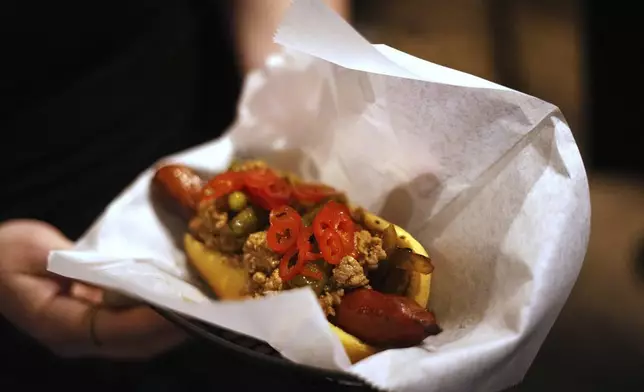
Shown is the The Cambodian Chili Dog at the Mawn restaurant in Philadelphia, Thursday, May 22, 2025. (AP Photo/Matt Rourke)
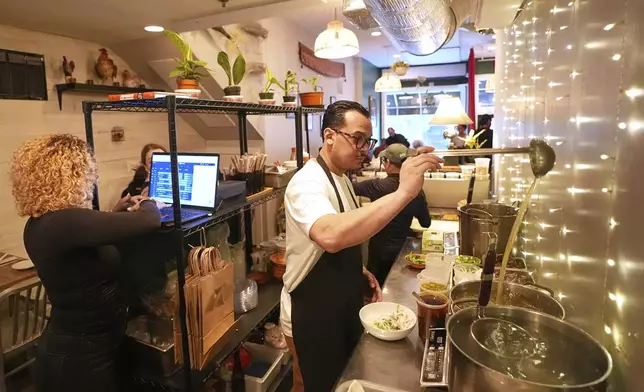
Chef Phila Lorn and Rachel Lorn work in their restaurant, Mawn, in Philadelphia, Thursday, May 22, 2025. (AP Photo/Matt Rourke)
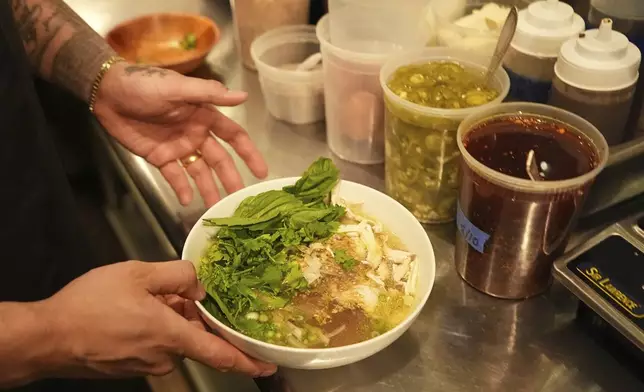
Chef Phila Lorn holds a bowl of the The Mawn Noodle soup at his restaurant, Mawn, in Philadelphia, Thursday, May 22, 2025. (AP Photo/Matt Rourke)
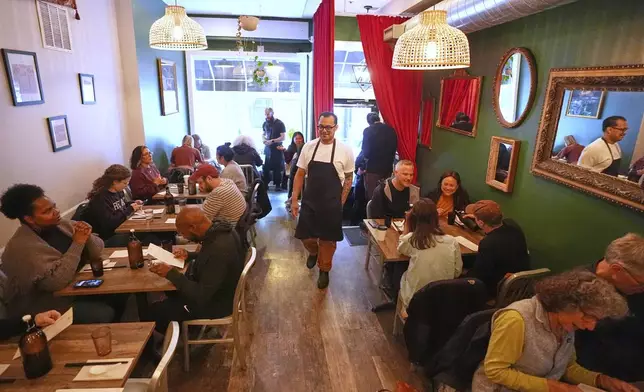
Chef Phila Lorn walks through his restaurant, Mawn, after opening for the day in Philadelphia, Thursday, May 22, 2025. (AP Photo/Matt Rourke)
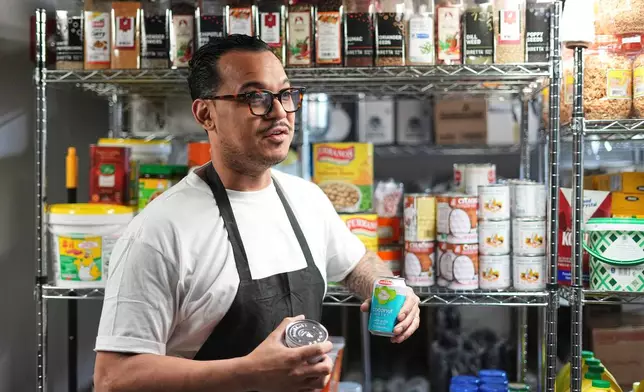
Chef Phila Lorn speaks during an interview at his restaurant, Mawn, in Philadelphia, Thursday, May 22, 2025. (AP Photo/Matt Rourke)
It was at that moment that Lorn realized Mawn — the phonetic spelling of the Khmer word for “chicken” — was more than a noodle shop. It meant representation.
In June, he will be representing his dual cultures — Cambodian and Philly — at his first James Beard Awards, as a nominee for Best Emerging Chef. In the food world, it's akin to getting nominated for the Academy Awards.
Cambodian restaurants may not be as commonplace in the U.S. as Chinese takeout or sushi spots. And Cambodian food is often lazily lumped in with the food of its Southeast Asian neighbors, despite its own distinctness. But in recent years, enterprising Cambodian American chefs have come into their own, introducing traditional dishes or putting their own twist on them.
Many of them were raised in families who fled the Khmer Rouge's reign of terror, which began 50 years ago and killed about 1.7 million people. Since then, the Cambodian community in the U.S. has grown and set down roots.
Through food, these chefs are putting the attention back on Cambodian heritage and culture, rather than that traumatic history.
Dr. Leakhena Nou, a sociology professor at California State University, Long Beach who has studied social anxiety among post-Khmer Rouge generations, says the Cambodian diaspora is often seen by others too narrowly through the lens of victimhood. In 2022, she publicly opposed California legislation that focused only on genocide for a K-12 curriculum on Cambodian culture.
“It’s a part of their history so they shouldn’t run away from it but at the same time they should force others to understand that that’s not the only part of their heritage, their historical identity,” she said.
Cambodian food has sometimes been hastily labeled as a mild mix of Thai and Vietnamese with some Chinese and Indian influence. But, it has its own native spices and flavors that have been used throughout Southeast Asia. Khmer food emphasizes seafood and meats, vegetables, noodles, rice and fermentation. Salty and sour are prevalent tastes, Nou says.
“It’s actually a very healthy diet for the most part in terms of fresh vegetables. Cambodians love to eat fresh vegetables dipped with some sauce," Nou said.
Signature dishes include amok, a fish curry; lok lak, stir-fried marinated beef; and samlar koko, a soup made using seasonal produce. Nou recalls her father making it with pork bone broth, fish, fresh coconut milk, lemongrass, vegetables and even wildflowers.
It was a half-century ago, on April 15, 1975, that the communist Khmer Rouge took over Cambodia. For the next four years, an estimated one-quarter of the population was wiped out due to starvation, execution and illness.
Refugees came in waves to the U.S. in the 1970s and 1980s. Most took on low-level entry jobs with few language barriers, Nou said. These included manufacturing, meatpacking and agricultural labor. Many worked in Chinese restaurants and doughnut shops.
The U.S. Cambodian population has jumped 50% in the last 20 years to an estimated 360,000 people, according to the Census 2023 American Community Survey.
Lorn’s family settled in Philadelphia in 1985. The only child born in the U.S., he was named after the city (but pronounced pee-LAH’). Like a lot of Asian American kids, Lorn was “the smelly kid” teased for not-American food in his lunch. But, he said, defending his lunchbox made him stronger. And he got the last laugh.
“It’s cool now to be 38 and have that same lunchbox (food) but on plates and we’re selling it for $50 a plate,” said Lorn, who opened Mawn with wife Rachel after they both had worked at other restaurants.
Indeed, besides popular noodle soups, Mawn has plates like the $60 steak and prohok, a 20-ounce ribeye with Cambodian chimichurri. Prohok is Cambodian fermented fish paste. Lorn’s version has lime juice, kulantro, Thai eggplants and roasted mudfish.
It sounds unappetizing, Lorn admits, “but everyone who takes a piece of rare steak, dips and eats it is just like, ‘OK, so let me know more about this food.'”
May, which is Asian American Pacific Islander Heritage Month and when Cambodia conducts a Day of Remembrance, is also when Long Beach has Cambodian Restaurant Week. The city is home to the largest concentration of Cambodians outside of Cambodia.
Chad Phuong, operator of Battambong BBQ pop-up, was a participant.
Phuong came to Long Beach as a child after fleeing the Khmer Rouge, which murdered his father. After high school, he worked at a Texas slaughterhouse and learned about cutting meats and barbecue. In 2020, he pivoted from working in the medical field to grilling.
Known as “Cambodian Cowboy," he has been profiled locally and nationally for brisket, ribs and other meats using a dry rub with Cambodian Kampot pepper, “one of the most expensive black peppers in the world." There's also sausage with fermented rice and sides like coconut corn.
The pitmaster recently started mentoring younger vendors. Contributing to the community feels like building a legacy.
“It just gives me a lot of courage to present my food,” Phuong said. “We don’t need to talk about the past or the trauma. Yes, it happened, but we’re moving on. We want something better.”
More Cambodian-run establishments have flourished. In 2023, Lowell, Massachusetts, mayor Sokhary Chau, the country’s first Cambodian American mayor, awarded a citation to Red Rose restaurant for being a Beard semifinalist. This year, Koffeteria bakery in Houston, Sophon restaurant in Seattle and chef Nite Yun of San Francisco’s Lunette Cambodia earned semifinalist nods.
Lorn, an admirer of San Francisco's Yun, says he still feels imposter syndrome.
“I feel like I’m more Ray Liotta than Nite Yun,” said Lorn. “Whether we win or not, to me, honestly, I won already."
Meanwhile, he is preparing to open a Southeast Asian oyster bar called Sao. It's not intended to be Cambodian, just a reflection of him.
“I don't want to be pigeonholed," Lorn said. “And it’s not me turning from my people. It's just me keeping it real for my people.”
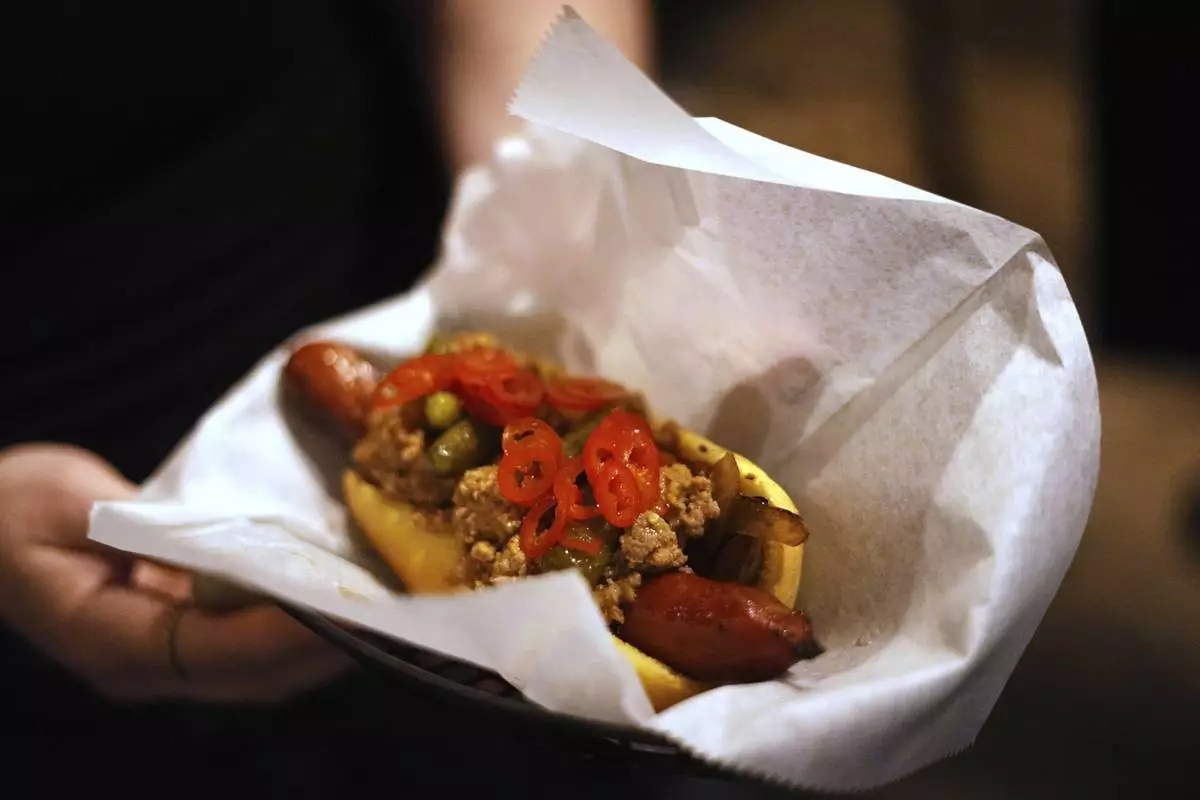
Shown is the The Cambodian Chili Dog at the Mawn restaurant in Philadelphia, Thursday, May 22, 2025. (AP Photo/Matt Rourke)
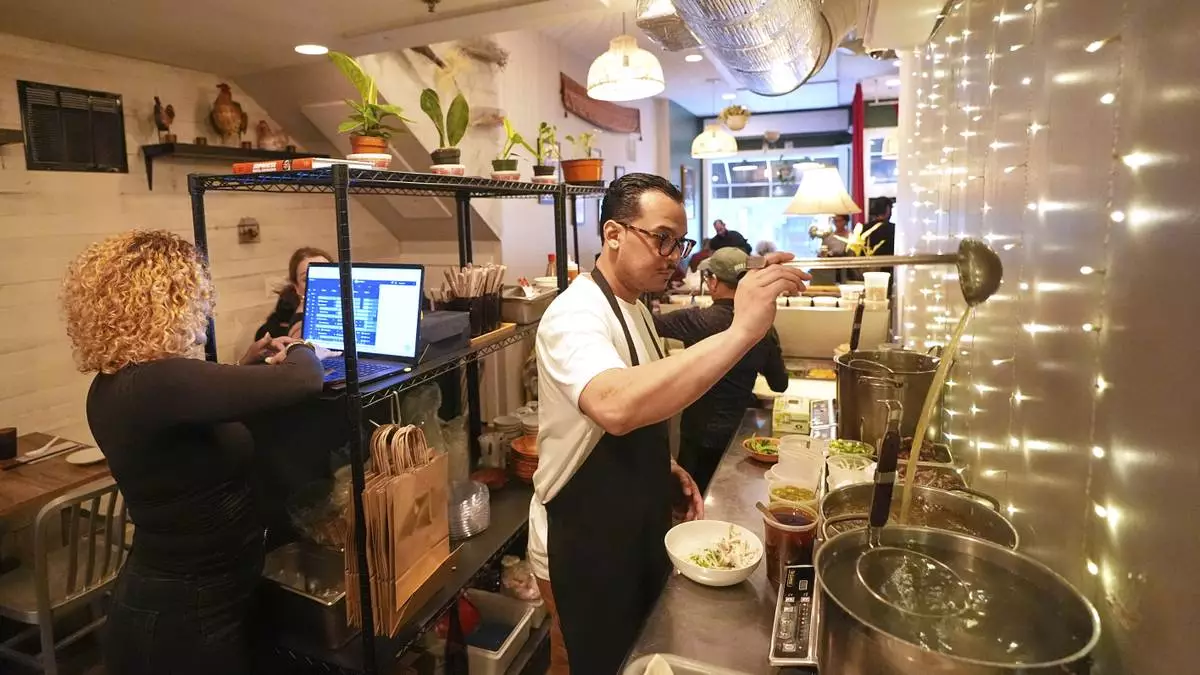
Chef Phila Lorn and Rachel Lorn work in their restaurant, Mawn, in Philadelphia, Thursday, May 22, 2025. (AP Photo/Matt Rourke)
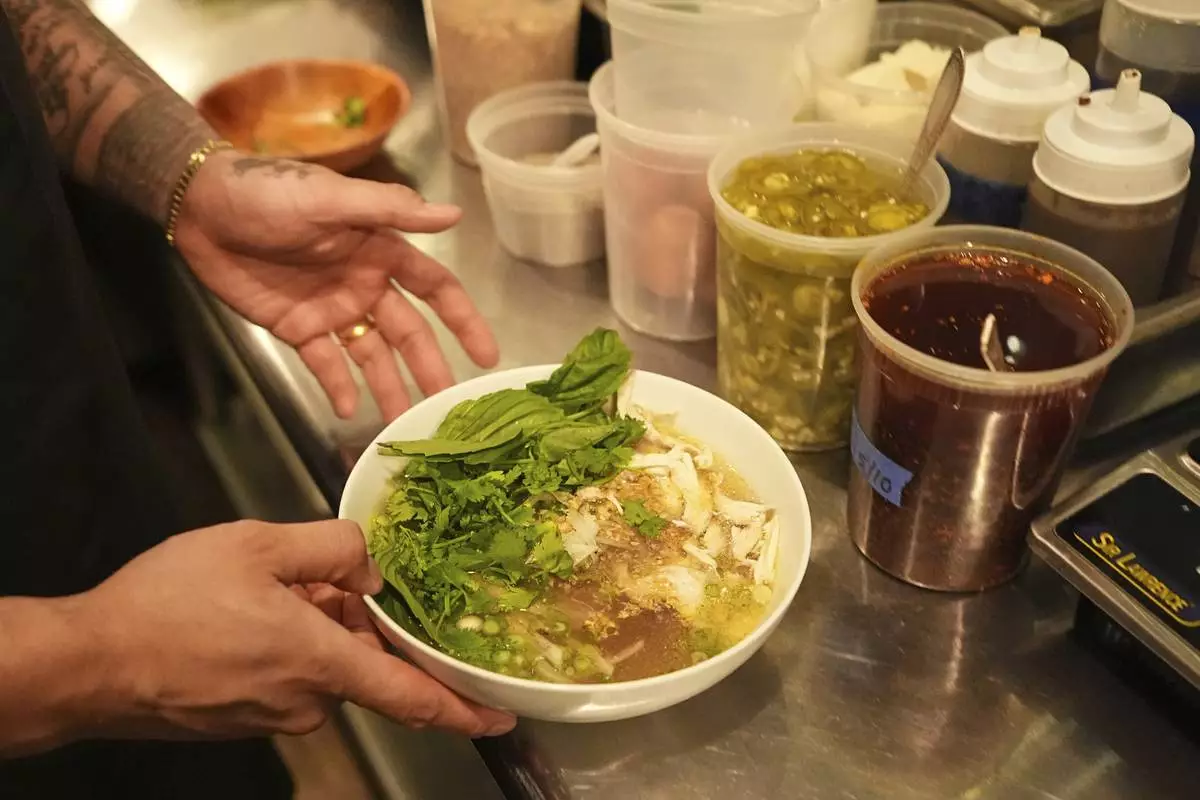
Chef Phila Lorn holds a bowl of the The Mawn Noodle soup at his restaurant, Mawn, in Philadelphia, Thursday, May 22, 2025. (AP Photo/Matt Rourke)
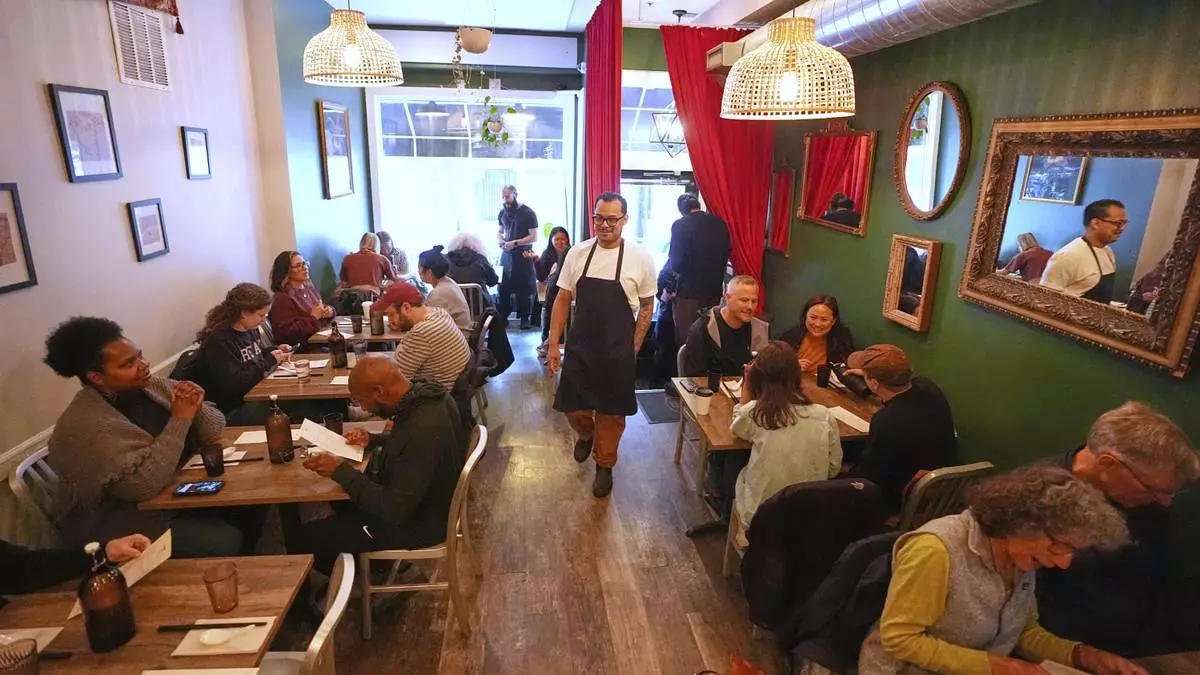
Chef Phila Lorn walks through his restaurant, Mawn, after opening for the day in Philadelphia, Thursday, May 22, 2025. (AP Photo/Matt Rourke)
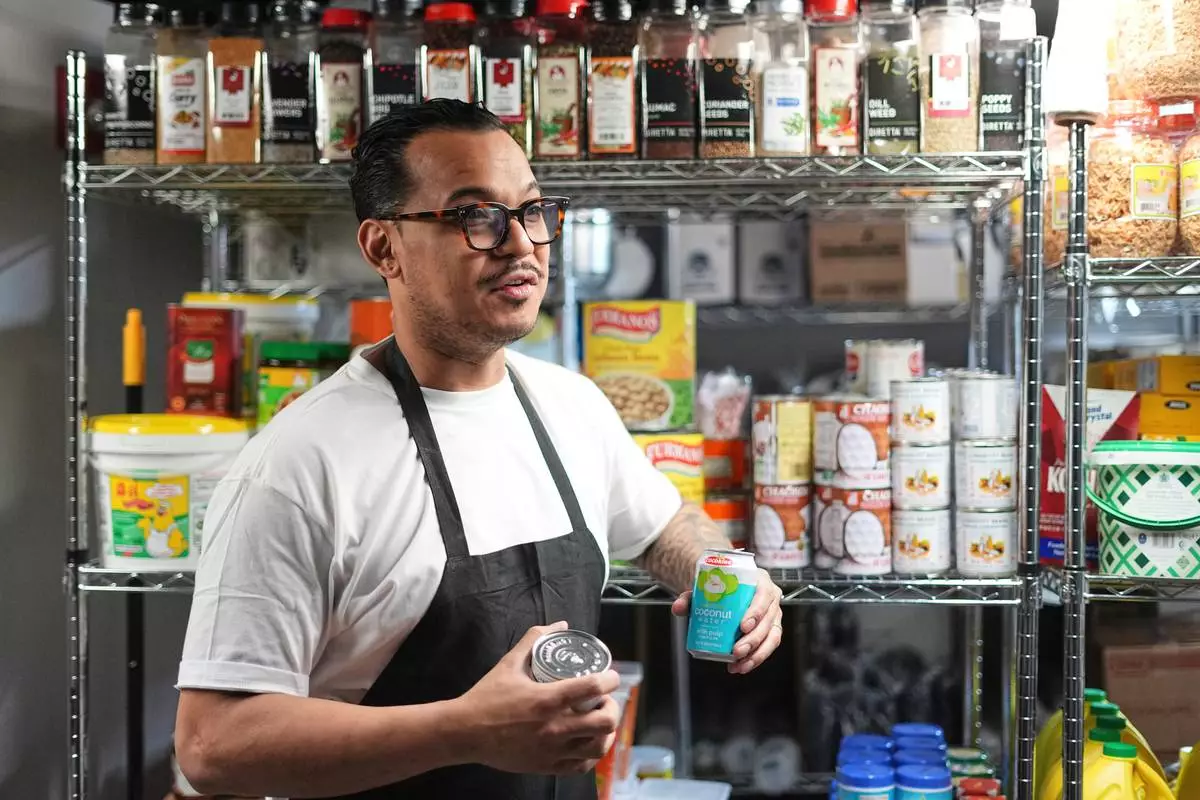
Chef Phila Lorn speaks during an interview at his restaurant, Mawn, in Philadelphia, Thursday, May 22, 2025. (AP Photo/Matt Rourke)