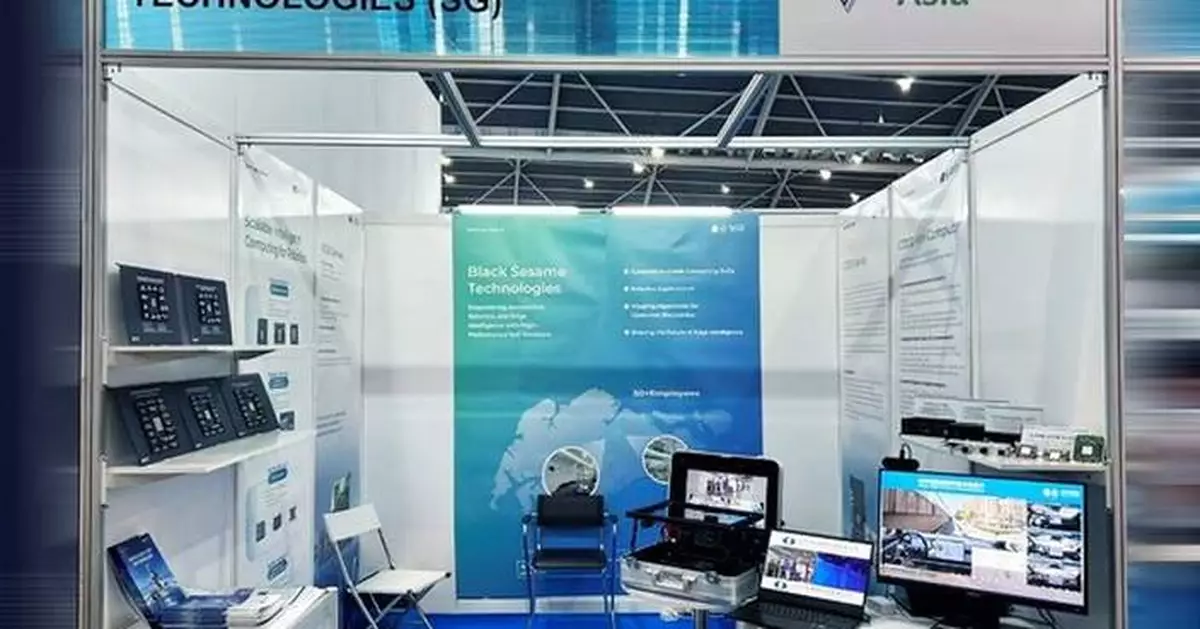
SINGAPORE, May 30, 2025 /PRNewswire/ -- From May 27-29, Black Sesame Technologies (Stock Code: 2533.HK), a leading automotive-grade computing SoC and Soc-based intelligent vehicle solution provider, made its grand debut at Asia Tech x Singapore (ATxSG) at the Singapore EXPO Convention Center. In the TechXLR8Asia zone (Booth 4N2-5) dedicated to AI, IoT and edge computing, the company showcased its full-stack solutions for robotics, advanced driver assistance systems (ADAS), and edge intelligence.
Leveraging years of expertise in the automotive industry, Black Sesame Technologies has expanded into robotics and edge computing through its proprietary IP cores, algorithms, and software ecosystems. The company's Huashan A1000/A2000 and Wudang C1200 chip families deliver high performance, reliability and cost efficiency, serving as core computing engines for ADAS, robotics, edge AI and consumer electronics. These solutions have empowered leading global automotive OEMs and Tier 1 suppliers.
At the exhibition, Black Sesame Technologies highlighted its comprehensive robotics solutions:
- Pre-designed SOM Boards: Powered by Huashan A1000/Wudang C1200 chips, providing scalable, energy-efficient hardware foundations that reduce development cycles
- Developer Kit/ Evaluation Board: Ready-to-use platforms with ROS1/ROS2 compatibility enabling rapid prototyping for SLAM navigation and multi-sensor fusion
- Turnkey Solutions: End-to-end services from chip selection to structural manufacturing
- Edge-side LLM AI: Industry-first solution enabling localized inference and autonomous decision-making
Since establishing its Singapore subsidiary in 2018, Black Sesame Technologies has built a team covering R&D, technical support, and business development. As a global operations hub, the Singapore team provides full lifecycle support for Southeast Asian clients from chip integration to deployment.
"Southeast Asia is an emerging frontier for robotics applications, with strong demand in industrial automation, smart logistics and urban mobility," said Dr. Xu Jin, General Manager of Black Sesame Technologies Singapore. "We deliver not just high-performance hardware, but also algorithm optimization and customized solutions to help customers overcome complex challenges."
Black Sesame Technologies will continue expanding partnerships across Southeast Asia to scale robotics applications in smart manufacturing, service robotics, and smart cities. The company also demonstrated a logistics robot prototype powered by its Wudang C1200 chip featuring edge-LLM enabled autonomous navigation.
Contact
For business or technical inquiries:
Black Sesame Technologies Pte. Ltd. (Singapore)
Address: 01 Fusionopolis Walk, #04-05/06, Solaris South Tower, Singapore 138628
Tel: +65 6908 2986
Email: sg@bst.ai
Website: https://www.blacksesame.com.cn
** The press release content is from PR Newswire. Bastille Post is not involved in its creation. **

Black Sesame Technologies Showcases Robotics Innovation at Asia Tech x Singapore
|
NCIS leads multi-institutional effort to develop expert multidisciplinary guidance to improve sarcoma diagnosis, referrals and outcomes
SINGAPORE, April 11, 2026 /PRNewswire/ -- Singapore is strengthening its approach to sarcoma care, a rare group of bone and soft tissue cancers that disproportionately affect adolescents and young adults, through closer coordination across specialties and institutions, enhanced clinical guidance, and continued investment in multidisciplinary care.
Sarcoma can arise almost anywhere in the body and often presents as a painless lump, resembling benign conditions. This frequently leads to delayed referrals and late‑stage diagnosis. While sarcoma accounts for fewer than one per cent of adult cancers, it represents approximately 21 per cent of paediatric cancers[1], affecting many adolescents and young adults.
To address these challenges, clinicians from across Singapore's healthcare system – including the National University Cancer Institute, Singapore (NCIS), National Cancer Centre Singapore (NCCS) and international contributors – have been working together to strengthen early recognition, clarify referral pathways and enhance multidisciplinary management. These efforts bring together expertise in surgery, medical oncology, radiation oncology, pathology, imaging and allied health to support better care for patients.
A rare cancer requiring highly complex, multidisciplinary care
With more than 100 subtypes, each requiring different diagnostic and treatment pathways, effective sarcoma care relies heavily on specialised expertise and coordinated multidisciplinary management.
When Mr Terence Goh was diagnosed with retroperitoneal pleomorphic sarcoma in 2023, he quickly learnt that sarcoma does not follow simple or predictable pathways, nor does its treatment. At 46, Mr Goh underwent neoadjuvant radiotherapy prior to surgery. This was followed by an exceptionally complex surgical journey involving multiple organs, prolonged operating time and intensive peri‑operative planning. His primary tumour, located deep within the retroperitoneum, required a highly complex operation involving multiple surgical teams. The surgery was prolonged and technically demanding, and he encountered significant challenges during both the peri‑operative and post‑operative periods. Radiotherapy further complicated the surgery, with surrounding tissues affected by scarring and inflammation. Subsequent developments required additional procedures, including the removal of a non‑functioning kidney compressed by the tumour.
Throughout his treatment journey, Mr Goh has been cared for at NCIS, where his case has required repeated multidisciplinary review, escalation of therapy and long‑term follow‑up care. Mr Goh underwent a complex chemotherapy protocol, targeted therapy in close coordination with the NUH's Division of Nephrology to protect his sole kidney, and multiple surgeries involving both the chest and abdomen.
"I'm still fighting," Mr Goh said. "What keeps me going is trusting the doctors and doing my best to live as normally as possible, for my family and for myself."
A father of two young children, Mr Goh credits his wife and family for sustaining him through repeated hospitalisations, treatment side effects and prolonged recovery. Despite ongoing challenges, he remains deeply supportive of sarcoma research and has expressed openness for his case to contribute to advancing medical knowledge.
"I hope more people understand sarcoma better," he said. "More research, more awareness and more treatment options can make a real difference."
Strengthening early identification and referral
A key challenge in sarcoma care is early identification. Many clinicians encounter sarcoma infrequently, which can lead to uncertainty in recognising suspicious features and knowing when to escalate care.
Adjunct Professor Mark Edward Puhaindran, Chairman of the Medical Board at National University Hospital (NUH) and Senior Consultant in the Division of Surgical Oncology, NCIS, added: "In clinical practice, the rarity of sarcoma means that many doctors may see only a handful of cases in their careers, leading to uncertainty in recognising the condition, and deciding when to escalate or refer. Strengthening awareness and mapping out clearer decision pathways are therefore important steps towards improving outcomes."
Developing expert multidisciplinary guidance
As part of this broader effort, clinicians from Singapore and international centres have come together to develop expert multidisciplinary guidance to support the diagnosis and management of sarcoma.
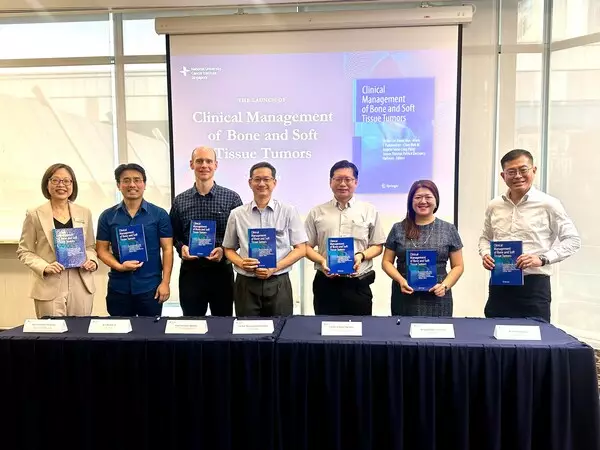
This includes the development of a new clinical handbook, Clinical Management of Bone and Soft Tissue Tumours. The Singapore‑led effort brings together the collective expertise of 70 local and international contributors across specialties and aims to support healthcare professionals in navigating complex diagnostic pathways, identifying when specialist referral is required, and determining appropriate multimodal treatment approaches.
Associate Professor Victor Lee Kwan Min, Head and Senior Consultant, Department of Pathology, NUH, and Senior Consultant, NCIS, a lead editor of the handbook[2] said: "Sarcoma pathology is inherently complex. These tumours are rare, highly diverse and often difficult to characterise, which means accurate diagnosis depends on specialist expertise supported by appropriate ancillary tests. We hope this handbook helps clinicians better navigate these complexities and arrive at the most appropriate treatment plan for their patients."
Among the handbook's lead editors is Associate Professor James Hallinan, Senior Consultant, Department of Diagnostic Imaging, NUH, and Senior Consultant, Division of Musculoskeletal Oncology, Department of Diagnostic Imaging, NCIS, who said: "Imaging plays a pivotal role in the early detection and characterisation of sarcomas. The handbook outlines core principles, indications and limitations to guide clinicians on when further investigation or specialist referral is warranted. Timely and appropriate imaging can significantly influence treatment planning and outcomes."
Developed by NCIS in partnership with institutes such as NCCS and international contributors, the handbook reflects Singapore's integrated ecosystem, which brings together orthopaedic oncology, pathology, radiology, surgery, medical oncology and allied health expertise within a single coordinated network.
Beyond diagnosis: fighting cancer with purpose
Mr Hilman Basri was just 29 when he first noticed a growing lump on his foot in late 2015. Initially dismissed as a minor issue, the swelling grew so large that he had to buy shoes a size bigger, but cancer was the last thing on his mind.
A referral led him to NCIS where a biopsy confirmed a rare diagnosis: clear cell sarcoma, an uncommon and aggressive subtype of soft tissue sarcoma. Surgery followed in January 2016, including complex reconstruction and a skin graft taken from his arm.
Although Mr Basri continues to live with persistent disease and has required further complex surgeries and ongoing medical treatment over the years, his journey has been defined not by limitation, but by determination.
Under the care of Adjunct Professor Mark Edward Puhaindran, who is also a lead editor of the handbook, Mr Basri's management extended beyond surgery to include long‑term follow‑up, rehabilitation, and continued treatment. Encouraged by Advanced Practice Nurse Ms Foong Li Li and his care team to choose resilience over resignation, Mr Basri reframed his outlook on life. He adopted a healthier lifestyle and turned to running as a way to cope, both physically and mentally, with the demands of living with cancer.
Since 2018, he has run the Run For Hope Marathon annually, often training and competing in between surgeries and medical treatments. Each race represents not recovery from cancer, but a powerful affirmation of what is still possible despite it.
"This is not a death sentence," Mr Basri said. "It is not the end, but the beginning of a new chapter."
| [1] Source: Burningham Z, Hashibe M, Spector L, Schiffman JD. The epidemiology of sarcoma. Clin Sarcoma Res. 2012;2:14. https://doi.org/10.1186/2045-3329-2-14. |
| [2] Editors of Clinical Management of Bone and Soft Tissue Tumours: Prof Mark Edward Puhaindran, Prof Victor Lee Kwan Min, Dr Thomas Patrick Decourcy Hallinan, Dr Angela Shien, Prof Bok Ai Choo |
Chinese Glossary
| National University Cancer Institute, Singapore (NCIS) | 新加坡国立大学癌症中心 |
| National University Hospital (NUH) | 国立大学医院 |
| National Cancer Centre Singapore (NCCS) | 新加坡国立癌症中心 |
| Adjunct Professor Mark Edward Puhaindran Chairman, Medical Board, National University Hospital (NUH) &
Senior Consultant
Division of Surgical Oncology
National University Cancer Institute, Singapore (NCIS) | Mark Edward Puhaindran客座教授 国立大学医院医疗委员会主席 & 高级顾问医生 肿瘤外科 新加坡国立大学癌症中心 |
| Associate Professor Victor Lee Kwan Min Head & Senior Consultant Department of Pathology
National University Hospital (NUH) &
Senior Consultant
National University Cancer Institute, Singapore (NCIS) | 李光明医生副教授 主任兼高级顾问医生 病理科 国立大学医院(国大医院) & 高级顾问医生
新加坡国立大学癌症中心 |
| Associate Professor James Hallinan Senior Consultant Department of Diagnostic Imaging National University Hospital (NUH) &
Senior Consultant
Division of Musculoskeletal Oncology, Department of Diagnostic Imaging
National University Cancer Institute, Singapore (NCIS) | 詹姆士•哈利南医生副教授 高级顾问医生 影像诊断科 国立大学医院(国大医院) & 高级顾问医生 肿瘤外科 (肌肉骨骼外科),
影像诊断科 新加坡国立大学癌症中心 |
| Mr Hilman Basri | Hilman Basri先生 |
| Mr Terence Goh | 吴振扬先生 |
About the National University Cancer Institute, Singapore (NCIS)
The National University Cancer Institute, Singapore (NCIS) is an academic, national specialist centre for cancer under the National University Health System (NUHS), and is the only public cancer centre in Singapore that treats both paediatric and adult cancers in one facility.
As one of two national cancer centres in Singapore, NCIS (pronounced as "n-sis") offers a broad spectrum of cancer care and management from screening, diagnosis and treatment to rehabilitation and survivorship, as well as palliative and long-term care. NCIS' strength lies in the multi-disciplinary approach taken by our clinician scientists and clinician-investigators to develop a comprehensive and personalised plan for each cancer patient.
NCIS provides the full suite of specialised oncology and haematology services at the NUH Medical Centre at Kent Ridge, Singapore, including those by the NCIS Chemotherapy Centre, NCIS Radiotherapy Centre and NCIS Cellular Therapy Centre.
NCIS also offers cancer services at other hospitals in Singapore:
- NCIS Cancer & Blood Clinic @ Ng Teng Fong General Hospital
- NCIS Radiotherapy Centre @ Tan Tock Seng Hospital
- NCIS Radiotherapy Clinic @ Khoo Teck Puat Hospital
To bring cancer care even closer to our patients, our NCIS on the Go programme delivers a range of cancer services at clinics within the community for their convenience.
For more information, please visit www.ncis.com.sg.
NCIS leads multi-institutional effort to develop expert multidisciplinary guidance to improve sarcoma diagnosis, referrals and outcomes
SINGAPORE, April 11, 2026 /PRNewswire/ -- Singapore is strengthening its approach to sarcoma care, a rare group of bone and soft tissue cancers that disproportionately affect adolescents and young adults, through closer coordination across specialties and institutions, enhanced clinical guidance, and continued investment in multidisciplinary care.
Sarcoma can arise almost anywhere in the body and often presents as a painless lump, resembling benign conditions. This frequently leads to delayed referrals and late‑stage diagnosis. While sarcoma accounts for fewer than one per cent of adult cancers, it represents approximately 21 per cent of paediatric cancers[1], affecting many adolescents and young adults.
To address these challenges, clinicians from across Singapore's healthcare system – including the National University Cancer Institute, Singapore (NCIS), National Cancer Centre Singapore (NCCS) and international contributors – have been working together to strengthen early recognition, clarify referral pathways and enhance multidisciplinary management. These efforts bring together expertise in surgery, medical oncology, radiation oncology, pathology, imaging and allied health to support better care for patients.
A rare cancer requiring highly complex, multidisciplinary care
With more than 100 subtypes, each requiring different diagnostic and treatment pathways, effective sarcoma care relies heavily on specialised expertise and coordinated multidisciplinary management.
When Mr Terence Goh was diagnosed with retroperitoneal pleomorphic sarcoma in 2023, he quickly learnt that sarcoma does not follow simple or predictable pathways, nor does its treatment. At 46, Mr Goh underwent neoadjuvant radiotherapy prior to surgery. This was followed by an exceptionally complex surgical journey involving multiple organs, prolonged operating time and intensive peri‑operative planning. His primary tumour, located deep within the retroperitoneum, required a highly complex operation involving multiple surgical teams. The surgery was prolonged and technically demanding, and he encountered significant challenges during both the peri‑operative and post‑operative periods. Radiotherapy further complicated the surgery, with surrounding tissues affected by scarring and inflammation. Subsequent developments required additional procedures, including the removal of a non‑functioning kidney compressed by the tumour.
Throughout his treatment journey, Mr Goh has been cared for at NCIS, where his case has required repeated multidisciplinary review, escalation of therapy and long‑term follow‑up care. Mr Goh underwent a complex chemotherapy protocol, targeted therapy in close coordination with the NUH's Division of Nephrology to protect his sole kidney, and multiple surgeries involving both the chest and abdomen.
"I'm still fighting," Mr Goh said. "What keeps me going is trusting the doctors and doing my best to live as normally as possible, for my family and for myself."
A father of two young children, Mr Goh credits his wife and family for sustaining him through repeated hospitalisations, treatment side effects and prolonged recovery. Despite ongoing challenges, he remains deeply supportive of sarcoma research and has expressed openness for his case to contribute to advancing medical knowledge.
"I hope more people understand sarcoma better," he said. "More research, more awareness and more treatment options can make a real difference."
Strengthening early identification and referral
A key challenge in sarcoma care is early identification. Many clinicians encounter sarcoma infrequently, which can lead to uncertainty in recognising suspicious features and knowing when to escalate care.
Adjunct Professor Mark Edward Puhaindran, Chairman of the Medical Board at National University Hospital (NUH) and Senior Consultant in the Division of Surgical Oncology, NCIS, added: "In clinical practice, the rarity of sarcoma means that many doctors may see only a handful of cases in their careers, leading to uncertainty in recognising the condition, and deciding when to escalate or refer. Strengthening awareness and mapping out clearer decision pathways are therefore important steps towards improving outcomes."
Developing expert multidisciplinary guidance
As part of this broader effort, clinicians from Singapore and international centres have come together to develop expert multidisciplinary guidance to support the diagnosis and management of sarcoma.
This includes the development of a new clinical handbook, Clinical Management of Bone and Soft Tissue Tumours. The Singapore‑led effort brings together the collective expertise of 70 local and international contributors across specialties and aims to support healthcare professionals in navigating complex diagnostic pathways, identifying when specialist referral is required, and determining appropriate multimodal treatment approaches.
Associate Professor Victor Lee Kwan Min, Head and Senior Consultant, Department of Pathology, NUH, and Senior Consultant, NCIS, a lead editor of the handbook[2] said: "Sarcoma pathology is inherently complex. These tumours are rare, highly diverse and often difficult to characterise, which means accurate diagnosis depends on specialist expertise supported by appropriate ancillary tests. We hope this handbook helps clinicians better navigate these complexities and arrive at the most appropriate treatment plan for their patients."
Among the handbook's lead editors is Associate Professor James Hallinan, Senior Consultant, Department of Diagnostic Imaging, NUH, and Senior Consultant, Division of Musculoskeletal Oncology, Department of Diagnostic Imaging, NCIS, who said: "Imaging plays a pivotal role in the early detection and characterisation of sarcomas. The handbook outlines core principles, indications and limitations to guide clinicians on when further investigation or specialist referral is warranted. Timely and appropriate imaging can significantly influence treatment planning and outcomes."
Developed by NCIS in partnership with institutes such as NCCS and international contributors, the handbook reflects Singapore's integrated ecosystem, which brings together orthopaedic oncology, pathology, radiology, surgery, medical oncology and allied health expertise within a single coordinated network.
Beyond diagnosis: fighting cancer with purpose
Mr Hilman Basri was just 29 when he first noticed a growing lump on his foot in late 2015. Initially dismissed as a minor issue, the swelling grew so large that he had to buy shoes a size bigger, but cancer was the last thing on his mind.
A referral led him to NCIS where a biopsy confirmed a rare diagnosis: clear cell sarcoma, an uncommon and aggressive subtype of soft tissue sarcoma. Surgery followed in January 2016, including complex reconstruction and a skin graft taken from his arm.
Although Mr Basri continues to live with persistent disease and has required further complex surgeries and ongoing medical treatment over the years, his journey has been defined not by limitation, but by determination.
Under the care of Adjunct Professor Mark Edward Puhaindran, who is also a lead editor of the handbook, Mr Basri's management extended beyond surgery to include long‑term follow‑up, rehabilitation, and continued treatment. Encouraged by Advanced Practice Nurse Ms Foong Li Li and his care team to choose resilience over resignation, Mr Basri reframed his outlook on life. He adopted a healthier lifestyle and turned to running as a way to cope, both physically and mentally, with the demands of living with cancer.
Since 2018, he has run the Run For Hope Marathon annually, often training and competing in between surgeries and medical treatments. Each race represents not recovery from cancer, but a powerful affirmation of what is still possible despite it.
"This is not a death sentence," Mr Basri said. "It is not the end, but the beginning of a new chapter."
[1] Source: Burningham Z, Hashibe M, Spector L, Schiffman JD. The epidemiology of sarcoma. Clin Sarcoma Res. 2012;2:14. https://doi.org/10.1186/2045-3329-2-14.
[2] Editors of Clinical Management of Bone and Soft Tissue Tumours: Prof Mark Edward Puhaindran, Prof Victor Lee Kwan Min, Dr Thomas Patrick Decourcy Hallinan, Dr Angela Shien, Prof Bok Ai Choo
Chinese Glossary
| National University Cancer Institute, Singapore (NCIS) | 新加坡国立大学癌症中心 |
| National University Hospital (NUH) | 国立大学医院 |
| National Cancer Centre Singapore (NCCS) | 新加坡国立癌症中心 |
| Adjunct Professor Mark Edward Puhaindran Chairman, Medical Board, National University Hospital (NUH) &
Senior Consultant
Division of Surgical Oncology
National University Cancer Institute, Singapore (NCIS) | Mark Edward Puhaindran客座教授 国立大学医院医疗委员会主席 & 高级顾问医生 肿瘤外科 新加坡国立大学癌症中心 |
| Associate Professor Victor Lee Kwan Min Head & Senior Consultant Department of Pathology
National University Hospital (NUH) &
Senior Consultant
National University Cancer Institute, Singapore (NCIS) | 李光明医生副教授 主任兼高级顾问医生 病理科 国立大学医院(国大医院) & 高级顾问医生
新加坡国立大学癌症中心 |
| Associate Professor James Hallinan Senior Consultant Department of Diagnostic Imaging National University Hospital (NUH) &
Senior Consultant
Division of Musculoskeletal Oncology, Department of Diagnostic Imaging
National University Cancer Institute, Singapore (NCIS) | 詹姆士•哈利南医生副教授 高级顾问医生 影像诊断科 国立大学医院(国大医院) & 高级顾问医生 肿瘤外科 (肌肉骨骼外科),
影像诊断科 新加坡国立大学癌症中心 |
| Mr Hilman Basri | Hilman Basri先生 |
| Mr Terence Goh | 吴振扬先生 |
National University Cancer Institute, Singapore (NCIS)
新加坡国立大学癌症中心
National University Hospital (NUH)
国立大学医院
National Cancer Centre Singapore (NCCS)
新加坡国立癌症中心
Adjunct Professor Mark Edward Puhaindran
Chairman, Medical Board, National University Hospital (NUH) &
Senior Consultant
Division of Surgical Oncology
National University Cancer Institute, Singapore (NCIS)
Mark Edward Puhaindran客座教授
国立大学医院医疗委员会主席 &
高级顾问医生
肿瘤外科
新加坡国立大学癌症中心
Associate Professor Victor Lee Kwan Min
Head & Senior Consultant
Department of Pathology
National University Hospital (NUH) &
Senior Consultant
National University Cancer Institute, Singapore (NCIS)
李光明医生副教授
主任兼高级顾问医生
病理科
国立大学医院(国大医院) &
高级顾问医生
新加坡国立大学癌症中心
Associate Professor James Hallinan
Senior Consultant
Department of Diagnostic Imaging
National University Hospital (NUH) &
Senior Consultant
Division of Musculoskeletal Oncology, Department of Diagnostic Imaging
National University Cancer Institute, Singapore (NCIS)
詹姆士•哈利南医生副教授
高级顾问医生
影像诊断科
国立大学医院(国大医院) &
高级顾问医生
肿瘤外科 (肌肉骨骼外科),
影像诊断科
新加坡国立大学癌症中心
Mr Hilman Basri
Hilman Basri先生
Mr Terence Goh
吴振扬先生
About the National University Cancer Institute, Singapore (NCIS)
The National University Cancer Institute, Singapore (NCIS) is an academic, national specialist centre for cancer under the National University Health System (NUHS), and is the only public cancer centre in Singapore that treats both paediatric and adult cancers in one facility.
As one of two national cancer centres in Singapore, NCIS (pronounced as "n-sis") offers a broad spectrum of cancer care and management from screening, diagnosis and treatment to rehabilitation and survivorship, as well as palliative and long-term care. NCIS' strength lies in the multi-disciplinary approach taken by our clinician scientists and clinician-investigators to develop a comprehensive and personalised plan for each cancer patient.
NCIS provides the full suite of specialised oncology and haematology services at the NUH Medical Centre at Kent Ridge, Singapore, including those by the NCIS Chemotherapy Centre, NCIS Radiotherapy Centre and NCIS Cellular Therapy Centre.
NCIS also offers cancer services at other hospitals in Singapore:
- NCIS Cancer & Blood Clinic @ Ng Teng Fong General Hospital
- NCIS Radiotherapy Centre @ Tan Tock Seng Hospital
- NCIS Radiotherapy Clinic @ Khoo Teck Puat Hospital
To bring cancer care even closer to our patients, our NCIS on the Go programme delivers a range of cancer services at clinics within the community for their convenience.
For more information, please visit www.ncis.com.sg.
** This press release is distributed by PR Newswire through automated distribution system, for which the client assumes full responsibility. **
SINGAPORE STRENGTHENS SARCOMA CARE THROUGH COORDINATED, MULTIDISCIPLINARY APPROACH