An event marking the upcoming Chinese Duanwu Festival, also known as the Dragon Boat Festival, was held by the Confucius Institute at Ricardo Palma University in Lima, Peru on Wednesday, immersing local students in Chinese cultural vibes.
The festival, always celebrated on the fifth day of the fifth month on the Chinese lunar calendar, will fall on Saturday (May 31) this year.
The event began with Chinese teachers telling local students about the origin of the festival, the stories of patriotic Chinese poet Qu Yuan, and customs like the dragon boat race and eating zongzi.
At a dragon boat design competition held amid the celebration, there was a variety of works featuring a good combination of Chinese and Peruvian cultural elements created by students.
The most outstanding dragon boat design was the largest green one which won the top prize in the competition.
"A dragon boat consists of several parts, including the keel, the dragon neck and tail. Besides, we have added some details which represent both Chinese and Peruvian cultures. We have also integrated it with the cultural elements of the festival, such as the zongzi that people eat on the Dragon Boat Festival. In addition, we have put in representative Chinese cultural symbols such as the panda, as well as elements of Peru like the llama. They symbolize the friendship between China and Peru," said Emily Moreano Francia, designer of the dragon boat.
A tug-of-war competition held at the event allowed Peruvian students to experience the joy of teamwork in laughter.
Another highlight at the event was zongzi, a traditional Duanwu Festival food made of sticky rice and various fillings wrapped in bamboo leaves. The delicious zongzi of different flavors satisfied the taste buds of the Peruvian student a lot, sparking their interest in Chinese food culture.
"This event is a great opportunity for students to gain a deeper understanding of Chinese culture. We hope that they will not just be spectators, but truly active participants. We not only spread language and culture, but also hope to help students understand and practice Chinese values that can be shared across cultures, and meanwhile integrate them into our own culture," said Cecilia Tello, director of the Confucius Institute at Ricardo Palma University.
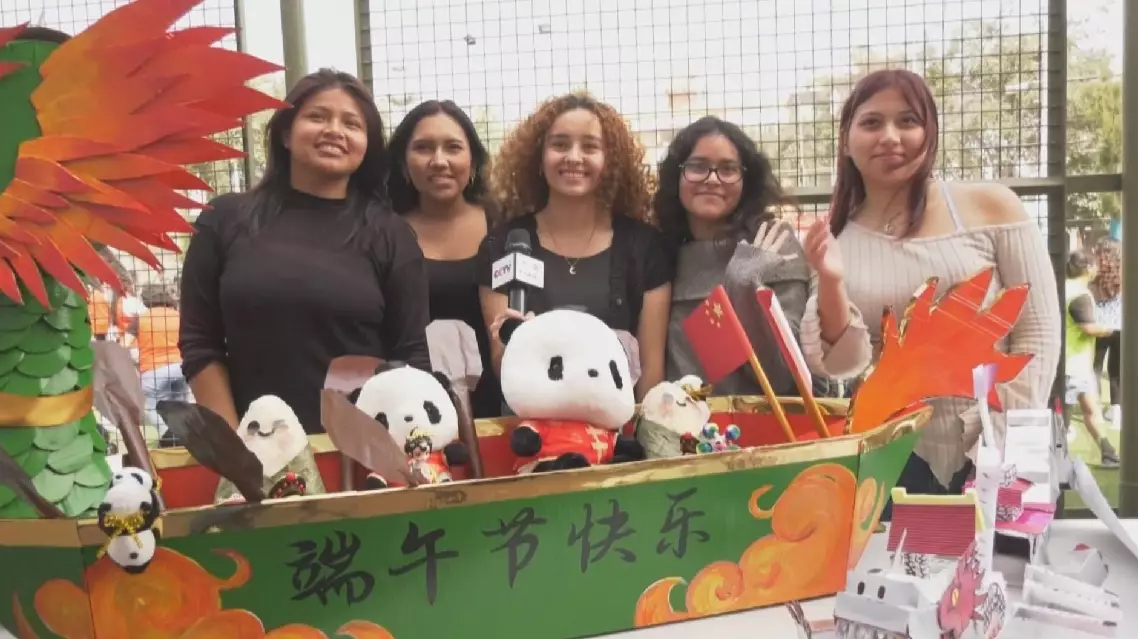
Duanwu Festival event immerses Peruvian university students in Chinese cultural vibes
Ronny Herman de Jong, a Dutch-American survivor of Japanese-run internment camps in Southeast Asia during World War II, has recounted the atrocities committed by the Japanese Imperial Army against women and children, urging the Japanese government to issue a formal apology to the victims and survivors.
Born in 1938 on the island of Java in the then Dutch East Indies (now Indonesia), de Jong was just a toddler when Japanese forces invaded in 1942.
Along with her mother and younger sister, she was forcibly interned in a concentration camp for women and children, where they endured nearly four years of starvation, disease, and brutal treatment, narrowly escaping death on multiple occasions.
"In the women's camps, they would put bamboo sticks under the fingernails. They put burning cigarette butts on women's breasts. That did not happen to my mom, but it happened to a lot of the people. They were severely maltreated. Even little babies were just killed. In the end, there were so many deaths. The mortality rate on Java [Island] was more than 10 times normal, and there were no longer coffins provided anymore. People that died just had to be taken out of the camp and dumped into a big pit that the women had to have dug, or they were just dumped over the fence," de Jong recounted.
After the war, her family emigrated to the United States. Decades later, she published a book based on her mother's secret diary -- smuggled out of the camp -- which chronicled their harrowing ordeal.
First released in Canada in 1992, the book met with significant resistance in Japan. According to de Jong, a Japanese journalist in Canada who had agreed to translate the work was later murdered, halting efforts to bring the account to Japanese readers.
To this day, de Jong stressed that Japan has never issued a formal apology to the victims or survivors of its wartime aggression across Asia.
"Japan has never offered an apology to any of the survivors or victims. Now, Japan is starting to change their democracy by changing that Article 9 [of the Japanese Constitution] that says Japan should not have any armed forces ever again that can start war. And now, the [Japanese] prime minister is trying to change that by reinforcing the Japanese arms," she said.
In 2001, de Jong realized how little the world knew about the Japanese-run internment camps in Southeast Asia during WWII. Declassified documents from the U.S. National Archives revealed a chilling plan: Japanese authorities had intended to systematically exterminate all remaining camp internees beginning in September 1945, just weeks after Japan announced its unconditional surrender.
Since then, de Jong has dedicated herself to compiling testimonies from WWII veterans and former child internees, publishing more books to ensure this history is never forgotten nor denied.
"What I want to say to the generations of now and to come, you have to remember this war -- the Second World War in the Pacific. It was the most cruel and expensive war ever. That is not a war that you can say 'oh, it did not happen'. It does not. That is not true. You have to remember this war," she said.
Concentration camp survivor recounts Japanese army's atrocities during WWII