Skip to Content Facebook Feature Image

What is the Hajj pilgrimage and what is Eid al-Adha? Why are they significant for Muslims?

ENT

What is the Hajj pilgrimage and what is Eid al-Adha? Why are they significant for Muslims?
ENT

ENT

What is the Hajj pilgrimage and what is Eid al-Adha? Why are they significant for Muslims?

2025-06-01 13:34 Last Updated At:13:40

Once a year, large numbers of Muslim pilgrims converging on Saudi Arabia unite in religious rituals and acts of worship as they perform the Hajj, one of the pillars of Islam. They fulfill a religious obligation, immersing themselves in what can be a spiritual experience of a lifetime for them and a chance to seek God’s forgiveness and the erasure of past sins.

Here’s a look at the pilgrimage and its significance to Muslims.

More Images
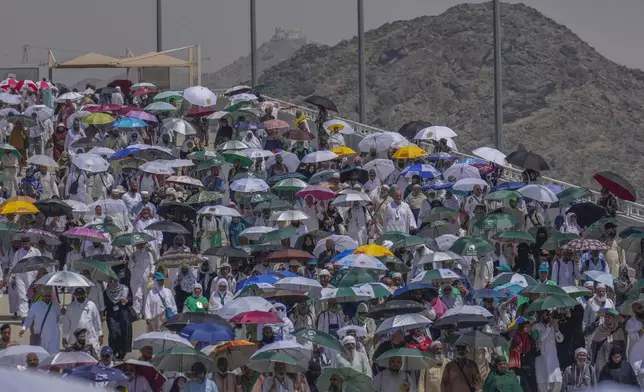
FILE - Muslim pilgrims use umbrellas to shield themselves from the sun as they arrive to cast stones at pillars in the symbolic stoning of the devil during the annual hajj, in Mina, near the holy city of Mecca, Saudi Arabia, Tuesday, June 18, 2024. (AP Photo/Rafiq Maqbool, File)
FILE - Muslim pilgrims use umbrellas to shield themselves from the sun as they arrive to cast stones at pillars in the symbolic stoning of the devil during the annual hajj, in Mina, near the holy city of Mecca, Saudi Arabia, Tuesday, June 18, 2024. (AP Photo/Rafiq Maqbool, File)

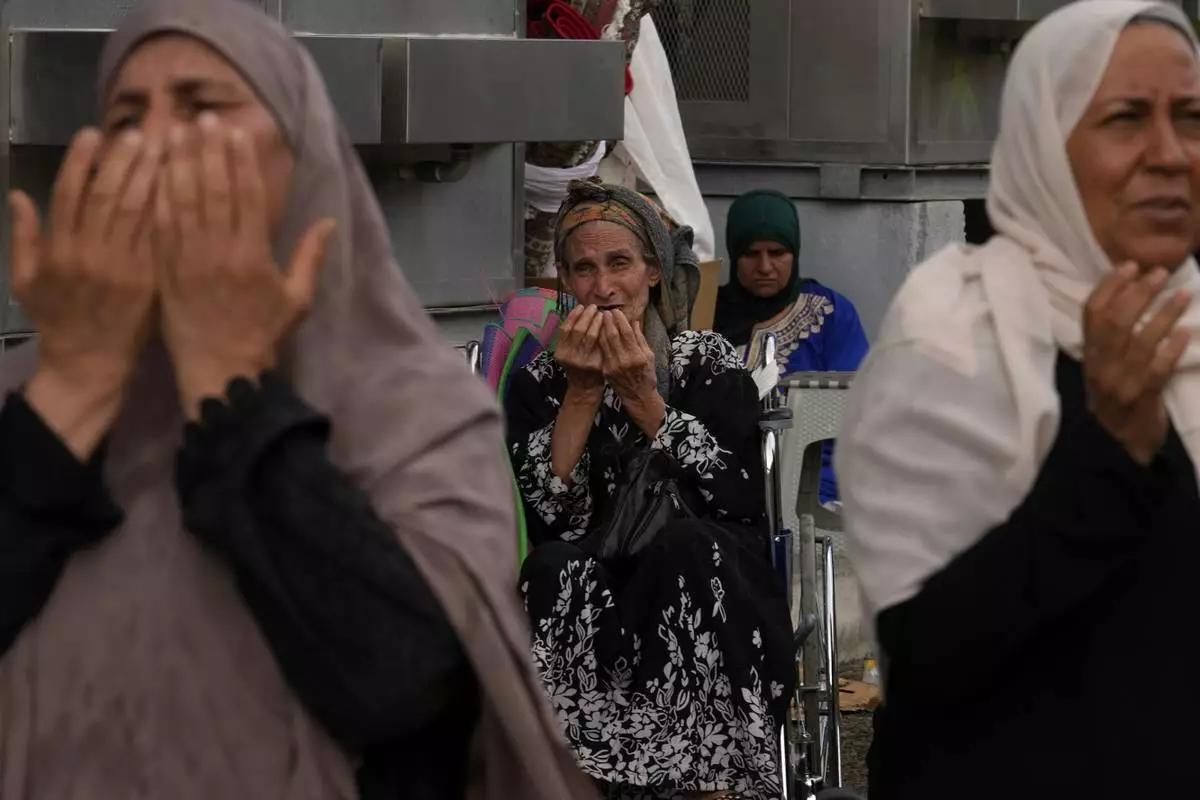
FILE - Muslim pilgrims pray after casting stones at pillars in the symbolic stoning of the devil during the annual hajj, as it rains in Mina, near the holy city of Mecca, Saudi Arabia, Monday, June 17, 2024. (AP Photo/Rafiq Maqbool, File)
FILE - Muslim pilgrims pray after casting stones at pillars in the symbolic stoning of the devil during the annual hajj, as it rains in Mina, near the holy city of Mecca, Saudi Arabia, Monday, June 17, 2024. (AP Photo/Rafiq Maqbool, File)

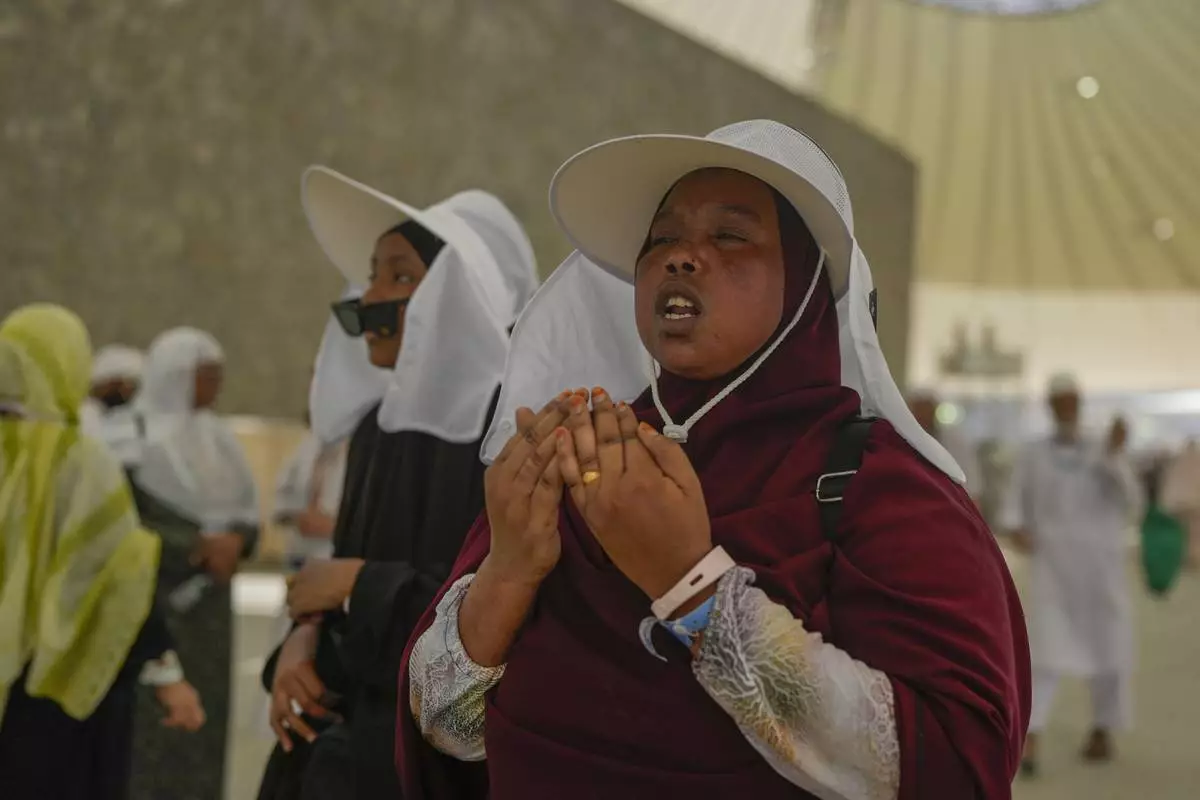
FILE - A pilgrim offer prayers after she cast stones at a pillar in the symbolic stoning of the devil, during the annual Hajj pilgrimage in Mina, near the holy city of Mecca, Saudi Arabia, Tuesday, June 18, 2024. (AP Photo/Rafiq Maqbool, File)
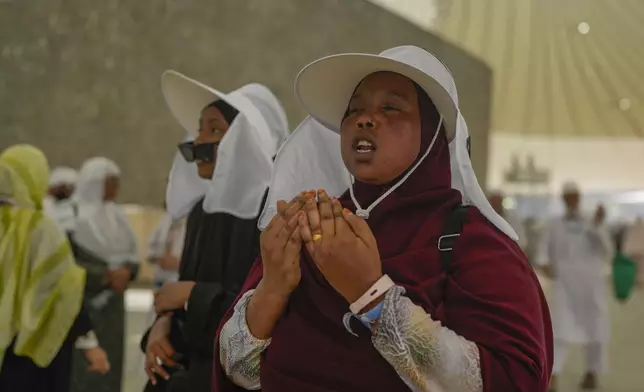
FILE - A pilgrim offer prayers after she cast stones at a pillar in the symbolic stoning of the devil, during the annual Hajj pilgrimage in Mina, near the holy city of Mecca, Saudi Arabia, Tuesday, June 18, 2024. (AP Photo/Rafiq Maqbool, File)

FILE - Muslim pilgrims use umbrellas to shield themselves from the sun as they gather outside Nimrah Mosque to offer the noon prayers in Arafat, on the second day of the annual hajj pilgrimage, near the holy city of Mecca, Saudi Arabia, Saturday, June 15, 2024. (AP Photo/Rafiq Maqbool, File)
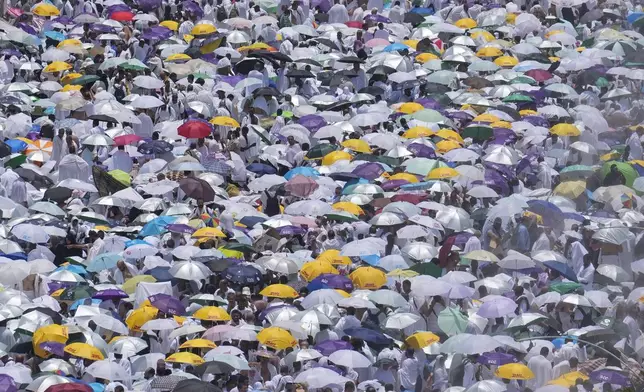
FILE - Muslim pilgrims use umbrellas to shield themselves from the sun as they gather outside Nimrah Mosque to offer the noon prayers in Arafat, on the second day of the annual hajj pilgrimage, near the holy city of Mecca, Saudi Arabia, Saturday, June 15, 2024. (AP Photo/Rafiq Maqbool, File)

FILE - FILE - Muslim pilgrims circumambulate the Kaaba, the cubic building at the Grand Mosque, during the annual Hajj pilgrimage in Mecca, Saudi Arabia, Monday, June 17, 2024. (AP Photo/Rafiq Maqbool, File, File)
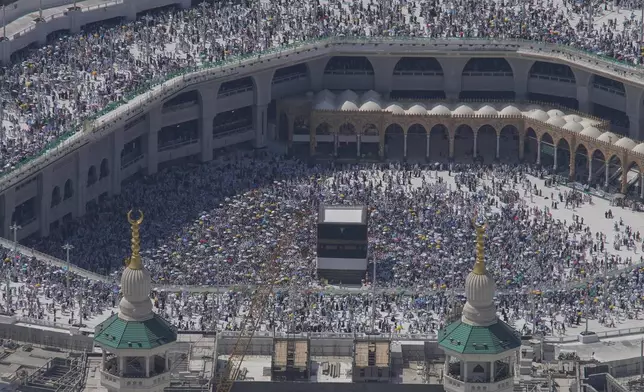
FILE - FILE - Muslim pilgrims circumambulate the Kaaba, the cubic building at the Grand Mosque, during the annual Hajj pilgrimage in Mecca, Saudi Arabia, Monday, June 17, 2024. (AP Photo/Rafiq Maqbool, File, File)

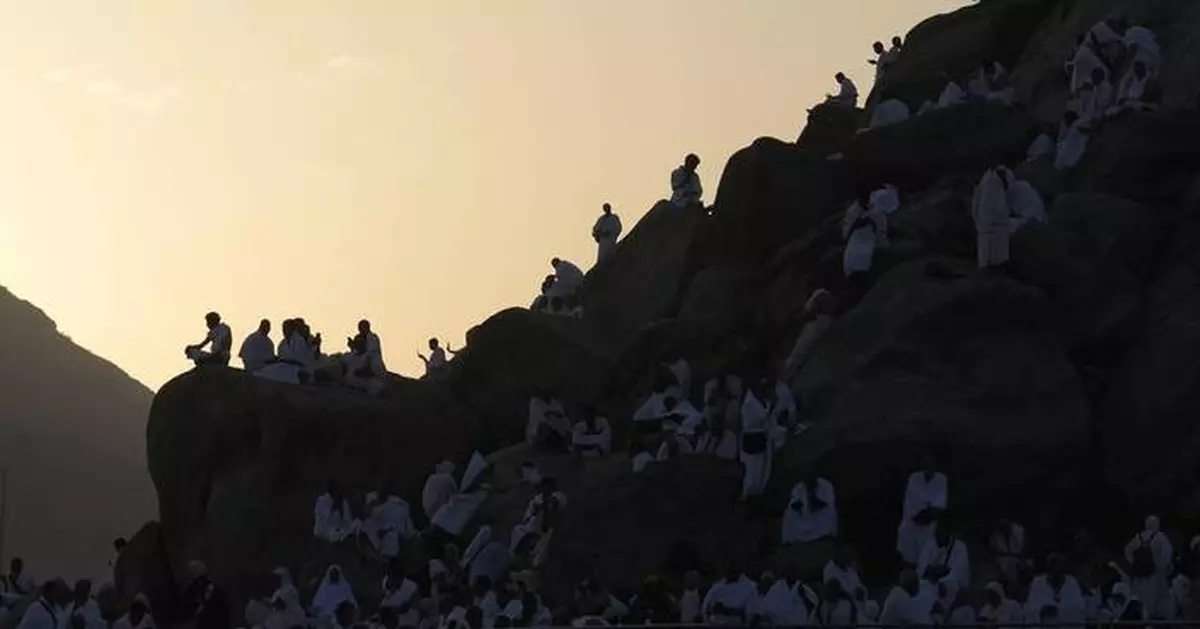
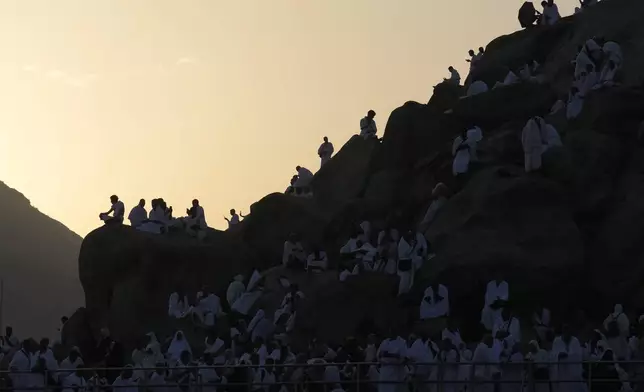
FILE - Muslim pilgrims gather at top of the rocky hill known as the Mountain of Mercy, on the Plain of Arafat, during the annual Hajj pilgrimage, near the holy city of Mecca, Saudi Arabia, Saturday, June 15, 2024.(AP Photo/Rafiq Maqbool, File)

FILE - Muslim pilgrims gather at top of the rocky hill known as the Mountain of Mercy, on the Plain of Arafat, during the annual Hajj pilgrimage, near the holy city of Mecca, Saudi Arabia, Saturday, June 15, 2024.(AP Photo/Rafiq Maqbool, File)

The Hajj is the annual Islamic pilgrimage to Mecca in Saudi Arabia and involves a series of religious rituals. It’s required once in a lifetime of every Muslim who can afford it and is physically able to make it. Some Muslims make the journey more than once.

It is also one of the Five Pillars of Islam, in addition to the profession of faith, prayer, almsgiving and fasting.

The Hajj occurs once a year during the lunar month of Dhul-Hijja, the 12th and final month of the Islamic calendar year. This year, the Hajj will start on June 4.

When the Hajj falls during the summer months, the intense heat can be especially challenging. Amid extreme high temperatures last year, more than 1,300 people died during the Hajj, Saudi authorities announced then. The country’s health minister said at the time that the vast majority of the fatalities were unauthorized pilgrims who walked long distances under the sun.

For pilgrims, performing the Hajj fulfills a religious obligation and is also a deeply spiritual experience. It’s seen as a chance to seek God’s forgiveness for past sins, to grow closer to God and to walk in the footsteps of prophets.

Communally, the Hajj unites Muslims of diverse races, ethnicities, languages and economic classes from around the world in performing religious rituals and acts of worshipping God at the same time and place. This leaves many feeling a sense of unity, connection, humility and equality. Pilgrims also show up with their own personal appeals, wishes and experiences.

Many pilgrims bring with them prayer requests from family and friends that they would like to be said on their behalf.

Some spend years hoping and praying to one day perform the Hajj or saving up money and waiting for a permit to embark on the trip.

Ahead of the journey, preparations may include packing various essentials for the physically demanding trip, seeking tips from those who’ve performed the pilgrimage before, attending lectures or consulting other educational material on how to properly perform a series of Hajj rituals as well as spiritually readying oneself.

Pilgrims make the intention to perform the Hajj and they enter a state of “ihram.” Being in ihram includes abiding by certain rules and prohibitions. For instance, men are not to wear regular sewn or stitched clothes that encircle the body, such as shirts, during ihram. Instead, there are simple ihram cloth garments for men; scholars say the purpose is to discard luxuries and vanity, shed worldly status symbols and immerse the pilgrim in humility and devotion to God.

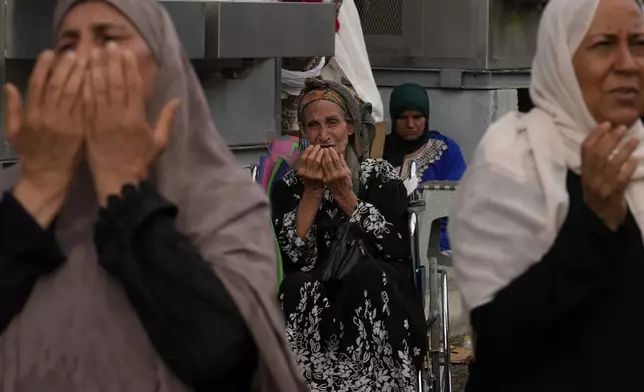
A spiritual highlight of the Hajj for many is standing on the plain of Arafat, where pilgrims praise God, plead for forgiveness and make supplications. Many raise their hands in worship with tears streaming down their faces.

Other rituals include performing “tawaf,” circumambulating, or circling the Kaaba in Mecca counterclockwise seven times. The Kaaba, a cube-shaped structure, is the focal point toward which Muslims face during their daily prayers from anywhere in the world.

Among other rituals, pilgrims also retrace the path of Hagar, or Hajar, the wife of Prophet Ibrahim, Abraham to Jews and Christians, who Muslims believe ran between two hills seven times searching for water for her son.

Eid al-Adha, or the “Feast of Sacrifice,” is the Islamic holiday that begins on the 10th day of the Islamic lunar month of Dhul-Hijja, during the Hajj.

A joyous occasion celebrated by Muslims around the world, Eid al-Adha marks Ibrahim’s test of faith and his willingness to sacrifice his son as an act of submission to God. During the festive holiday, Muslims slaughter sheep or cattle and distribute some meat to poor people.

Associated Press religion coverage receives support through the AP’s collaboration with The Conversation US, with funding from Lilly Endowment Inc. The AP is solely responsible for this content.
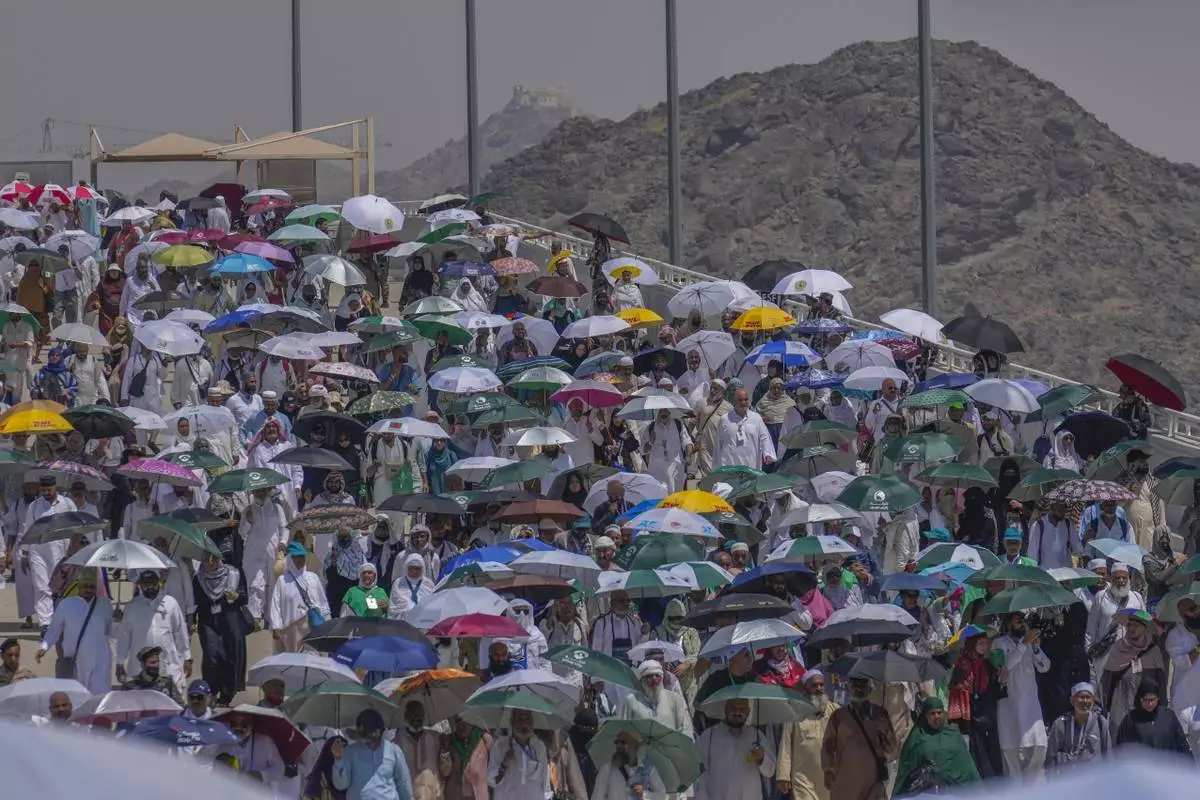
FILE - Muslim pilgrims use umbrellas to shield themselves from the sun as they arrive to cast stones at pillars in the symbolic stoning of the devil during the annual hajj, in Mina, near the holy city of Mecca, Saudi Arabia, Tuesday, June 18, 2024. (AP Photo/Rafiq Maqbool, File)
FILE - Muslim pilgrims use umbrellas to shield themselves from the sun as they arrive to cast stones at pillars in the symbolic stoning of the devil during the annual hajj, in Mina, near the holy city of Mecca, Saudi Arabia, Tuesday, June 18, 2024. (AP Photo/Rafiq Maqbool, File)

FILE - Muslim pilgrims pray after casting stones at pillars in the symbolic stoning of the devil during the annual hajj, as it rains in Mina, near the holy city of Mecca, Saudi Arabia, Monday, June 17, 2024. (AP Photo/Rafiq Maqbool, File)
FILE - Muslim pilgrims pray after casting stones at pillars in the symbolic stoning of the devil during the annual hajj, as it rains in Mina, near the holy city of Mecca, Saudi Arabia, Monday, June 17, 2024. (AP Photo/Rafiq Maqbool, File)

FILE - A pilgrim offer prayers after she cast stones at a pillar in the symbolic stoning of the devil, during the annual Hajj pilgrimage in Mina, near the holy city of Mecca, Saudi Arabia, Tuesday, June 18, 2024. (AP Photo/Rafiq Maqbool, File)
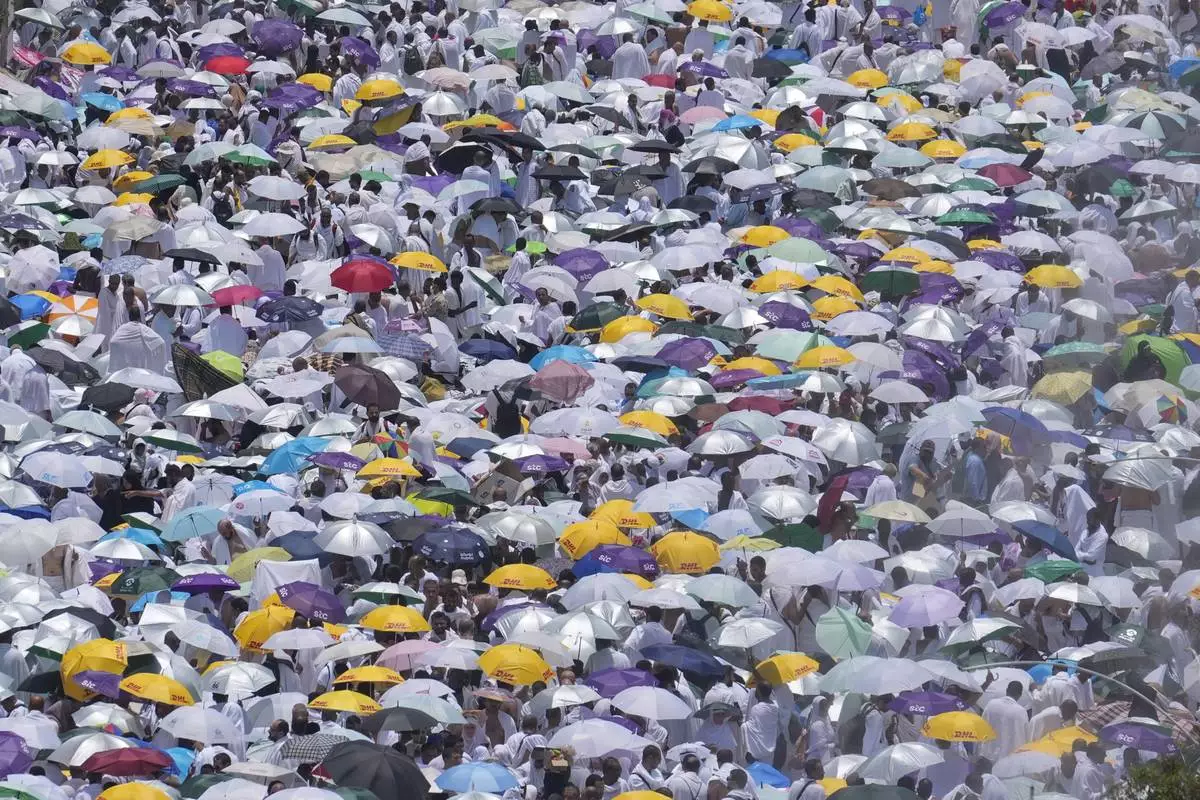
FILE - A pilgrim offer prayers after she cast stones at a pillar in the symbolic stoning of the devil, during the annual Hajj pilgrimage in Mina, near the holy city of Mecca, Saudi Arabia, Tuesday, June 18, 2024. (AP Photo/Rafiq Maqbool, File)

FILE - Muslim pilgrims use umbrellas to shield themselves from the sun as they gather outside Nimrah Mosque to offer the noon prayers in Arafat, on the second day of the annual hajj pilgrimage, near the holy city of Mecca, Saudi Arabia, Saturday, June 15, 2024. (AP Photo/Rafiq Maqbool, File)
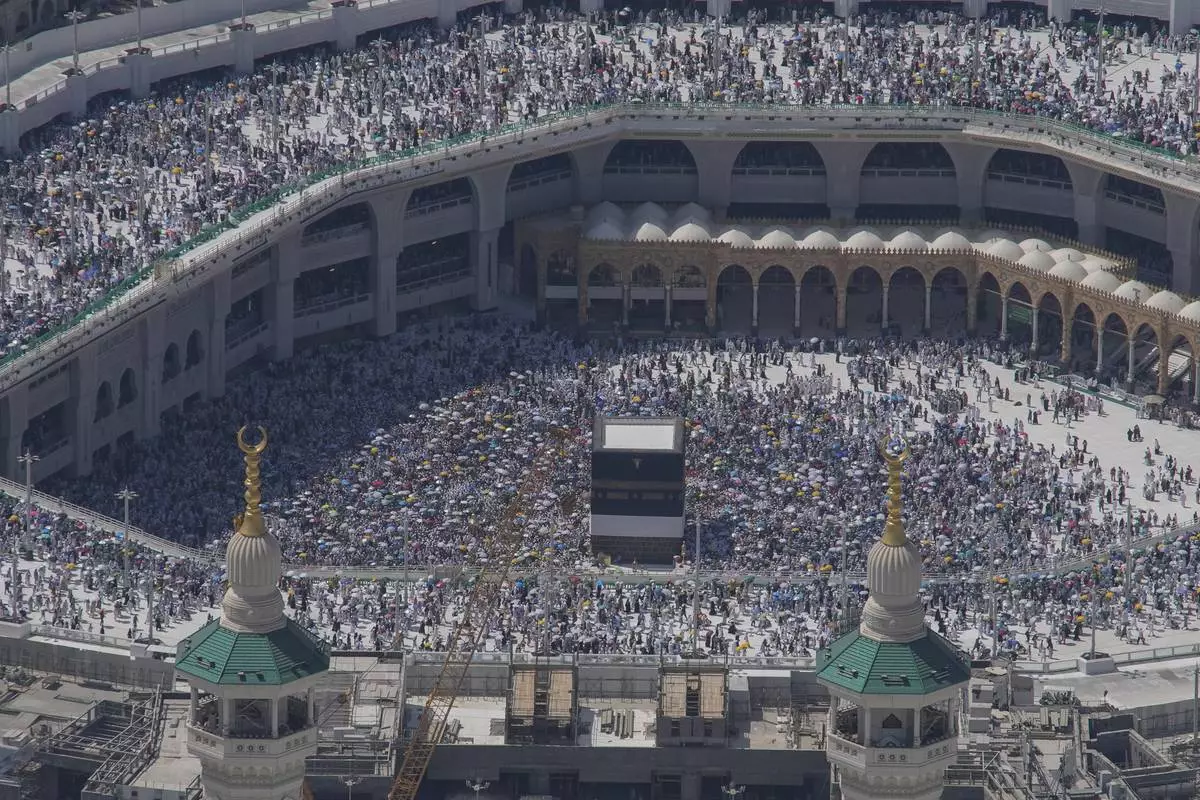
FILE - Muslim pilgrims use umbrellas to shield themselves from the sun as they gather outside Nimrah Mosque to offer the noon prayers in Arafat, on the second day of the annual hajj pilgrimage, near the holy city of Mecca, Saudi Arabia, Saturday, June 15, 2024. (AP Photo/Rafiq Maqbool, File)

FILE - FILE - Muslim pilgrims circumambulate the Kaaba, the cubic building at the Grand Mosque, during the annual Hajj pilgrimage in Mecca, Saudi Arabia, Monday, June 17, 2024. (AP Photo/Rafiq Maqbool, File, File)
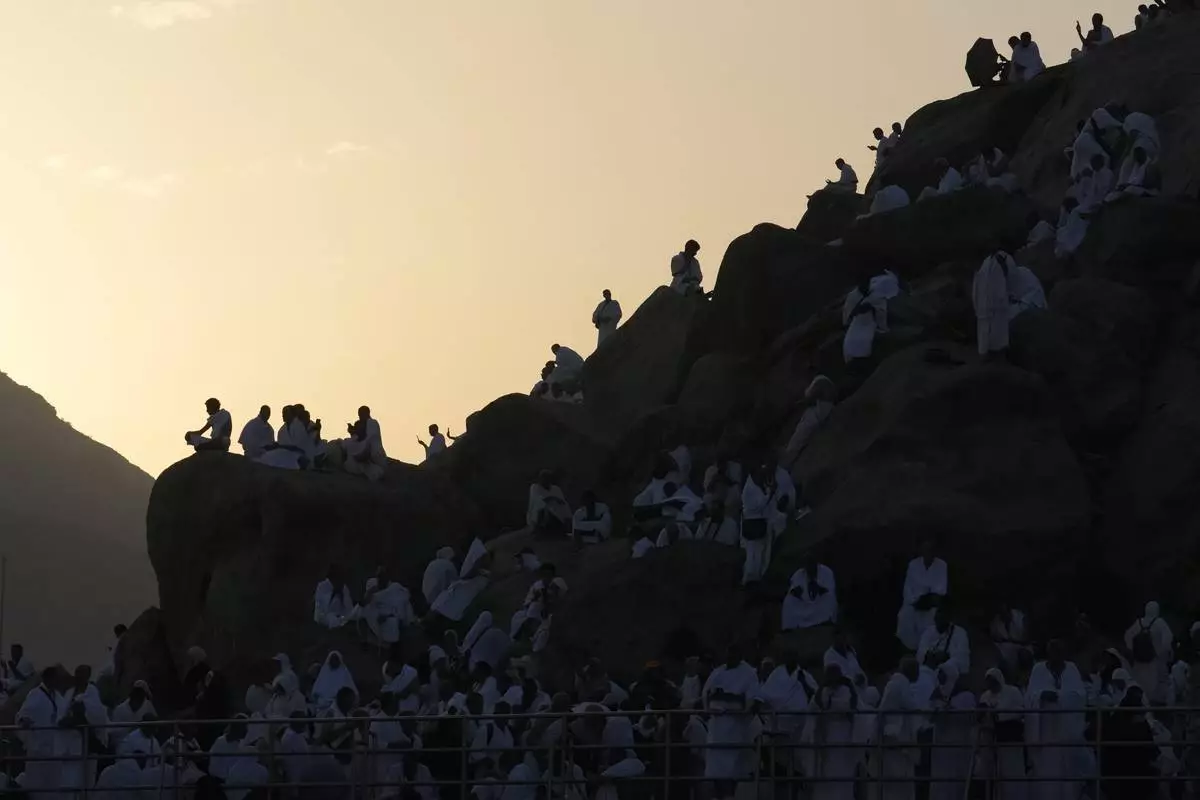
FILE - FILE - Muslim pilgrims circumambulate the Kaaba, the cubic building at the Grand Mosque, during the annual Hajj pilgrimage in Mecca, Saudi Arabia, Monday, June 17, 2024. (AP Photo/Rafiq Maqbool, File, File)

FILE - Muslim pilgrims gather at top of the rocky hill known as the Mountain of Mercy, on the Plain of Arafat, during the annual Hajj pilgrimage, near the holy city of Mecca, Saudi Arabia, Saturday, June 15, 2024.(AP Photo/Rafiq Maqbool, File)
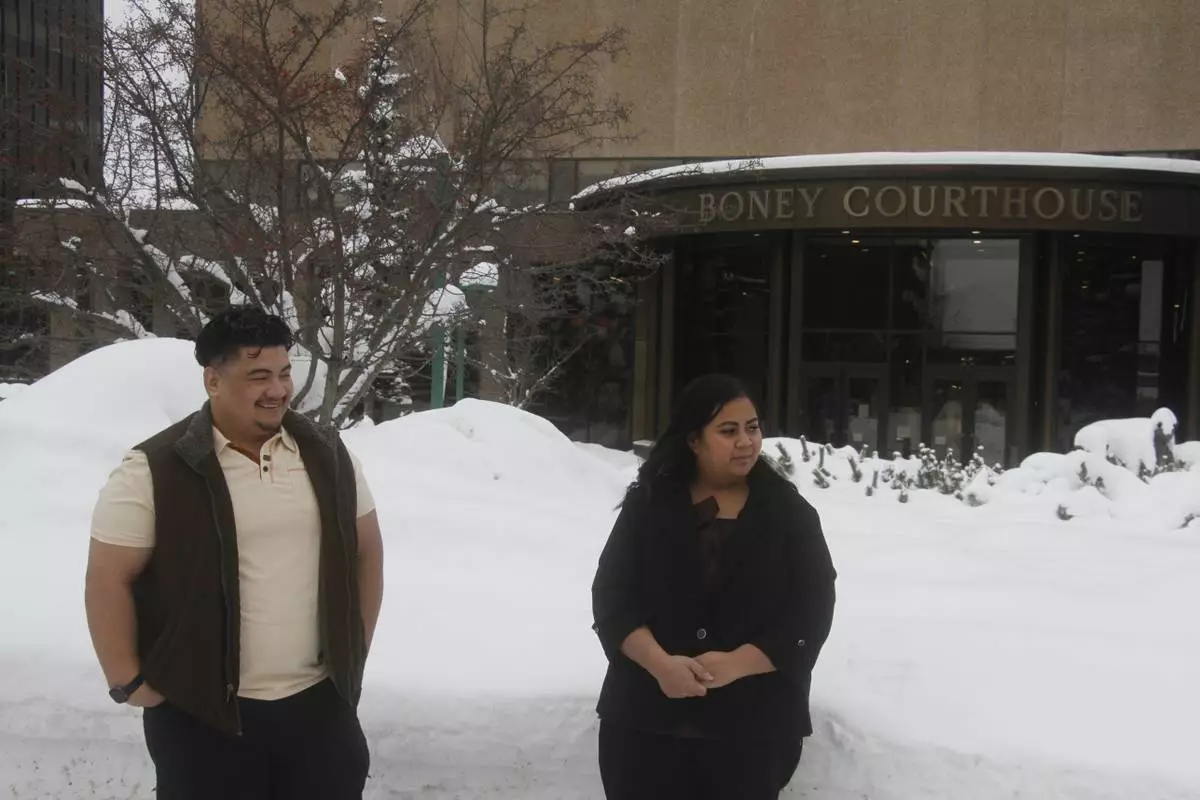
FILE - Muslim pilgrims gather at top of the rocky hill known as the Mountain of Mercy, on the Plain of Arafat, during the annual Hajj pilgrimage, near the holy city of Mecca, Saudi Arabia, Saturday, June 15, 2024.(AP Photo/Rafiq Maqbool, File)

ANCHORAGE, Alaska (AP) — A state appeals court is being asked to dismiss felony voter misconduct charges against an Alaska resident born in American Samoa, one of numerous cases that have drawn attention to the complex citizenship status of people born in the U.S. territory.

In arguments Thursday, attorneys for Tupe Smith plan to ask the Alaska Court of Appeals in Anchorage to reverse a lower court's decision that let stand the indictment brought against her. Her supporters say she made an innocent mistake that does not merit charges, but the state contends Smith falsely and deliberately claimed citizenship.

Prosecutors also have brought charges against 10 other people from American Samoa in the small Alaska community of Whittier, including Smith’s husband and her mother-in-law. American Samoa is the only U.S. territory where residents are not automatically granted citizenship by being born on American soil and instead are considered U.S. nationals. Paths to citizenship exist, such as naturalization, though that process can be expensive and cumbersome.

American Samoans can serve in the military, obtain U.S. passports and vote in elections in American Samoa, but they cannot hold public office in the U.S. or participate in most U.S. elections.

About 25 people gathered on a snowy street outside the courthouse before Thursday's hearing to support Smith. One woman, Fran Seager of Palmer, held a sign that said, “Support our Samoans. They are US nationals.”

Smith's husband, Michael Pese, thanked the American Samoa community in the Anchorage area. “If it wasn’t for you guys, I wouldn’t be strong enough to face this head on,” he said.

State Sen. Forrest Dunbar, a Democrat who attended the rally, said the Alaska Department of Law has limited resources.

“We should be going after people who are genuine criminals, who are violent criminals, or at least have the intent to deceive,” he said. “I do not think it is a good use of our limited state resources to go after these hardworking, taxpaying Alaskans who are not criminals.”

Smith was arrested after winning election to a regional school board in 2023. She said she relied on erroneous information from local election officials when she identified herself as a U.S. citizen on voter registration forms.

In a court filing in 2024, one of her previous attorneys said that when Smith answered questions from the Alaska state trooper who arrested her, she said she was aware that she could not vote in presidential elections but was “unaware of any other restrictions on her ability to vote.”

Smith said she marks herself as a U.S. national on paperwork. But when there was no such option on voter registration forms, she was told by city representatives that it was appropriate to mark U.S. citizen, according to the filing.

Smith “exercised what she believed was her right to vote in a local election. She did so without any intent to mislead or deceive anyone,” her current attorneys said in a filing in September. “Her belief that U.S. nationals may vote in local elections, which was supported by advice from City of Whittier election officials, was simply mistaken.”

The state has said Smith falsely and deliberately claimed citizenship. Prosecutors pointed to the language on the voter application forms she filled out in 2020 and 2022, which explicitly said that if the applicant was not at least 18 years old and a U.S. citizen, “do not complete this form, as you are not eligible to vote.”

The counts Smith was indicted on “did not have anything to do with her belief in her ability to vote in certain elections; rather they concerned the straightforward question of whether or not Smith intentionally and falsely swore she was a United States citizen,” Kayla Doyle, an assistant attorney general, said in court filings last year.

One of Smith's attorneys, Neil Weare, co-founder of the Washington-based Right to Democracy Project, said by email last week that if the appeals court lets stand the indictment, Alaska will be “the only state to our knowledge with such a low bar for felony voter fraud.”

Bohrer reported from Juneau, Alaska.

Michael Pese and his wife, Tupe Smith, stand outside the Boney Courthouse in Anchorage, Alaska, Thursday, Jan. 15, 2026, ahead of the Alaska Court of Appeals hearing a challenge to the voter fraud case brought against her by the state. (AP Photo/Mark Thiessen)

Michael Pese and his wife, Tupe Smith, stand outside the Boney Courthouse in Anchorage, Alaska, Thursday, Jan. 15, 2026, ahead of the Alaska Court of Appeals hearing a challenge to the voter fraud case brought against her by the state. (AP Photo/Mark Thiessen)

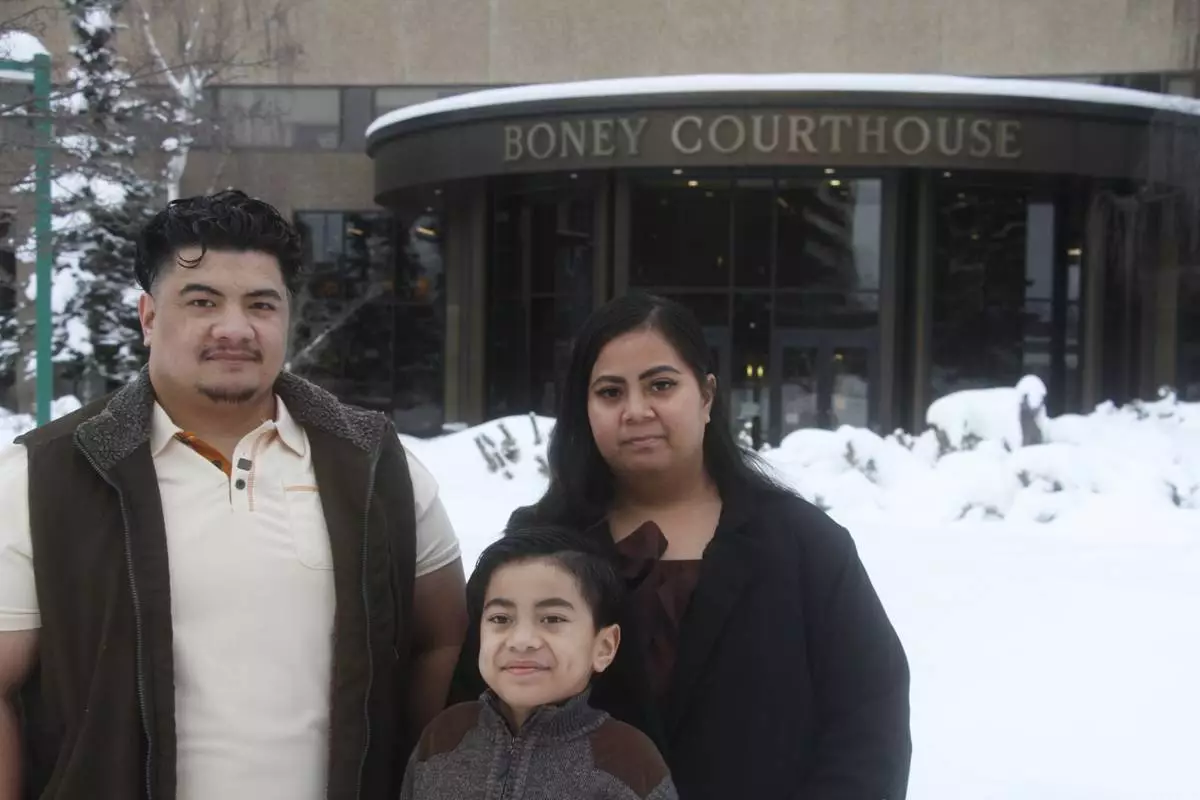
Michael Pese, left, his wife, Tupe Smith, and their son Maximus pose for a photo outside the Boney Courthouse in Anchorage, Alaska, Thursday, Jan. 15, 2026, ahead of the Alaska Court of Appeals hearing a challenge to the voter fraud case brought against her by the state. (AP Photo/Mark Thiessen)

Michael Pese, left, his wife, Tupe Smith, and their son Maximus pose for a photo outside the Boney Courthouse in Anchorage, Alaska, Thursday, Jan. 15, 2026, ahead of the Alaska Court of Appeals hearing a challenge to the voter fraud case brought against her by the state. (AP Photo/Mark Thiessen)

FILE - Tupe Smith poses for a photo outside the school in Whittier, Alaska, May 13, 2025. (AP Photo/Mark Thiessen, File)

FILE - Tupe Smith poses for a photo outside the school in Whittier, Alaska, May 13, 2025. (AP Photo/Mark Thiessen, File)

Recommended Articles