Global visitors at the 21st China International Cartoon and Animation Festival (CICAF), which opened on Thursday in Hangzhou City of east China's Zhejiang Province, are engaging in discussions about China's development in the animation industry and suggesting new strategies for its greater success overseas.
The CICAF has emerged as one of China's largest and most influential animation events, attracting over 18 million visitors and 21,000 companies from around the world to date.
"The festival has entered its 21st year, and we have many highlights in terms of international cooperation. For example, experts and industry insiders from the U.S., Russia, South Korea and Croatia have participated in various activities," said Wang Tian, a coordinator of the Organizing Committee of the CICAF.
This year's event is even more appealing, as the international acclaim of Chinese animation received a significant boost from the global box office success of "Ne Zha 2" earlier this year.
When the festival was first launched two decades ago, China's modern animation industry was just beginning, and production standards were relatively low
But things have changed with the success of "Monkey King: Hero is Back" in 2015, which grossed 956 million yuan (about 130.8 million U.S. dollars).
While the film marked a promising start, production standards still required significant improvement due to technological limitations, according to Li Baochuan, a professor at the School of Cultural Creativity and Media, Hangzhou Normal University.
"We have seen that the Ne Zha films significantly surpass 'Monkey King: Hero is Back' in terms of storytelling and technology, which can be attributed to the growth of a new generation of Chinese animators," he said.
Although Ne Zha 2 topped the global box office chart, the majority of its earnings has come from the domestic market, with the overseas revenues accounting for less than 3 percent.
A film's global success hinges on adopting tailored strategies for different markets, according to Li.
"If an animated film aims for global success, factors such as dubbing and improving the translation of Chinese dialog need to be considered early in the production process," he said.
Josh Selig, an American Emmy Award-winning writer, also noted that consumer behavior in different markets plays a significant role in films' global success.
"Many internationally-animated films are dubbed into English. The first release of 'Ne Zha 2' was in Mandarin with subtitles. For family audience, subtitles are not usually considered that appealing," said Selig, who is also President of China Bridge Content, a New York and Beijing-based content and consulting firm.
Other global artists at the event are finding inspiration in the beauty of Hangzhou. South Korean illustrator Yong E has created a painting dedicated to the city.
"I have done my research on the history and modern development of Hangzhou. I combined the history and the modernity and then a little bit of my own imagination," he said.
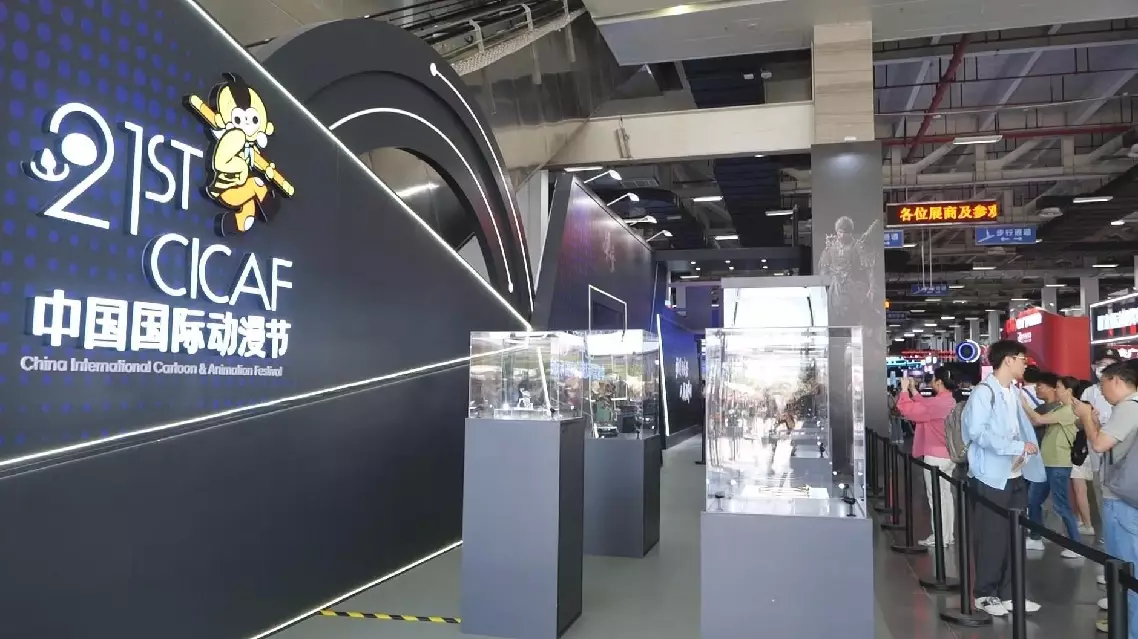
Global professionals discuss China's animation development