China Coast Guard (CCG) officers have for decades dedicated themselves to protecting the marine ecosystem of the Weizhou Island in south China's Guangxi Zhuang Autonomous Region, the country's only nearshore observation point for Bryde's whales, by employing electronic monitoring systems and public legal education to combat growing threats from illegal fishing and eco-tourism pressures.
The Weizhou Island, given its particular status in the ecosystem, attracts both researchers and eco-tourists, with CCG officers acting as dedicated protectors of the marine mammals in the sea waters around it.
"The marine environment around the Weizhou Island is vibrant, featuring coral reefs and serving as a feeding ground for Bryde's whales, which return for predation each year between December and April," said Wu Yuanpeng, a law enforcement officer at the Haicheng Second Workstation under Guangxi's Beihai Bureau of the CCG.
The Beibu Gulf, home to the Weizhou Island, is situated in the northern part of the South China Sea. It is not only one of China's main fishing grounds but also a crucial habitat for the whales.
"There are illegal fishing activities in this sea area sometimes. There are a lot of fish in these waters, especially small ones. At night, illegal fishing boats use lights to attract them and catch all the small fish that Bryde's whales feed on," Wu said.
Whale watching, a popular tourism item on the island, could disrupt the lives of these marine creatures. To mitigate the possible impact, CCG officers have collaborated with local travel agencies to install electronic fences, preventing boats from entering the central area.
"Our role in ecological and environmental protection is mainly that of a supervisor and law enforcer. Targeting lawbreaking acts, we carry out supervision and inspection in a timely manner," said Li Qian, another law enforcement officer at the Haicheng Second Workstation.
The growing investment in marine fisheries has led to ecological conflicts, prompting authorities to prioritize legal education to curb unintentional illegal fishing.
"In recent years, as marine economic activities have become more frequent involving the application of advanced technology, residents around here have been investing more into marine fisheries. With this growing investment, some conflicts related to marine ecological protection have also emerged. Many of them may not fully understand the law, and when it comes to illegal fishing, they might not even realize that what they're doing is in violation of law. That's why our first step is to focus on legal education -- raising awareness and helping the public understand the relevant laws and regulations," said Lei Guoning, deputy director of the Guangxi's Beihai Bureau of the CCG.
Many tourists visiting the island come from inland areas, where the Coast Guard and maritime law are often distant from their daily lives. But officers ensure that help is always within reach, with the CCG hotline "95110" available for assistance.
"The Weizhou Island -- honestly, since the moment I arrived, I've felt this little island is truly a lovely place. The fishermen and tourists here are all very warm and friendly. The fishermen will greet us whenever they see us, even when we head out to sea. Living and working alongside the people in this jurisdiction, protecting them, really feels like a meaningful job," Li said.

China Coast Guard officers dedicated to protecting marine ecosystem of south China's Weizhou Island
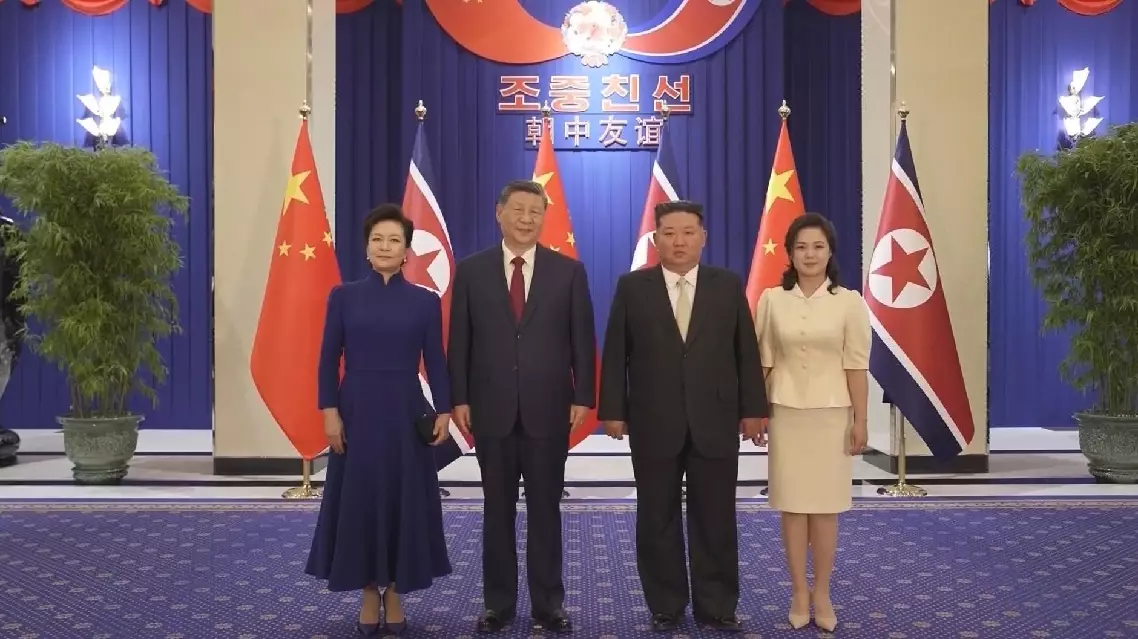
Xi Jinping, general secretary of the Communist Party of China (CPC) Central Committee and Chinese president, said on Monday that the relationship between China and the Democratic People's Republic of Korea (DPRK) stands at a new historical starting point.
Xi arrived in the DPRK capital of Pyongyang earlier on Monday to begin a two-day state visit at the invitation of Kim Jong Un, general secretary of the Workers' Party of Korea and president of the State Affairs of the DPRK, marking his first trip to the country in seven years.
Delivering a speech at a welcome banquet hosted by Kim, Xi pointed out that China and the DPRK, linked by mountains and rivers and sharing a common future, have seen their traditional friendship passed down across generations and grow ever stronger over time through the test of the evolving international landscape.
This year marks the 65th anniversary of the China-DPRK Treaty of Friendship, Cooperation and Mutual Assistance, and the China-DPRK relationship stands at a new historical starting point, Xi said, noting that he has reached important consensus with Kim during his visit.
From the strategic perspective of the future and destiny of socialism, both leaders have agreed to seize the general trend of the times, respond to the shared aspirations of the two peoples, strengthen high-level exchanges, deepen strategic communication, expand practical cooperation, enhance people-to-people bonds, promote the high-level development of China-DPRK relations, jointly open up brighter prospects for the socialist cause of both countries, and contribute to the continuous progress of human society, Xi said.
The successful convening of the Ninth Congress of the WPK this year has made strategic plans and major arrangements for the long-term development of the Party and the country's cause, ushering in a new period of comprehensive development of the DPRK's socialist cause, Xi said.
As good neighbors, good friends and good comrades, the Chinese side sincerely wishes that, under the strong leadership of the Central Committee of the WPK headed by General Secretary Kim, the DPRK people will successfully accomplish the goals and tasks set by the Ninth Congress of the WPK and make constant new achievements in the socialist cause of the DPRK, Xi said.
On behalf of the WPK, the government and the people of the DPRK, Kim extended the warmest welcome to Xi on his visit. Kim said that Pyongyang was filled with an atmosphere of friendship on this special day as the DPRK's Party, government and people warmly welcomed their most distinguished guest.
Noting that Xi's first overseas trip of the year had brought him to the DPRK, Kim said this fully demonstrated the great importance Xi attached to developing relations between the two parties and the two countries, and constituted the most valuable support for the DPRK's socialist cause.
Noting the meeting with Xi came nine months after their previous meeting, Kim said that during this meeting, they reached important consensus on further advancing DPRK-China relations with new contemporary connotations in light of new changing circumstances, and exchanged views on international and regional issues of mutual concern, which will surely accelerate the development of the DPRK-China friendship with profound historical traditions, and contribute to peace and stability in the region and the world.
The DPRK people take heartfelt joy in the remarkable achievements made by the brotherly Chinese people, Kim said, expressing belief that under the leadership of the CPC with Xi at its core, the great Chinese people will surely create greater achievements in building a great modern socialist country in all respects, realizing the Second Centenary Goal, and completing the new journey toward the great rejuvenation of the Chinese nation.
Xi says China-DPRK ties stand at new historical starting point