PHNOM PENH, Cambodia (AP) — Cambodia said it plans to seek a ruling from the U.N.’s International Court of Justice over border disputes with Thailand, one of which triggered a fatal military clash last week.
Cambodia’s National Assembly, where Prime Minister Hun Manet’s ruling Cambodian People’s Party holds all but a handful of seats, voted on Monday to support the government’s decision.
In 1962, the ICJ awarded to Cambodia the disputed territory on which a historic temple is located, rankled Thailand and to this day remains a major irritant in bilateral relations. The ICJ reaffirmed its ruling in 2013.
Speaking on Monday at a meeting of the Paris-based Organization for Economic Cooperation and Development, Thailand's Foreign Minister Maris Sangiampongsa said Cambodia has the right to file a case with the court, but that would not affect talks between the two countries under existing mechanisms He said Thai officials will meet later this week to issue a clear stance on the matter.
Thailand’s Deputy Prime Minister Phumtham Wechayachai, who is also defense minister, said in a post on Facebook that both countries are working to resolve the crisis by avoiding further confrontations and violence.
“I’d like to assure that we will avoid escalation of the conflict that would only result in losses for both sides in every aspect,” he wrote.
A border dispute near Morokot village, in Cambodia's northwestern province of Preah Vihear, on May 28 left one Cambodian soldier dead. It began when Cambodian troops were conducting a routine patrol along the border when the Thai side opened fire, according to Cambodian officials.
The Thai army says that Cambodian soldiers entered a disputed patch of land and opened fire when Thai soldiers approached them to negotiate.
Hun Manet in social media posts on Sunday declared that his government will ask the court to rule on the demarcation of several disputed areas, including where the centuries-old Hindu-style Ta Moan Thom, Ta Moan Toch and Ta Kro Bei temples are located.
In February, Cambodian troops and their family members entered the Ta Moan Thom temple in disputed territory and sang the Cambodian national anthem, leading to a brief argument with Thai forces.
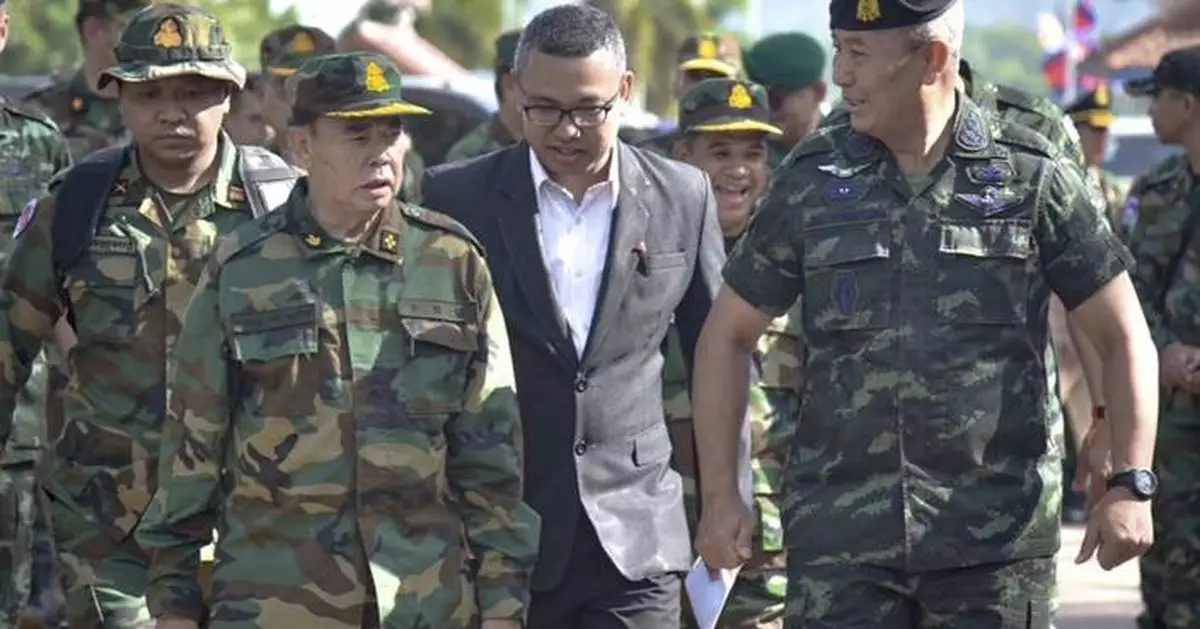
Following last week's incident, both sides called for calm and talks to ease their differences, while reserving the right to use military action to safeguard their sovereignty. On May 29, the two countries' army commanders met to discuss how to avoid more clashes
On Monday, Hun Manet called for the two countries to have their Joint Border Commission continue the work of border demarcation, as well as having the ICJ take up the issue.
He said his government would take the cases of the other disputed areas to the ICJ to determine ownership even if Thailand did not join in the appeal, in order “to end this problem and extinguish it once and for all so that there is no further confusion.”
“In particular, let’s not fall for the incitement of a handful of extremist groups in Cambodia and Thailand, and let’s not fall into the problem of confrontation by armed forces of the two countries,” he said.
Hun Manet’s intention to appeal to The Hague-based court may touch a raw nerve in Thailand, because the 1962 ruling awarding the major Preah Vihear temple to Cambodia is a touchstone issue for Thai nationalists. and wielded in domestic politics.
Last year, Thai Prime Minister Paetongtarn Shinatwatra’s government was attacked on nationalist grounds for proposing to resume talks with Cambodia on demarcation of maritime territory believed to hold profitable hydrocarbon resources.
In 2008, there were several deadly clashes between Cambodia and Thai forces at the Preah Vihear promontory, an area on which sits a 1,000-year-old temple that was listed as a UNESCO World Heritage Site that same year.
——-
Associated Press writer Jintamas Saksornchai in Bangkok contributed to this report.
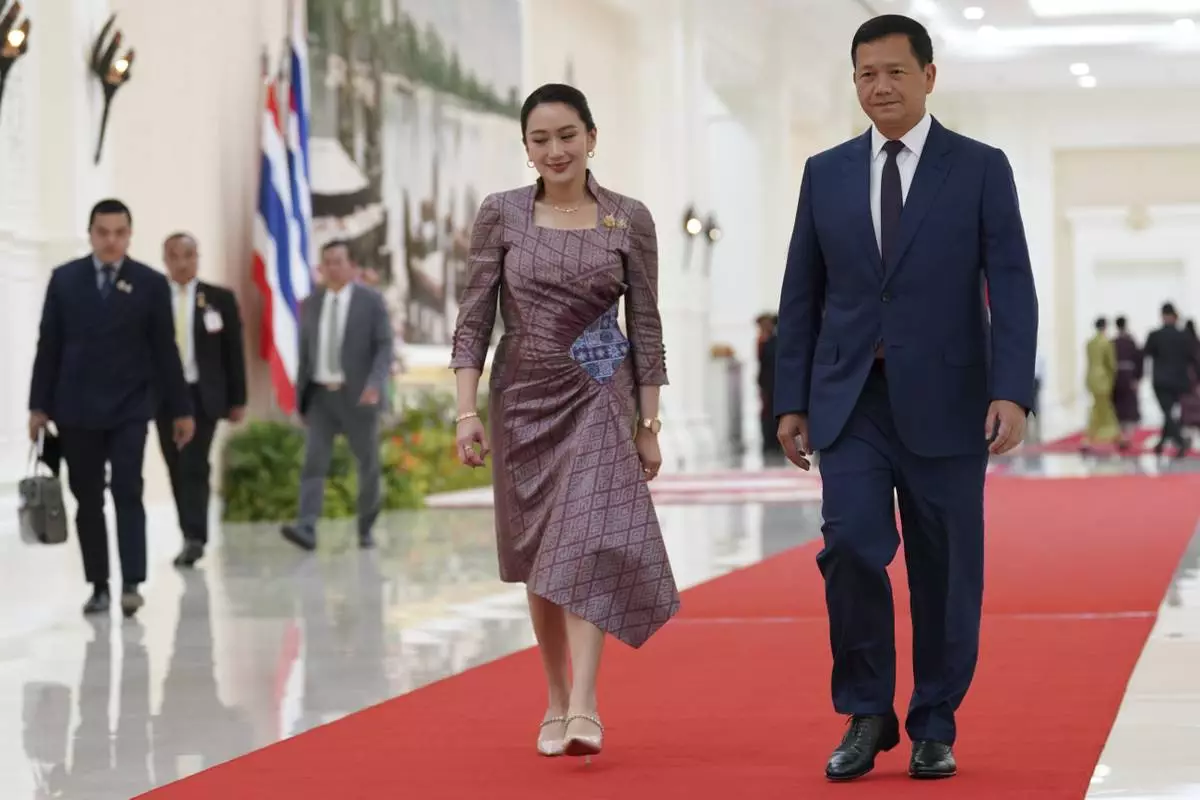
FILE - In this photo released by Agence Kampuchea Press (AKP), Thailand Prime Minister Paetongtarn Shinawatra, center, accompanied by Cambodian counterpart Hun Manet, right, arrives for a meeting at Peace Palace in Phnom Penh, Cambodia, April 23, 2025. (AKP via AP)
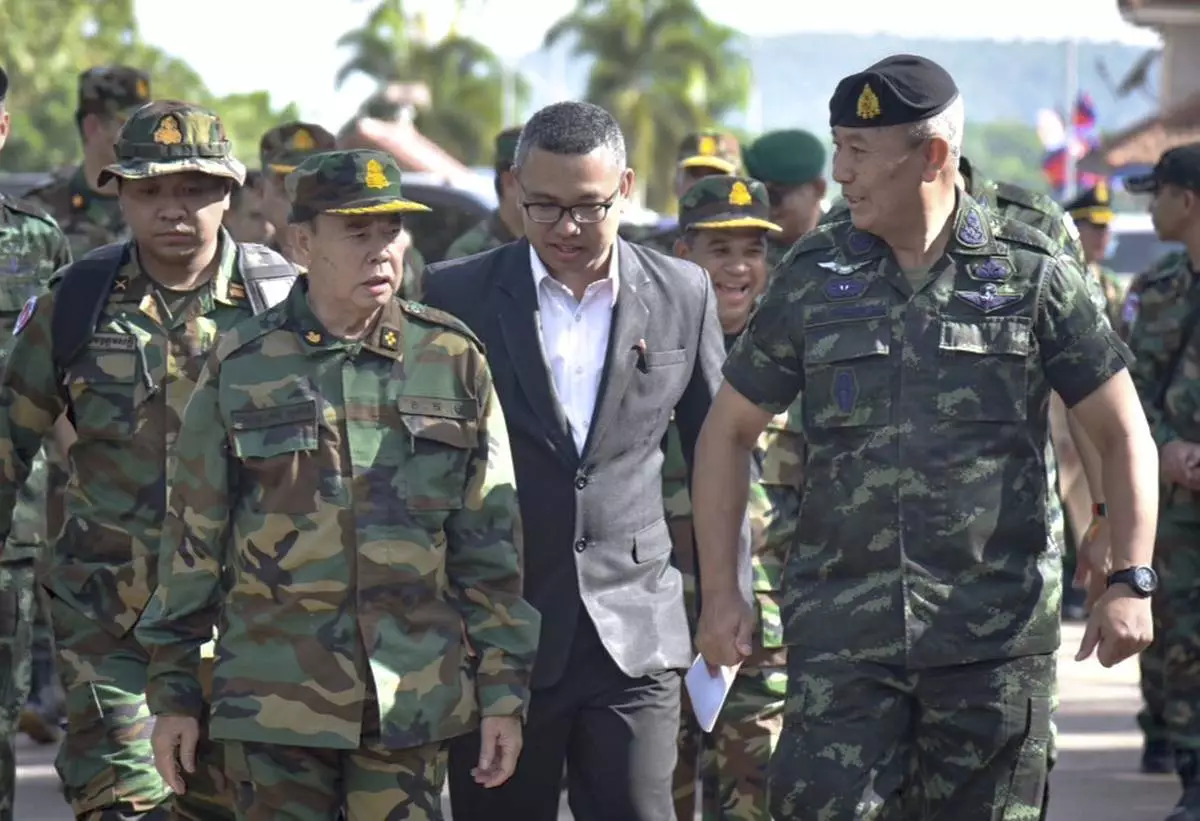
FILE - In this photo released by the Thai Royal Thai Army, Cambodian Chief of Army Mao Sophan, left, meets with Thailand Chief of Army Gen. Pana Claewplodtook, right, at a border checkpoint in Surin province, Thailand, May 29, 2025. (Thai Royal Thai Army via AP, file)
OKLAHOMA CITY (AP) — Shai Gilgeous-Alexander isn't scoring the way he usually does, but the Oklahoma City Thunder are still winning the way they normally do.
Gilgeous-Alexander, the reigning NBA MVP, averaged 31.1 points during the regular season. In the Western Conference semifinals against the Los Angeles Lakers, he is averaging 20 points and taking only 14 shots per game.
Oklahoma City has still won the first two games by an average of 18 points. Gilgeous-Alexander and Chet Holmgren each scored 22 points, and the defending champion Thunder beat the Lakers 125-107 on Thursday night.
Ajay Mitchell, starting in place of injured Jalen Williams, is averaging 19 points on 50% shooting in the series for Oklahoma City.
“I think the coaching staff does a good job at just getting all of us ready,” said Mitchell, a second-year guard. "And we have a lot of competitors. Like, everyone’s a competitor on our team. So every time the lights are bright, everyone’s ready to go.”
Holmgren is the leading scorer for the Thunder in the best-of-seven series with 23 points per game. The 2026 All-Star also is averaging 10.5 rebounds and 2.5 blocks.
Jared McCain, a midseason acquisition from the Philadelphia 76ers, barely played in the first round against Phoenix but has averaged 15 points and made 8 of 10 3-pointers in the series.
“He goes in there, stays in character, stays aggressive," Thunder coach Mark Daigneault said. "He’s going to shoot the next shot. He makes the right plays, plays inside the team. He competes defensively, has had good defensive possessions for us. And he was huge tonight. You need that in a playoff series.”
The Lakers again were without scoring champion Luka Doncic, who is out indefinitely with a strained left hamstring. They also were missing forward Jarred Vanderbilt, the reserve forward who dislocated the pinkie on his right hand during the second quarter of Game 1. The Lakers had three players finish with five fouls, limiting their aggressiveness late in the game.
Los Angeles guard Austin Reaves, who struggled with his shot in Game 1, scored 31 points on 10-for-16 shooting in Game 2. LeBron James, coming off a 27-point effort in Game 1, followed that up with 23.
With the Lakers up 63-61 early in the third quarter, Gilgeous-Alexander got tied up with Reaves and was called for his fourth foul. Upon review, it was upgraded to a flagrant 1 for Gilgeous-Alexander's follow through. Oklahoma City's Alex Caruso was called for a technical foul as the situation was being sorted out.
Gilgeous-Alexander left the game with the Lakers up 65-61, but the Thunder rallied and took control without him. On a fast break, Holmgren found a trailing Jaylin Williams, who hit a 3-pointer and was fouled. His free throw put the Thunder up 85-74.
The Thunder outscored the Lakers 32-15 while Gilgeous-Alexander was out in the third quarter to take a 93-80 lead into the fourth.
“It was amazing," Gilgeous-Alexander said. “They strung together stops, they’re playing the right way offensively and things are going their way. Full confidence in those guys. They know how to win basketball games. And we've proven that. They’ve proven that no matter who’s on the floor, they know how to get the job done. And they just did it again tonight."
The Lakers cut Oklahoma City's lead to five in the fourth quarter before the Thunder pulled away again.
Los Angeles will host Game 3 on Saturday.
“We just stuck with it,” Holmgren said. “It’s the game of basketball. It’s not always going to go your way. It’s about how you respond. And this team has proven many times that we know how to respond. And we did so tonight.”
This story has been corrected to show that Shai Gilgeous-Alexander is averaging 20, not 19, points per game against the Lakers.
AP NBA: https://apnews.com/hub/NBA
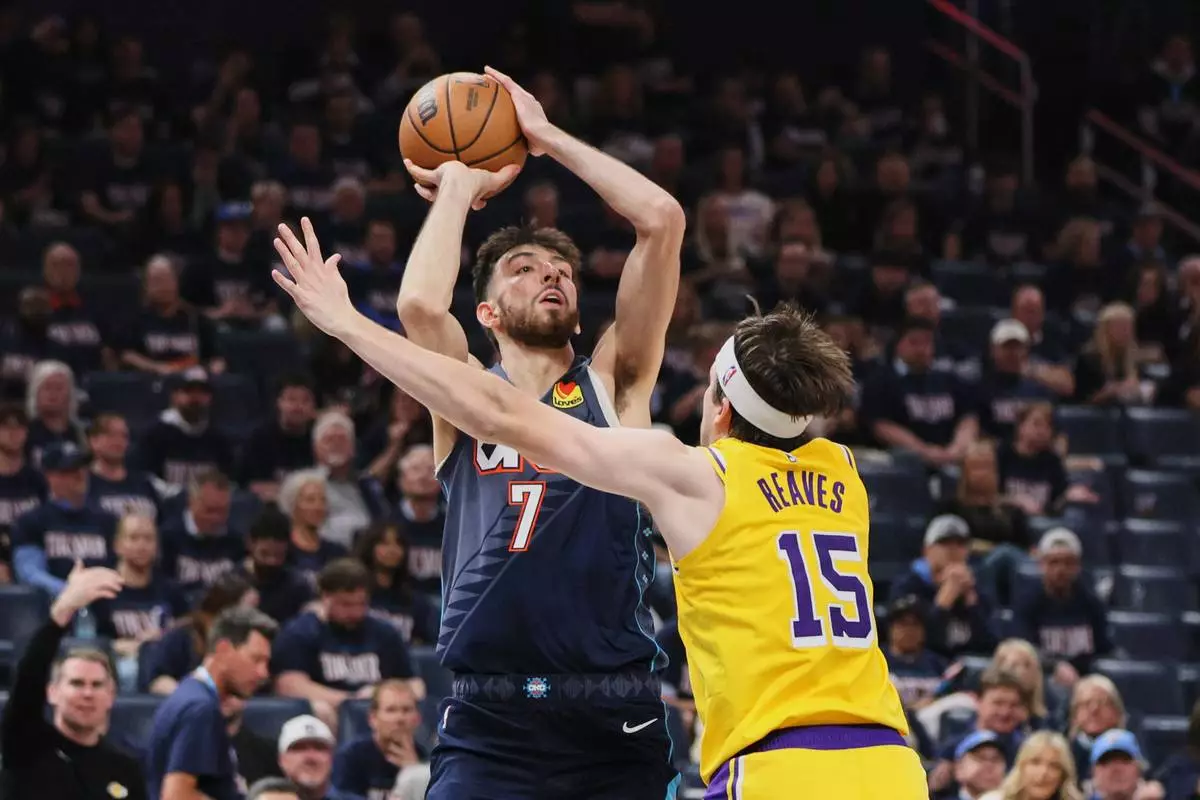
Oklahoma City Thunder's Chet Holmgren (7) shoots over Los Angeles Lakers' Austin Reaves (15) in the second half of Game 2 in a second-round NBA basketball playoffs series Thursday, May 7, 2026, in Oklahoma City. (AP Photo/Nate Billings)
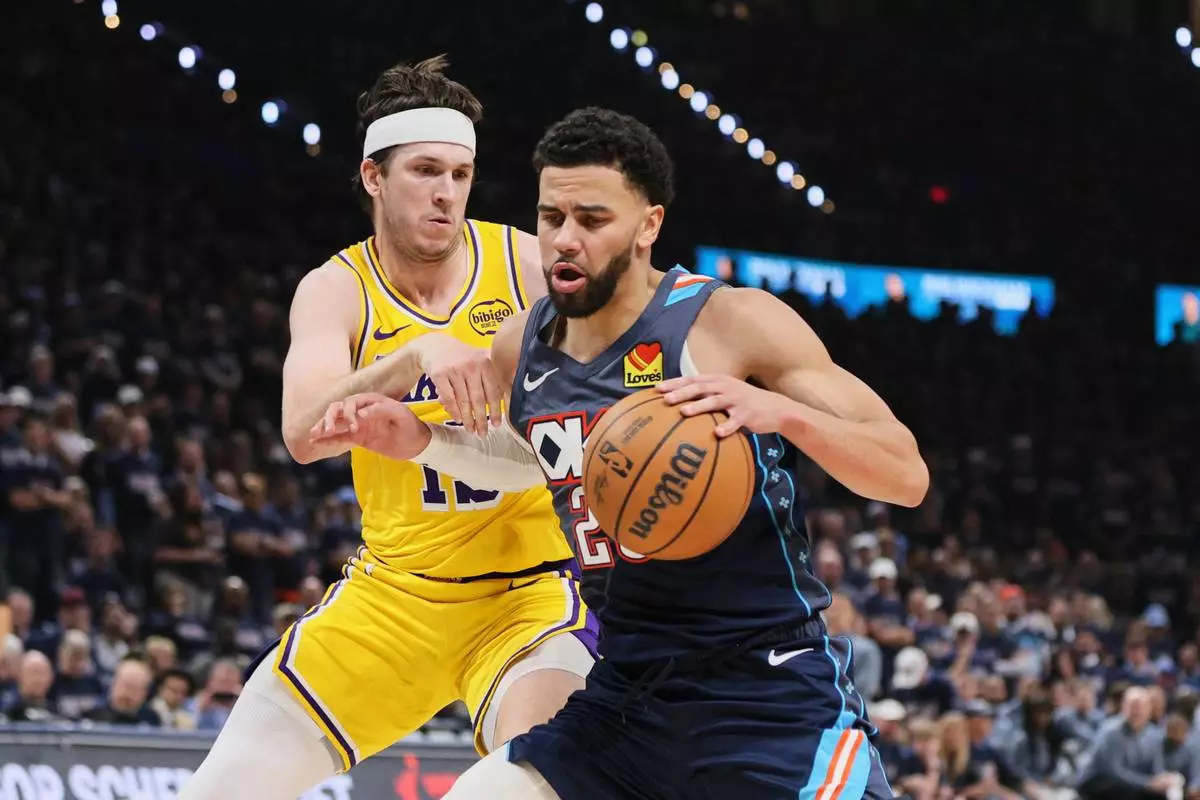
Oklahoma City Thunder guard Ajay Mitchell, front, works for a shot as Los Angeles Lakers' Austin Reaves, rear, defends in the second half of Game 2 in a second-round NBA basketball playoffs series Thursday, May 7, 2026, in Oklahoma City. (AP Photo/Nate Billings)
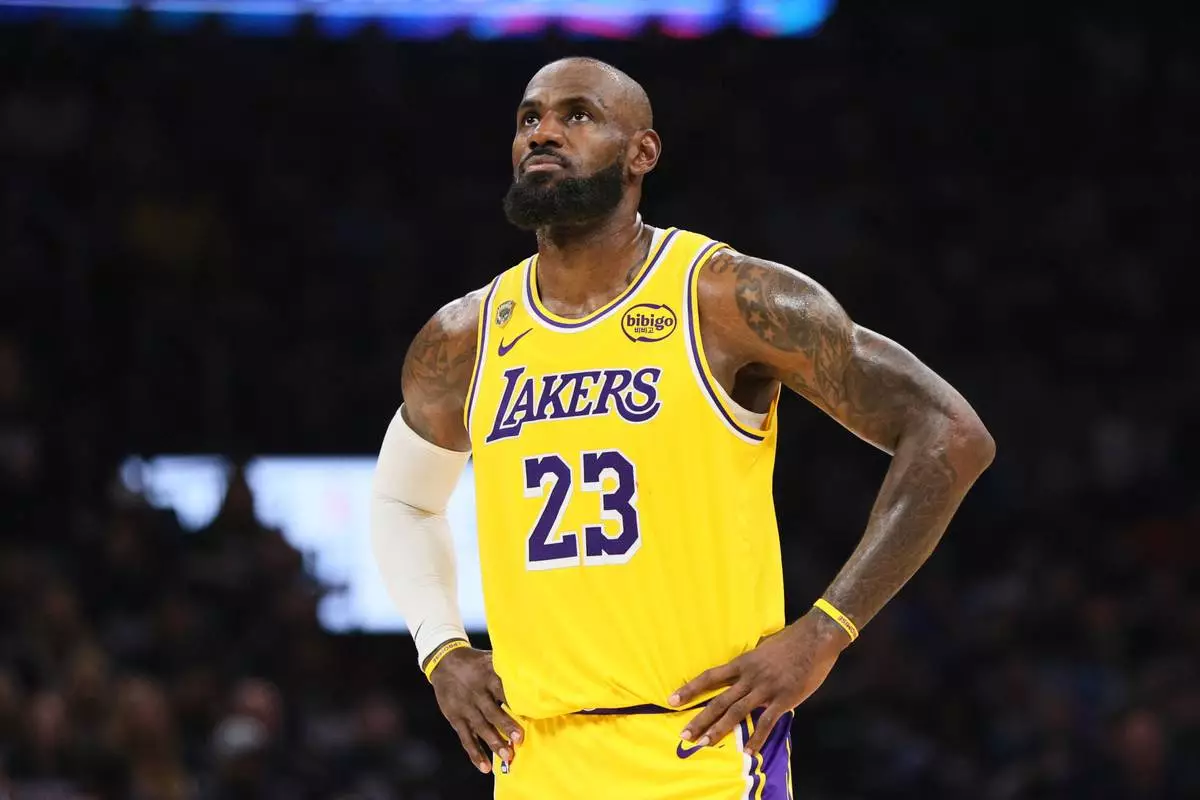
Los Angeles Lakers' LeBron James stands on the court in the second half of Game 2 in a second-round NBA basketball playoffs series against the Oklahoma City Thunder Thursday, May 7, 2026, in Oklahoma City. (AP Photo/Nate Billings)
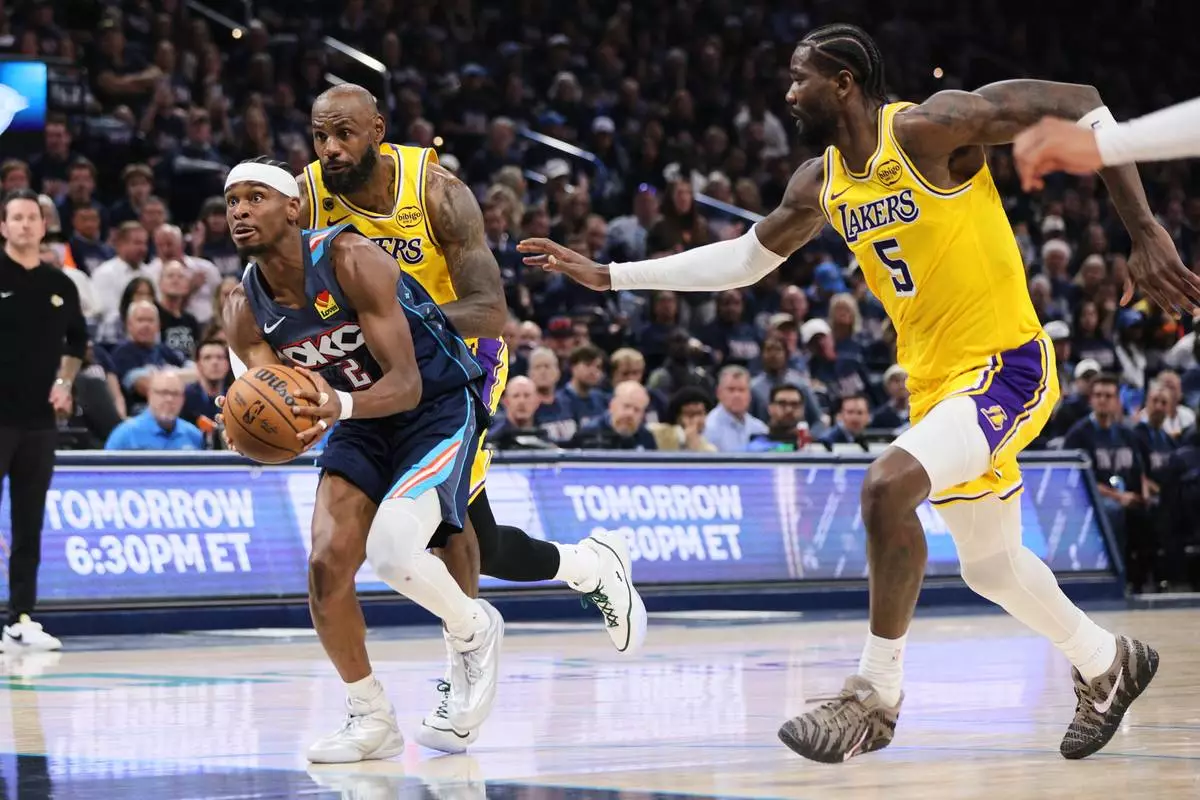
Oklahoma City Thunder guard Shai Gilgeous-Alexander (2) drives to the basket past Los Angeles Lakers' Deandre Ayton (5) and LeBron James, rear, in the second half of Game 2 in a second-round NBA basketball playoffs series Thursday, May 7, 2026, in Oklahoma City. (AP Photo/Nate Billings)
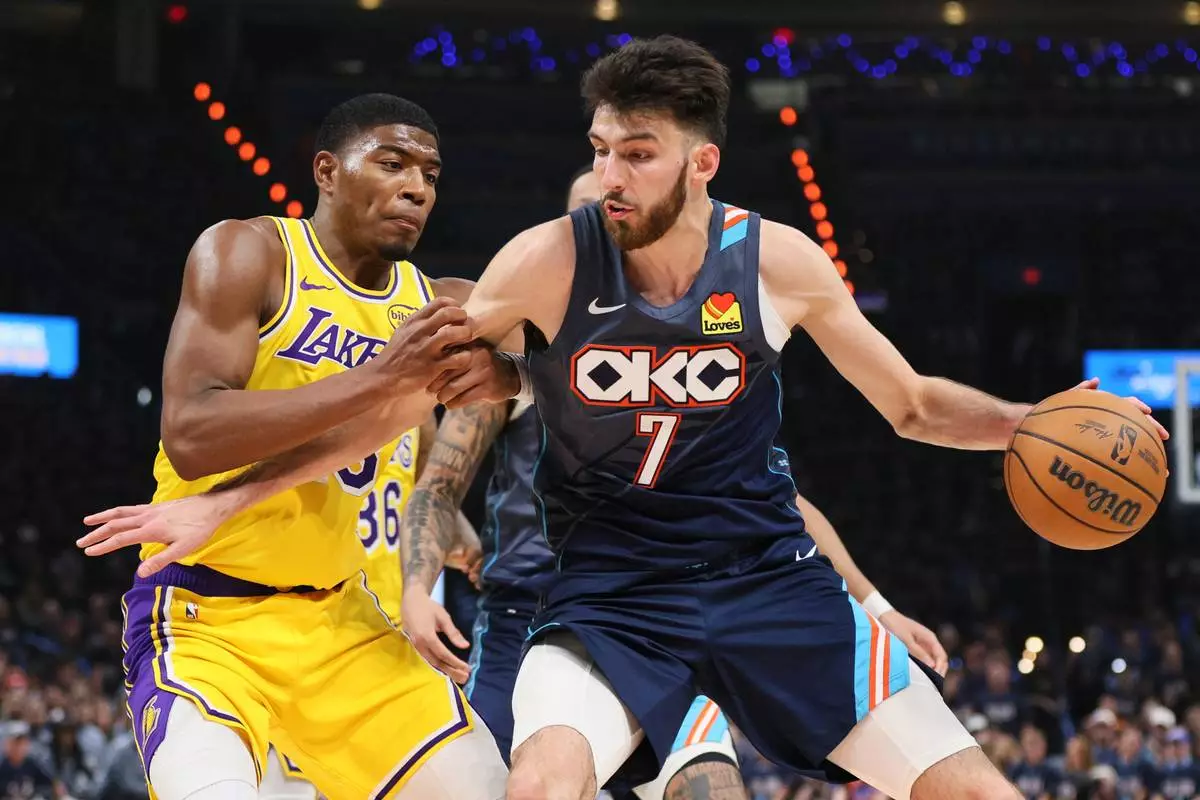
Oklahoma City Thunder center Chet Holmgren (7) works to the basket against Los Angeles Lakers forward Rui Hachimura (28) in the second half of Game 2 in a second-round NBA basketball playoffs series Thursday, May 7, 2026, in Oklahoma City. (AP Photo/Nate Billings)