More and more foreigners in China have joined dragon boat races held across the country over the recent years, showcasing their enthusiasm for the sport as well as Chinese traditional culture.
In English, Duanwu Festival is called the "Dragon Boat Festival," and the sport of dragon boat race has always been popular overseas.
Konna, a Russian dragon boat racer from the Beijing International Dragon Boat Club, is one of the enthusiasts who love participating in group sports events.
"I first saw dragon boat race in Guangdong. One morning, I spotted people paddling at a park and asked my local friends how to get involved. I love dragon boating because it's a team activity. Once you are in the boat, you are part of a team, and I really enjoy that feeling," said Konna.
From fascination to participation, Konna now trains every weekend with her dragon boat team and has become an experienced paddler. She has also traveled to various Chinese cities to compete in races, immersing herself in the local culture.
Through dragon boating, she has gained a deeper understanding of the Chinese values of perseverance, teamwork, and unity.
The Beijing International Friendship Dragon Boat Club was founded in 2001. Initially composed of embassy staff, the club has since expanded to Shanghai, Guangzhou, and other cities, with around 4,000 to 5,000 members from all over the world.
"When we first formed the team, about three-quarters of the members were foreigners. Through our training and competitions, we've not only promoted dragon boat race in China, but also taken this Chinese-origin sport abroad, showcasing China's strength," said He Xianguo, founder of the club.
This year's dragon boat race in east China's Fujian Province also saw strong participation from international dragon boat lovers.
2025 Fuzhou International Dragon Boat Invitational and Belt and Road Youth International Dragon Boat Invitational attracted 71 teams from 30 countries and regions in the world, including Malaysia, Germany, the United Kingdom, and Iran, all paddling together in friendly competition.
"I came to Fuzhou specifically for this race. I really love Chinese festivals, and this event is a window for foreigners to experience authentic Chinese culture," said Holly Richard John, a member of the British Fujian Chamber of Commerce.
The Duanwu Festival is a traditional Chinese holiday celebrated on the fifth day of the fifth month of the Chinese lunar calendar. The festival was celebrated on May 31 this year. Some of its most well-known festivities include dragon boat races and eating zongzi - sticky rice dumplings wrapped in bamboo leaves.
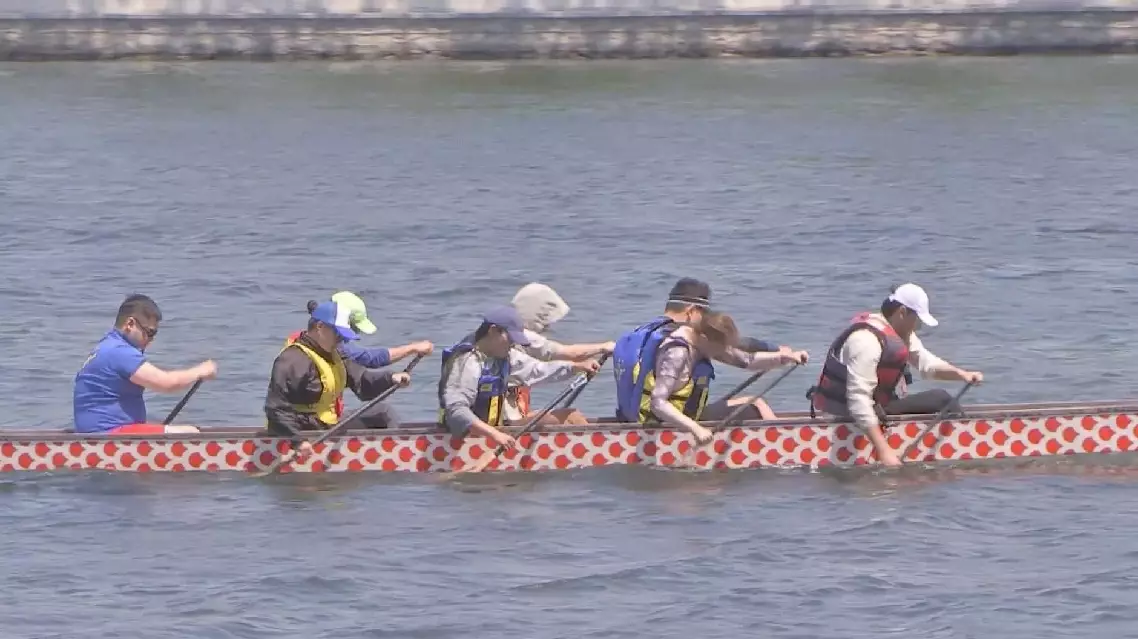
Expats show enthusiasm for Chinese traditional culture by joining dragon boat race