Stylish tea-brewing robots are injecting new life to century-old tea artistry in a cultural festival in Chengdu City of southwest China's Sichuan Province.
For people in Chengdu, tea is more than a drink. It's a way of life that permeates every aspect of their daily routines, from bustling street corners to serene city parks.
Rooted in Sichuan's history over a century ago, the art of tea pouring using long-spouted kettles has captivated audiences with its elegance, all while serving a practical function of cooling the boiling water to the perfect temperature for teas.
"People in Chengdu are especially fond of tea, most commonly green or floral types, brewed with exceptionally fine and tender young buds. The kettle's long spout cools the boiling water to around 80 degree Celsius as it pours - just right for these kinds of tea," said He Tingting, an inheritor of long-spout tea art and an exhibitor at the Ninth Chengdu International Festival of Intangible Cultural Heritage which runs till Tuesday.
Holding the long, gleaming spout felt a bit like wielding a sword - graceful yet demanding. But even a craft as hands-on as tea pouring is getting a high-tech twist.
In another booth of the exhibition, a tea-making robot handles the entire process - boiling, brewing, and pouring - with impressive precision. Its moves may be mechanical, but customers say the tea still tastes just right.
"This robot learned tea making techniques from the 17th-generation inheritor of the imperial tribute tea tradition dating back to Emperor Qianlong's era. While there are still slight differences in pour speed, it's getting very close. Young people love seeing heritage skills combined with smart technology. It helps us reach a much broader audience," said Xiang Hao, research and development director of Gincy Robotics, the company that developed this robot.
The tea-brewing robot is just one part of a bigger vision.
"Our priority is to build a smart teahouse with not only robot tea masters, but also lifelike robots to greet guests, emotional-support robot pets, and holographic 3D displays of intangible cultural heritage. These robot pandas can smile, cry, and interact with people," said Hu Yong, general manager of Starmoon Vision Technology.
Relaxing in a massage chair that simulates traditional Chinese techniques, people can immersing themselves in the warmth of tea poured by a real person while embracing the futuristic allure of a teahouse where tradition and innovation coexist seamlessly.
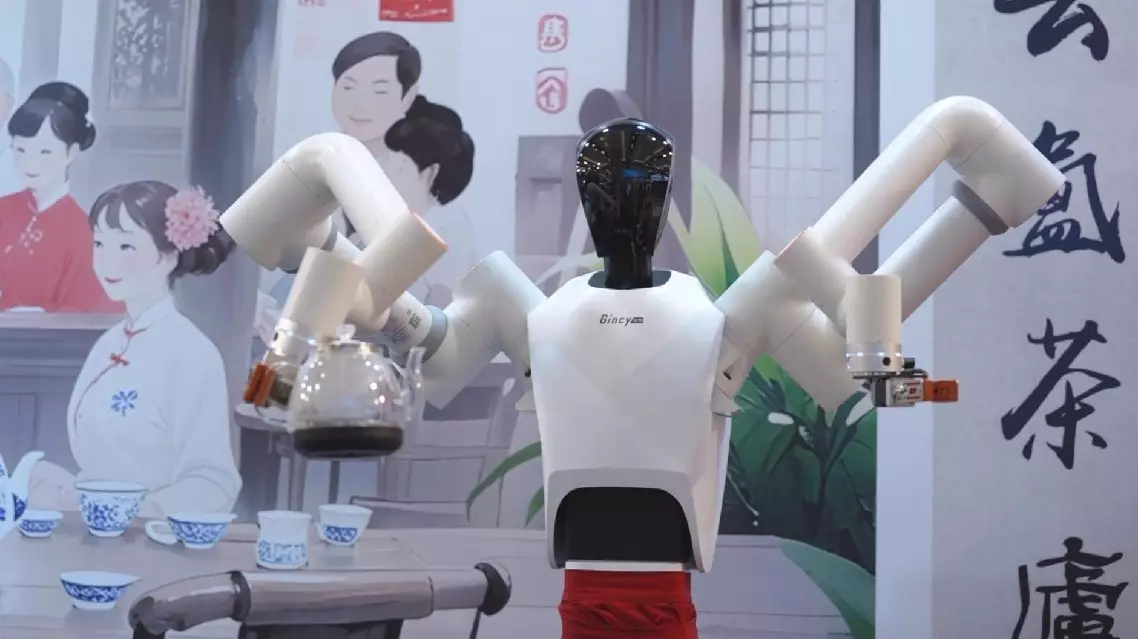
New trend of robotic tea-brewing stirs cultural interest in Chengdu