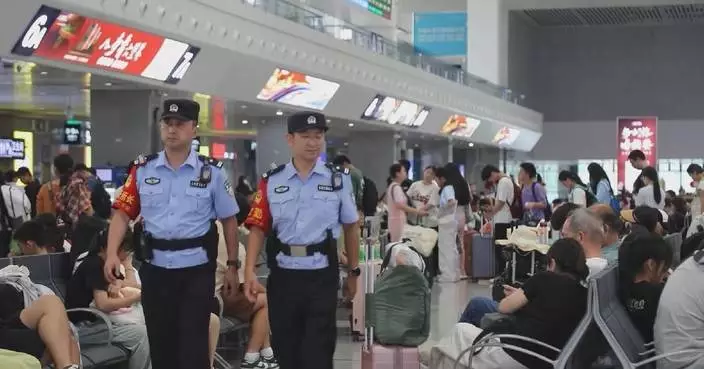
China's tourism market showed steady growth during the just-concluded Dragon Boat Festival holiday, with 119 million domestic tourist trips recorded nationwide, according to data from the Ministry of Culture and Tourism on Tuesday.
The figure represents a 5.7 percent increase compared to the same period last year. Total tourism spending reached 42.73 billion yuan (about 5.93 billion U.S. dollars), up 5.9 percent from the previous year, the ministry said.
This year's Dragon Boat Festival, also known as the Duanwu Festival, was celebrated on May 31, and the public holiday ran from May 31 to June 2.
Traditional festival activities drove much of the tourism activity, with dragon boat races in Guangdong, Hunan, Jiangxi, Guizhou and Zhejiang provinces attracting large crowds. Cultural venues including the Palace Museum and National Museum of China reported strong attendance, while Beijing hosted 1,119 commercial performances drawing 458,000 spectators.
The holiday period, which overlapped with Children's Day this year, saw a surge in family travel. Theme parks and short-distance trips via high-speed rail or car proved particularly popular in major city clusters like the Yangtze River Delta and Beijing-Tianjin-Hebei region. County-level destinations also gained traction among travelers seeking less crowded alternatives.
Tourism authorities unveiled multiple measures to boost spending, including discounted tickets and promotional packages. Technology-enhanced experiences, such as drone delivery services in Shenzhen and AI-powered travel planning in Jiangsu's Zhouzhuang ancient town, added modern touches to traditional festival celebrations.

China registers 119 million domestic tourist trips during Dragon Boat Festival holiday

Chinese tourists are returning to Thailand in large numbers, providing a welcome boost to the country's tourism sector, as holidaymakers from China to the Southeast Asian nation are up by nearly 30 percent.
After a decline in Chinese travelers to Thailand over the past two years, numbers have surged this year, offsetting a slump in arrivals from the Middle East due to conflict, higher fares and fewer flights.
In the first week of May, which included China's May Day holiday from May 1 to 5, arrivals from China were up by 28 percent year on year, with a total of almost 135,000 visitors, an average of more than 19,000 per day, according to a report released by Bangkok financial consultants FSS Investment Securities.
Chinese travelers accounted for 22 percent, more than a fifth of all foreign tourist arrivals, approaching figures not seen since before COVID-19.
Rena Yu, a Chinese tourist, said she is drawn by the "many different cultures" and local cuisines in Thailand.
"More and more people around us visit here and they had a very wonderful experience. So, it makes we (us) go (come) here to visit," said Liu Xiaojing, another Chinese tourist.
While the number of non-Chinese visitors was down by nine percent overall, primarily due to unrest in the Middle East, those from China outperformed the market, providing a major boost to Thailand's tourism sector.
"It's very helpful for the tourism industry in Thailand because of the situation in the Middle East. And lately, we're really improving in numbers from Chinese tourists. Because last year, we faced declining in the Chinese market of around 30 to 40 percent from the previous year," said Thienprasit Chaiyapatranun, executive director of the Thai Hotels Association.
Thai officials have worked to reassure Chinese visitors that the country is a safe destination after concerns over security and reports of illegal employment scams.
"After the visitation of the royal family, I mean the king, to China last year, late of last year, that is the turning point of the coming-back of the Chinese tourists, because they thought about the relationship is stronger than before, I mean, in every level, not only the government, but also the people-to-people [level] as well," said Sirigesanong Trirattanasongpol, executive director of East Asia at the Tourism Authority of Thailand.
It seems to have been successful, with Chinese visitors expected to remain a key driver of growth in the Thai tourism sector for the rest of the year.
Surge in Chinese tourists provides major boost to Thai tourism sector