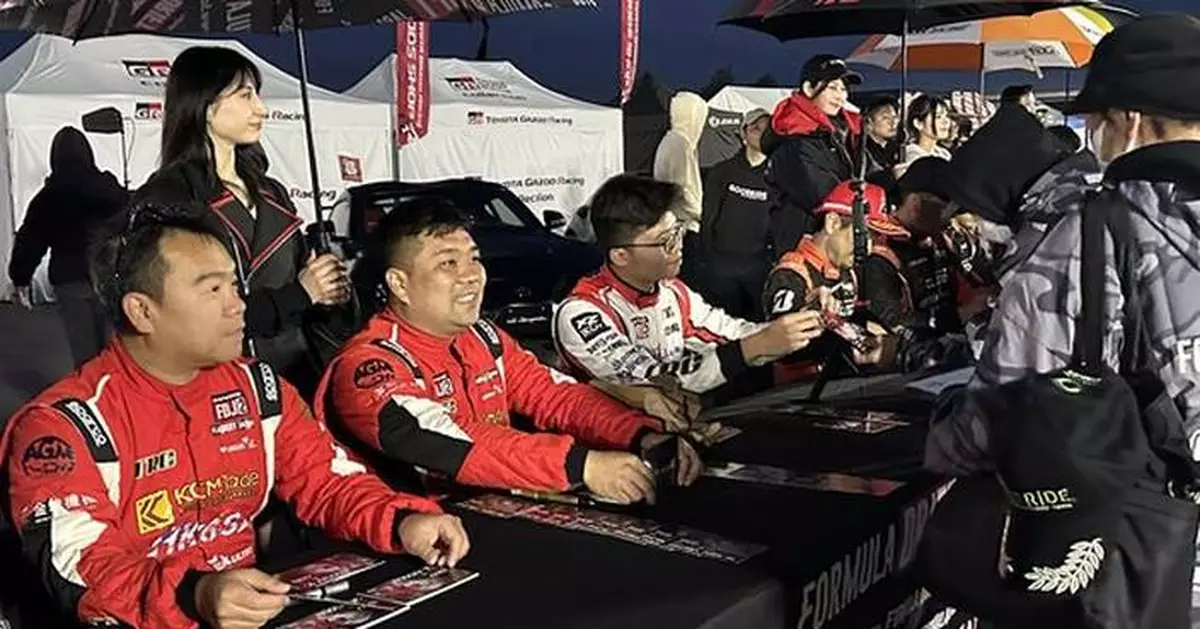
HONG KONG, June 3, 2025 /PRNewswire/ -- Hong Kong-based drift team TRC (TYPE R CLUB) is set to compete in the 2025 season of Formula Drift Japan 2 (FDJ2), poised to challenge the pinnacle of international drifting. Led by Team Principal and lead racer James Tang, the team will be joined by a cohort of promising young talent from across Asia. Combining technical precision with relentless passion, TRC is committed to delivering standout performances and making a strong mark throughout the season.
Two Decades of Dedication – From Hong Kong to the Global Stage
Since its establishment in 2005, TRC has remained dedicated to promoting motorsport culture. From touring car racing to competitive drifting, the team has built a comprehensive and professional development pathway for emerging racers. Headquartered in Hong Kong and operating primarily out of the Zhuhai International Circuit, TRC has consistently hosted a range of track days, car tuning events, and drift competitions, providing valuable hands-on experience to racers throughout Asia.
FDJ2 Campaign: Enhanced Racer Line-up
The 2025 FDJ2 season commenced in April, with TRC fielding a dynamic team that combines seasoned professionals with rising stars of the drifting world:
- James Tang|Hong Kong
TRC Team Principal and lead racer with over 20 years of competitive experience. Tang has participated in prestigious events including the TCR International Series and the Red Bull Drift Battle. - Hubert Li|Hong Kong
Wine entrepreneur and RSR x TRC racer. Competing since 2017 in a Toyota GR86 (ZN8), Li has previously advanced to the top 32 in competition. - Ken Yeung|Hong Kong
Founder of AGM Motor and KCM TRADE x TRC racer. Since 2023, he has competed with a Toyota ALTEZZA (SXE10), reaching the top 8 in prior FDJ2 events. - Ryan Tsui|Hong Kong
CEO of a fintech group and an active contributor to the local drifting scene. Tsui promotes the development of drifting culture and motorsport exchange throughout Asia. He competed in FDJ2 2024 with a ToyotaCHASER (JZX100) as a KCM TRADE x TRC racer. - Timmy Wu|Hong Kong
Two-time RC model drift world champion, now racing with RSR x TRC. Since 2024, Wu has competed in a Toyota GR86 (ZN8) and advanced to the top 8 in FDJ2. - Julian Kwok|Hong Kong
RSR x TRC racer and student, set to make his official debut in 2025 driving a Toyota Supra (A80). At just 14 years old, Kwok is the youngest racer on the team and will be competing in FDJ2 for the first time.
TRC will compete in the full FDJ2 season, contending alongside elite racers from Japan, Mainland China, New Zealand, and Bangladesh.
Looking Ahead – TRC Anchored in Hong Kong, Connecting the Asian Motorsport Community
TRC affirms that the 2025 FDJ2 campaign is more than a racing endeavour—it is a mission to foster deeper connections within Asia's motorsport ecosystem. Through international competition, the team aims to further accelerate the growth of the local drifting scene, nurture emerging talent, and integrate motorsport education with charitable initiatives to broaden its social impact.
** The press release content is from PR Newswire. Bastille Post is not involved in its creation. **
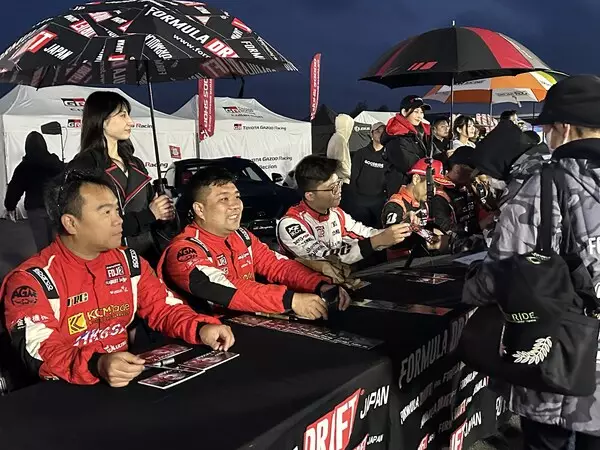
TRC Drift Team Competes in 2025 FDJ2 International Series — Igniting Asian Drift Fever
|
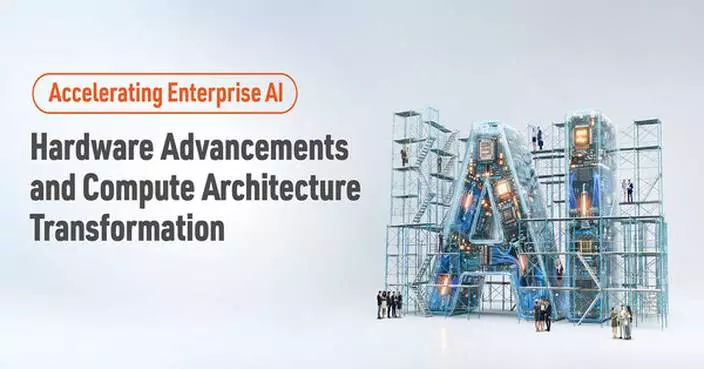
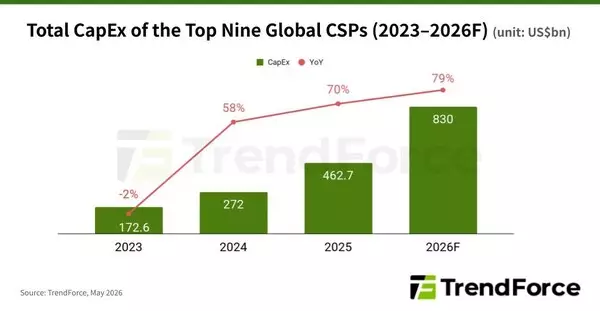
NEW YORK, May 6, 2026 /PRNewswire/ -- TrendForce's latest findings on the AI industry highlight that several major North American CSPs have recently raised their 2026 capital expenditure (CapEx) guidance in response to strong AI demand. As a result, TrendForce has revised its forecast for the combined CapEx of the world's top nine CSPs—Google, AWS, Meta, Microsoft, Oracle, ByteDance, Tencent, Alibaba, and Baidu—up to approximately US$830 billion in 2026, with the annual growth rate raised from 61% to 79%.
Taking a look at the four major U.S. CSPs, Microsoft has increased its CapEx outlook to $190 billion, implying approximately 130% YoY growth. Around roughly $25 billion is attributable to rising component costs. Similarly, Google has raised its guidance from $175–185 billion to $180–190 billion, with growth exceeding 100%. Meta has revised its CapEx range upward from $115–135 billion to $125–145 billion, representing approximately 85% YoY growth. Lastly, AWS is expected to exceed $230 billion in CapEx this year, with growth of over 50% driven by demand for AI cloud services.
TrendForce notes that the pace of CapEx expansion among North American CSPs exceeds the global average, underscoring that AI infrastructure has become a core long-term strategic priority. Investment is increasingly concentrated in the deployment of high-performance GPU clusters, in-house ASIC development, and next-generation data centers designed to support high-power-density computing.
The sharp rise in CapEx also signals sustained momentum in data center construction, led primarily by AWS, Microsoft, Google, Meta, and Oracle. As of the end of 2025, these five North American CSPs had deployed 800–900 data centers globally, with AWS accounting for the lion's share.
Among Chinese CSPs, Alibaba and ByteDance are the main drivers of expansion—though their strategies diverge. Alibaba is focusing on localized nodes and sovereign cloud offerings through Alibaba Cloud to penetrate emerging markets. Since announcing expansion plans in 2025, the company has established new regions in Brazil, France, and the Netherlands, enlarging its global footprint to 29 regions and 94 availability zones.
In contrast, ByteDance is aggressively expanding overseas through TikTok, with operations established across eight countries, including the U.S., Brazil, and Ireland, and major investments in Europe, Thailand, and Malaysia. This makes it the most geographically aggressive Chinese CSP.
TrendForce further notes that sustained AI demand will continue to drive global data center growth, with total installed power capacity expected to reach approximately 155 GW in 2026 (~+29% YoY). AI servers are also projected to surpass general-purpose servers in total electricity consumption in 2026 due to significantly higher power consumption per unit.
Further jumps in power consumption are expected in 2027–2028 as platforms such as GB300/Rubin and ASIC-based AI servers enter mass production. This trend will, in turn, support growth in key components such as HVDC power systems and liquid cooling systems.
For more information on TrendForce's semiconductor reports and market data, please visit the Report Page, or Email (SR_MI@trendforce.com) the Sales Department.
For more on the latest technology industry news and trends, please visit News.
About TrendForce
TrendForce is a global leader in technology industry analysis and consulting services. With deep expertise spanning foundry, DRAM, HBM, NAND Flash, AI servers, robotics, near-eye displays, display panels, LEDs, MLCC, and green energy, it also offers in-depth research into key market drivers such as AI, automotive technologies, 5G/6G communications, LEO satellites, and the IoT.
Backed by a team of top industry professionals, TrendForce has been at the forefront of global market research for over 25 years. More than 60% of its clients are among the world's top 500 companies.
TrendForce's global footprint includes Taipei, Shenzhen, Silicon Valley, New York, and Tokyo. With timely and strategic industry analysis, TrendForce delivers the critical information that empowers businesses to make smarter, faster decisions.
CONTACT: pengchen@trendforce.com
NEW YORK, May 6, 2026 /PRNewswire/ -- TrendForce's latest findings on the AI industry highlight that several major North American CSPs have recently raised their 2026 capital expenditure (CapEx) guidance in response to strong AI demand. As a result, TrendForce has revised its forecast for the combined CapEx of the world's top nine CSPs—Google, AWS, Meta, Microsoft, Oracle, ByteDance, Tencent, Alibaba, and Baidu—up to approximately US$830 billion in 2026, with the annual growth rate raised from 61% to 79%.
Taking a look at the four major U.S. CSPs, Microsoft has increased its CapEx outlook to $190 billion, implying approximately 130% YoY growth. Around roughly $25 billion is attributable to rising component costs. Similarly, Google has raised its guidance from $175–185 billion to $180–190 billion, with growth exceeding 100%. Meta has revised its CapEx range upward from $115–135 billion to $125–145 billion, representing approximately 85% YoY growth. Lastly, AWS is expected to exceed $230 billion in CapEx this year, with growth of over 50% driven by demand for AI cloud services.
TrendForce notes that the pace of CapEx expansion among North American CSPs exceeds the global average, underscoring that AI infrastructure has become a core long-term strategic priority. Investment is increasingly concentrated in the deployment of high-performance GPU clusters, in-house ASIC development, and next-generation data centers designed to support high-power-density computing.
The sharp rise in CapEx also signals sustained momentum in data center construction, led primarily by AWS, Microsoft, Google, Meta, and Oracle. As of the end of 2025, these five North American CSPs had deployed 800–900 data centers globally, with AWS accounting for the lion's share.
Among Chinese CSPs, Alibaba and ByteDance are the main drivers of expansion—though their strategies diverge. Alibaba is focusing on localized nodes and sovereign cloud offerings through Alibaba Cloud to penetrate emerging markets. Since announcing expansion plans in 2025, the company has established new regions in Brazil, France, and the Netherlands, enlarging its global footprint to 29 regions and 94 availability zones.
In contrast, ByteDance is aggressively expanding overseas through TikTok, with operations established across eight countries, including the U.S., Brazil, and Ireland, and major investments in Europe, Thailand, and Malaysia. This makes it the most geographically aggressive Chinese CSP.
TrendForce further notes that sustained AI demand will continue to drive global data center growth, with total installed power capacity expected to reach approximately 155 GW in 2026 (~+29% YoY). AI servers are also projected to surpass general-purpose servers in total electricity consumption in 2026 due to significantly higher power consumption per unit.
Further jumps in power consumption are expected in 2027–2028 as platforms such as GB300/Rubin and ASIC-based AI servers enter mass production. This trend will, in turn, support growth in key components such as HVDC power systems and liquid cooling systems.
For more information on TrendForce's semiconductor reports and market data, please visit the Report Page, or Email (SR_MI@trendforce.com) the Sales Department.
For more on the latest technology industry news and trends, please visit News.
About TrendForce
TrendForce is a global leader in technology industry analysis and consulting services. With deep expertise spanning foundry, DRAM, HBM, NAND Flash, AI servers, robotics, near-eye displays, display panels, LEDs, MLCC, and green energy, it also offers in-depth research into key market drivers such as AI, automotive technologies, 5G/6G communications, LEO satellites, and the IoT.
Backed by a team of top industry professionals, TrendForce has been at the forefront of global market research for over 25 years. More than 60% of its clients are among the world's top 500 companies.
TrendForce's global footprint includes Taipei, Shenzhen, Silicon Valley, New York, and Tokyo. With timely and strategic industry analysis, TrendForce delivers the critical information that empowers businesses to make smarter, faster decisions.
CONTACT: pengchen@trendforce.com
** This press release is distributed by PR Newswire through automated distribution system, for which the client assumes full responsibility. **
North American AI Data Center Expansion Drives 2026 CapEx of Top Nine CSPs to US$830 Billion, Says TrendForce