China's new energy vehicles (NEVs) have been transported from Shanghai to Japan through a roll-on-roll-off (ro-ro) passenger-cargo vessel for the first time.
On Wednesday, 20 Chinese NEVs boarded the vessel New Jian Zhen, which then departed for Osaka, Japan.
"A total of 400 NEVs are scheduled to be delivered to Japan via New Jian Zhen in multiple batches. This indicates that NEVs made in China have gained recognition from developed countries. Moreover, these vehicles are relatively compact with long battery life, making them popular among major Japanese companies," said Shi Yunfeng, head of the freight department of the China-Japan International Ferry Company.
Since 1985, a regular route has been established between Shanghai and Osaka and Kobe in Japan to facilitate the personnel and logistics exchanges between the two countries. The ships operating on the route are named after Jianzhen, a Chinese monk in the Tang Dynasty (618-907) who helped promote Buddhism in Japan.
Historically, the route has been used for traditional foreign trade items like clothing and furniture. It is the only ro-ro passenger-cargo vessel route from Shanghai to Japan and has been running successfully for four decades.
In the first five months of this year, the customs at Shanghai's Wusong Port handled over 8,000 twenty-foot container equivalent units (TEUs) of import and export goods between China and Japan, an increase of more than 12 percent year on year.
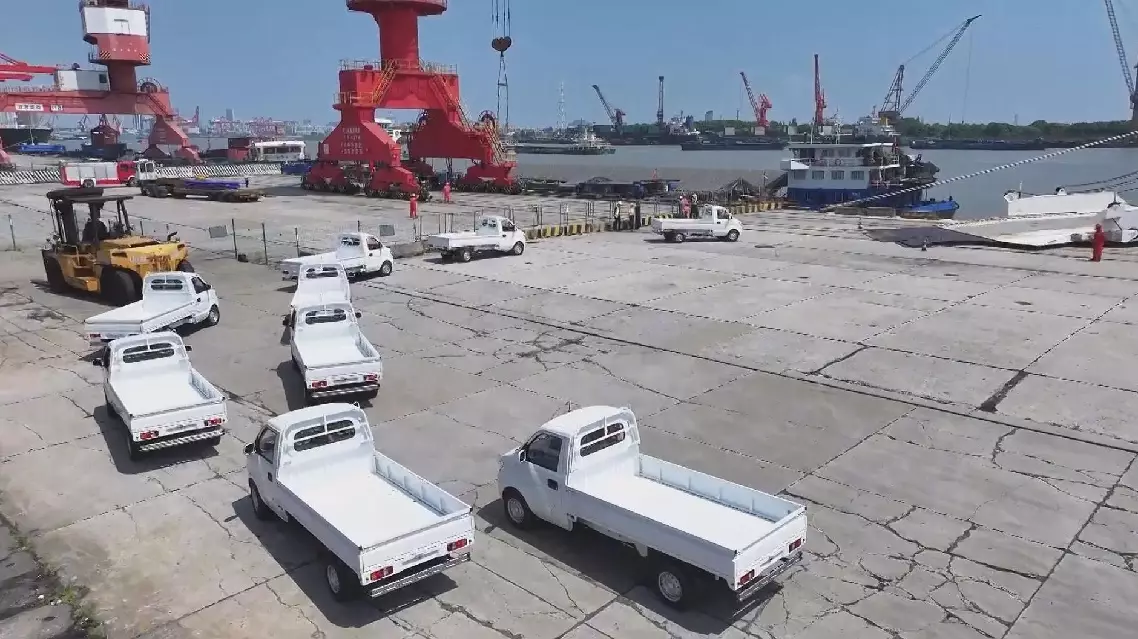
China's NEVs exported to Japan via Shanghai's ro-ro passenger-cargo vessel for 1st time