GAINESVILLE, Va. (AP) — As much as Bryson DeChambeau loves to practice and compete, the U.S. Open champion also appreciates the limited LIV Golf schedule that gives him time to pursue other interests.
DeChambeau arrived at Robert Trent Jones Golf Club for LIV Golf Virginia after a characteristically busy few days that included a round of golf with President Donald Trump and some short-game practice on the South Lawn of the White House.
Now the big-hitting YouTube star turns his attention to the 54-hole LIV event that starts Friday at Robert Trent Jones Golf Club. He said the thick rough and fast greens at RTJ would help prepare him for Oakmont, where he will try next week to win his third U.S. Open after triumphs last year at Pinehurst No. 2 and in 2020 at Winged Foot.
“I think LIV afforded me the opportunity to spend more time thinking, strategizing, getting my body healthy, ready for majors in a pretty unique way,” DeChambeau said Wednesday. “For me, it was a great thing. I thought there was an opportunity to do other things in life, and look, do I want to win every single tournament I show up to? 100%.”
The RTJ event is the eighth of 14 tournaments this year for the globetrotting, Saudi-funded LIV Golf League. Although PGA Tour players have more freedom to set their own schedules, they typically play more often. For top-ranked Scottie Scheffler, the U.S. Open will be the fourth of five events in a seven-week stretch.
DeChambeau hasn't competed since last month's PGA Championship, won by Scheffler. While DeChambeau was enjoying a friendly round with Trump and posting a YouTube short in which he hit golf balls from the top of a mountain and the Bonneville Salt Flats in Utah, Scheffler was finishing off his third win of the past month at the Memorial.
“I’ve been doing some fun side quests, yes, there’s no doubt,” DeChambeau said.
When he does compete, nobody practices harder than DeChambeau. He hit 1,029 range balls — more than anyone else in the field — at the Masters, where he finished in a tie for fifth.
The 31-year-old DeChambeau said he developed his practice habits as a teenager, when other junior golfers in California were beating him even though they didn't appear to try as hard.
“It stemmed from me not being as good as others and then realizing I can only be as good as how hard I work,” DeChambeau said. “So I just became obsessed with hitting crazy amounts of golf balls.”
Known for trying to optimize his swing and his equipment to produce a consistent ball flight — a long, high draw — DeChambeau also spends time practicing the unusual shots he needs to finish off tournaments.
“As much as I am a robot, and try to swing it as straight as possible and just stable as possible, I still do have to hit cuts and draws and hit weird shots every once in a while,” he said. “Giving myself those opportunities in the bunker, in the bush, whatever, has only aided in my golf career.”
After he shocked the golf world four years ago by winning the PGA Championship at age 50, Phil Mickelson had a moment of honest self-assessment.
“It’s very possible that this is the last tournament I ever win. Like if I’m being realistic,” Mickelson said on that triumphant Sunday at Kiawah Island.
Mickelson hasn't won since, and while he wasn't eager to reflect Wednesday on a career that includes six major titles and just as many famous near-misses, he indicated his competitive future is limited.
He said he wants to help his teammates on LIV's HyFlyers squad and would step away if he's no longer doing that.
“I’m also going to be 55 in a couple weeks, so I want to be realistic there, too. I want this team to succeed. I don’t want to hold it back,” Mickelson said. “If I’m holding it back, then it’s time for me to move on and get somebody else in here.”
Mickelson also acknowledged the possibility that Oakmont will be his last U.S. Open. He has a record six runner-up finishes at the national championship, the only major he hasn't won.
“There’s a high likelihood that it will be,” Mickelson said, “but I haven’t really thought about it too much.”
The USGA gave Mickelson a special exemption to the 2021 U.S. Open at Torrey Pines, which he ultimately didn't need because he won at Kiawah a month earlier. Nonetheless, the USGA historically does not grant more than one special exemption to non-U.S. Open champions. The only player to get more than one such invitation without having won the championship is Seve Ballesteros, who got two.
Mickelson has missed the past three U.S. Open cuts. He remains exempt for the other three majors as a past champion.
AP golf: https://apnews.com/hub/golf

President Donald Trump, right, walks toward the Oval Office as he returns to the White House with Bryson DeChambeau, winner of the 2024 U.S. Open, after playing golf, Sunday, June 1, 2025. (AP Photo/Manuel Balce Ceneta)
SANTIAGO, Chile (AP) — As Chileans head to vote on Sunday, even detractors of ultra-conservative former lawmaker José Antonio Kast say the candidate whose radical ideas lost him the past two elections is now almost certain to become Chile’s next leader.
Kast’s meaningful lead in the polls over his rival in the presidential runoff, communist Jeannette Jara, shows how the hard-liner agitating for mass deportations of immigrants has seized the mantle of the traditional right in a country that once defined its post-dictatorship democratic revival with a vow to contain such political forces.
But much is also up for grabs about Chile’s political direction.
Kast's claim to a popular mandate depends on his margin of victory on Sunday over Jara, the center-left governing party candidate who narrowly beat him in the first round of elections last month.
Although various right-wing parties won around 70% of the vote in that election, substantial support for a populist center-right candidate who described himself as an alternative to Kast’s “fascism” revealed that, between the contrasting ideologies of the front-runners, sit hundreds of thousands of centrist voters with no real representation.
“Both are too extreme for me,” said Juan Carlos Pileo, 44, who plans to cast a blank ballot Sunday, as voting is now mandatory in Chile’s elections. “I can’t trust someone who says she’s a communist to be moderate. And I can’t trust someone who exaggerates the amount of crime we have in this country and blames immigrants to be fair and respectful.”
It remains a question whether Kast, an admirer of U.S. President Donald Trump, can implement his more grandiose promises.
They include slashing $6 billion in public spending over just 18 months without eliminating social benefits, deporting over 300,000 immigrants in Chile with no legal status and expanding the powers of the army to fight organized crime in a country still haunted by Gen. Augusto Pinochet’sbloody military dictatorship from 1973 to 1990.
For one, Kast’s far-right Republican Party lacks a majority in Congress, meaning that he’ll need to negotiate with moderate right-wing forces that could bristle at those proposals, significantly shaping policy and his own legacy.
Political compromises could temper Kast’s radicalism, but also jeopardize his position with voters who expect him to deliver quickly on his law-and-order campaign promises.
At each campaign event, Kast has taken to ticking off the number of days remaining until Chile's March 11 presidential inauguration, warning they should get out before they'll "have to leave with just the clothes on their backs.”
Jorge Rubio, 63, a Chilean banker in downtown Santiago, the capital, said he's “also counting down the days.”
“That’s why we’re voting for Kast," he said.
As the pandemic shuttered borders, transnational criminal organizations like Tren de Aragua seized illegal migration routes to gain a foothold in Chile, long considered among Latin America's safest countries. Homicides hit a record high in 2022, the first year of President Gabriel Boric’s tenure.
Kast insists that Boric’s government is too soft on immigration and crime, which the far-right leader argues are connected although the data does not necessarily support his narrative. Boric’s approval rating has plummeted, standing now at just 30%.
Yet many say the firebrand former student protester who came to power in 2021 pledging to transform Chile's market-led economy, has risen to the occasion. Boric went from criticizing the use of police force on the campaign trial to pouring money into the security forces. He sent the military to reinforce Chile's northern border, stiffened penalties for organized crime and created the country's first public security ministry.
Chile's homicide rate is now falling, about on par with the rate in the United States. That has done nothing to change Chileans' feelings of profound insecurity.
In Libya, where fractious militias jostle for political power, over 70% of people feel safe walking alone at night, according to a recent Gallup survey of 144 countries.
In Chile, just 39% of people do, around the same as in Ecuador, which is now in the midst of a violent, drug-driven crime wave.
As Boric's former minister of labor, Jara became popular for passing some of the administration's most important welfare measures.
That matters little now. Voters' concerns have forced her to switch gears. She has vowed to toughen border security, register undocumented migrants, tackle money laundering and step up police raids.
But promises to restore law and order are more persuasive coming from an insurgent outsider who has made security a key part of his agenda for years.
“Kast has been smart and strategic in focusing on migration and security," said Lucía Dammert, a sociologist and Boric’s first chief of staff. “It has been very difficult for the Jara campaign to move him away from those issues.”
Learning from his previous two failed presidential runs, Kast has avoided topics that fire up his critics — such as his German-born father’s Nazi past, his nostalgia for Pinochet's dictatorship and his opposition to same-sex marriage and abortion.
When asked, Kast says only that his values remain the same. His supporters, including voters who previously spurned him over his social conservatism, now say that abstract human rights concerns come after their need for safety on the streets.
“It's not very nice to hear that he's going to separate immigrant children from their parents, it's sad, that's going to be a problem for me,” said Natacha Feliz, a 27-year-old immigrant from the Dominican Republic referring to a recent interview in which Kast said immigrant parents without legal status who didn’t self-deport would be obliged to hand their kids over to the state.
“But this is happening everywhere, not just in Chile. Let's just hope that our security situation improves."
Associated Press writer Nayara Batschke in Santiago, Chile, contributed to this report.
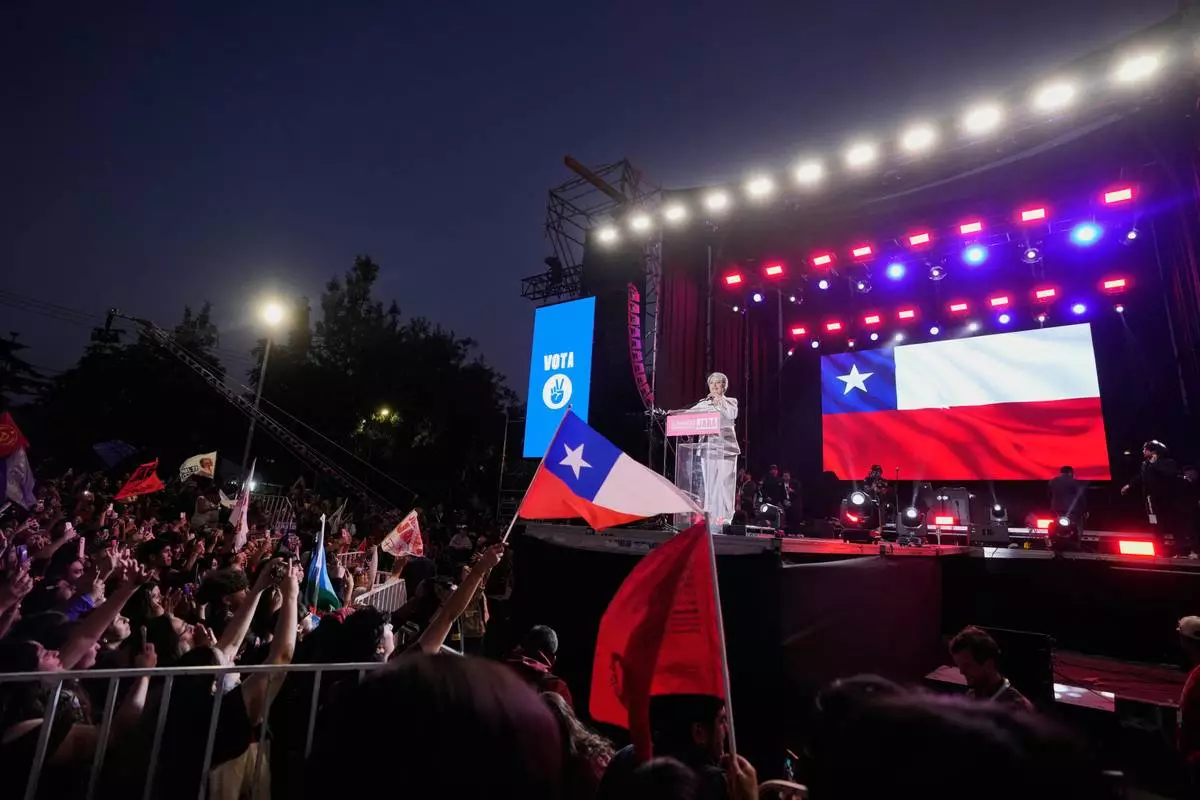
Presidential candidate Jeannette Jara of the Unidad por Chile coalition addresses supporters during a rally ahead of the presidential runoff election in Santiago, Chile, Wednesday, Dec. 10, 2025. (AP Photo/Natacha Pisarenko)
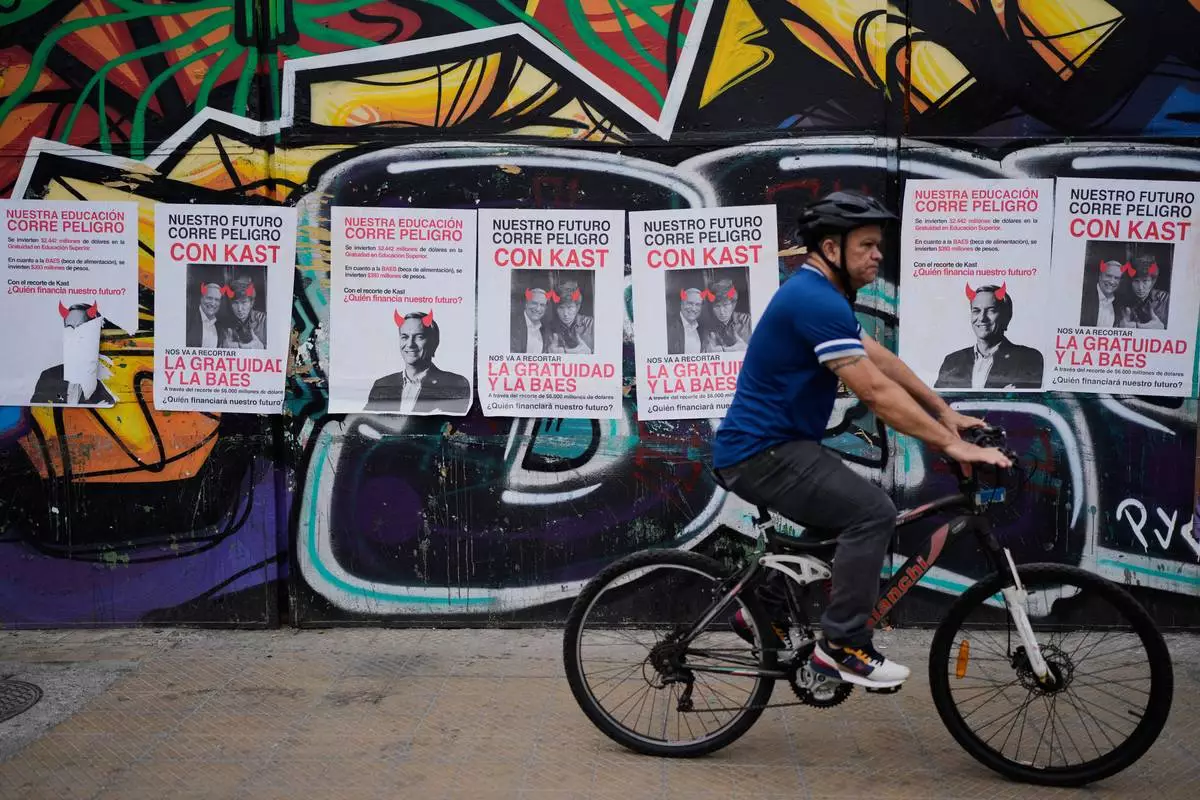
A man cycles past campaign ads for presidential candidate Jose Antonio Kast and Argentina's President Javier Milei reading in Spanish "Our future is in danger" ahead of the presidential runoff election in Santiago, Chile, Friday, Dec. 12, 2025. (AP Photo/Natacha Pisarenko)
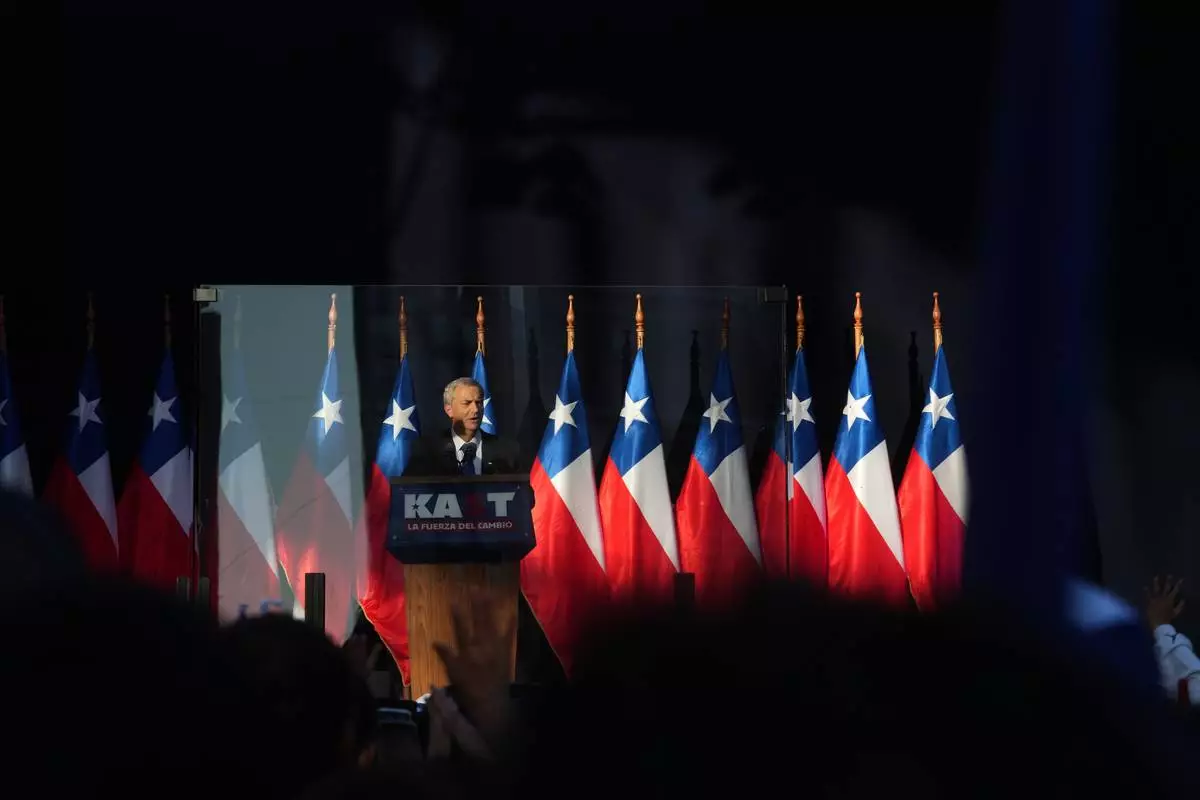
Presidential candidate Jose Antonio Kast of the Republican Party addresses supporters, from behind a protective glass panel, during a rally ahead of the runoff election in Temuco, Chile, Thursday, Dec. 11, 2025. (AP Photo/Esteban Felix)
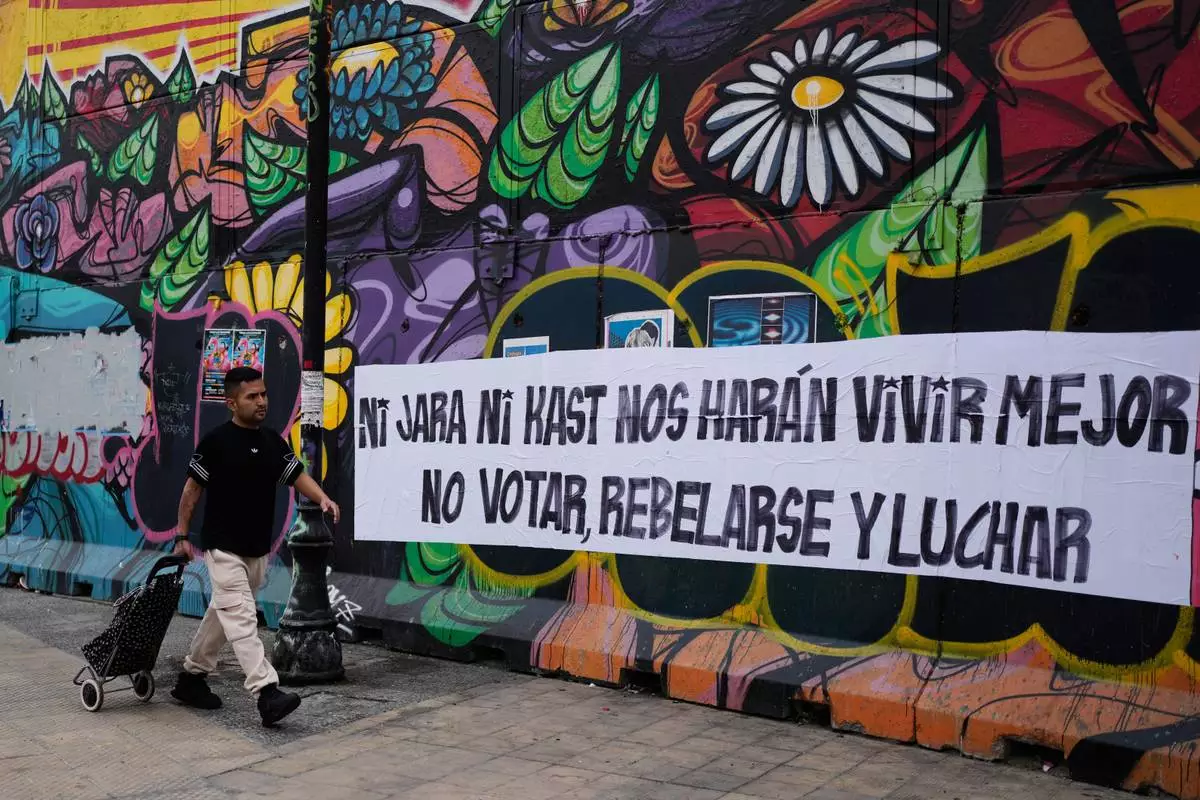
A campaign banner reads in Spanish "Neither Jara nor Kast will make our lives better, don't vote, rebel and fight" ahead of the presidential runoff election in Santiago, Chile, Friday, Dec. 12, 2025. (AP Photo/Natacha Pisarenko)

Presidential candidates Jose Antonio Kast of the Republican Party and Jeannette Jara of the Unity for Chile coalition shake hands during a debate ahead of runoff elections in Santiago, Chile, Tuesday, Dec. 9, 2025. (AP Photo/Esteban Felix)