Shanghai's Old City Hall, a landmark building completed in 1922, has opened to the public following a decade of restoration and integrated into modern urban life.
Located in the core of the city's famous waterfront area known as the Bund, the building was first constructed in 1914 and served as the seat of the Shanghai Municipal People's Government after the founding of the People's Republic of China in 1949.
Since comprehensive restoration started on the building in 2015, the city has revitalized its appearance while preserving the architectural integrity and adding new spaces. It has been renamed "The Bund City Hall Plaza."
"We've added an auditorium inside and a public commercial space on the top floor. We also added two buildings in the courtyard. These spaces are designed to attract residents and tourists, providing open areas for everyone," said Zhu Yifeng, general manager of Shanghai Bund Old Building Investment and Development Company.
The revitalized city hall now boasts a mixed-use layout, with 70 percent dedicated to office space, 20 percent to cultural facilities, and 10 percent to commercial property, creating a 3,000-square-meter courtyard for the public, the only one of its kind on the Bund.
In addition to an atrium garden open to the public, other areas like the office of Shanghai Mayor Chen Yi, who worked in the building from 1949 to 1954, and adjacent building spaces have also been restored as key cultural relic protection areas available to visitors.
Every detail has been restored as much as possible from windows to bricks and even plaster moldings or wooden doors.
"The lights that you can see are all historical relics from a hundred years ago. Their copper finishes have been restored," said Sun Cheng, a project manager.
During the recent Dragon Boat Festival holiday, the newly opened Old City Hall welcomed many visitors eager to experience Shanghai's history and culture.
"I recently learned that the Old City Hall was open to the public, so I made a reservation and came with some friends. Experiencing it now, I feel delighted," said a resident.
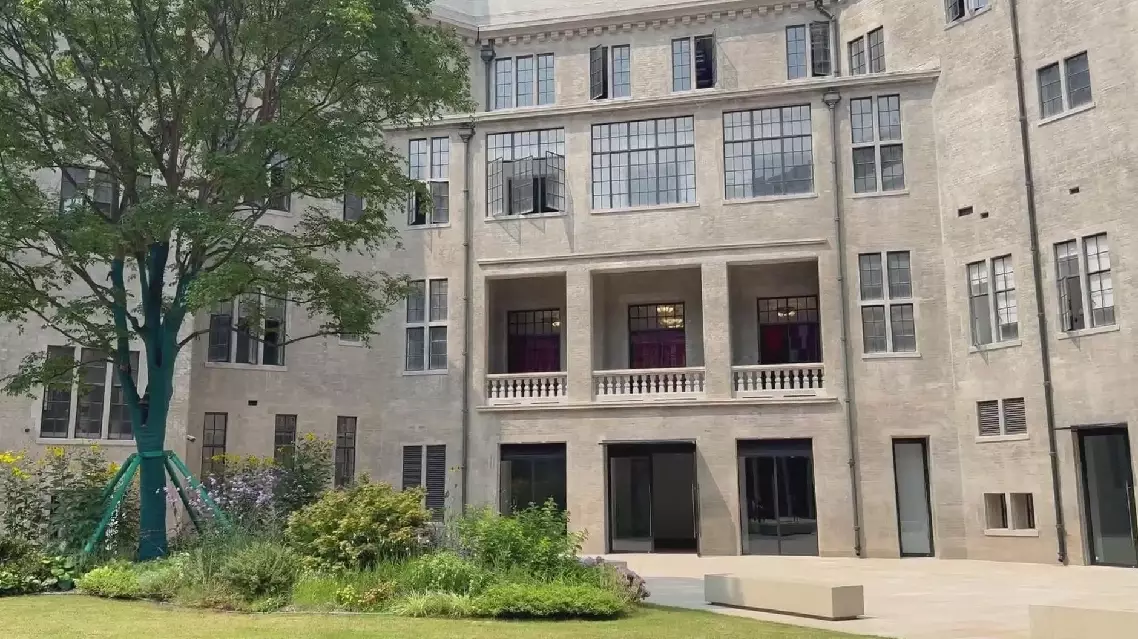
Shanghai's historic city hall opens to public after restoration

Xi Jinping, general secretary of the Communist Party of China (CPC) Central Committee, on Monday called for advancing full and rigorous Party self-governance with higher standards and more concrete measures.
Xi, also Chinese president and chairman of the Central Military Commission, made the remarks while addressing the fifth plenary session of the 20th CPC Central Commission for Discipline Inspection (CCDI) in Beijing.
Xi urged efforts to confine power to an institutional cage in a more well-conceived and effective manner, and press ahead with the anti-corruption fight with a clearer understanding and stronger resolve, thus providing a strong guarantee for achieving the goals and tasks of the 15th Five-Year Plan period (2026-2030).
Xi pointed out that in 2025, the CPC Central Committee had intensified efforts to improve Party conduct, uphold integrity and combat corruption, achieving notable results. Xi said efforts were made to maintain a tough stance against corruption and eradicate the breeding grounds and conditions for corruption.
Xi emphasized that implementing the major decisions and plans of the CPC Central Committee is a fundamental requirement for upholding its authority and its centralized, unified leadership.
Party organizations at all levels and Party members and officials should implement the decisions and plans of the Fourth Plenary Session of the 20th CPC Central Committee with concrete actions, he said.
Xi noted that confining power to an institutional cage is an important task in exercising full and rigorous Party self-governance.
He stressed that all are equal before the law and regulations, that compliance with them admits no privilege, and that enforcement of the law and regulations allows no exception.
Xi underscored that the fight against corruption is a major struggle that the Party cannot afford to lose, and must never lose.
He said that the current anti-corruption situation remains grave and complex, and that the task of eliminating the soil and conditions breeding corruption remains arduous. Xi added that it is essential to maintain a firm stance to leave corrupt officials with no place to hide.
Stressing the need to stay attuned to new trends and features of corruption, Xi urged efforts to innovate methods and approaches, promptly detect and accurately identify corrupt practices, and effectively address all forms of corruption, so as to continuously enhance the penetrating power of anti-corruption efforts.
He also urged strengthening coordination among all forms of oversight to advance integrated governance through whole-process collaboration, and called for sustained efforts to forge a loyal, upright and responsible disciplinary inspection and supervision force that dares to and is good at fighting against corruption.
Members of the Standing Committee of the Political Bureau of the CPC Central Committee Li Qiang, Zhao Leji, Wang Huning, Cai Qi and Ding Xuexiang attended the meeting.
Li Xi, a member of the Standing Committee of the Political Bureau of the CPC Central Committee and secretary of the CCDI, presided over the meeting. On Monday afternoon, on behalf of the standing committee of the CCDI, Li also delivered a work report.
Xi urges advancing Party self-governance with higher standards, more concrete measures