The fast-moving consumer market of Shanghai is attracting a growing number of global brands eager to seize business opportunities created by supportive policies that help them open new stores and launch products.
Shopping areas and malls across the metropolis have been witnessing a slew of first-in-China store openings. Among them is running shoe brand Hoka, which has opened a new mega-store in Xintiandi, the city's high-end shopping district.
"Doing it here in Shanghai feels very right, because it's a very sophisticated fast-moving marketplace. Retailer executions here are very strong. The consumer expects great(ness). So, actually this was a perfect moment and location to actually open the biggest and best expression of our brand," said Marco Ellerker, President of Global Marketplace at Deckers Brands, the parent company of Hoka.
The city has recently implemented various measures to help promote its "debut economy" with pilot efforts being launched to streamline customs clearance for imported products that are about to meet the public for the first time in Shanghai.
Efforts have begun to pay off as new stores open in commercial circles at an accelerating pace. According to Shanghai Municipal Commission of Commerce, from January to April, 301 brands opened their first-in-China stores in Shanghai.
Global brands said Shanghai's pilot efforts to streamline inspection for imported consumer goods has drastically cut the procedures needed in the customs clearance of their products that are about to debut in the city.
"It is our first entry into the Chinese market, and we opened pop-up stores, which are preferred by customers, and launched many of our new products here. The updated policy has been helping our brand greatly. In particular, the streamlined customs clearance can help our pop-up stores to launch the new products in the shortest possible time," said Dai Li, director of product design at Grove, a South Korean clothing brand.
The improved facilitation measures will allow an expanded array of goods, including clothing, toys, tableware, electronics, and appliances to enjoy streamlined customs clearance.
Ju Xinping, director of Order Department of Shanghai Municipal Commission of Commerce, said the measure is part of efforts to help give consumers in Shanghai access to the latest high-quality products.
"We have worked with Shanghai Customs to create China's first inspection model for imported consumer goods that are about to meet the customer for the first time and the model combines a whitelist and differentiated certification standards. By implementing the updated policy, we are looking forward to addressing some key issues along with the customs, so that the latest and the best goods from across the world will meet the customers as soon as possible in Shanghai," said Ju.

Shanghai attracts scores of global brand store-openings with updated policies
The Exhibition Hall of Evidence of Crimes Committed by Unit 731 of the Japanese Imperial Army in northeast China's Harbin released on Thursday a 38-minute video of a former member of Unit 731, a notorious Japanese germ-warfare unit during World War II (WWII).
In the footage, former Unit 731 member Tsuruo Nishijima detailed how the unit used meteorological data to carry out bacterial dispersal and frostbite experiments.
The video was recorded in 1997 by Japanese scholar Fuyuko Nishisato and donated to the exhibition hall in 2019, according to the hall, which was built on the former site of the headquarters of Unit 731 in Harbin, capital city of Heilongjiang Province.
Nishijima joined Unit 731 in October 1938 and served in the unit's meteorological squad. The squad was not a simple observation section but rather an auxiliary force supporting the unit's human experiments in the field by measuring wind direction, wind speed and other conditions to ensure optimal experimental results.
Nishijima confirmed in the footage that "the meteorological squad had to be present at every field experiment." He testified to the "rainfall experiments" conducted by Unit 731, which involved aircraft releasing bacterial agents at extremely low altitudes.
At a field-testing site in Anda City, Heilongjiang, Unit 731 aircraft descended to about 50 meters above the ground and sprayed bacterial culture liquids onto "maruta" -- human test subjects -- who were tied to wooden stakes. Each experiment involved about 30 people, spaced roughly 5 meters apart. After the experiments, the victims were loaded into sealed trucks and transported back to the unit, where their symptoms and disease progression were recorded over a period of several days.
Nishijima also revealed that a Japanese military doctor once died after removing the mask and becoming infected during an experiment, indirectly proving the extreme virulence of the bacterial agents.
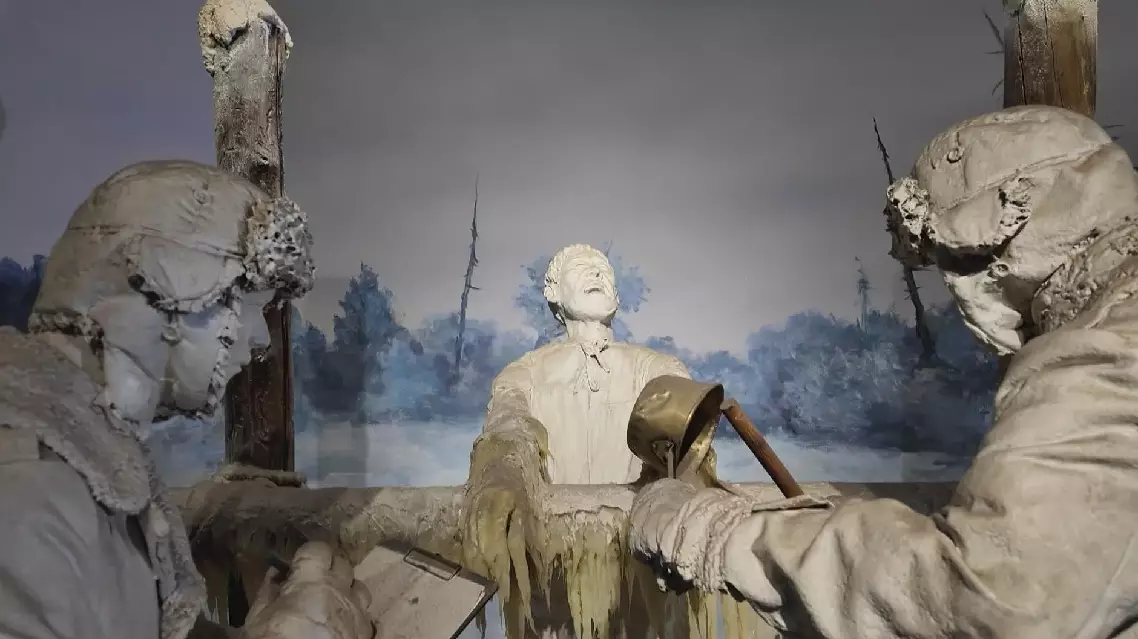
The video further disclosed details of the meteorological squad's involvement in frostbite experiments. To study wartime needs in frigid regions, the invading Japanese army forced the victims to expose their bodies for five to ten minutes in temperatures ranging from minus 20 to minus 35 degrees Celsius and observed their physical reactions.
"For example, during frostbite experiments, we would be sent outside to observe the weather. They wouldn't bring many people out at once, only two or three, who would be forced to take off their upper garments or all their clothes. In fact, it was already quite tough to stay out there for five to ten minutes, because it was too cold," Nishijima said.
According to the exhibition hall, Unit 731 had a separate frostbite laboratory, with Hisato Yoshimura serving as the leader of the unit's frostbite study squad from 1938 to 1945.
In a paper on frostbite published in 1941, Yoshimura recorded data from live human experiments to study the occurrence of frostbite and pathological changes in the human body under different conditions.
"This is a form from the paper. Titled 'The Severity and Process of Frostbite,' it divides frostbite into three stages. The symptoms of the first-degree frostbite are redness and swelling. Blisters appear in the second stage. And the third-degree frostbite features necrosis and ulceration. It says here that, in the third stage, from the 50th to the 60th day, toes and fingers detached. There is no doubt that these data were obtained through numerous human experiments," said Tan Tian, a researcher of the exhibition hall.
Nishijima's video, a piece of oral history from a perpetrator's perspective, further reconstructs the criminal chain of Unit 731 and once again demonstrates that the invading Japanese army's biological warfare crime was systematic and inhumane, and was an undeniable historical truth, according to the exhibition hall.
"Unit 731's frostbite experiments were essentially conducted to prevent and treat frostbite during combat in cold environments. However, for the so-called prevention and treatment of frostbite, they caused frostbite on living people for experiments and data analysis. So in nature, it still serves the purpose of war," said Jin Shicheng, director of the Department of Publicity, Education and Exhibition at the hall.
Unit 731 was a top-secret biological and chemical warfare research base established in Harbin as the nerve center for Japanese biological warfare in China and Southeast Asia during WWII.
At least 3,000 people were used for human experiments by Unit 731, and more than 300,000 people in China were killed by Japan's biological weapons.
Video offers new evidence of Japan's wartime germ-warfare crimes in northeast China