CAPE TOWN, South Africa (AP) — Cutting off the horns of sedated rhinos with a chainsaw has been viewed by wildlife conservationists in Africa for more than 30 years as a necessary evil to save the iconic endangered species from poaching.
They hoped the drastic action was working, but evidence was scarce.
Now, a study published Thursday in the academic journal Science has found that dehorning rhinos has led to a large reduction in poaching in game reserves in and around the Kruger National Park in northern South Africa — an area that's home to 25% of the world's rhinos and is especially vulnerable to poaching.
The results of the seven-year study that ended in 2023 are seen as long-awaited evidence that removing rhinos' horns — which needs to be done every one to two years because they grow back — helps them survive, even if the animals lose part of their makeup.
The conclusions seem obvious. Lucrative illegal markets in parts of southeast Asia and China crave rhino horns for use in traditional medicines, and removing the rhinos' horns take away what poachers are after.
But Tim Kuiper, a biodiversity scientist at South Africa's Nelson Mandela University and the lead author of the study, said it was new to have long-term data from multiple sites on dehorning rhinos. He said the study, conducted between January 2017 and December 2023, focused on 11 reserves in the Kruger area and compared data from eight that dehorned their rhinos against the three that didn't.
It also analyzed data from the reserves before and after they dehorned their rhinos.
The study showed that dehorning consistently reduced poaching, Kuiper said. It found that the dehorning of more than 2,000 rhinos resulted in a 78% reduction in poaching in those eight reserves, providing some confirmation that such an invasive intervention was worth it.
“It is a big part of what a rhino is, having a horn,” Kuiper said. “So having to remove it is kind of a necessary evil, if I can put it that way. But it’s very effective. There’s no doubt it saved hundreds of rhinos' lives.”
South Africa has the largest numbers of black and white rhinos. Namibia, Zimbabwe and Kenya also have significant populations. There are around 17,500 white rhinos and 6,500 black rhinos left in the world, with black rhino numbers reduced from 70,000 in 1970 to less than 2,500 by the time poaching reached a crisis point in the mid-1990s, according to the Save the Rhino organization.
Dehorning rhinos started in southern Africa as early as 1989. It has not been accepted without question.
There has been opposition from animal rights activists but also questions from conservationists over what impact it has on a rhino's wellbeing, and what a future might look like with more hornless rhinos.
Vanessa Duthe, a rhino researcher in South Africa not involved in the study, said rhinos use their horns to defend themselves against predators, to compete for territory and, in the case of black rhinos, to look for food. There is also evidence that dehorned rhinos adjust their movements to live in smaller ranges, she said.
She said conservationists don't know the full impacts of dehorning, but research had found it had no adverse effect on rhinos' breeding rates or mortality rates.
“What we do know is that the benefits of dehorning by far outweigh any ecological cost that we’re aware of today,” Duthe said. She said dehorning a rhino now takes around 10 minutes and the process causes minimum distress. Blindfolds and earmuffs are put on sedated rhinos during dehorning, which also provides an opportunity to microchip rhinos and collect samples that aid research.
Conservationists agree that dehorning alone will not end rhino poaching and Kuiper said he saw it as a short-to-mid-term solution. Other efforts like more effective law enforcement and better support for game rangers on the frontline are key.
While South Africa has helped pull rhinos back from the threat of extinction, more than 400 rhinos a year are still killed by poachers in the country.
The dehorning study was a collaboration between scientists from three South African universities, Oxford University in England and game reserve managers and rangers. It also involved the South African National Parks department, the World Wildlife Fund and the Rhino Recovery Fund.
AP Africa news: https://apnews.com/hub/africa
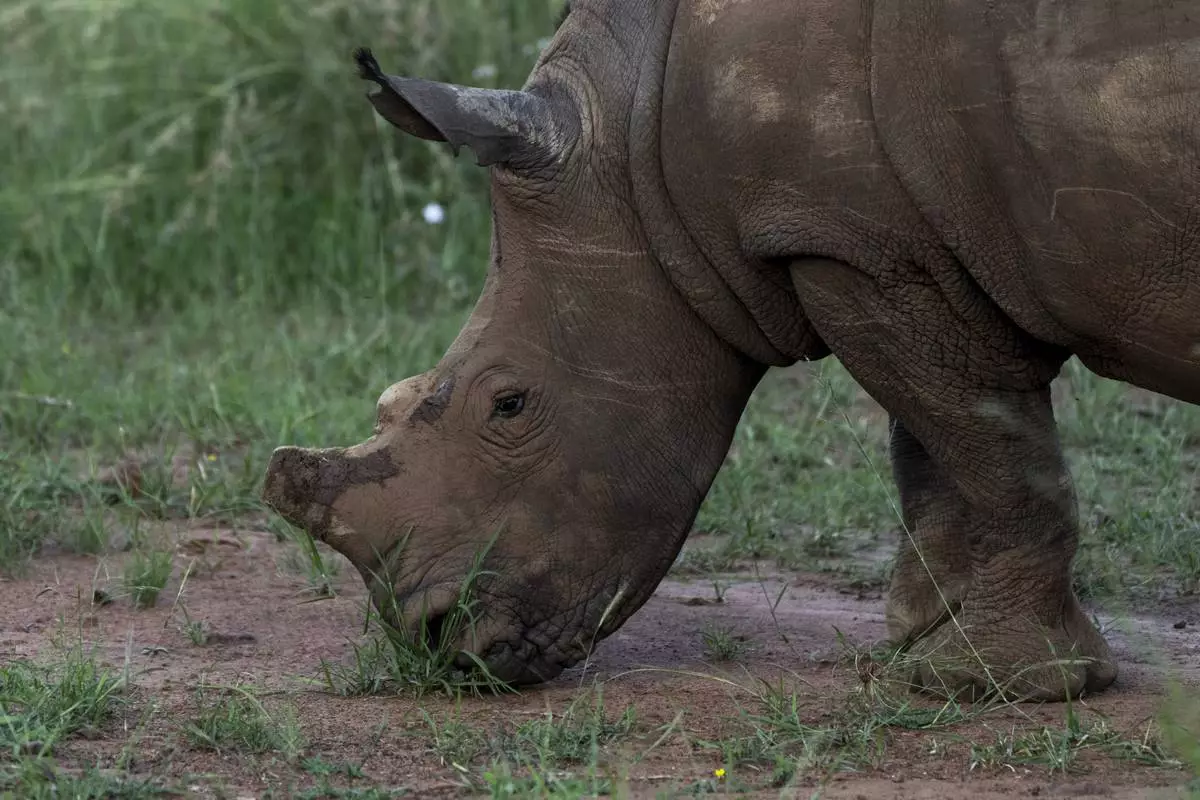
A de-horned rhino grazes in South Africa's Pilanesberg National Park, Feb. 25, 2025. (AP Photo/Jerome Delay)
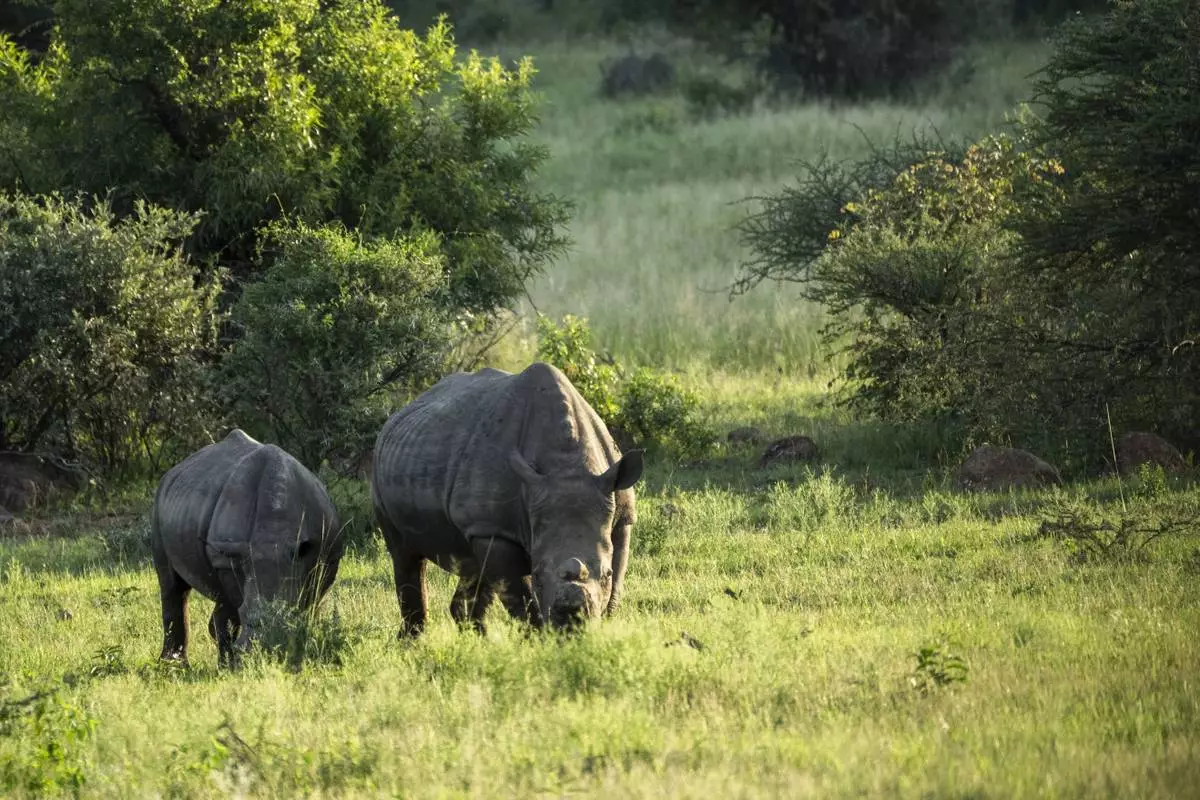
Two de-horned rhinos graze in South Africa's Pilanesberg National Park, Feb. 25, 2025. (AP Photo/Jerome Delay)
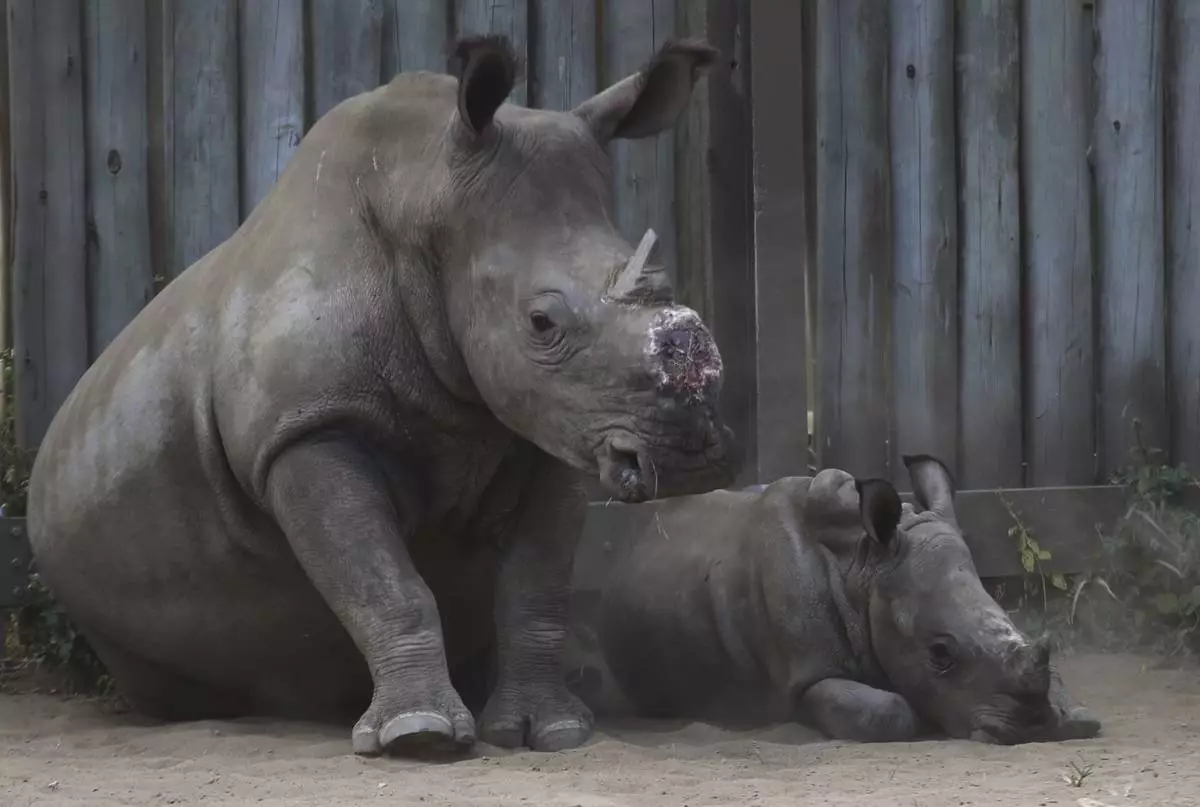
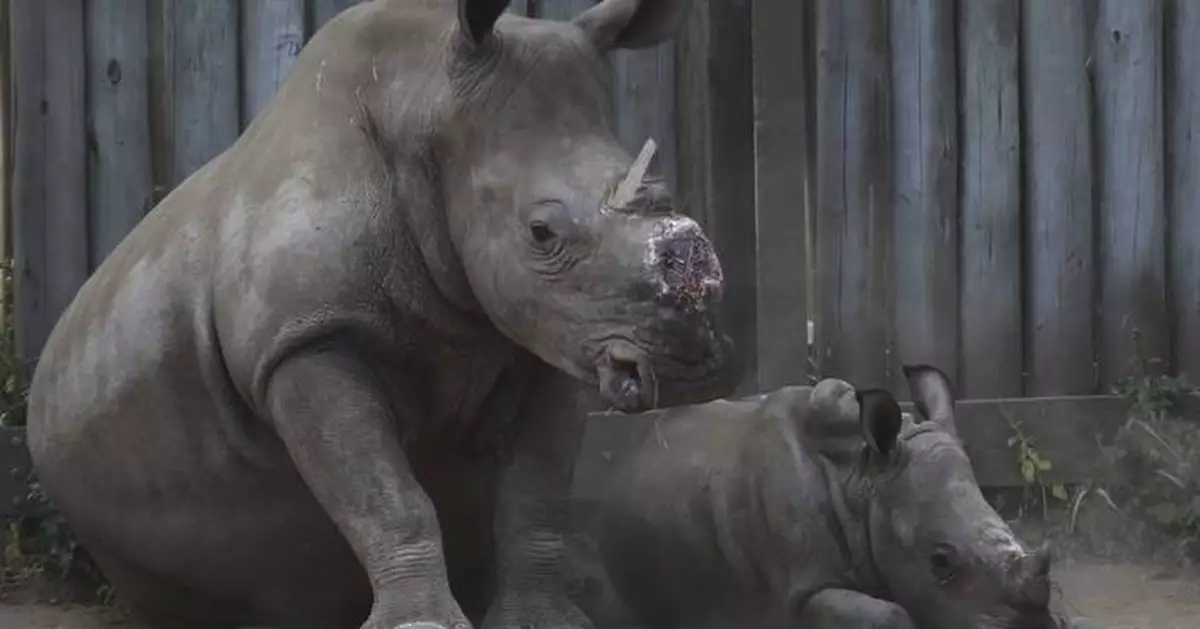
FILE -- In this file photo taken Feb. 15, 2016, a de-horned rhino and her calf rest in their corral at a rhino orphanage in the Hluhluwe-iMfolozi Game Reserve in the KwaZulu Natal province South Africa. (AP Photo/Denis Farrell-File)
MINNEAPOLIS (AP) — Hennepin County Attorney Mary Moriarty on Friday called on members of the public to send any video or other evidence in the fatal shooting of Renee Good directly to her office, challenging the Trump administration's decision to leave the investigation solely to the FBI.
Moriarty said that although her office has collaborated effectively with the FBI in past cases, she is concerned by the Trump administration's decision to bar state and local agencies from playing any role in the investigation into Wednesday's killing of Good by an Immigration and Customs Enforcement officer in Minneapolis.
She also said that despite the Trump administration’s insistence that the officer who shot Good has complete legal immunity, that isn’t the case.
“We do have jurisdiction to make this decision with what happened in this case,” she said at a news conference. “It does not matter that it was a federal law enforcement agent.”
Moriarty said her office would post a link for the public to submit footage of the shooting, even though she acknowledged that she wasn't sure what legal outcome submissions might produce.
The prosecutor's announcement came on a third day of Minneapolis protests over Good's killing and a day after federal immigration officers shot and wounded two people in Portland, Oregon.
Good's wife, Becca Good, released a statement to Minnesota Public Radio on Friday saying, “kindness radiated out of her.”
"On Wednesday, January 7th, we stopped to support our neighbors. We had whistles. They had guns," Becca Good said.
“I am now left to raise our son and to continue teaching him, as Renee believed, that there are people building a better world for him,” she wrote. “That the people who did this had fear and anger in their hearts, and we need to show them a better way.”
The reaction to the Good's shooting was immediate in the city where police killed George Floyd in 2020, with hundreds of protesters converging on the shooting scene and the school district canceling classes for the rest of the week as a precaution.
On Thursday night, hundreds marched in freezing rain down one of Minneapolis’ major thoroughfares, chanting “ICE out now!” and holding signs saying, “Killer ice off our streets." And on Friday, protesters were out again demonstrating outside of a federal facility that is serving as a hub for the immigration crackdown that began Tuesday in the Twin Cities of Minneapolis and St. Paul. Authorities erected barricades outside the facility Friday.
City workers, meanwhile, removed makeshift barricades made of old Christmas trees and other debris that had been blocking the streets near the scene of Good's shooting. Officials said they would leave up a shrine to the 37-year-old mother of three.
The Portland shootings happened outside a hospital Thursday afternoon. Federal immigration officers shot and wounded a man and woman, identified by the Department of Homeland Security as Venezuela nationals Luis David Nico Moncada and Yorlenys Betzabeth Zambrano-Contreras, who were inside a vehicle, and their conditions weren't immediately known. The FBI and the Oregon Department of Justice were investigating.
Portland Mayor Keith Wilson and the city council called on ICE to end all operations in the city until a full investigation is completed. Hundreds protested Thursday night at a local ICE building. Early Friday, Portland police reported that officers had arrested several protesters after asking the to get out of a street to allow traffic to flow.
Just as it did following Good's shooting, DHS defended the actions of the officers in Portland, saying it occurred after a Venezuelan man with alleged gang ties and who was involved in a recent shooting tried to “weaponize” his vehicle to hit the officers. It wasn't immediately clear if the shootings were captured on video, as Good's was.
The Minneapolis shooting happened on the second day of the immigration crackdown in the Twin Cities, which Homeland Security said is the biggest immigration enforcement operation ever. More than 2,000 officers are taking part and Noem said they have made more than 1,500 arrests.
The government is also shifting immigration officers to Minneapolis from sweeps in Louisiana, according to documents obtained by The Associated Press. This represents a pivot, as the Louisiana crackdown that began in December had been expected to last into February.
Good's death — at least the fifth tied to immigration sweeps since Trump took office — has resonated far beyond Minneapolis, as protests happening in other places, including Texas, California, Detroit and Missouri.
In Washington, D.C., on Thursday, a woman held a sign that said, “Stop Trump’s Gestapo,” as hundreds of people marched to the White House. Protesters in Pflugerville, Texas, north of Austin, banged on the walls of an ICE facility. And a man in Los Angeles burned an American flag in front of federal detention center.
Homeland Security Secretary Kristi Noem, President Donald Trump and others in his administration have repeatedly characterized the Minneapolis shooting as an act of self-defense and cast Good as a villain, suggesting she used her vehicle as a weapon to attack the officer who shot her.
But state and local officials and protesters rejected that characterization, with Minneapolis Mayor Jacob Frey saying videos show the self-defense argument is “garbage.”
Several bystanders captured footage of Good's killing, which happened in a neighborhood south of downtown.
The recordings show an officer approaching an SUV stopped across the middle of the road, demanding the driver open the door and grabbing the handle. The Honda Pilot begins to pull forward and a different ICE officer standing in front of it pulls his weapon and immediately fires at least two shots at close range, jumping back as the vehicle moves toward him.
It is not clear from the videos if the vehicle makes contact with the officer, and there is no indication of whether the woman had interactions with agents earlier. After the shooting, the SUV speeds into two cars parked on a curb before crashing to a stop.
The federal agent who fatally shot Good is an Iraq War veteran who has served for nearly two decades in the Border Patrol and ICE, according to records obtained by AP.
Noem has not publicly named him, but a Homeland Security spokesperson said her description of his injuries last summer refers to an incident in Bloomington, Minnesota, in which court documents identify him as Jonathan Ross.
Ross got his arm stuck in the window of a vehicle whose driver was fleeing arrest on an immigration violation. Ross was dragged and fired his Taser. A jury found the driver guilty of assaulting a federal officer with a dangerous weapon.
Attempts to reach Ross, 43, at phone numbers and email addresses associated with him were not successful.
Associated Press reporters Steve Karnowski and Mark Vancleave in Minneapolis; Ed White in Detroit; Valerie Gonzalez in Brownsville, Texas; Graham Lee Brewer in Norman, Oklahoma; Michael Biesecker in Washington; Jim Mustian and Safiyah Riddle in New York; Ryan Foley in Iowa City, Iowa; and Hallie Golden in Seattle contributed to this report.
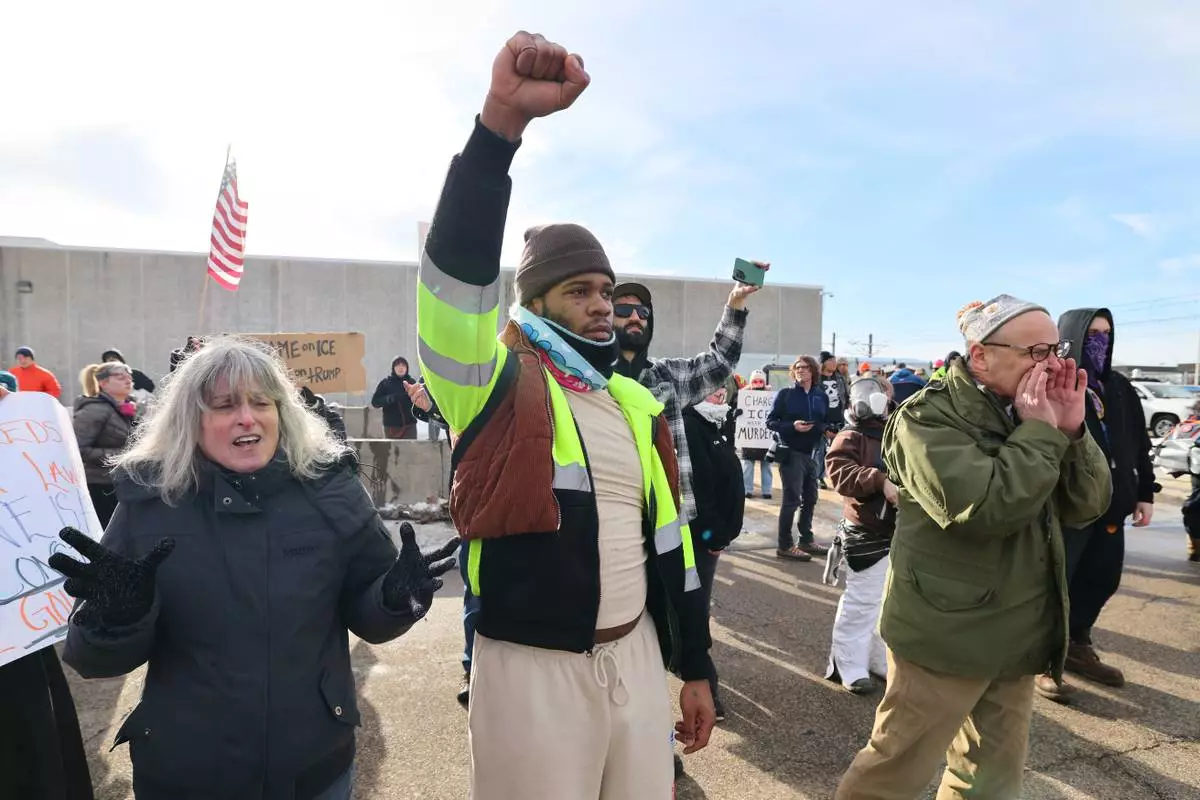
Protesters confront law enforcement outside the Bishop Henry Whipple Federal Building in Minneapolis, Friday, Jan. 9, 2026.(AP Photo/Adam Bettcher)
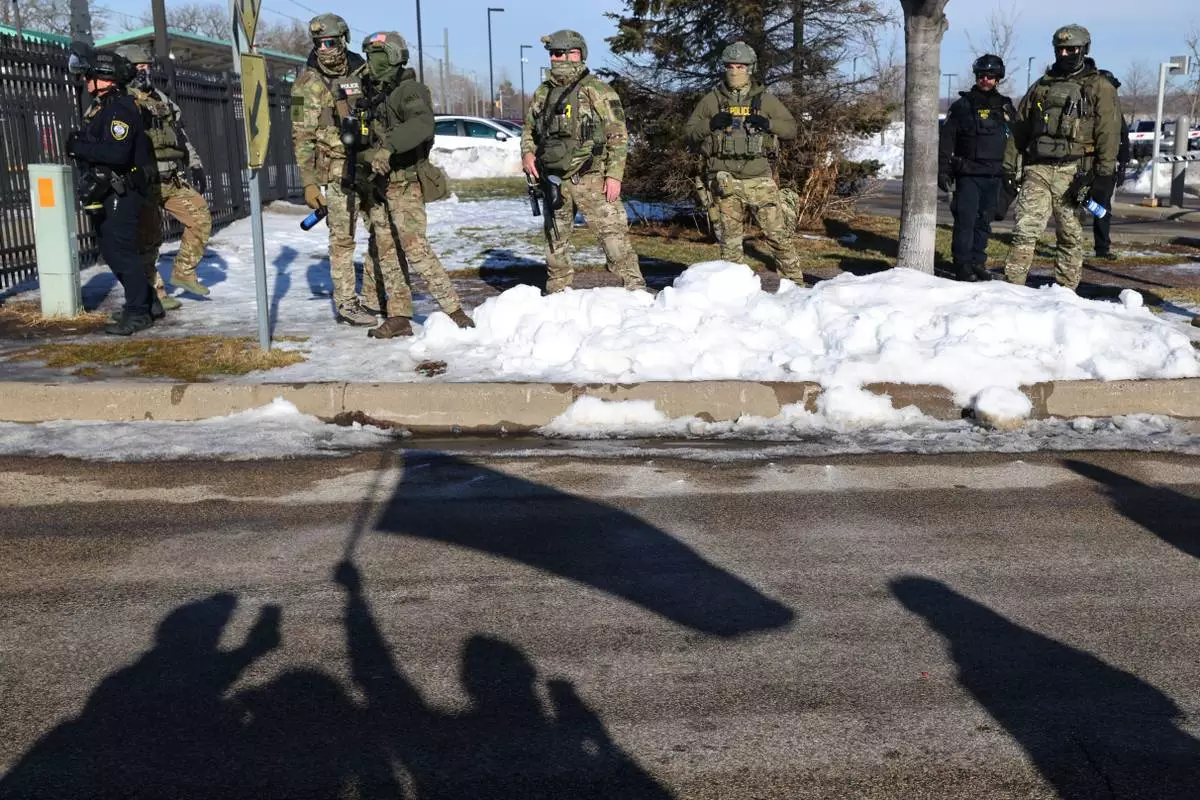
Protesters' shadows are cast on the street near law enforcement outside the Bishop Henry Whipple Federal Building in Minneapolis, Friday, Jan. 9, 2026. (AP Photo/Adam Bettcher)
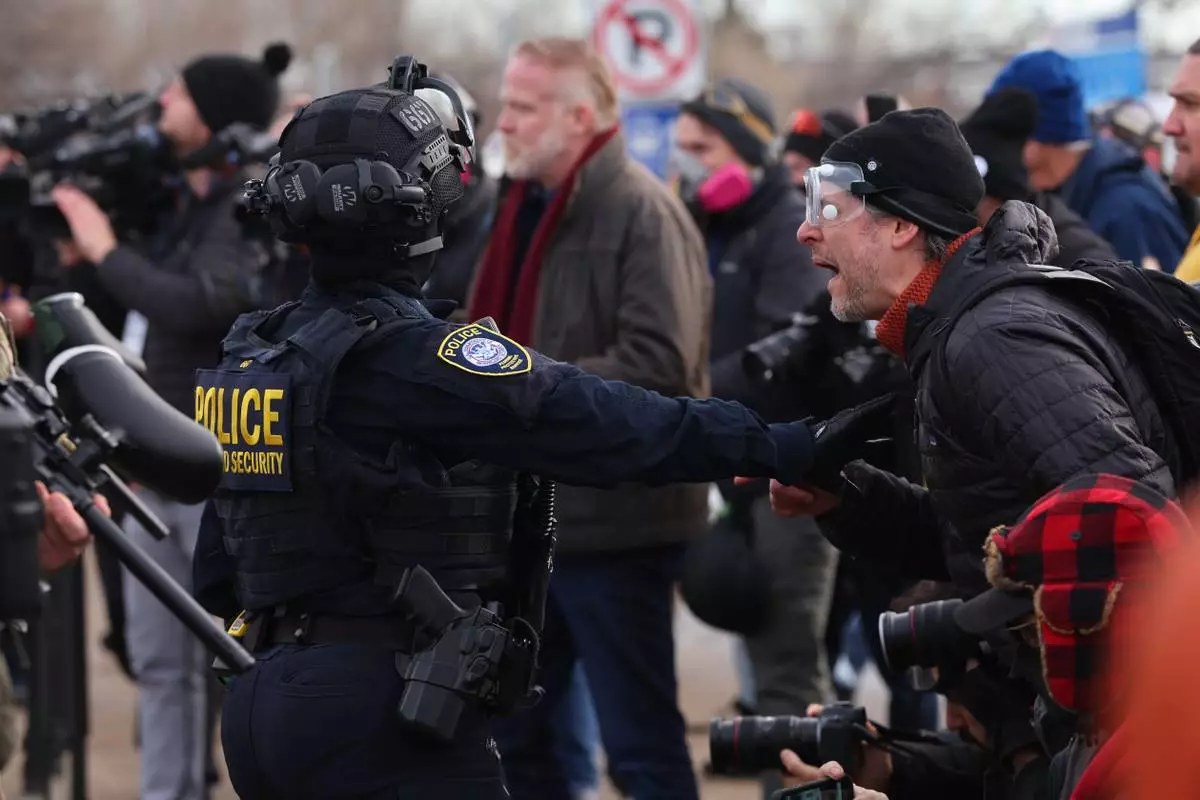
Protesters confront law enforcement outside the Bishop Henry Whipple Federal Building in Minneapolis, Friday, Jan. 9, 2026.(AP Photo/Adam Bettcher)
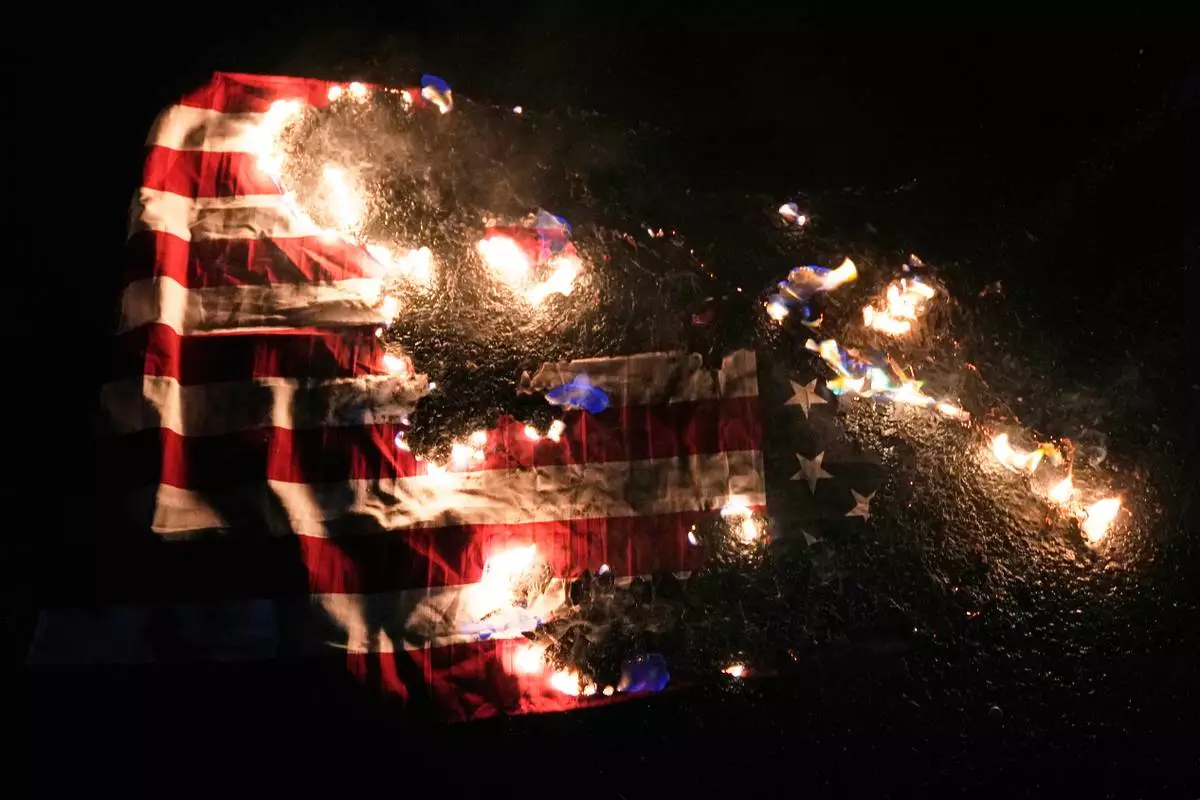
An American flag burns outside the U.S. Immigration and Customs Enforcement facility on Thursday, Jan. 8, 2026, in Portland, Ore. (AP Photo/Jenny Kane)
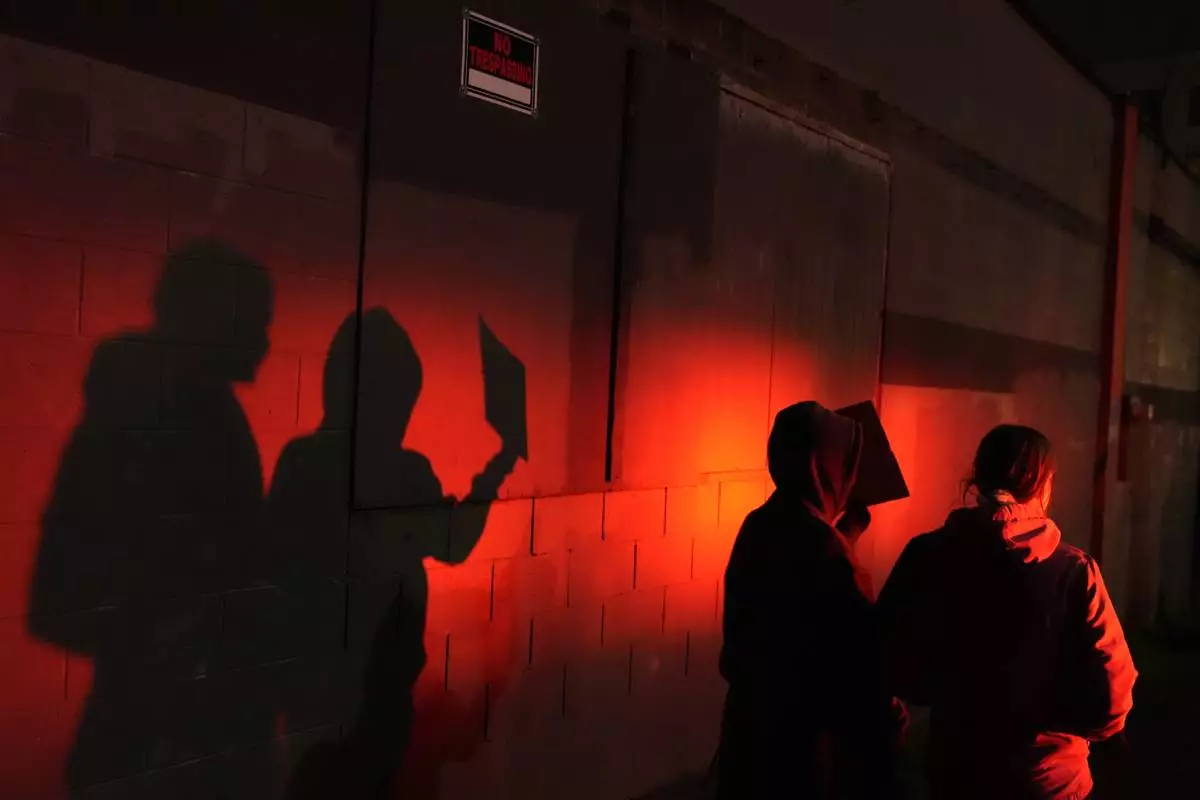
Two protesters are lit by a police light as they walk outside the U.S. Immigration and Customs Enforcement facility on Thursday, Jan. 8, 2026, in Portland, Ore. (AP Photo/Jenny Kane)
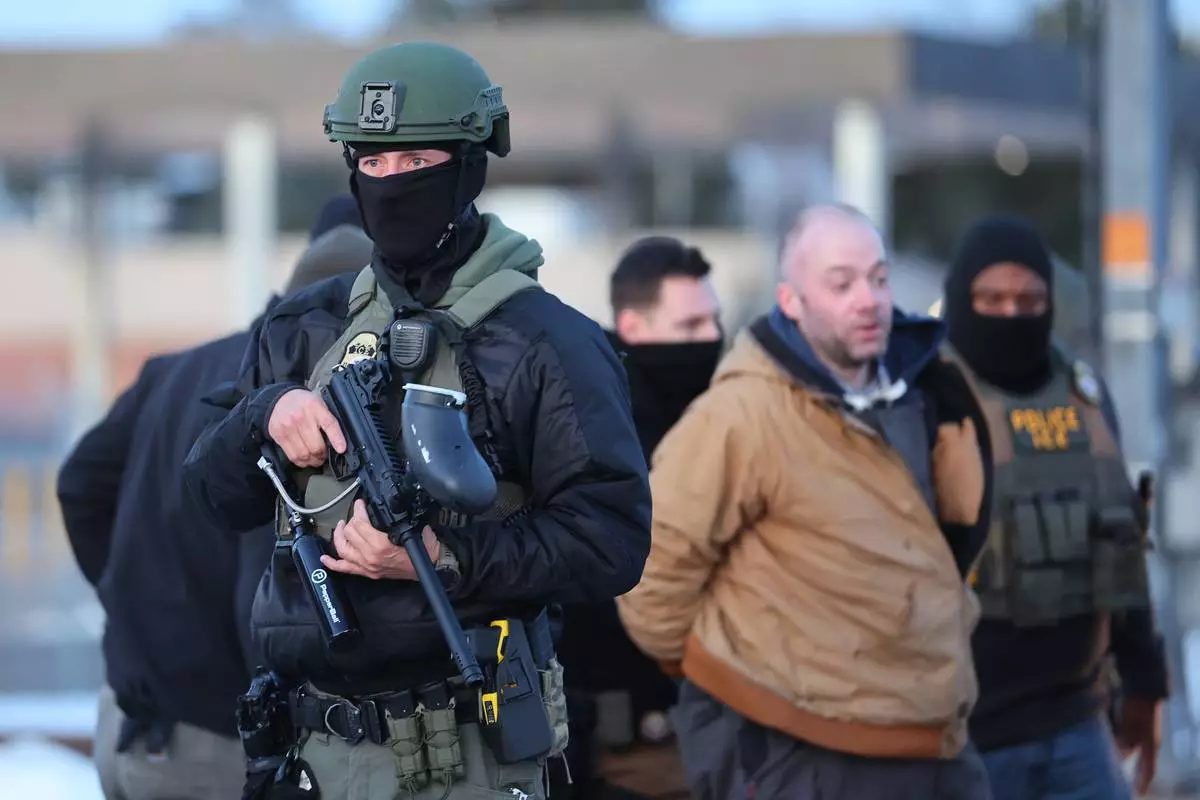
Protesters are arrested by federal agents outside the Bishop Henry Whipple Federal Building in Minneapolis, Friday, Jan. 9, 2026. (AP Photo/Adam Bettcher)
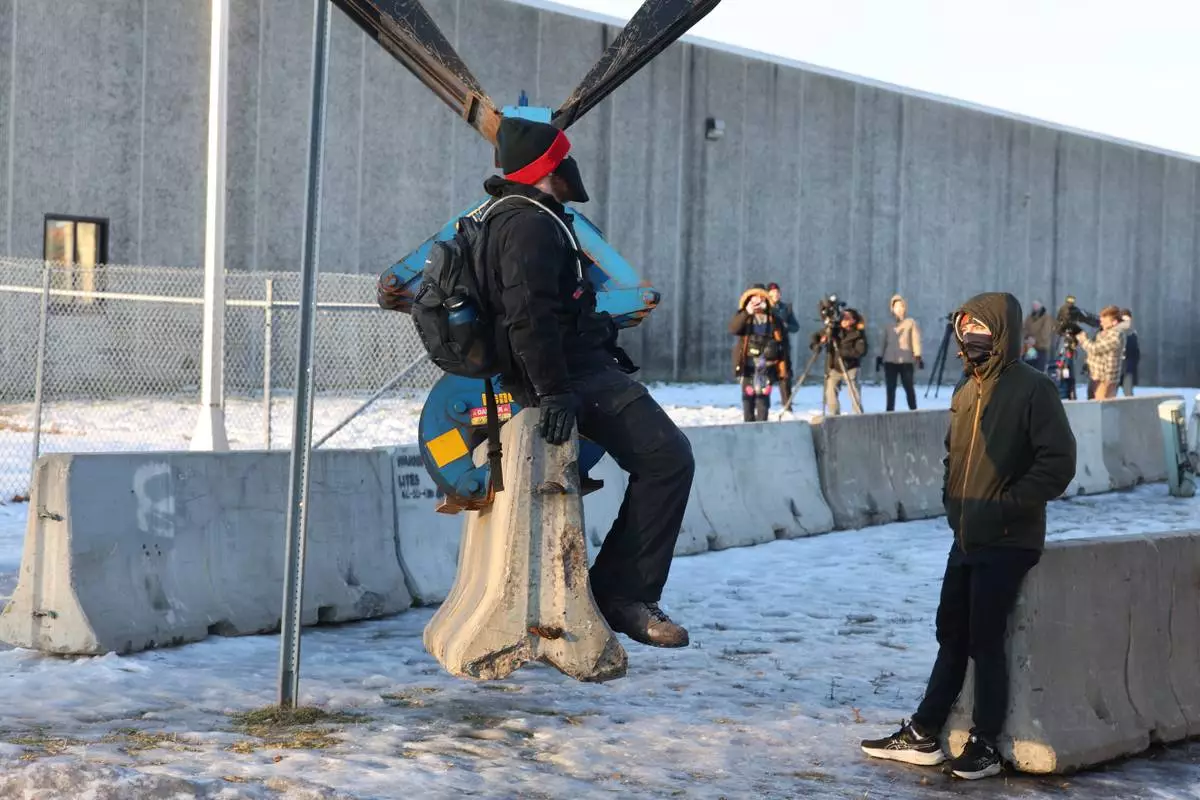
Protesters sit on a barrier that is being assembled outside the Bishop Henry Whipple Federal Building as protesters gather in Minneapolis, Friday, Jan. 9, 2026. (AP Photo/Adam Bettcher)
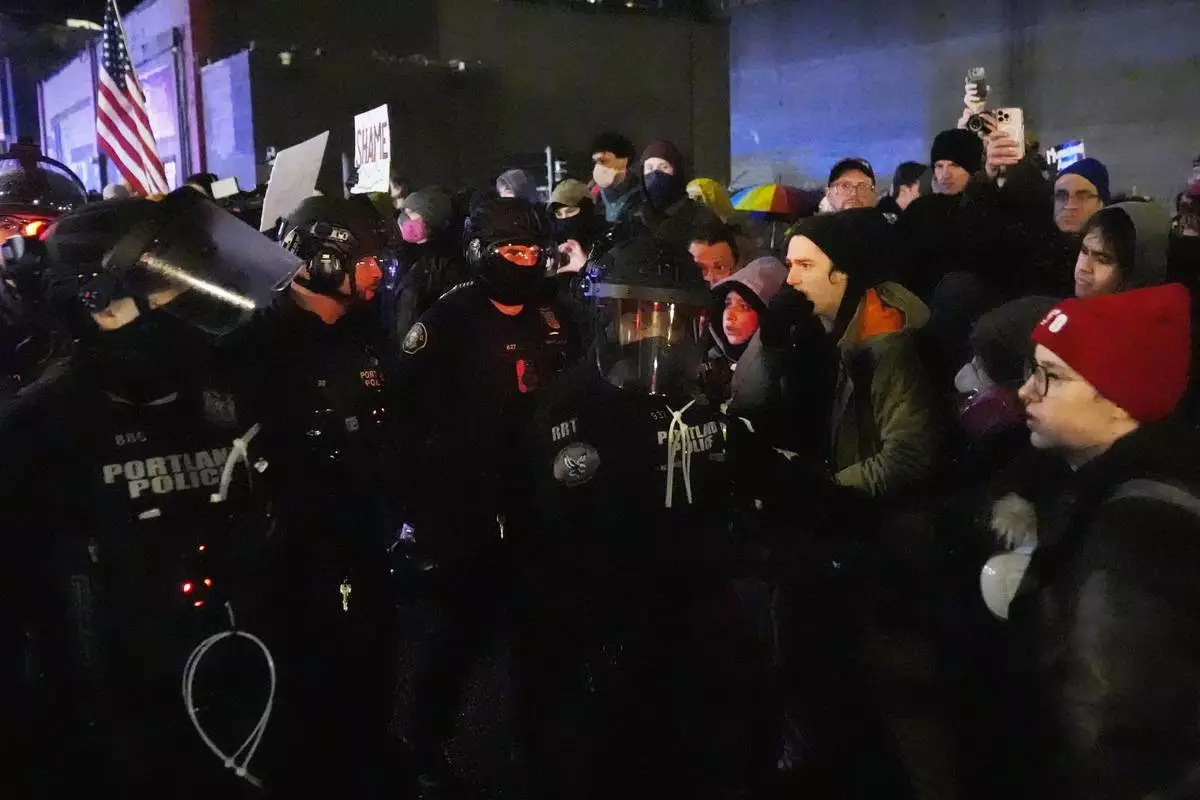
Protesters stand off against law enforcement outside the U.S. Immigration and Customs Enforcement facility in Portland, Ore., Thursday, Jan. 8, 2026. (AP Photo/Jenny Kane)
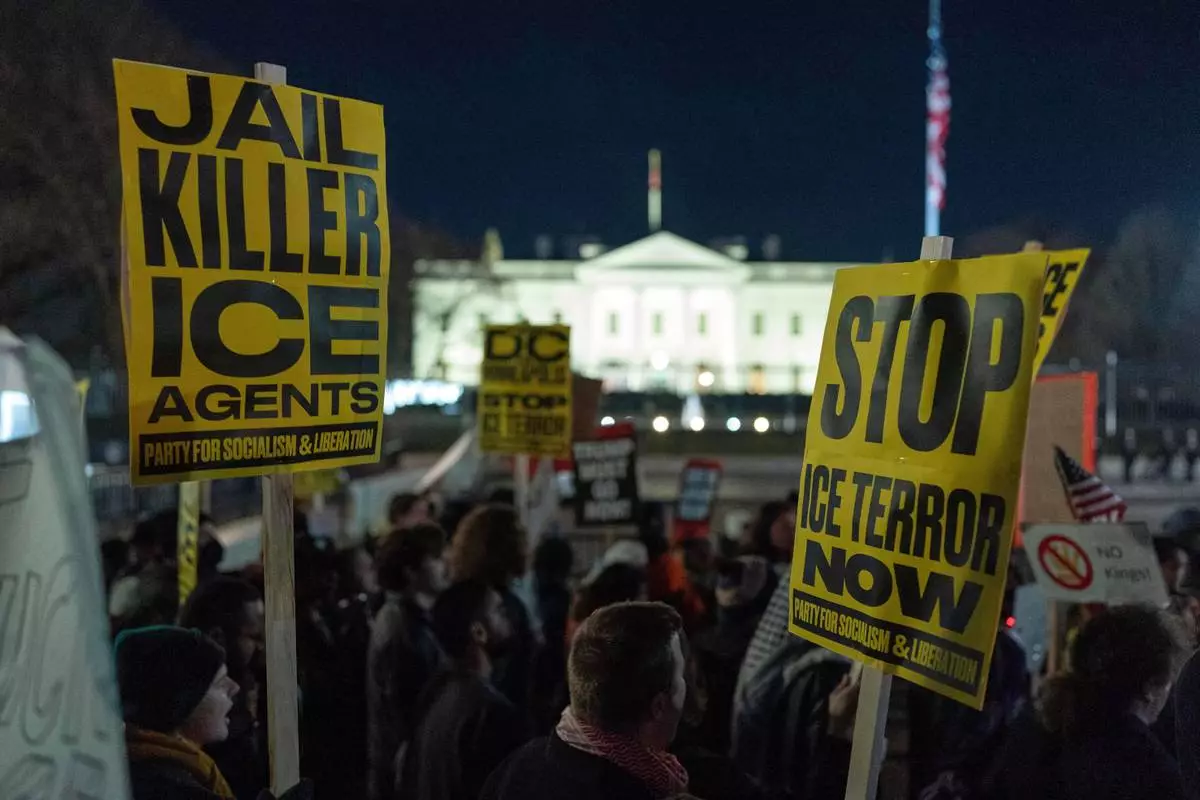
Demonstrators protest outside the White House in Washington, Thursday, Jan. 8, 2026, against the Immigration and Customs Enforcement (ICE) agent who fatally shot Renee Nicole Good in Minneapolis. (AP Photo/Jose Luis Magana)
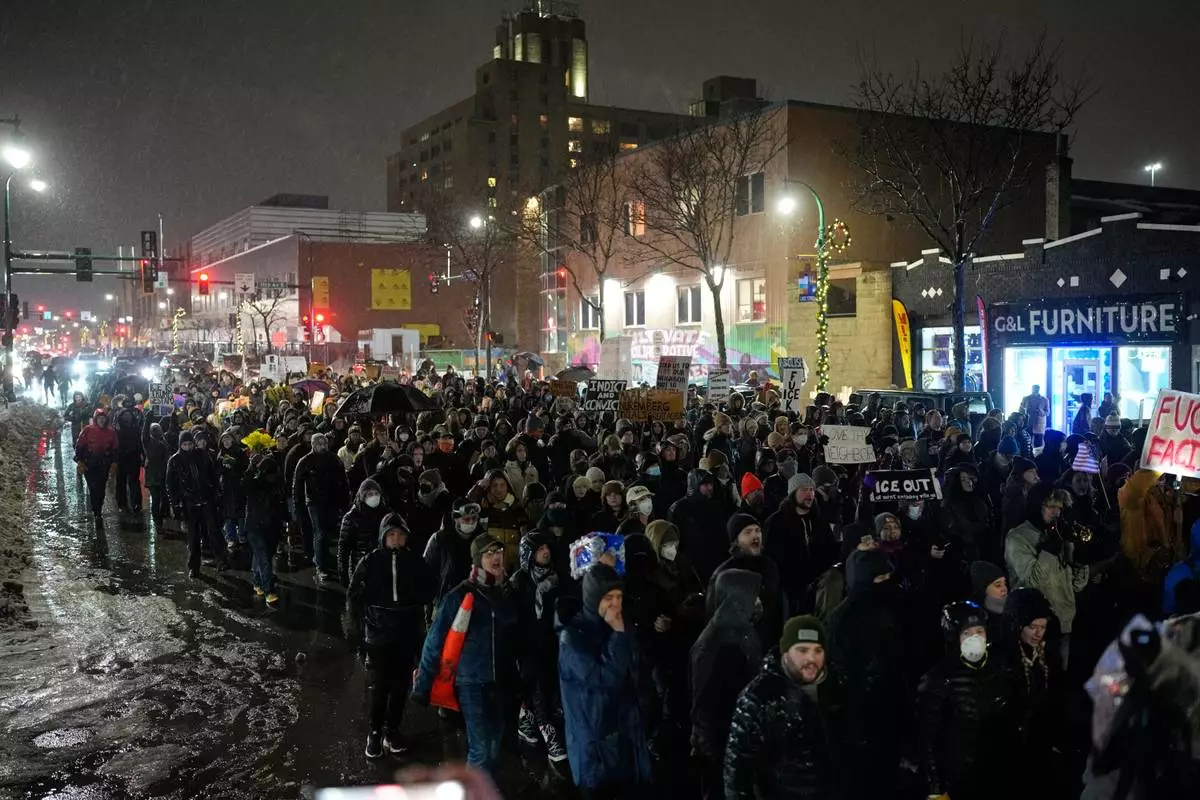
Protesters chant and march during a rally for Renee Good, who was fatally shot by an ICE officer the day before, Thursday, Jan. 8, 2026, in Minneapolis. (AP Photo/John Locher)
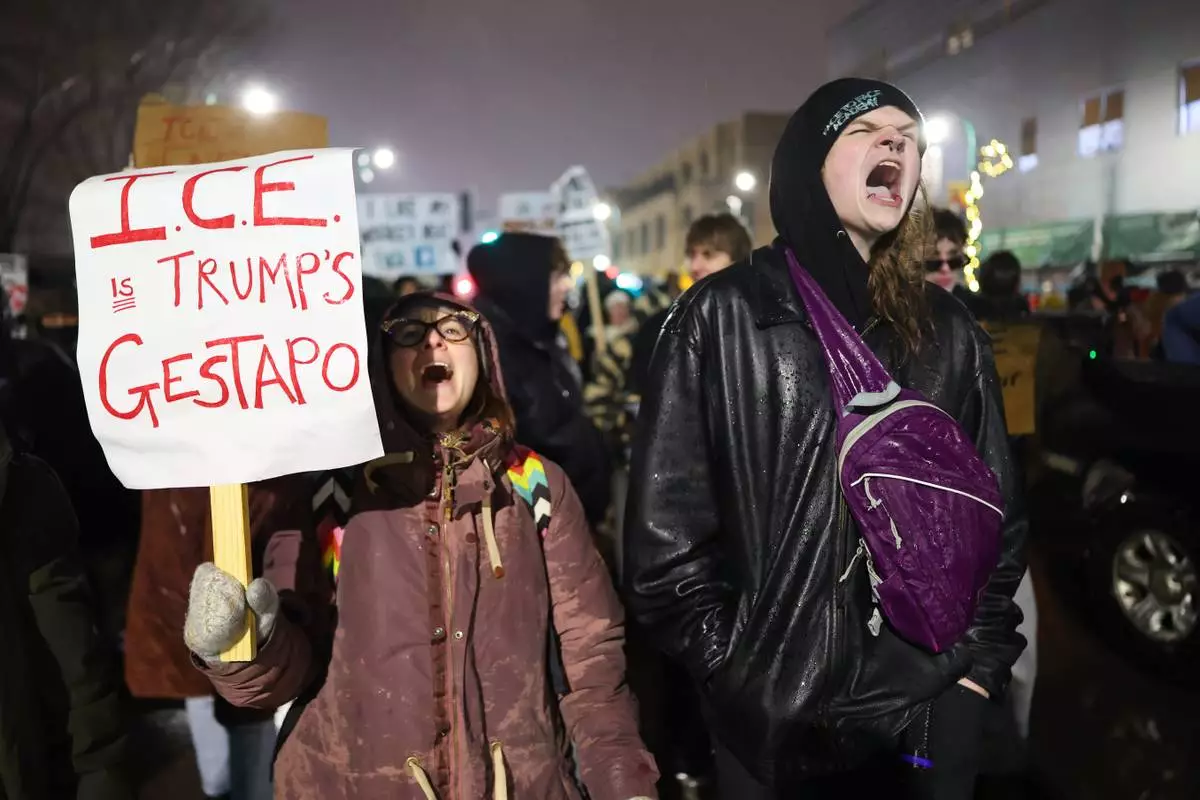
Protesters gather during a rally for Renee Good, Thursday, Jan. 8, 2026, in Minneapolis, after she was fatally shot by an ICE officer the day before. (AP Photo/Adam Bettcher)
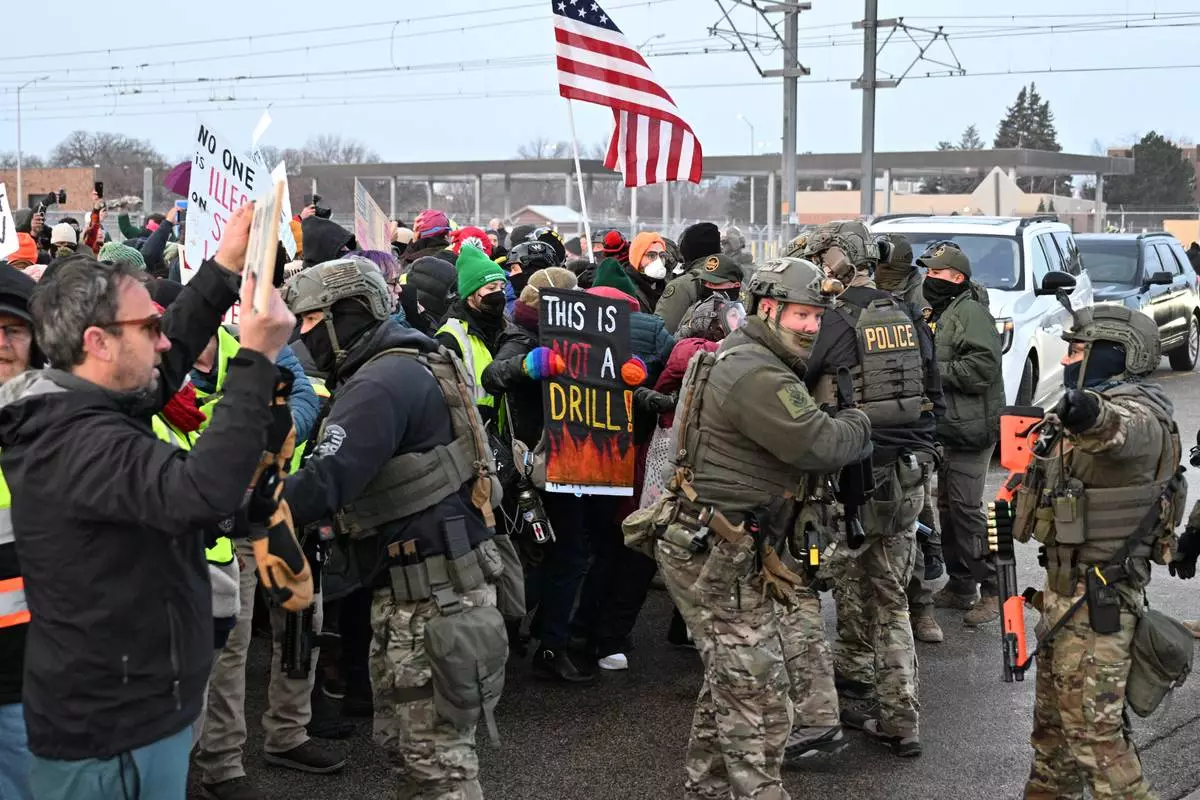
Protesters confront federal agents outside the Bishop Henry Whipple Federal Building, Thursday, Jan. 8, 2026, in Minneapolis, Minn. (AP Photo/Tom Baker)
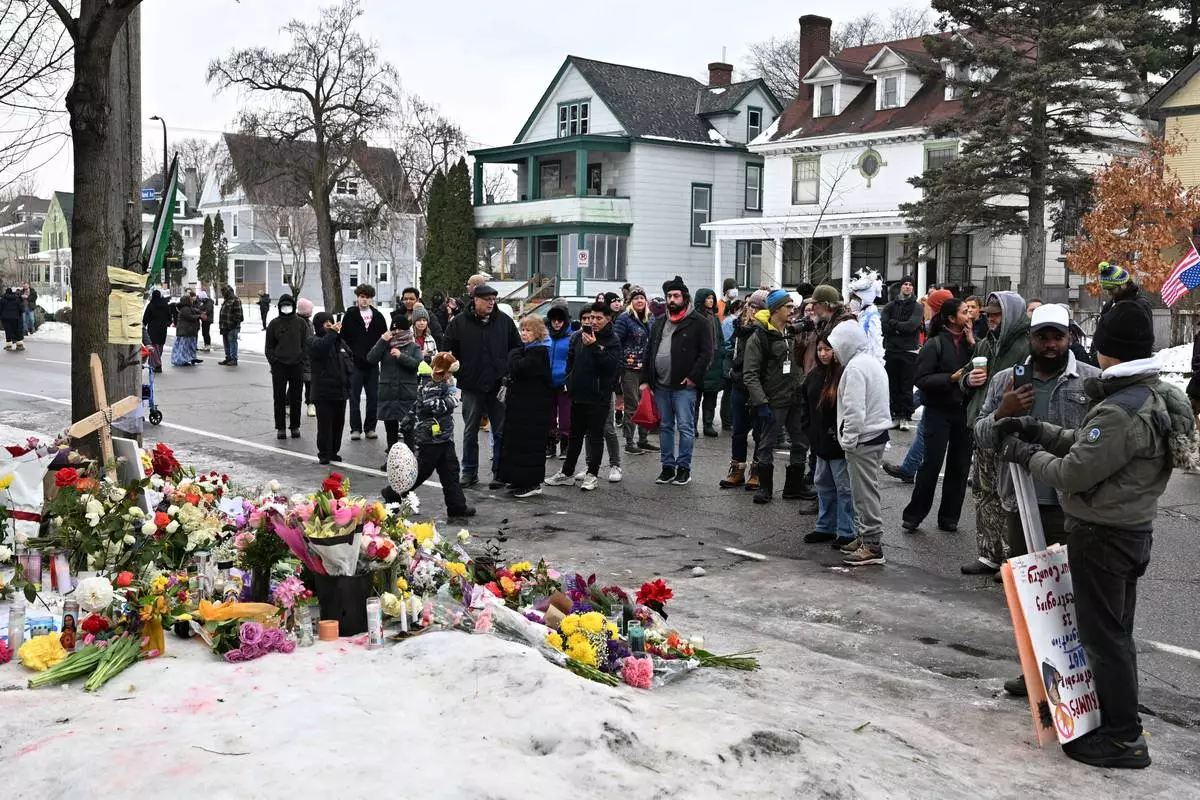
People gather around a makeshift memorial honoring the victim of a fatal shooting involving federal law enforcement agents, near the site of the shooting, Thursday, Jan. 8, 2026, in Minneapolis. (AP Photo/Tom Baker)
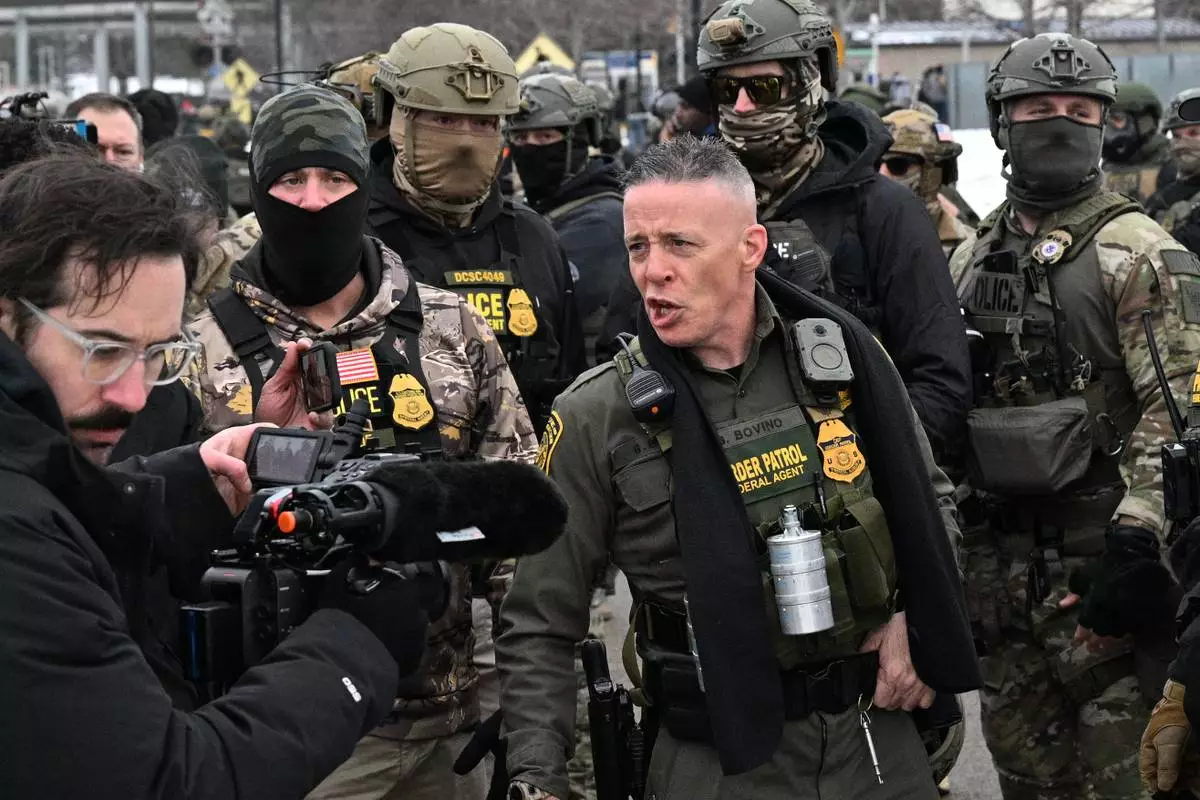
U.S. Border Patrol Cmdr. Gregory Bovino arrives as protesters gather outside the Bishop Henry Whipple Federal Building, Thursday, Jan. 8, 2026, in Minneapolis, Minn. (AP Photo/Tom Baker)
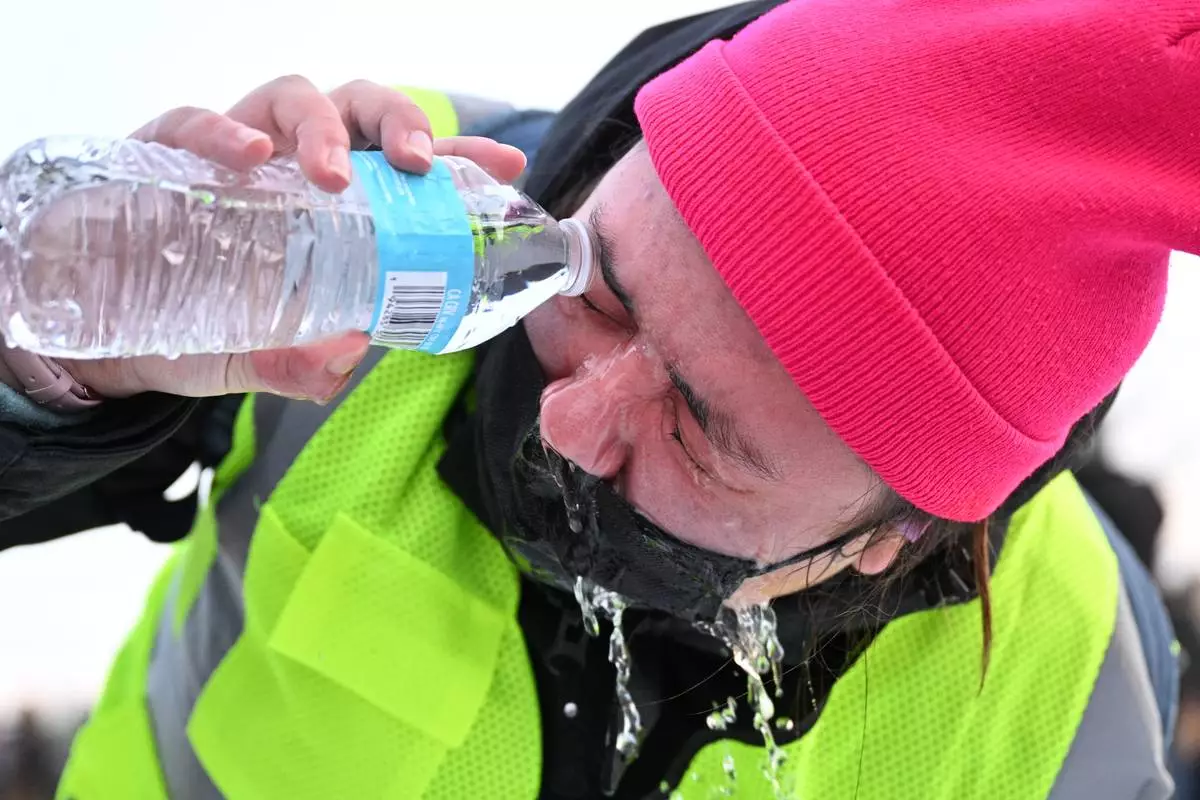
A protester pours water in their eye after confronting law enforcement outside the Bishop Henry Whipple Federal Building, Thursday, Jan. 8, 2026, in Minneapolis, Minn. (AP Photo/Tom Baker)
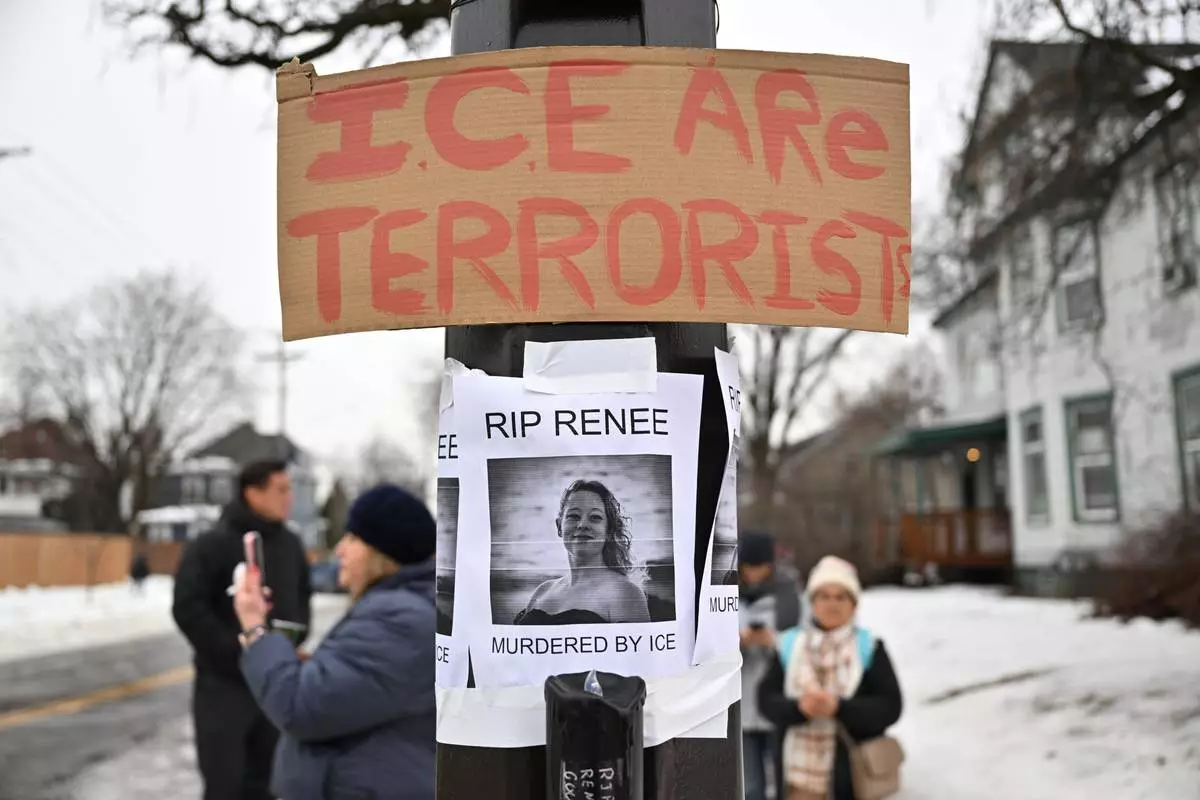
People gather around a makeshift memorial honoring the victim of a fatal shooting involving federal law enforcement agents, near the site of the shooting, Thursday, Jan. 8, 2026, in Minneapolis. (AP Photo/Tom Baker)