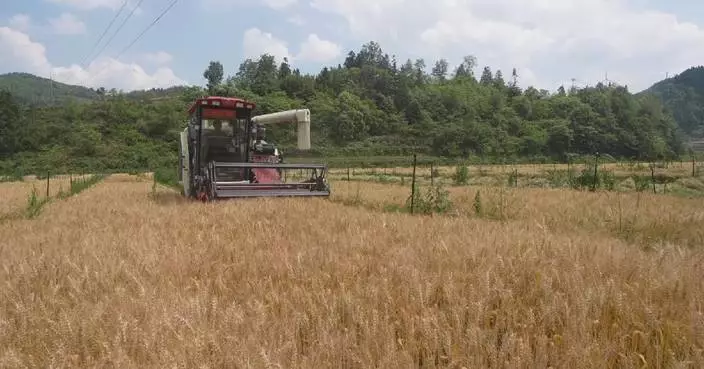
Farmers in southern China have adopted diverse agricultural machinery to plant rice seedlings in early June, significantly reducing labor costs and improving efficiency.
Rice planting, as one of the most labor-intensive agricultural tasks, has long faced challenges in adopting mechanized farming. However, in Boyuan Village of east China's Fujian Province, local farmers have installed special rails to facilitate the movement of mini-sized machinery, bringing new technologies to local terraced rice fields over 700 years of history.
The newly built system spans over 5,000 meters of rail, connecting layered fields with elevation differences exceeding 100 meters. This transport network allows farmers to deliver supplies to upper terraces with the simple push of a button, replacing the backbreaking manual hauling of the past.
In addition, to address the limitations of small, fragmented plots, farmers have adopted compact agricultural machinery specifically designed for mountainous terrain. These mini-plot machines not only perfectly fit terraced fields but also ensure precise field leveling, enabling even water distribution for optimal rice growth.
In Wushi City's Shijian Town, east China's Anhui Province, farmers have equipped transplanters with BeiDou navigation systems, achieving planting accuracy of 3-5 centimeters. The Beidou system also allows machinery to work in straight lines autonomously, allowing operators to replenish seedlings while the system maintains operation.
A provincial rice transplanting competition was held on Thursday in Xiaoshan District of Hangzhou City, east China's Zhejiang Province. The event attracted farmers from 11 districts, requiring participants to transplant using machines with high speed and precision. The event is part of the efforts to promote the adoption of mechanized farming techniques.
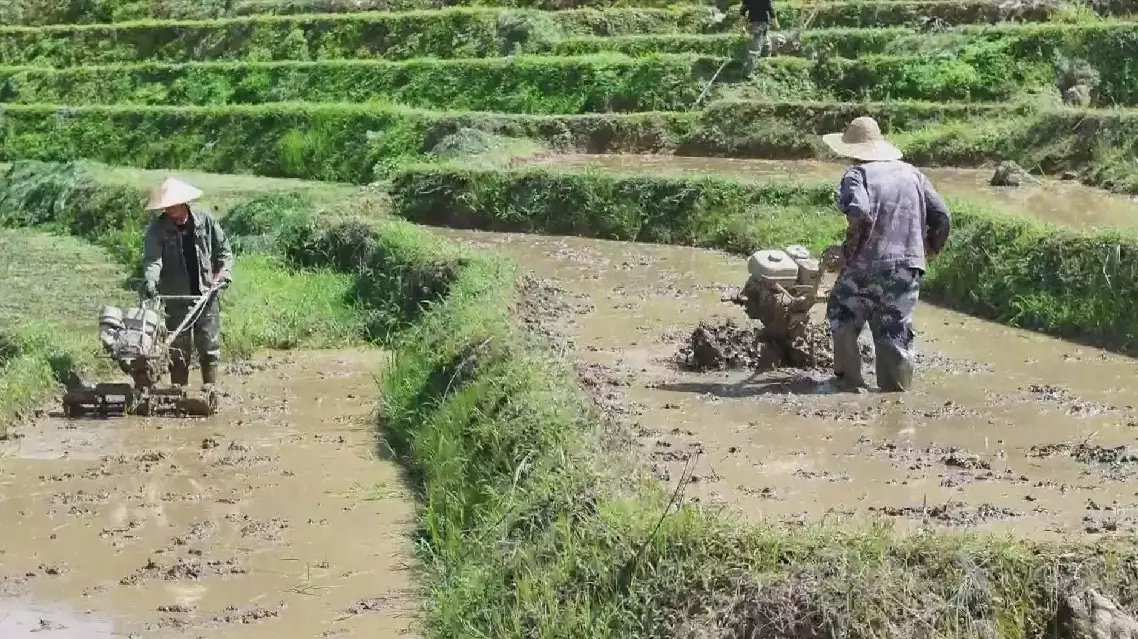
Agricultural machinery facilitates rice farming in southern China