SAN FRANCISCO--(BUSINESS WIRE)--Jun 6, 2025--
Kargo, a leader in industrial artificial intelligence (AI) technology, announced an $18.4 million investment led by Matter Venture Partners, with participation from previous investors Sozo Ventures and Founders Fund, as well as existing customers and new strategic investors Lineage and Armada Supply Chain Solutions, LLC. Kargo also announced the successful rollout of its computer vision solution at 240 Armada dock doors to automate inventory management across the food supply chain provider’s national network of warehouse hubs.
This press release features multimedia. View the full release here: https://www.businesswire.com/news/home/20250606420349/en/
“Comprehensive, proprietary data is the key to unlocking the full potential of AI. Kargo has become the trusted provider of inventory data to leading global supply chains. AI plays a critical role in supply chain integrity and we’re helping customers across industries build their AI stack to connect their warehouses, back offices and customers,” said Sam Lurye, founder and CEO of Kargo. “This capital investment enables Kargo to develop new products that connect supply chain data and rapidly expand our customer base.”
Kargo provides Kargo Towers and Kargo Lifts, integrated hardware and software solutions that automate freight data capture and verification. Kargo Towers are installed at warehouse loading docks or gateways, and use AI-powered cameras to gather information on freight labels, cases and product condition. Kargo’s LLM structures the image data into coherent inventory information to flag exceptions (i.e. overages, shortages, damage or compliance concerns) in real-time. The Kargo Lift is purpose-built for forklifts and automated guided vehicles (AGVs) and extends Kargo’s AI capabilities to a new vantage point.
By providing visual proof of the contents and condition of every pallet, Kargo supplies customers with accurate and timely inventory data. This deep technical moat has resulted in:
"Kargo played a critical role in our ability to successfully implement AI in a meaningful way. We were live in under a month, significantly enhancing our inventory management. Our clients – predominantly large, multi-unit restaurant companies – benefited almost immediately from increased accuracy and traceability.” said Rick Rover, President of Armada’s warehouse division. “Our commitment to reliability, agility, and resilience ensures exceptional service that consistently benefits our clients.”
“Kargo is redefining how supply chains operate by making freight data visible, reliable, and actionable at scale,” said Haomiao Huang, Founding Partner at Matter Venture Partners. “Their rapid customer adoption, real-world impact, and deep technical moat make them a category-defining company in logistics AI. We’re proud to back Kargo as they build the modern infrastructure layer for the physical economy.
About Kargo
Kargo’s mission is to create a universal interpreter for supply chains by using computer vision to connect the physical world of freight to the digital systems used to manage it. Kargo believes that applications of artificial intelligence like this are critical to a more efficient future for logistics. The Kargo system verifies all inbound and outbound freight in real-time, aggregating data, ensuring accuracy, and providing visibility that enables efficient warehouse operations and supply chain management. Kargo was founded in 2019 and is headquartered in San Francisco. To learn more, visit: https://kargo.ai/
About Matter Venture Partners
Matter Venture Partners is a venture capital firm dedicated to accelerating HardTech innovation—reshaping industries like semiconductors, robotics, AI infrastructure, and electrification. As experienced founders and investors, Matter combines capital with deep technical and operational expertise to help startups scale. The firm partners with strategic LPs and leverages a global supply chain network to support founders from early product-market fit through industrial-scale growth. Matter raised a $311 million inaugural fund in 2023 and is headquartered in Palo Alto, California. To learn more, visit: www.mattervp.com
About Armada
Armada Supply Chain Solutions creates innovative, data-driven, fully integrated supply chain solutions that improve business performance for our clients, enabling them to serve their customers best. We deliver supply chain solutions with extraordinary service, powered by technology, driven by analytics, operating at scale. We are revolutionizing the way supply chains are managed by creating resilient and agile networks to manage the challenges of today’s market. Armada believes there’s a better way – a better way rooted in transparency, advocacy, and ingenuity. To learn more, visit: www.armada.net
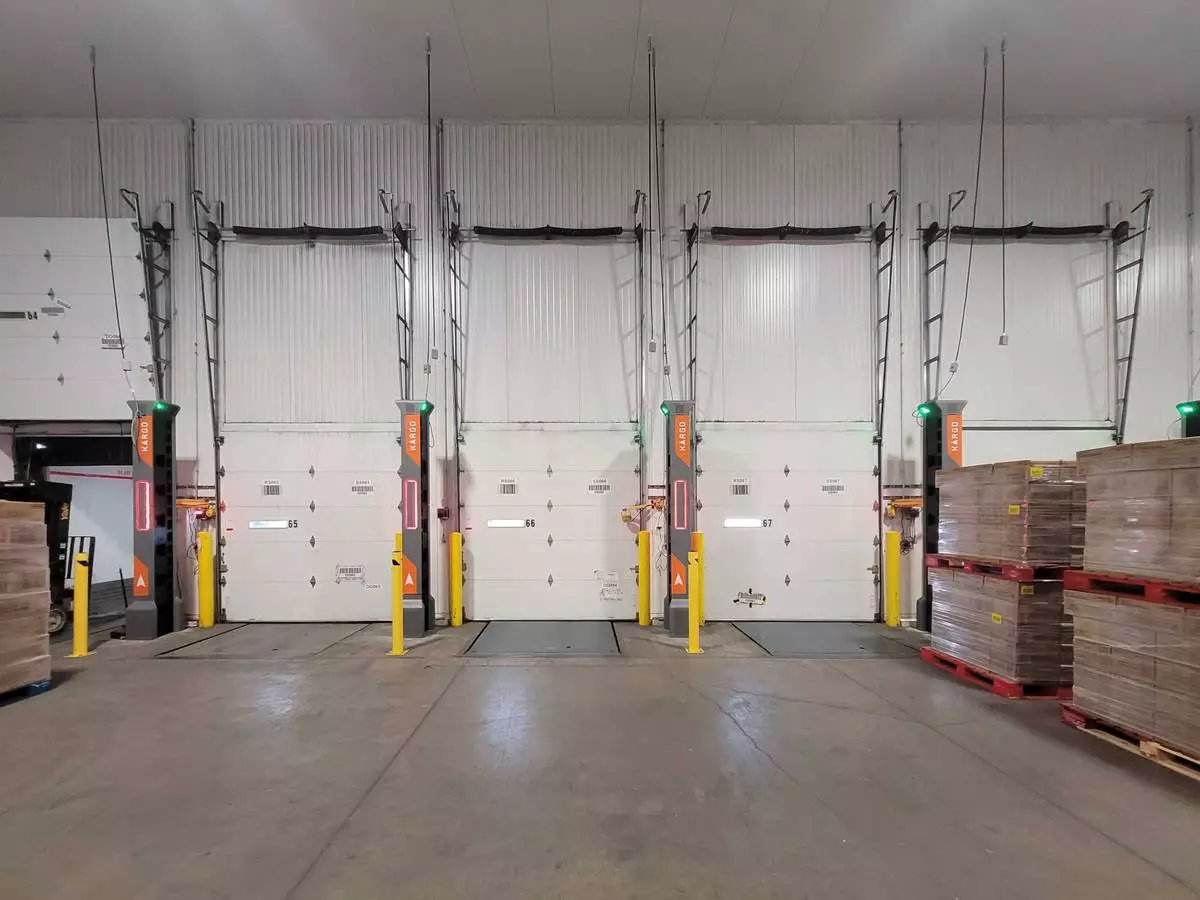
Kargo towers at loading dock doors.
JEFFERSON CITY, Mo. (AP) — A battle over Missouri’s congressional districts vaulted back to the U.S. Supreme Court on Wednesday, two months before a pivotal November election that will determine control of Congress and affect the fate of President Donald Trump’s agenda.
A series of conflicting court rulings has left a scar on Missouri — and left voters befuddled and unsure which U.S. House districts they will be voting in and which candidates will appear on their ballots.
A federal appeals court panel on Wednesday sided with Republicans, declining to halt a federal judge’s order favoring a new map backed by Trump. But that decision immediately was appealed to the U.S. Supreme Court, which just a day earlier had let stand a ruling by Missouri's top court against the Trump-backed districts.
Time is rapidly expiring to figure it out. Federal law sets a Sept. 19 deadline to mail absentee ballots to overseas citizens and military voters.
Here's a look at how Missouri arrived at this point and the difficulties it now faces.
Trump urged Republican-led states last year to redraw congressional districts to their advantage ahead of the midterm elections. Texas went first. Missouri was the second GOP state to act. State lawmakers passed new U.S. House districts last September targeting a Kansas City-based seat held by Democratic Rep. Emanuel Cleaver.
The new districts were intended to help Republicans win seven of the state's eight House seats in the midterm elections — a gain of one seat.
Redistricting opponents collected hundreds of thousands of petition signatures seeking to force a statewide vote on the new districts. They submitted the signatures in December. But Republican Secretary of State Denny Hoskins waited until August — on the same day as Missouri's primary — to reject the petition. Hoskins asserted that a referendum petition could not be used for congressional redistricting.
The delay by Hoskins was intentional. It allowed Missouri's new congressional districts to be used in the primaries.
The Missouri Supreme Court said Hoskins was wrong. It ordered him to put the redistricting referendum on the November ballot, which he did. But more than that, the court said the new districts never became law and instead were suspended retroactively to the December petition submission.
The court barred Hoskins from using the new map and said the old map — passed by Republican lawmakers in 2022 after the last census — must be used in the November election. The U.S. Supreme Court on Tuesday declined to hear an appeal.
Mere minutes after the U.S. Supreme Court's action, federal District Judge Stephen Clark of Missouri issued a contradictory decision. He temporarily barred Hoskins from using any map other than the new congressional districts in the November election. Clark said switching districts between the primary and general election could violate voters' federal rights.
Redistricting opponents asked the 8th U.S. Circuit Court of Appeals to reverse Clark's order, but it declined to do so. So they quickly asked the U.S. Supreme Court to intervene.
Redistricting opponents also have asked the Missouri Supreme Court to hold Hoskins in contempt for taking steps to use the new districts in November. The court set a contempt hearing for Thursday.
State attorneys for Hoskins, meanwhile, want the federal judge to block the contempt hearing. They contend Hoskins was merely following orders, arguing that a federal court order — based on the U.S. Constitution — supersedes a state order based on the state constitution.
After a U.S. Supreme Court ruling in April weakened the federal Voting Rights Act, Alabama lawmakers voted to change some of their congressional districts. The high court allowed it to happen, even though voting had occurred in a May primary. Alabama instead held a new primary for the revised districts in August.
A similar scenario unfolded in Texas three decades ago. After Texas held its 1996 primaries, a federal court struck down several congressional districts. The state subsequently held an open primary for those districts in the November election, putting candidates from both parties on the same ballot. If no one got a majority, the top two advanced to a runoff.
In Missouri's case, no court has suggested redoing the primary. Candidates who won in August already have been certified for the November ballot according to the number of the district that they won.
“Here in Missouri, we’ve witnessed a series of unprecedented actions, one after another,” said Travis Crum, a law professor at Washington University in St. Louis, who specializes in election law.
Do voters have a right for congressional district boundaries to stay the same from the primary to the general election? “That is a tough and complicated legal question, and there is no definitive ruling from the Supreme Court that one could point to for an answer,” Crum said.
Candidates knew of the ongoing litigation when they signed up to seek office.
“The fact that the district lines changed, that was a chance that you take when you run,” said Michael Wolff, a former Missouri chief justice who later served as dean of the Saint Louis University Law School.
Over the past year, more than a dozen lawsuits have been filed over Missouri's redistricting. Some voters have rallied against it at the state Capitol and courthouses. Others have winced in confusion when listening to explanations about which district they reside in.
Toby Thacker, who lives on a farm near Sedalia, has shifted from the 4th District, currently held by Republican Rep. Mark Alford, to Cleaver's 5th District under the new map. Thacker said he generally supports Republicans, who redrew the map.
But “I'm not very happy with them for doing that,” Thacker recently told The Associated Press.
Cliff Keith, of Washington, Missouri, recently joined protesters outside the Missouri Capitol.
“They have absolutely no business redrawing the districts right now, just before an election,” Keith said.
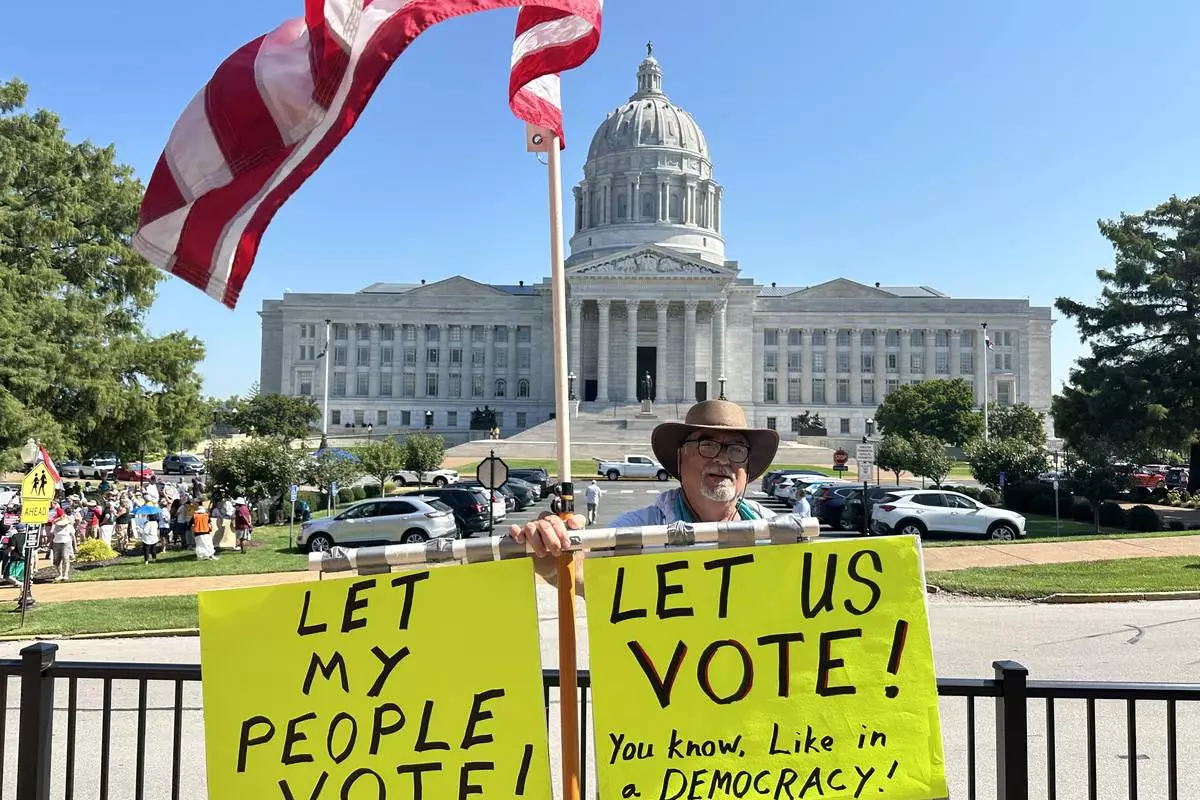
In this photo taken with a smartphone, Steve Dakopolos demonstrates in front of the state Capitol in Jefferson City, Mo., Wednesday, Sept. 2, 2026, in support of a referendum petition seeking a statewide vote on a congressional redistricting plan. (AP Photo/David A. Lieb)