NEW YORK (AP) — The world’s richest man could lose billions in his fight with world’s most powerful politician.
The feud between Elon Musk and Donald Trump could mean Tesla’s plans for self-driving cars hit a roadblock, SpaceX flies fewer missions for NASA, Starlink gets fewer overseas satellite contracts and the social media platform X loses advertisers.
Maybe, that is. It all depends on Trump’s appetite for revenge and how the dispute unfolds.
Joked Telemetry Insight auto analyst Sam Abuelsamid, “Since Trump has no history of retaliating against perceived adversaries, he’ll probably just let this pass.”
Turning serious, he sees trouble ahead for Musk.
“For someone that rants so much about government pork, all of Elon’s businesses are extremely dependent on government largesse, which makes him vulnerable.”
Trump and the federal government also stand to lose from a long-running dispute, but not as much as Musk.
The dispute comes just a week before a planned test of Tesla’s driverless taxis in Austin, Texas, a major event for the company because sales of its EVs are lagging in many markets, and Musk needs a win.
Trump can mess things up for Tesla by encouraging federal safety regulators to step in at any sign of trouble for the robotaxis.
Even before the war of words broke out on Thursday, the National Highway Transportation Safety Administration requested data on how Musk’s driverless, autonomous taxis will perform in low-visibility conditions. That request follows an investigation last year into 2.4 million Teslas equipped with full self-driving software after several accidents, including one that killed a pedestrian.
A spokesman for NHTSA said the probe was ongoing and that the agency "will take any necessary actions to protect road safety.”
The Department of Justice has also probed the safety of Tesla cars, but the status of that investigation is unclear. The DOJ did not respond immediately to requests for comment.
The promise of a self-driving future led by Tesla inspired shareholders to boost the stock by 50% in the weeks after Musk confirmed the Austin rollout. But on Thursday, the stock plunged more than 14% amid the Trump-Musk standoff. On Friday, it recovered a bit, bouncing back nearly 4%.
“Tesla’s recent rise was almost entirely driven by robotaxi enthusiasm," said Morningstar analyst Seth Goldstein. “Elon’s feud with Trump could be a negative.”
One often-overlooked but important part of Tesla’s business that could take a hit is its sales of carbon credits.
As Musk and Trump were slugging it out Thursday, Republican senators inserted new language into Trump’s budget bill that would eliminate fines for gas-powered cars that fall short of fuel economy standards. Tesla has a thriving side business selling “regulatory credits” to other automakers to make up for their shortfalls.
Musk has downplayed the importance of the credits business, but the changes would hurt Tesla as it reels from boycotts of its cars tied to Musk’s time working for Trump.
Credit sales jumped by a third to $595 million in the first three months of the year even as total revenue slumped.
Musk’s foray into right-wing politics cost Tesla sales among the environmentally minded consumers who embraced electric cars and led to boycotts of Tesla showrooms.
If Musk has indeed ended his close association with Trump, those buyers could come back, but that’s far from certain.
Meanwhile, one analyst speculated earlier this year that Trump voters in so-called red counties could buy Teslas “in a meaningful way.” But he’s now less hopeful.
“There are more questions than answers following Thursday developments,” TD Cowen’s Itay Michaeli wrote in his latest report, “and it’s still too early to determine any lasting impacts.”
Michaeli’s stock target for Tesla earlier this year was $388. He has since lowered it to $330. Tesla was trading Friday at $300.
Tesla did not respond to requests for comment.
Trump said Thursday that he could cut government contracts to Musk’s rocket company, SpaceX, a massive threat to a company that has received billions of federal dollars.
The privately held company that is reportedly worth $350 billion provides launches, sends astronauts into space for NASA and has a contract to send a team from the space agency to the moon next year.
But if Musk has a lot to lose, so does the U.S.
SpaceX is the only U.S. company capable of transporting crews to and from the space station, using its four-person Dragon capsules. The other alternative is politically dicey: depending wholly on Russia's Soyuz capsules.
Musk knew all this when he shot back at Trump that SpaceX would begin decommissioning its Dragon spacecraft. But it is unclear how serious his threat was. Several hours later — in a reply to another X user — he said he wouldn’t do it.
A subsidiary of SpaceX, the satellite internet company Starlink, appears to also have benefited from Musk’s once-close relationship with the president.
Musk announced that Saudi Arabia had approved Starlink for some services during a trip with Trump in the Middle East last month. The company has also won a string of other recent deals in Bangladesh, Pakistan, India and elsewhere as Trump has threatened tariffs.
It’s not clear how much politics played a role, and how much is pure business.
On Friday, The Associated Press confirmed that India had approved a key license to Starlink. At least 40% of India’s more than 1.4 billion people have no access to the internet.
Big advertisers that fled X after Musk welcomed all manner of conspiracy theories to the social media platform have started to trickle back in recent months, possibly out of fear of a conservative backlash.
Musk has called their decision to leave an “illegal boycott” and sued them, and the Trump administration recently weighed in with a Federal Trade Commission probe into possible coordination among them.
Now advertisers may have to worry about a different danger.
If Trump sours on X, "there’s a risk that it could again become politically radioactive for major brands,” said Sarah Kreps, a political scientist at Cornell University. She added, though, that an “exodus isn’t obvious, and it would depend heavily on how the conflict escalates, how long it lasts and how it ends.”
Associated Press Writer Barbara Ortutay in San Francisco contributed to this report.
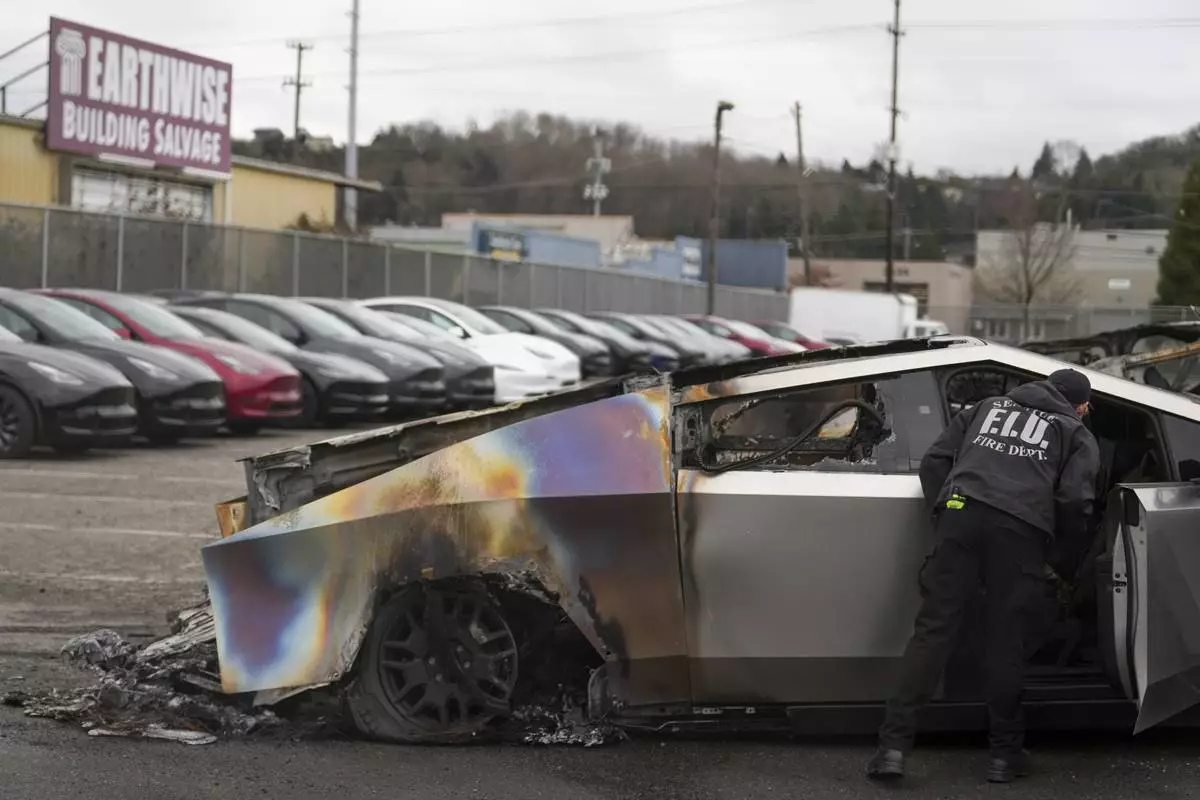
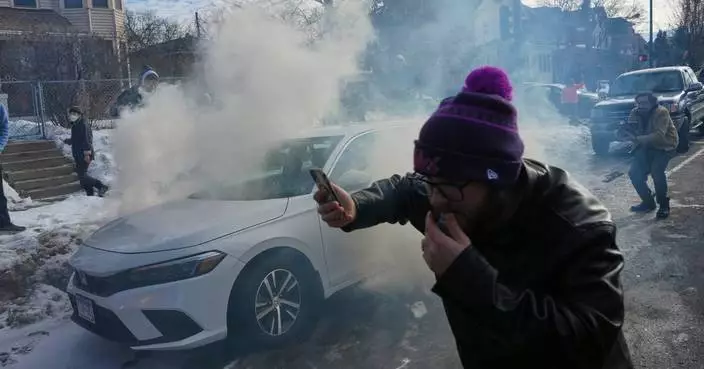
FILE - A member of the Seattle Fire Department inspects a burned Tesla Cybertruck at a Tesla lot in Seattle on March 10, 2025. (AP Photo/Lindsey Wasson, File)
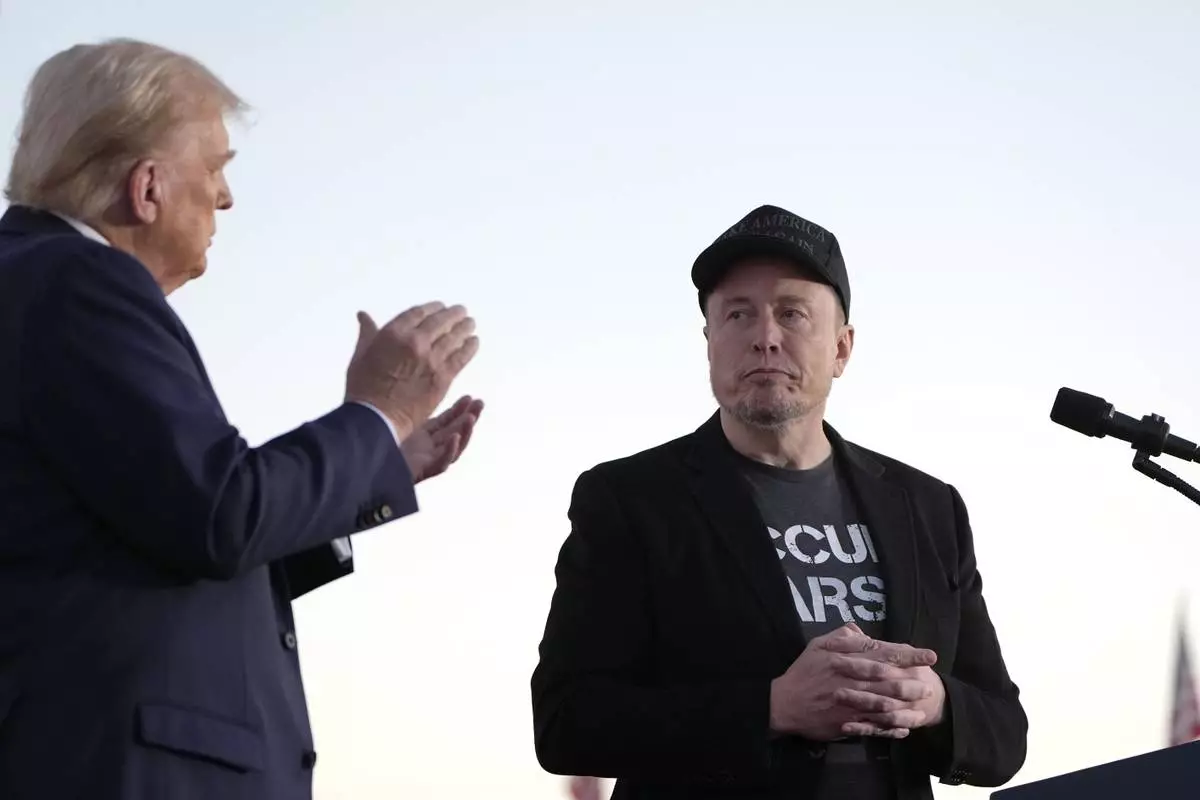
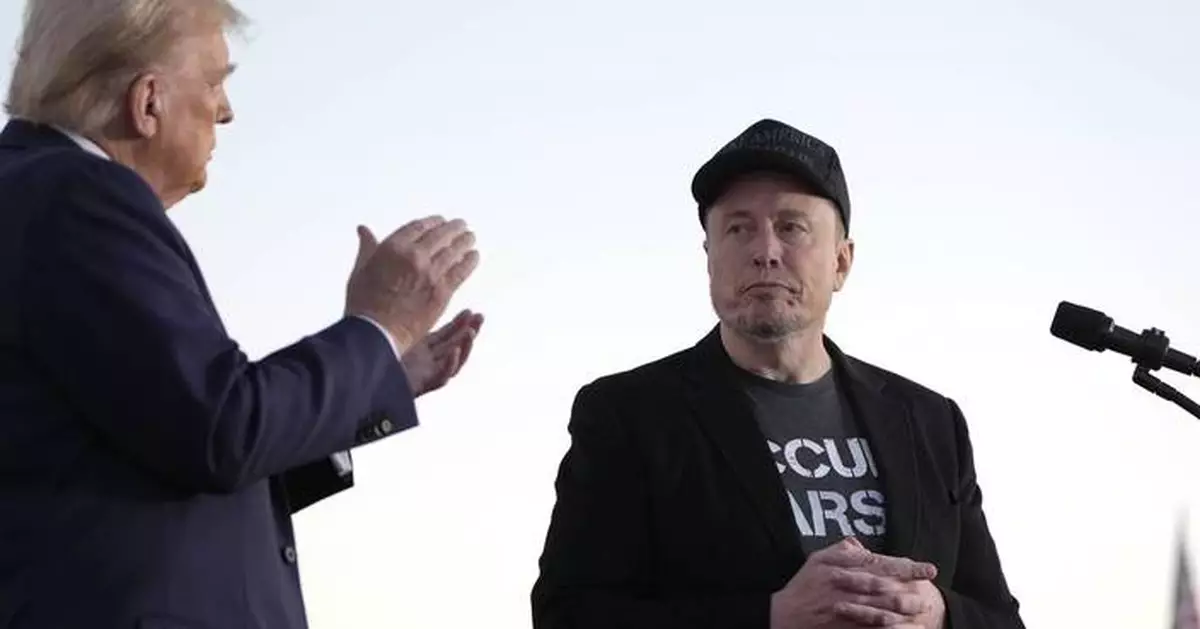
FILE - Republican presidential nominee former President Donald Trump, left, claps as Tesla and SpaceX CEO Elon Musk prepares to depart after a campaign event at the Butler Farm Show on Oct. 5, 2024, in Butler, Pa. (AP Photo/Alex Brandon, File)
WASHINGTON (AP) — The Trump administration's criminal investigation of Federal Reserve Chair Jerome Powell appeared on Monday to be emboldening defenders of the U.S. central bank, who pushed back against President Donald Trump’s efforts to exert more control over the Fed.
The backlash reflected the overarching stakes in determining the balance of power within the federal government and the path of the U.S. economy at a time of uncertainty about inflation and a slowing job market. This has created a sense among some Republican lawmakers and leading economists that the Trump administration had overstepped the Fed's independence by sending subpoenas.
The criminal investigation — a first for a sitting Fed chair — sparked an unusually robust response from Powell and a full-throated defense from three former Fed chairs, a group of top economic officials and even Republican senators tasked with voting on Trump's eventual pick to replace Powell as Fed chair when his term expires in May.
White House press secretary Karoline Leavitt told reporters that Trump did not direct his Justice Department to investigate Powell, who has proven to be a foil for Trump by insisting on setting the Fed's benchmark interest rates based on the data instead of the president's wishes.
“One thing for sure, the president’s made it quite clear, is Jerome Powell is bad at his job,” Leavitt said. “As for whether or not Jerome Powell is a criminal, that’s an answer the Department of Justice is going to have to find out.”
The investigation demonstrates the lengths the Trump administration is willing to go to try to assert control over the Fed, an independent agency that the president believes should follow his claims that inflationary pressures have faded enough for drastic rate cuts to occur. Trump has repeatedly used investigations — which might or might not lead to an actual indictment — to attack his political rivals.
The risks go far beyond Washington infighting to whether people can find work or afford their groceries. If the Fed errs in setting rates, inflation could surge or job losses could mount. Trump maintains that an economic boom is occurring and rates should be cut to pump more money into the economy, while Powell has taken a more cautious approach in the wake of Trump's tariffs.
Several Republican senators have condemned the Department of Justice's subpoenas of the Fed, which Powell revealed Sunday and characterized as “pretexts” to pressure him to sharply cut interest rates. Powell also said the Justice Department has threatened criminal indictments over his June testimony to Congress about the cost and design elements of a $2.5 billion building renovation that includes the Fed's headquarters.
“After speaking with Chair Powell this morning, it’s clear the administration’s investigation is nothing more than an attempt at coercion,” said Sen. Lisa Murkowski, R-Alaska, on Monday.
Jeanine Pirro, U.S. attorney for the District of Columbia, said on social media that the Fed “ignored” her office’s outreach to discuss the renovation cost overruns, “necessitating the use of legal process — which is not a threat.”
“The word ‘indictment’ has come out of Mr. Powell’s mouth, no one else’s,” Pirro posted on X, although the subpoenas and the White House’s own statement about determining Powell's criminality would suggest the risk of an indictment.
A bipartisan group of former Fed chairs and top economists on Monday called the Trump administration's investigation “an unprecedented attempt to use prosecutorial attacks" to undermine the Fed's independence, stressing that central banks controlled by political leaders tend to produce higher inflation and lower growth.
“I think this is ham-handed, counter-productive, and going to set back the president’s cause,” said Jason Furman, an economist at Harvard and former top adviser to President Barack Obama. The investigation could also unify the Fed’s interest-rate setting committee in support of Powell, and means “the next Fed chair will be under more pressure to prove their independence.”
The subpoenas apply to Powell's statements before a congressional committee about the renovation of Fed buildings, including its marble-clad headquarters in Washington, D.C. They come at an unusual moment when Trump was teasing the likelihood of announcing his nominee this month to succeed Powell as the Fed chair and could possibly be self-defeating for the nomination process.
While Powell's term as chair ends in four months, he has a separate term as a Fed governor until January 2028, meaning that he could remain on the board. If Powell stays on the board, Trump could be blocked from appointing an outside candidate of his choice to be the chair.
Powell quickly found a growing number of defenders among Republicans in the Senate, who will have the choice of whether to confirm Trump's planned pick for Fed chair.
Sen. Thom Tillis, a North Carolina Republican and member of the Senate Banking panel, said late Sunday that he would oppose any of the Trump administration’s Fed nominees until the investigation is "resolved."
“If there were any remaining doubt whether advisers within the Trump Administration are actively pushing to end the independence of the Federal Reserve, there should now be none,” Tillis said.
Sen. Dave McCormick, R-Penn, said the Fed may have wasted public dollars with its renovation, but he said, “I do not think Chairman Powell is guilty of criminal activity.”
Senate Majority Leader John Thune offered a brief but stern response Monday about the tariffs as he arrived at the U.S. Capitol, suggesting that the administration needed “serious” evidence of wrongdoing to take such a significant step.
“I haven’t seen the case or whatever the allegations or charges are, but I would say they better, they better be real and they better be serious,” said Thune, a Republican representing South Dakota.
If Powell stays on the board after his term as chair ends, the Trump administration would be deprived of the chance to fill another seat that would give the administration a majority on the seven-member board. That majority could then enact significant reforms at the Fed and even block the appointment of presidents at the Fed's 12 regional banks.
“They could do a lot of reorganizing and reforms” without having to pass new legislation, said Mark Spindel, chief investment officer at Potomac River Capital and author of a book on Fed independence. “That seat is very valuable.”
Powell has declined at several press conferences to answer questions about his plans to stay or leave the board.
Scott Alvarez, former general counsel at the Fed, says the investigation is intended to intimidate Powell from staying on the board. The probe is occurring now “to say to Chair Powell, ’We’ll use every mechanism that the administration has to make your life miserable unless you leave the Board in May,'" Alvarez said.
Asked on Monday by reporters if Powell planned to remain a Fed governor, Kevin Hassett, director of the White House National Economic Council and a leading candidate to become Fed chair, said he was unaware of Powell’s plans.
“I’ve not talked to Jay about that,” Hassett said.
A bipartisan group of former Fed chairs and top economists said in their Monday letter that the administration’s legal actions and the possible loss of Fed independence could hurt the broader economy.
“This is how monetary policy is made in emerging markets with weak institutions, with highly negative consequences for inflation and the functioning of their economies more broadly,” the statement said.
The statement was signed by former Fed chairs Ben Bernanke, Janet Yellen, and Alan Greenspan, as well as former Treasury Secretaries Henry Paulson and Robert Rubin.
Still, Trump's pressure campaign had been building for some time, with him relentlessly criticizing and belittling Powell.
He even appeared to preview the shocking news of the subpoenas at a Dec. 29 news conference by saying he would bring a lawsuit against Powell over the renovation costs.
“He’s just a very incompetent man,” Trump said. “But we’re going to probably bring a lawsuit against him.”
__
AP writers Lisa Mascaro and Joey Cappelletti contributed to this report.
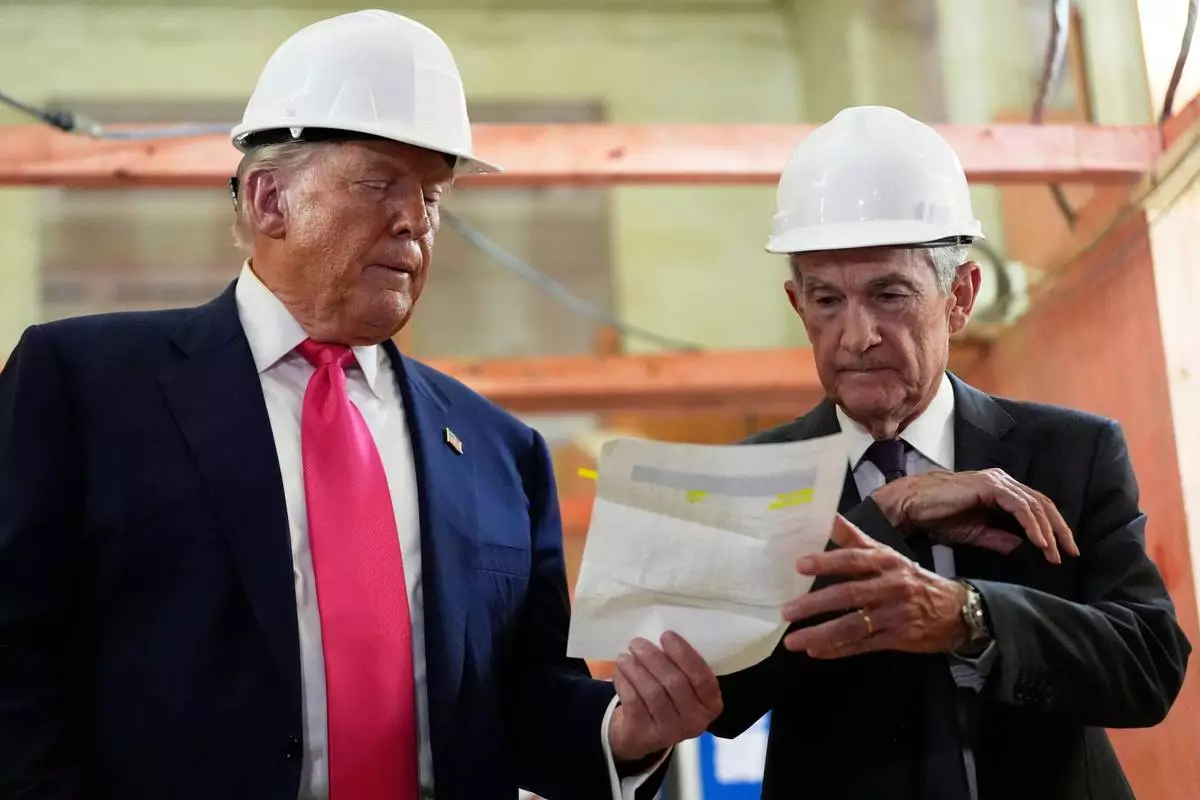
FILE - Federal Reserve Chairman Jerome Powell, right, and President Donald Trump look over a document of cost figures during a visit to the Federal Reserve, July 24, 2025, in Washington. (AP Photo/Julia Demaree Nikhinson, File)