NICE, France (AP) — An ominous chain unspools through the water. Then comes chaos. A churning cloud of mud erupts as a net plows the seafloor, wrenching rays, fish and a squid from their home in a violent swirl of destruction. This is industrial bottom trawling. It’s not CGI. It’s real. And it’s legal.
“Ocean With David Attenborough” is a brutal reminder of how little we see and how much is at stake. The film is both a sweeping celebration of marine life and a stark exposé of the forces pushing the ocean toward collapse.
The British naturalist and broadcaster, now 99, anchors the film with a deeply personal reflection: “After living for nearly a hundred years on this planet, I now understand that the most important place on Earth is not on land, but at sea.”
The film traces Attenborough's lifetime — an era of unprecedented ocean discovery — through the lush beauty of coral reefs, kelp forests and deep-sea wanderers, captured in breathtaking, revelatory ways.
But this is not the Attenborough film we grew up with. As the environment unravels, so too has the tone of his storytelling. “Ocean” is more urgent, more unflinching. Never-before-seen footage of mass coral bleaching, dwindling fish stocks and industrial-scale exploitation reveals just how vulnerable the sea has become. The film’s power lies not only in what it shows, but in how rarely such destruction is witnessed.
“I think we’ve got to the point where we’ve changed so much of the natural world that it’s almost remiss if you don’t show it,” co-director Colin Butfield said. “Nobody’s ever professionally filmed bottom trawling before. And yet it’s happening practically everywhere.”
The practice is not only legal, he adds, but often subsidized.
“For too long, everything in the ocean has been invisible,” Butfield said. “Most people picture fishing as small boats heading out from a local harbor. They’re not picturing factories at sea scraping the seabed.”
In one harrowing scene, mounds of unwanted catch are dumped back into the sea already dead. About 10 million tons (9 million metrics tonnes) of marine life are caught and discarded each year as bycatch. In some bottom trawl fisheries, discards make up more than half the haul.
Still, “Ocean” is no eulogy. Its final act offers a stirring glimpse of what recovery can look like: kelp forests rebounding under protection, vast marine reserves teeming with life and the world’s largest albatross colony thriving in Hawaii’s Papahānaumokuākea Marine National Monument. These aren’t fantasies; they’re evidence of what the ocean can become again, if given the chance.
Timed to World Oceans Day and the U.N. Ocean Conference in Nice, the film arrives amid a growing global push to protect 30% of the ocean by 2030 — a goal endorsed by more than 190 countries. But today, just 2.7% of the ocean is effectively protected from harmful industrial activity.
The film’s message is clear: The laws of today are failing the seas. So-called “protected” areas often aren’t. And banning destructive practices like bottom trawling is not just feasible — it’s imperative.
As always, Attenborough is a voice of moral clarity. “This could be the moment of change,” he says. “Ocean” gives us the reason to believe — and the evidence to demand — that it must be.
“Ocean” premieres Saturday on National Geographic in the U.S. and streams globally on Disney+ and Hulu beginning Sunday.
Follow Annika Hammerschlag on Instagram @ahammergram.
The Associated Press receives support from the Walton Family Foundation for coverage of water and environmental policy. The AP is solely responsible for all content. For all of AP’s environmental coverage, visit https://apnews.com/hub/climate-and-environment

A barracuda, center, swims in the protected area of France's Porquerolles National Park ahead of the U.N. Ocean Conference on Friday, June 6, 2025. (AP Photo/Annika Hammerschlag)
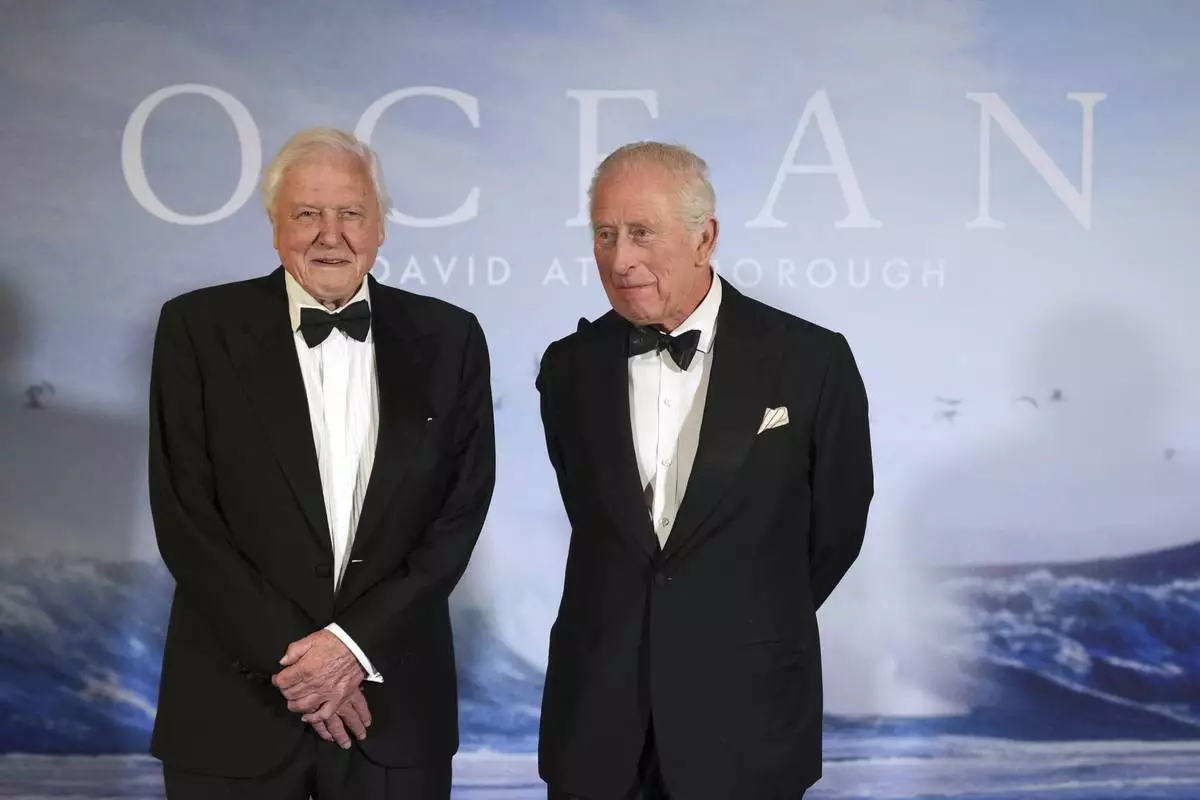
FILE - Britain's King Charles III meets broadcaster and biologist David Attenborough, left, as he attends the "Ocean with David Attenborough" film premiere in London, May 6, 2025. (AP Photo/Alastair Grant, Pool, File)
PITTSBURGH (AP) — Lamar Jackson thought it was over. That the Baltimore Ravens' unwieldy season would end up in a familiar spot: the playoffs.
Then, rookie kicker Tyler Loop's potential game-winning field goal from 44 yards out drifted a little right. And then a little further right. And then a little further right still.
By the time it fluttered well wide of the goalposts, the playoffs were gone. So was Jackson's certainty after a 26-24 loss to Pittsburgh on Sunday night sent the Ravens into what could be a turbulent offseason.
“I'm definitely stunned, man,” Jackson said. “I thought we had it in the bag. ... I don't know what else we can do.”
Jackson, who never really seemed fully healthy during his eighth season as he battled one thing after another, did his part. The two-time NFL MVP passed for 238 yards and three touchdowns, including two long connections with Zay Flowers in the fourth quarter that put the Ravens (8-9) in front.
It just wasn't enough. Baltimore's defense, which played most of the second half without star safety Kyle Hamilton after Hamilton entered the concussion protocol, wilted against 42-year-old Steelers quarterback Aaron Rodgers.
Rodgers passed for a season-high 294 yards, including a 26-yard flip to a wide-open Calvin Austin with 55 seconds to go after a defender slipped, symbolic of a season in which Baltimore's defense only occasionally found its form.
Still, the Ravens had a chance when Jackson found Isaiah Likely for a 28-yard gain on fourth down from midfield. A couple of snaps later, the 24-year-old Loop walked on to try to lift Baltimore to its third straight division title.
Instead, the rookie said he “mishit” it. Whatever it was, it never threatened to sneak between the goalposts.
“It’s disappointing,” Loop said.
Loop was talking about the game. He might as well have been talking about his team's season.
The Ravens began 1-5 as Jackson dealt with injuries and the defense struggled to get stops. Baltimore found a way to briefly tie the Steelers for first in late November, only to then split its next four games, including a home loss to Pittsburgh.
Still, when Jackson and the Ravens walked onto the Acrisure Stadium turf on Sunday night in the 272nd and final game of the NFL regular season, Baltimore was confident. The Ravens drilled Pittsburgh in the opening round of the playoffs a year ago behind the ever-churning legs of running back Derrick Henry.
When Henry ripped off a gain of 40-plus yards on the game's first offensive snap, it looked like it was going to be more of the same. While Henry did rush for 126 yards and joined Hall of Famer Barry Sanders as the only running backs in NFL history to have five 1,500-yard seasons, he was less effective in the second half.
Even that first run was telling of what night it was going to be, as an illegal block by wide receiver Zay Flowers cost Baltimore some field position. The Ravens ended up scoring on the drive anyway, thanks to a 38-yard fourth-down flip from Jackson to a wide-open Devontez Walker, but it started a pattern that was hard to shake as several steps forward were met with one step back on a night the Ravens finished with nine penalties for 78 yards.
“We were having a lot of penalties, which kept stopping drives," Jackson said. “But I'm proud of my guys because we kept overcoming. We kept overcoming adversity and situations like this. Divisional games (can) be like that sometimes.”
Particularly when the Steelers are on the other side of the line of scrimmage. Pittsburgh has won 10 of the last 13 meetings. And while a handful of them have been in late-season matchups with the Ravens already assured of reaching the playoffs, the reality is the Steelers have been able to regularly do something that most others have not: found a way to beat Jackson.
“It comes down to situations like this,” Jackson said. “Two-point conversion one year. Field goal another year. And again this year. Just got to find a way to get that win here.”
And figure out who is going to be around to help get it.
Head coach John Harbaugh's 18th season in Baltimore ended with the Ravens missing the playoffs for just the second time in eight years. Jackson turns 29 this week and is still one of the most electric players in the league.
Yet Harbaugh and Jackson have yet to find a way to have that breakthrough season that Harbaugh enjoyed with Joe Flacco in 2013 when the Ravens won the Super Bowl.
There was hope when the season began that the roadblocks that have long been in the franchise's way — Kansas City and Patrick Mahomes chief among them — would be gone.
While the Ravens did get their way in a sense — the Chiefs will watch the playoffs from afar for the first time in a decade after a nightmarish season of their own — it never all came together.
Jackson declined to endorse Harbaugh returning for a 19th season, saying the loss was still too fresh to zoom out on what it might mean for the franchise going forward.
Harbaugh, for his part, certainly seems up for running it back in the fall.
“I love these guys,” he said afterward. “I love these guys.”
AP NFL: https://apnews.com/hub/nfl

Baltimore Ravens quarterback Lamar Jackson, right, hands the ball off to running back Derrick Henry (22) during the first half of an NFL football game against the Pittsburgh Steelers, Sunday, Jan. 4, 2026, in Pittsburgh. (AP Photo/Gene J. Puskar)

Baltimore Ravens head coach John Harbaugh talks with an offical during the second half of an NFL football game against the Pittsburgh Steelers, Sunday, Jan. 4, 2026, in Pittsburgh. (AP Photo/Justin Berl)

Pittsburgh Steelers defensive tackle Cameron Heyward, left, greets Baltimore Ravens quarterback Lamar Jackson (8) after an NFL football game Sunday, Jan. 4, 2026, in Pittsburgh. (AP Photo/Gene J. Puskar)

Pittsburgh Steelers safety Jabrill Peppers (40) reacts after Baltimore Ravens kicker Tyler Loop (33) missed a field goal attempt in the second half of an NFL football game against the Pittsburgh Steelers, Sunday, Jan. 4, 2026, in Pittsburgh. (AP Photo/Gene J. Puskar)