Two years after its full launching of intensified campaign, China's Three-North Shelterbelt Forest Program (TSFP) has evolved into a balanced approach that prioritizes both ecological quality and economic benefits.
The TSFP was Launched in 1978 and is the world's largest afforestation initiative and tackles desertification in the northwestern, northern and northeastern parts of China. It has achieved significant results since the full launch of its intensified campaign in June 2023, completing 8.2 million hectares of afforestation and sand control tasks across the three key battlefronts.
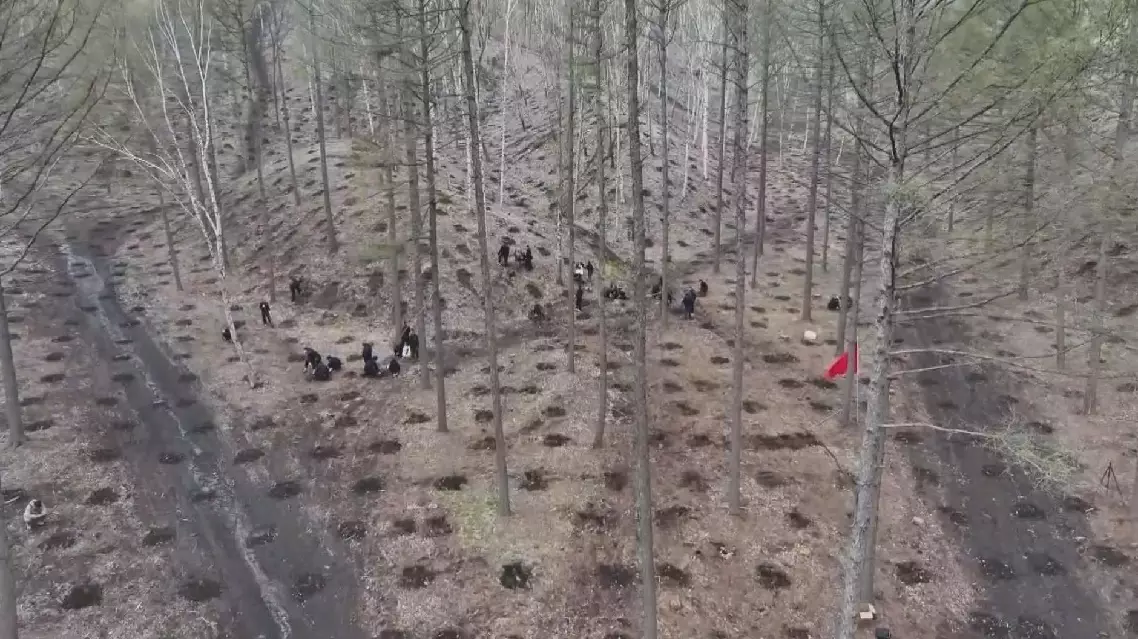
At Hebei's Saihanba Mechanical Forest Farm in north China, workers are carefully planting saplings in fertile soil, pioneering an approach of multispecies planting in forests to promote the growth of trees compared with single-species planting.
"We've introduced a new species, Siberian pine, to create a near-natural, mixed forest. This will enhance biodiversity and strengthen the forest's resilience," said Chang Weiqiang, director of afforestation department of Saihanba Mechanical Forest Farm.
As a key part of the TSFP project, the Saihanba farm is refining its forest quality by diversifying tree species and strategically combining trees and shrubs. This method not only prevents pests, but also transforms artificial ecological forests into more stable ecosystem.
"We're prioritizing quality, economic vitality, and public benefit, and we are promoting high-quality development to truly enrich our 'green assets'," said An Changming, Party Secretary of Saihanba Mechanical Forest Farm.
While adhering to the promotion of green expansion, green revitalization, and green protection, some regions are turning desertification control into economic opportunity.
In Zhangwu County of northeast China's Liaoning Province, once plagued by nearly 350,000 hectares of sandy land, locals are now intercroping medicinal herbs within newly planted poplar forests, stabilizing soil while boosting incomes.
"(Herb planting within forests) combats desertification while generating solid profits," said Zhao Meng from Liaoning Agricultural Science and Technology Co., Ltd.
During planting and harvest seasons, the project employs over 300 nearby villagers daily at 120 yuan (about 16.7 U.S. dollars) per day, enabling locals to earn money without leaving home.
The TSFP, planned to be completed by 2050, is a cross-century program consisting of eight phases of work, and it is currently in its sixth phase.
China is among the countries with the most serious desertification problem in the world. The "Three-North" regions, which refer to the north, northwest, and northeast of China, account for 45 percent of China's total land area while containing 84 percent of the desertified land.
China’s desertification fight yields sustainable retruns for both nature, people