
Skip to Content Facebook Feature Image

Historic Shikumen building complex fully restored to original site in Shanghai

China

China

China

Historic Shikumen building complex fully restored to original site in Shanghai

2025-06-07 15:41 Last Updated At:06-08 00:17

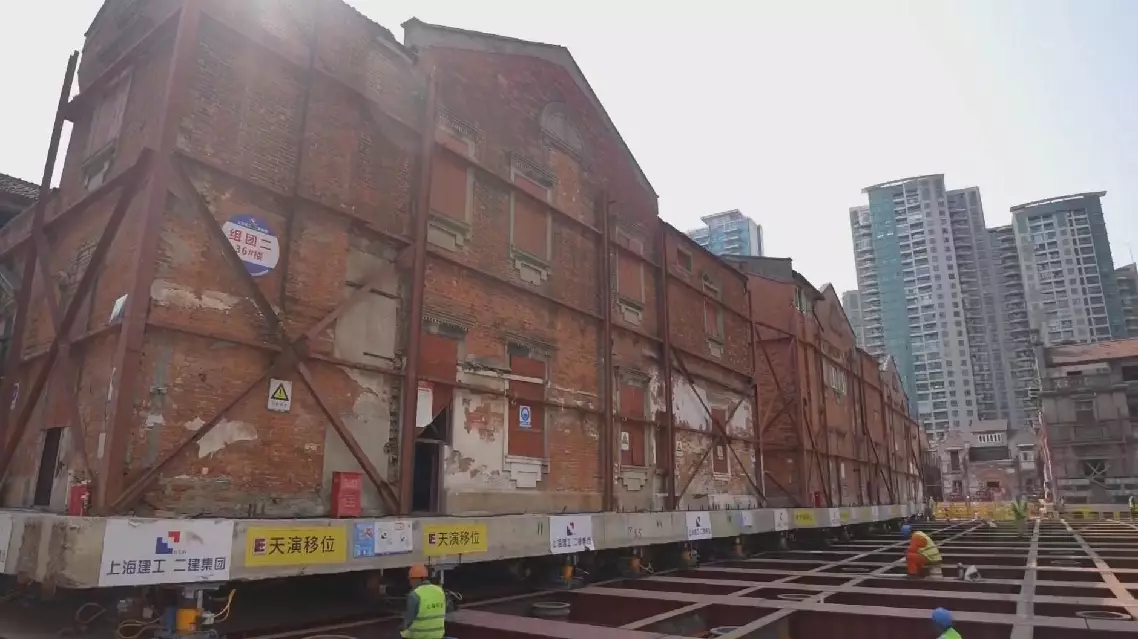
Shanghai has finished the homecoming project of the 7,500-tonne "Huayanli" Shikumen complex in Zhangyuan, completing the delicate preservation project on Saturday, as part of Shanghai's innovative endeavor to harmonize historic conservation with urban modernization.

The 140-year-old Zhangyuan cultural and historical block, celebrated as "Shanghai's Premier Garden," constitutes the largest and most well-preserved collection of the city’s representative Shikumen (stone-gate) architecture.

More Images
Historic Shikumen building complex fully restored to original site in Shanghai

Historic Shikumen building complex fully restored to original site in Shanghai
Historic Shikumen building complex fully restored to original site in Shanghai

Historic Shikumen building complex fully restored to original site in Shanghai

Historic Shikumen building complex fully restored to original site in Shanghai

Historic Shikumen building complex fully restored to original site in Shanghai

Historic Shikumen building complex fully restored to original site in Shanghai
Historic Shikumen building complex fully restored to original site in Shanghai
In 2018, the Shanghai government launched a protective restoration project for Zhangyuan. To avoid damages caused by underground constructions, the city temperately relocated some of the Shikumen structures.

On May 19, Shanghai initiated the lay-back of the 4,000-square-meter Huayanli complex, comprising three distinctive Shikumen buildings. Supported by hundreds of robotic devices, the structures "walked" as a whole at an average pace of 10 meters per day, and have moved back to the original location on Saturday.

To accomplish this unprecedented move, engineers deployed 432 miniature robotic walkers beneath the buildings' foundations. These synchronized devices operated in pairs, with one stabilizing while the other advanced, creating a reciprocating motion that gently transported the whole historic structure complex without damaging their intricate decorative structures and connecting corridors.

"We specially developed high-capacity walking devices for this project, with an astonishing installation quantity of 432 units. These devices, paired with 216 power stations, form a highly complex integrated control system, that can monitor real-time abnormal building deformation, ensuring uniform force distribution between the mechanical equipment and the structure at all times," said Zhang Yi, General Manager of Urban Renewal Construction Cooperation of Shanghai Construction No. 2 Group, who is responsible for the project.

After the Huayanli complex returns to its position, another round of underground construction will be launched. Given the high density of buildings in the area, engineers have to adopt a top-down approach to expand new underground spaces.

"We have to first relocate the floor slabs in different zones, and thus shell we free up space on-site, allowing for the expansion of underground areas," said Zhang.

Aimed to preserve the Shikumen neighborhood's legacy amid the city's dynamic growth, the project plans to revitalize the historical Huayanli buildings into a new commercial district in the future.

"After the construction of the eastern section of Zhangyuan is completed, the ground level will feature an art center, a luxury hotel, and a performing arts center. Combined with the commercial functions of the western section, it will form a high-end commercial space," said Chen Rujian, Deputy General Manager of Shanghai Jing'an Real Estate Group.

Historic Shikumen building complex fully restored to original site in Shanghai

Historic Shikumen building complex fully restored to original site in Shanghai
Historic Shikumen building complex fully restored to original site in Shanghai

Historic Shikumen building complex fully restored to original site in Shanghai

Historic Shikumen building complex fully restored to original site in Shanghai

Historic Shikumen building complex fully restored to original site in Shanghai

Historic Shikumen building complex fully restored to original site in Shanghai

Historic Shikumen building complex fully restored to original site in Shanghai

Farmers across the U.S. Midwest, a major agricultural hub with over 200 million acres of cropland, are facing unprecedented challenges as the cost of essential agricultural inputs, particularly diesel and fertilizer, has surged in recent weeks.

This sharp increase is largely attributed to the ongoing U.S.-Israeli war with Iran, which began in late February, and its ripple effects on global markets. The rising expenses are casting a shadow over the upcoming planting season, threatening to erode profitability for many.

At a farm in southern Illinois, preparations for planting season are underway, a process that critically relies on the application of fertilizer. However, the cost of this vital resource has escalated dramatically.

Brian Duncan, a farmer in Illinois, highlighted the global nature of the impact.

"The Strait of Hormuz is very important for transit of fuel and fertilizer, and it's a global market. So even if the shipments that were coming here are not impacted, what we will see is a global rise in price because of that insecurity, and it will impact us here," he said.

With many U.S. farmers locking in fertilizer prices last year, the full impact on farmers is only likely to be felt later in the year, if the conflict continues and fertilizer prices remain high.

Robb Ewoldt, a farmer in the neighboring state of Iowa, echoed these concerns. He noted that while farmers have faced high costs before, the current situation is compounded by depressed commodity prices for crops like soybeans and corn, meaning farmers face the prospect of producing at a loss this year.

"We have higher cost, and that's the biggest thing. We have had our costs be higher in the past, but right now, our commodity prices are a little bit depressed, and so it's making it very challenging to be profitable and make a positive cash flow for the year," said Ewoldt.

As fertilizer prices skyrocket, concerns are growing for many farmers. In the longer term, if input costs including fertilizer remain high, the consequences for farmers could be dire.

"The sentiment is, you know, when I go to meetings, we think, well, there's going to be, some of us aren't going to be here next year because we're not going to be in business," said Ewoldt.

"I'd say it's a time of concern, perhaps a time of survival mode, where we're looking to cut costs, not make any new expenditures, and try to hang on for either a better marketplace dynamic or a significant lowering of our input costs," said Duncan.

As the planting season commences, the inherent optimism of farmers will be put to the test against a backdrop of economic uncertainty and geopolitical volatility.

Soaring diesel, fertilizer costs hit US farmers

Soaring diesel, fertilizer costs hit US farmers

Soaring diesel, fertilizer costs hit US farmers

Soaring diesel, fertilizer costs hit US farmers

Soaring diesel, fertilizer costs hit US farmers

Soaring diesel, fertilizer costs hit US farmers

Recommended Articles