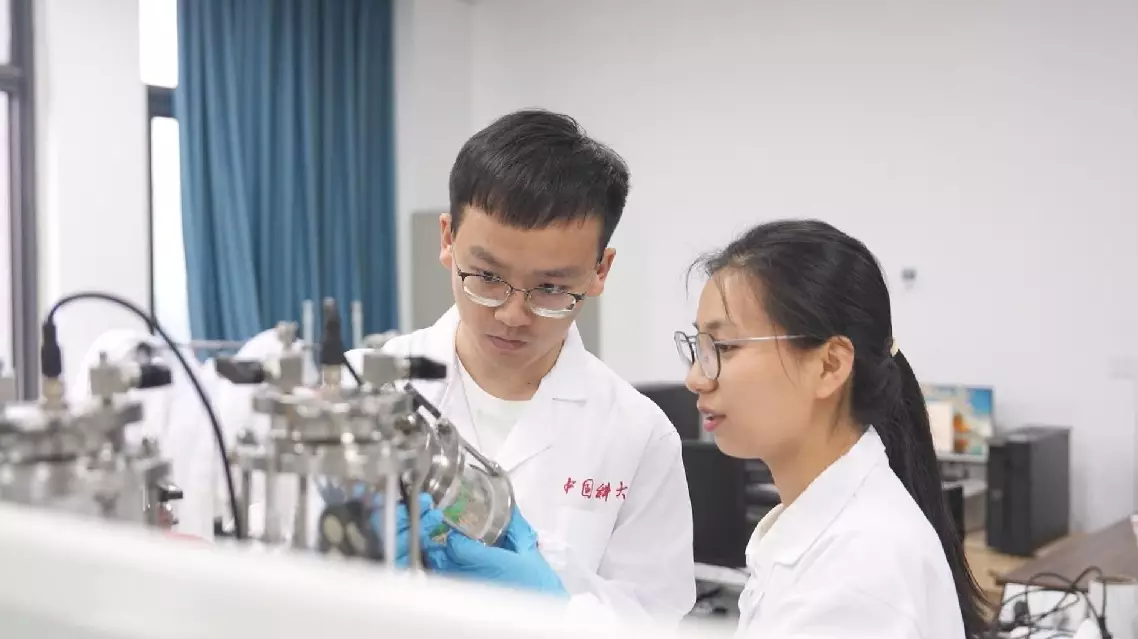
Chinese scientists have made progress in power generation and storage on Mars in terms of how to effectively use resources there to ensure the energy supply for conducting long-term research and stationing researchers on the planet in the future.
The researchers from the University of Science and Technology of China (USTC) have proposed a new idea of using the Martian atmosphere as a medium for power generation.
"The medium serves as an energy converter in a power generation system. Simply speaking, we can compare it to the 'blood' of the system. The air on Mars has good performance in heat-to-electricity conversion. It has a large molecular weight and a high specific heat capacity, which means that it is excellent in heat-to-electricity conversion," said Shi Lingfeng, a researcher at the USTC.
Compared with using rare gases helium and xenon as the medium, studies by the USTC researchers have showed that if the Martian atmosphere, over 95 percent of which is carbon dioxide, serves as the medium, the power generation efficiency can be increased by 20 percent and the maximum power density, by 14 percent. The more accessible medium makes it possible to generate power for Mars exploration in accordance with local conditions.
"Using the Martian atmosphere means using resources there. Therefore, this is a very good technological solution for the building of a sustainable Mars research station in the future," said Shi.
The researchers have also studied how to use the Martian atmosphere to store electrical energy, putting forward the innovative concept of the "Mars battery".
The Mars battery uses active substances in the Martian atmosphere as reactive fuel to generate electricity and provide energy for Mars probes and bases. It can combine electrical energy, light energy and thermal energy, and store the energies into its battery system.
"The Mars air battery actually has the same operating principle of the lithium-air battery and the lithium-carbon dioxide battery. It absorbs components from the Martian atmosphere into itself and uses them as the main active gases to release electrical energy, which can be used by Mars rovers or Mars helicopters," said Xiao Xu, another researcher.
The researchers conducted tests on the performance of the battery under conditions simulating the atmosphere and the temperature difference between day and night on Mars. The results show that the battery can still power electronic devices steadily even in a low temperature of zero degrees Celsius.
Using the Martian atmosphere as the medium not only significantly reduces the overall weight of the battery system, but also enables in-situ energy acquisition and self-sufficiency, providing a new energy storage solution for Mars development and research. This is of great significance for enhancing China's self-reliance and sustainability in missions on Mars.
China has been accelerating its Mars exploration in recent years, with the Tianwen-3 probe expected to be launched around 2028 and bring Mars samples back to Earth around 2031.
China makes progress in power generation, storage on Mars
The Exhibition Hall of Evidence of Crimes Committed by Unit 731 of the Japanese Imperial Army in northeast China's Harbin released on Thursday a 38-minute video of a former member of Unit 731, a notorious Japanese germ-warfare unit during World War II (WWII).
In the footage, former Unit 731 member Tsuruo Nishijima detailed how the unit used meteorological data to carry out bacterial dispersal and frostbite experiments.
The video was recorded in 1997 by Japanese scholar Fuyuko Nishisato and donated to the exhibition hall in 2019, according to the hall, which was built on the former site of the headquarters of Unit 731 in Harbin, capital city of Heilongjiang Province.
Nishijima joined Unit 731 in October 1938 and served in the unit's meteorological squad. The squad was not a simple observation section but rather an auxiliary force supporting the unit's human experiments in the field by measuring wind direction, wind speed and other conditions to ensure optimal experimental results.
Nishijima confirmed in the footage that "the meteorological squad had to be present at every field experiment." He testified to the "rainfall experiments" conducted by Unit 731, which involved aircraft releasing bacterial agents at extremely low altitudes.
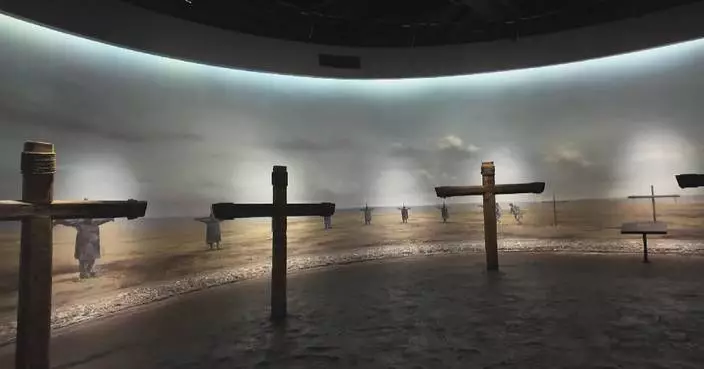
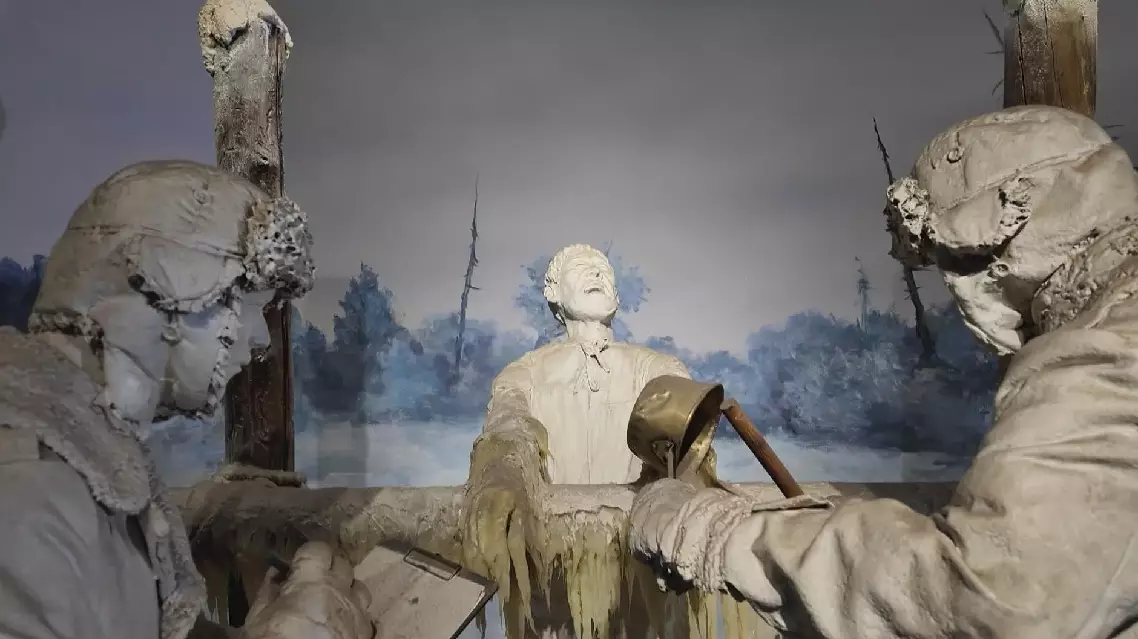
At a field-testing site in Anda City, Heilongjiang, Unit 731 aircraft descended to about 50 meters above the ground and sprayed bacterial culture liquids onto "maruta" -- human test subjects -- who were tied to wooden stakes. Each experiment involved about 30 people, spaced roughly 5 meters apart. After the experiments, the victims were loaded into sealed trucks and transported back to the unit, where their symptoms and disease progression were recorded over a period of several days.
Nishijima also revealed that a Japanese military doctor once died after removing the mask and becoming infected during an experiment, indirectly proving the extreme virulence of the bacterial agents.
The video further disclosed details of the meteorological squad's involvement in frostbite experiments. To study wartime needs in frigid regions, the invading Japanese army forced the victims to expose their bodies for five to ten minutes in temperatures ranging from minus 20 to minus 35 degrees Celsius and observed their physical reactions.
"For example, during frostbite experiments, we would be sent outside to observe the weather. They wouldn't bring many people out at once, only two or three, who would be forced to take off their upper garments or all their clothes. In fact, it was already quite tough to stay out there for five to ten minutes, because it was too cold," Nishijima said.
According to the exhibition hall, Unit 731 had a separate frostbite laboratory, with Hisato Yoshimura serving as the leader of the unit's frostbite study squad from 1938 to 1945.
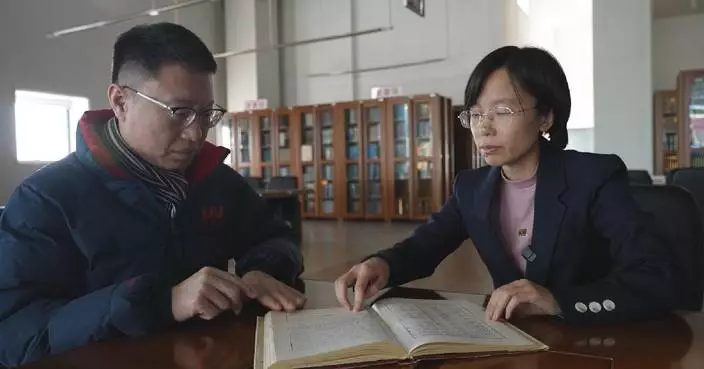
In a paper on frostbite published in 1941, Yoshimura recorded data from live human experiments to study the occurrence of frostbite and pathological changes in the human body under different conditions.
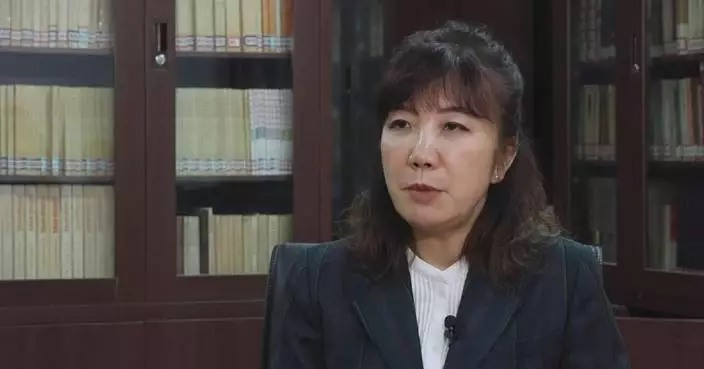
"This is a form from the paper. Titled 'The Severity and Process of Frostbite,' it divides frostbite into three stages. The symptoms of the first-degree frostbite are redness and swelling. Blisters appear in the second stage. And the third-degree frostbite features necrosis and ulceration. It says here that, in the third stage, from the 50th to the 60th day, toes and fingers detached. There is no doubt that these data were obtained through numerous human experiments," said Tan Tian, a researcher of the exhibition hall.
Nishijima's video, a piece of oral history from a perpetrator's perspective, further reconstructs the criminal chain of Unit 731 and once again demonstrates that the invading Japanese army's biological warfare crime was systematic and inhumane, and was an undeniable historical truth, according to the exhibition hall.
"Unit 731's frostbite experiments were essentially conducted to prevent and treat frostbite during combat in cold environments. However, for the so-called prevention and treatment of frostbite, they caused frostbite on living people for experiments and data analysis. So in nature, it still serves the purpose of war," said Jin Shicheng, director of the Department of Publicity, Education and Exhibition at the hall.
Unit 731 was a top-secret biological and chemical warfare research base established in Harbin as the nerve center for Japanese biological warfare in China and Southeast Asia during WWII.
At least 3,000 people were used for human experiments by Unit 731, and more than 300,000 people in China were killed by Japan's biological weapons.
Video offers new evidence of Japan's wartime germ-warfare crimes in northeast China