The American Chamber of Commerce in Shanghai (AmCham Shanghai) marked its 110th anniversary with a gala in Shanghai on Friday, celebrating over a century of U.S.-China business engagement.
Founded only three years after the U.S. Chamber of Commerce, AmCham Shanghai has been playing a key role in linking the world's two largest economies, despite the ups and downs in the history of China-U.S. relations.
Around 300 guests attended the anniversary gala, hoping to foster commerce, dialogue and mutual understanding between the two countries.
"AmCham was founded back in 1915 by 45 businesspeople from the United States who were working in Shanghai. And right now, we have more than 1,000 companies here in Shanghai, members of AmCham, and we have more than 3,000 individual members," said Jeffrey Lehman, chair of AmCham Shanghai.
Shanghai, a favored investment hub for international enterprises, has been uniquely positioned to help strengthen China-U.S. trade and economic ties.
From Coca-Cola, AIG, and Ford to 3M, Disney, and Tesla, these American brands have been gaining success in China.
"According to the statistics published by the U.S.-China Business Council last year, over 90 percent of U.S. companies in China are profitable. The annual output of the Tesla factory in Shanghai was about one million units in recent years," said Chen Jing, president of the Shanghai People's Association for Friendship with Foreign Countries, while addressing the anniversary gala.
For both Chinese and U.S. businesses, Thursday's phone call between Chinese President Xi Jinping and U.S. President Donald Trump sent positive signals.
"I think all of us were happy to learn about the phone call. We're looking forward to November 5th, to the CIIE, back in Shanghai. And we expect to have continued increases in participation by American companies and hopefully by lots of vendors," said Lehman.
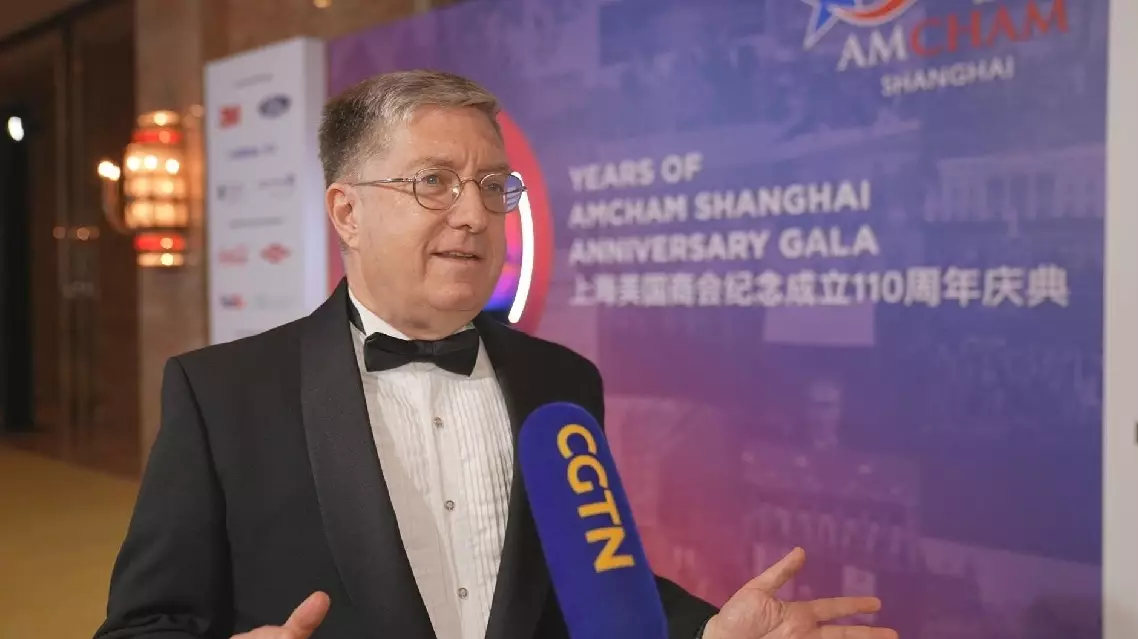
AmCham Shanghai marks 110 years of US-China commerce, cooperation
Artists have reimagined ancient themes through a modern lens at the 60th Venice Biennale China National Pavilion Exhibition, now underway in Shanghai.
The main feature of the exhibition is a fully immersive project by artist Che Jianquan, who has placed consecutive screens placed side by side to present his two-decade-long documentation of the same pavilion since 2003.
Through his lens, the artist captures the pavilion, as it emerges and disappears amidst mist and clouds, evoking the aesthetic of misty landscapes in traditional Chinese ink paintings.
"At the beginning, I wanted to use painting to document my feeling, but later I realized that painting was somewhat powerless. So, starting in 2003, I began using the earliest video equipment to start recording. What I care about more is a place—a very small location—and the unique connection it has within that field to history and to the culture of that region. I think this is something I hope to achieve: through a seemingly ordinary scene, to uncover the stories behind it, as well as its possible influence on both the past era and the present," said Chen.
Established in 1895, the Venice Biennale is one of the premier events in the global art world. This year, the China National Pavilion Exhibition, under the theme "Atlas: Harmony in Diversity," presents not only the documentary archives of 100 Chinese paintings held overseas, but also seven contemporary artworks created by seven Chinese artists exploring themes, such as architecture, landscapes, figures, flora and fauna.
"The core of the Venice Biennale is contemporary art, reflecting the spirit of the present era—yet the present and history cannot be separated. This exhibition is rooted in the tradition of Chinese painting across dynasties, drawing from over 20,000 individual works that took us twenty years to collect globally," said Wang Xiaosong, an artist and the curator of the exhibition.
"Notably, we discovered that more than 3,000 of these paintings had been lost overseas, which we spent two decades retrieving through digital tools. This is how we engage with traditional art: through each artist's reflection and a new understanding of the relationship between the ancients, the present, and the future," he added.
Wang drew special attention to a piece by the modern artist Qiu Zhenzhong, who he said merges the art of Chinese gardens with calligraphy using traditional methods to showcase contemporary issues such as environmental and ecological change.
"It's like a dialogue with nature," Wang said.
The exhibition in Shanghai is the final stop of the national tour, following the legs in the southwest Chinese city of Chongqing and the southern Chinese city of Guangzhou, and will run until May 31.
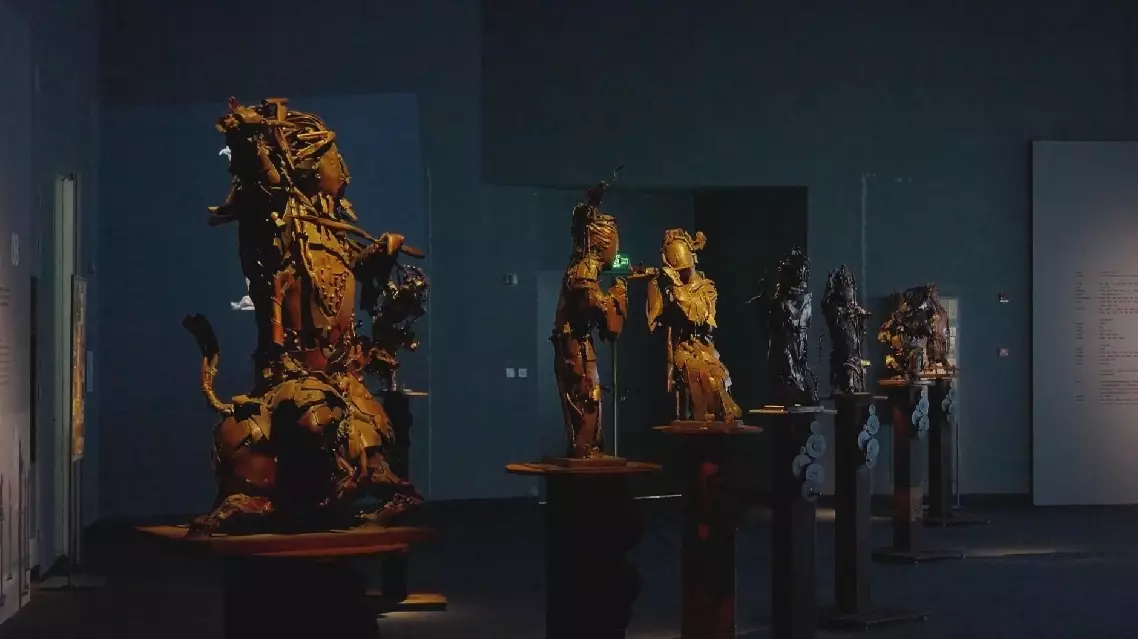
Exhibition in Shanghai bridges contemporary art with centuries of Chinese artistic tradition