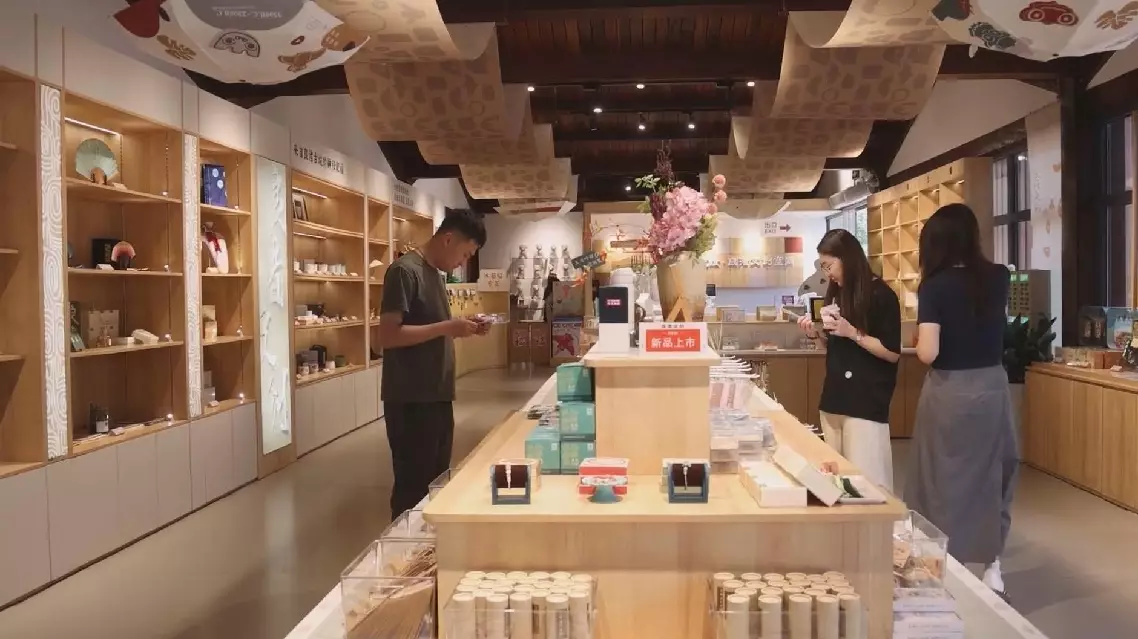
The park of Archaeological Ruins of Liangzhu City, inscribed as a UNESCO World Heritage site in 2019, in east China's Hangzhou City has drawn visitors with creative products inspired its 5,000-year-old culture.
Toy bricks, picture books, 3D printed models, fluffy toys and fridge magnets designed with the motif of the ancient civilization are gaining popularity among young people.
One of the most popular products is a set of building blocks of Mojiao Mountain site, the central palace area of the Liangzhu site.
With nearly 600 pieces, the finished building block displays the palace architectural features such as wooden frame, mud wall and thatched roof.
"The block building is nice-looking and delicate. I hope to take it home and keep it as a collection," said Wang Youzhe, a child visitor at the park.
"The kid can have a deep understanding of history through building blocks. It's a very good experience," said He Liu, a parent among the visitors.
Lu Yiying, manager of the Liangzhu cultural creative product development team, said the building block clearly exhibited the exquisite craftsmanship of Liangzhu ancestors.
"The Mojiao Mountain is actually the highest and the central most place of the entire Liangzhu City site. Liangzhu ancestors respected the high and the central place. By building these blocks, we can not only see what our palaces look like outside, but also perceive accurately their internal structures. So people will understand the wisdom and exquisite craftsmanship of the Liangzhu ancestors," Lu said.
The Liangzhu ruins serve as a testimony to the existence of Chinese civilization for least 5,000 years. More than 350 sites of the Liangzhu civilization, all dating back around 5,000 years, have been discovered in the lower reaches of China's longest river, the Yangtze.
Among the most important archaeological findings are large expanses of prehistorical rice paddies--the oldest dating back over 6,000 years, and a trove of jade carving artifacts as well as agricultural tools such as plows.
Lu said many cultural elements discovered at the sites have inspired designs into picture books for children to learn about the ancient civilization.
"Picture books suit children very much, so I want to buy a copy home. The [ancient cooking utensil of] Ding [in the book] is a particularly representative cultural relic of Liangzhu culture, which could pass on the concept of Liangzhu culture to pals," said Lou Xinyi, a tourist.
The sales of Liangzhu cultural and creative products in physical stores have totaled 160 million yuan (about 22 million U.S. dollars) so far this year, boosting the park's cultural and tourism consumption, Lu said.
"Holidays like the May Day and the National Day are always peak seasons with high flows of tourists. Visitors often buy cultural and creative products as souvenirs for relatives and friends. So, we hope Liangzhu culture can be introduced to more households through these cultural and creative products," Lu said.
5,000-year-old Liangzhu site draws visitors with creative products