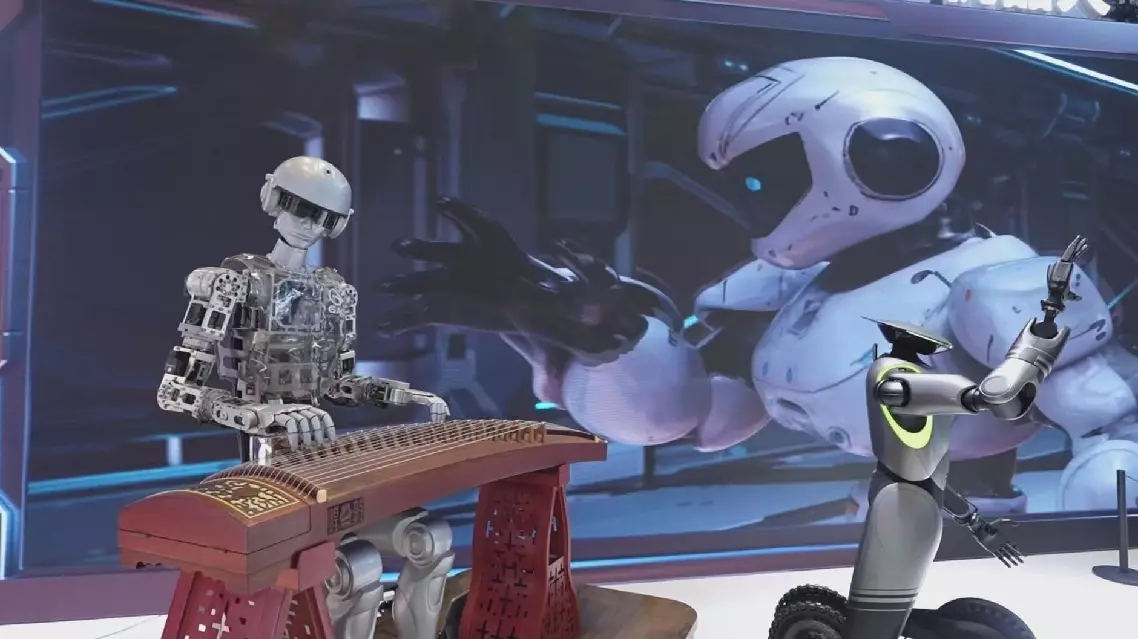
New quality productive forces are reshaping traditional industries in south China's tech hub of Shenzhen, involving both cutting-edge technologies and their innovative applications.
From brain-computer interfaces to AI-powered or 3D-printed cultural products, the city is constantly exploring new scenarios and driving traditional industries forward.
At the Global AI Device Expo 2025, China's first specialized trade show dedicated entirely to AI smart devices that ran from May 22 to 24, Shenzhen-based Coocaa Brain-Computer Interface showcased a magical headband, which enables visitors to control claw machines with their mind.
"This technology we use is called electroencephalographic biofeedback. It was previously used to train astronauts and athletes to improve their focus," said Xie Xinxing, sales manager of Coocaa.
Like the EEG-powered headband, Shenzhen's high-tech sector is sensing opportunities in other areas such as the cultural industries.
During this year's China (Shenzhen) International Cultural Industries Fair, which took place from May 22 to 26, a dedicated AI section was set up for the first time in the event's history to showcase the latest integration of AI technology with cultural products.
One of the fascinating exhibits is an AI-powered doll that can serve as visitors' AI guide for the exhibition.
"It can provide everyone with companionship, knowledge, and guided tour value, acting as a little tour guide during the cultural industries fair," said Guo Zhi, founder and CEO of Alipal.
When it comes to the electronics industry in Shenzhen, one name cannot be omitted: Huaqiangbei. Evolving alongside the city's development since the 1980s, the Huaqiangbei electronics district is the first Chinese electronics commercial street.
Though Huaqiangbei was once known for cheap "white label" e-products, it is now a showroom for cutting-edge "black tech" items like robot dogs, AI, and AR glasses -- all available for purchase.
This rapid development is made possible by the seamless integration of Shenzhen's advanced technology and manufacturing capabilities with the robust production infrastructure of neighboring Dongguan City, home to over 4,000 toy companies.
One in every four pieces of global cartoon merchandise is produced in Dongguan, and nearly 85 percent of China's trendy toys are also made there.
To the south of Shenzhen is Hong Kong, an excellent gateway for companies looking to go out.
"The stuffed toy factory is based in Dongguan, while the overall software and hardware teams, including the assembly of our smart hardware, are based in Shenzhen. The area where we are located is called the Hetao District, which is a highland of core technological value in the Guangdong-Hong Kong-Macao Greater Bay Area. Whether it's quantum computing, biomedicine, or artificial intelligence, they are all situated in this highland in Shenzhen. We develop our scenario-focused application thoroughly and then extend it nationwide. We hope that through the economic engine of the Guangdong-Hong Kong-Macao Greater Bay Area, we can bring our products and application to the whole country. Hong Kong offers us a broader international perspective, and it is also one of the beachheads in building our own overseas strategy," Guo said.
Shenzhen leverages new quality productive forces to reshape traditional industries