Tourists are flocking to Turpan in Xinjiang Uygur Autonomous Region to brave the scorching temperatures beneath the iconic Flaming Mountains, one of northwest China's legendary hotspots.
Known as one of the hottest places in China, the Flaming Mountains have recorded a surface temperature of up to 65 degrees Celsius and an air temperature of around 45 degrees Celsius.
As temperatures continue to soar, Xinjiang's weather authorities issued an orange alert for high heat conditions on Sunday.
However, the daily number of visitors to this scenic area has remained above 4,500 for several days.
Visitors line up to snap photos by a giant thermometer, crafted in the shape of Sun Wukong's Ruyi Jingu Bang from the classic novel "Journey to the West", which references the Flaming Mountains and has contributed to the site's popularity.
Some visitors also try eggs cooked in the scorching sand, seasoned with chili and cumin for a unique "Flaming Mountains flavor".
Meanwhile, themed souvenirs inspired by the "Journey to the West" have also been well received by the visitors.
"I have seen the Flaming Mountains in the TV-series version of the Journey to the West since I was a child. And now, I've finally seen them in person and felt the heat here," said one of the tourists.
The heatwave is expected to last until June 13, with temperatures at the Flaming Mountains continuing to rise.
"We have made full preparations for the high temperatures. We have placed first-aid kits in various key areas, set up multiple cool-down rooms, and installed air coolers in open-air areas," said Lan Yunxia, marketing director of the scenic area.
China has a three-tier warning system for high temperatures, with red representing the most severe warning, followed by orange and yellow.
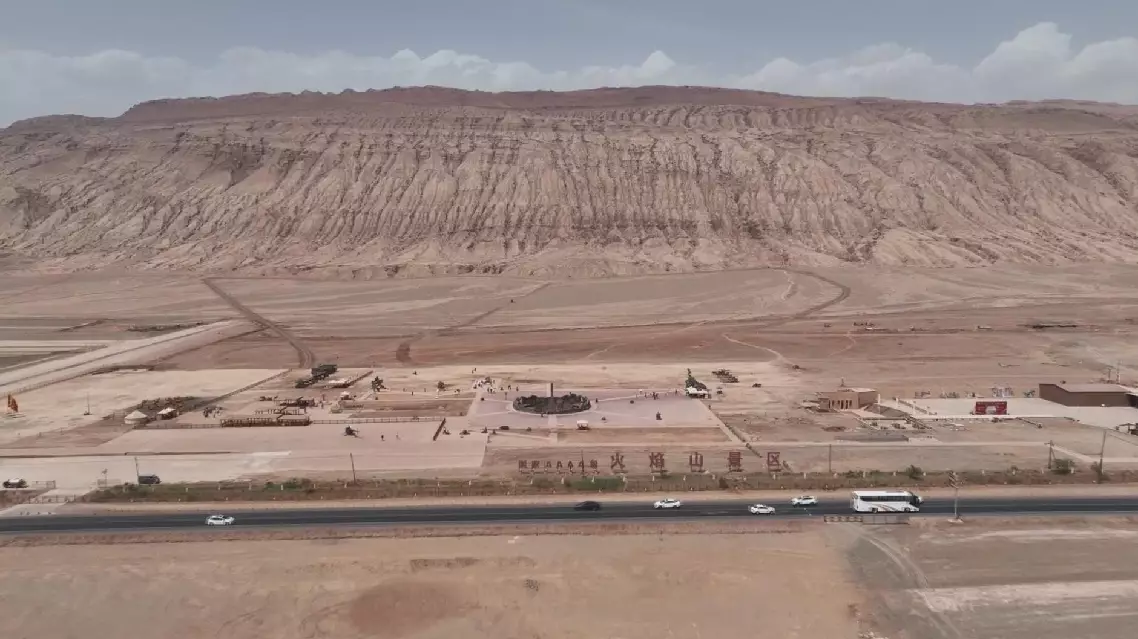
Xinjiang's iconic Flaming Mountains draw in scores of adventurous tourists
The Shenzhou-21 crew aboard China's orbiting Tiangong space station completed their mission's third series of extravehicular activities (EVAs) on Friday, according to the China Manned Space Agency (CMSA).
The astronaut trio -- Zhang Lu, Wu Fei and Zhang Hongzhang -- worked for roughly five and a half hours and completed their EVAs at 01:36 (Beijing Time), assisted by the space station's robotic arm and a team on Earth.
The trio completed the installation of a space debris protection device for the space station, and extravehicular equipment and facility inspections, among other tasks. Zhang Lu, the commander of the Shenzhou-21 mission, and Wu Fei conducted the spacewalk and returned to the Wentian lab module safely, according to the CMSA.
Zhang Lu has so far carried out seven EVAs, making him one of the Chinese astronauts with the most spacewalks to date.
Since completing their second series of EVAs on March 16, the Shenzhou-21 astronauts have steadily advanced experiments in areas such as space life sciences, human research, and microgravity physical science. They have carries out in-orbit environmental monitoring, equipment inspection and maintenance, and supply management. The crew has also completed a full-system pressure emergency drill, emergency life-support training, and preparations for extravehicular activities.
The three astronauts have been in orbit for more than five months and remain in good working and living condition.
To further validate technologies related to long-term human habitation in orbit and to maximize the comprehensive benefits of using the Shenzhou-22 spacecraft as an emergency launch vehicle to resupply the space station, it has been decided, after careful evaluation and assessment, that the crew's stay in orbit will be extended by approximately one month.
During the upcoming phase of their space journey, the crew will continue to conduct scientific experiments and technical tests, and will also celebrate the Space Day of China, which is marked annually on April 24, and the International Workers' Day on May 1 while in orbit.

Shenzhou-21 astronauts complete 3rd series of extravehicular activities