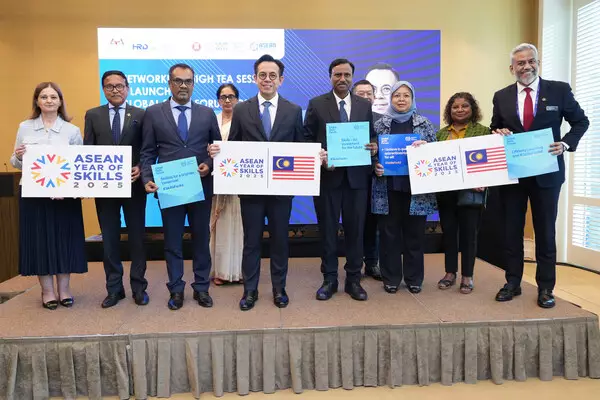
GENEVA, June 10, 2025 /PRNewswire/ -- Malaysia has been honoured with the international recognition of hosting the Global Skills Forum (GSF) 2025, marking the first time the prestigious event will be held outside of Geneva.
The official announcement was made on June 9 by Malaysia's Minister of Human Resources, The Honourable Steven Sim Chee Keong, during a high-level event co-organised with the International Labour Organization (ILO) in Geneva. The GSF main event will take place in Kuala Lumpur on 22–23 October 2025.
Malaysia's selection as host reflects not only its role as Chair of ASEAN 2025, but also the country's growing leadership in workforce transformation, labour market reform and human capital development. The GSF 2025 will also serve as a flagship initiative under the ASEAN Year of Skills (AYOS), led by Human Resource Development Corporation, an agency under the Ministry of Human Resources Malaysia.
First hosted by the ILO in Geneva in 2024, GSF's second edition in Malaysia signals global confidence in the country's skills leadership and future-of-work readiness.
Malaysia's Global Commitment: Skills Access Without Borders
"GSF 2025 is not just about future skills – it is about fairness," said Minister Steven Sim. "Whether you are a coder in Hanoi, a delivery rider in Jakarta, or a factory worker in Kuala Lumpur, your work deserves respect, your safety deserves protection, and your skills deserve investment."
He continued, "To commemorate this important milestone, I am pleased to announce the global expansion of e-LATiH, Malaysia's national online learning platform. e-LATiH now offers free and borderless access to reskilling and upskilling content for any learner, anywhere in the world."
"Additionally, as announced during the ASEAN Human Capital Development Investment Symposium on 27 May, Malaysia is opening our National Training Week (NTW), taking place from 14 to 21 June 2025, to all ASEAN citizens for the first time. The programme will offer over 65,000 free skills development courses, delivered through both online and physical formats, covering areas such as artificial intelligence, digitalisation, green technology, and leadership. We welcome ASEAN citizens to join us in this regional initiative," concluded Minister Steven Sim.
GSF 2025 will convene 200+ delegates from 16 countries, including ministers, experts, industry and union leaders, and global bodies.
Strategic objectives include:
- Strengthening regional cooperation on skills mobility and labour certification.
- Accelerating investment in green and digital skills.
- Strengthening public-private partnerships in workforce development through Sector Skills Bodies (SSBs) and innovation-driven ecosystems.
- Launching Malaysia's National Human Resources Policy 2024–2030 as a model for ASEAN-wide collaboration.
Against this backdrop, GSF 2025 will serve as a platform to address key workforce challenges, including:
- Gig economy integration and protections
GSF 2025 will tackle gig work formalisation and protections, with Malaysia leading via its upcoming Gig Workers Bill, scheduled for tabling in Parliament in the second half of 2025.
- Expanding social protection for all workers
GSF 2025 will explore inclusive models for income security and universal protection, addressing gaps faced by informal, migrant, and self-employed workers in ASEAN.
- Rethinking occupational safety
Following Malaysia's ratification of ILO Convention C155, GSF 2025 will examine how digitalisation, remote work, and labour fragmentation are reshaping workplace safety and regulations.
- Private sector at the centre of skills innovation
For the first time, GSF 2025 will spotlight private sector leadership, with industry, employers, and training providers driving agile, future-ready skills systems.
For information, www.aseanyearofskills.org. For media and partnership, CommsPR@hrdcorp.gov.my.
** The press release content is from PR Newswire. Bastille Post is not involved in its creation. **
Malaysia to host first Global Skills Forum outside Geneva, under ASEAN Year of Skills
A state- and city-backed track pairs the Seoul ANCHOR Project with the university's own global scholarship, waiving 100 percent of tuition for selected students in the natural sciences and engineering — and adding research, internship and Korean-language support on top.
SEOUL, South Korea, Aug. 25, 2026 /PRNewswire/ -- For a prospective graduate student weighing a move to Korea, the arithmetic usually begins with tuition. Sogang University Graduate School is betting that removing that line from the calculation — entirely, for a defined group of international students in science and engineering — will change who applies, and who stays.
Through the SOGANG RISE SURPASS TRACK, eligible international students admitted to the natural sciences and engineering fields of the General Graduate School can receive a 50 percent tuition scholarship funded through the Seoul ANCHOR Project and a further 50 percent through the Sogang Global Scholarship. Stacked, the two awards amount to a full tuition waiver. Admission fees and other applicable mandatory fees are not included.
The track sits within Subproject 1-2, "Attracting International Talent for Advanced Future Industries," under the Seoul ANCHOR Project, an initiative supported by the Ministry of Education and the Seoul Metropolitan Government.
Beyond the tuition line
The program is described as more than a discount. Alongside the waiver, the SOGANG RISE SURPASS TRACK may provide academic support grants, research-publication incentives, Korean-language proficiency enhancement grants, internship support and other assistance tied to academic and career development.
The intent, according to the university, is to let international students concentrate on graduate-level study and research while building familiarity with Korea's academic, research and industry environments — the practical fluency that often determines whether a foreign graduate can convert a Korean degree into a Korean career.
A research university with a stated purpose
Sogang University Graduate School operates under the motto "Obedire Veritati" — "Be Obedient to the Truth" — and locates its research-oriented academic environment in the heart of Seoul. Its Jesuit educational tradition emphasizes rigorous scholarship, critical inquiry and the pursuit of knowledge, and its graduate programs are framed around developing researchers, professionals, innovators and global leaders.
The graduate school offers master's and doctoral programs across 39 departments spanning the humanities, social sciences, natural sciences, engineering and interdisciplinary fields, with close faculty mentorship a recurring feature of how the university describes graduate study there.
Its academic reach extends past its own campus. Sogang maintains exchange and cross-registration arrangements with other universities in Seoul — an arrangement that lets students broaden coursework and research connections across several of the capital's major institutions.
The community a student would join
More than 2,000 students are currently enrolled in the graduate school, among them approximately 250 international students from a range of academic and cultural backgrounds. The university points to that community as a working environment for academic exchange and collaboration both inside and outside the classroom.
The alumni base is considerably larger. Sogang has awarded graduate degrees to approximately 14,670 master's degree holders and 2,400 doctoral degree holders.
How admission works
Applicants to master's programs are generally required to hold a bachelor's degree; applicants to doctoral programs are generally required to hold both bachelor's and master's degrees. Depending on the department, applicants may need to submit Korean-language proficiency scores such as TOPIK, or English-language proficiency scores including IELTS or TOEFL. Language-test exemptions may be available under certain conditions.
Language proficiency also carries financial weight independent of the STEM track. Students who meet the relevant TOPIK or English-language test requirements — including IELTS, TOEFL iBT and NEW TEPS — may be eligible for the Sogang Global Scholarship, which covers 30 percent to 80 percent of tuition depending on language proficiency scores and scholarship tier.
Looking ahead
For international students and families considering graduate study in Korea, the offer is a specific one: advanced academic and research work in Seoul, supported by faculty mentorship, cross-university academic connections and a range of scholarship options — and, for a defined group in the sciences and engineering, no tuition bill at the end of it.
Detailed information on admissions requirements, scholarship eligibility and application procedures is available through the official guidelines of Sogang University Graduate School.
Graduate School of Sogang University
gradsch@sogang.ac.kr
** This press release is distributed by PR Newswire through automated distribution system, for which the client assumes full responsibility. **
Sogang University Opens a Full-Tuition Path for International STEM Graduate Students in Seoul