The multimodal transport center of the China-SCO Local Economic and Trade Cooperation Demonstration Area (SCODA) in China's eastern coastal city of Qingdao has evolved into a pivotal hub for international trade, seamlessly integrating sea, road, air and rail transport.
So far, the multimodal transport center has rolled out cross-border trains directly connecting with more than 20 cities in SCO member countries. With six to 10 trains arriving and departing daily, the center handles up to 2,000 containers in a single day.
Innovatively employing a one-stop multimodal transport model, it integrates customs supervision, port dispatch, and railway transportation systems, enabling seamless transfer of sea containers to railways and zero waiting time for transit goods.
Cross-border logistics efficiency has significantly improved, with a 55.4 percent year-on-year increase in transit container volume in 2024.
"Containers transported over an 80-kilometer distance between ports can achieve same-day turnover, thereby boosting logistics efficiency for businesses by over 20 percent and reducing costs by 15 percent," said Liu Tao, deputy head of the Huangdao station under China Railway Jinan Group.
At the transport center, goods from Japan and South Korea can quickly access the China-Europe freight train network through Shandong ports, reaching Europe in the west. European goods can also be redistributed to Japan and South Korea, establishing a two-way circulation trade pattern.
"In the first five months of this year, around 23,000 TEUs of goods were dispatched via the land-sea express line to Japan and South Korea, doubling the volume of the same period last year," said Zhang Peng, general manager of Shandong Hi-Speed Qiluhao Investment Development Co., Ltd.
Shandong has currently opened over 70 China-Europe rail-sea intermodal routes, with transport chains covering more than 180 countries across five continents globally. In 2024, the rail-sea intermodal volume surpassed 4.2 million TEUs.
"Next, we will focus on advancing the construction of the China-Europe freight train assembly center, expanding the SCO international logistics main channel, establishing a "gateway" for Chinese enterprises to SCO countries, ensuring the regular operation of international transport corridors across the Caspian Sea, and refining mechanisms for cross-regional consultation, joint contribution and shared benefits, " said Guo Xiaozhong, deputy director of the SCODA management committee.
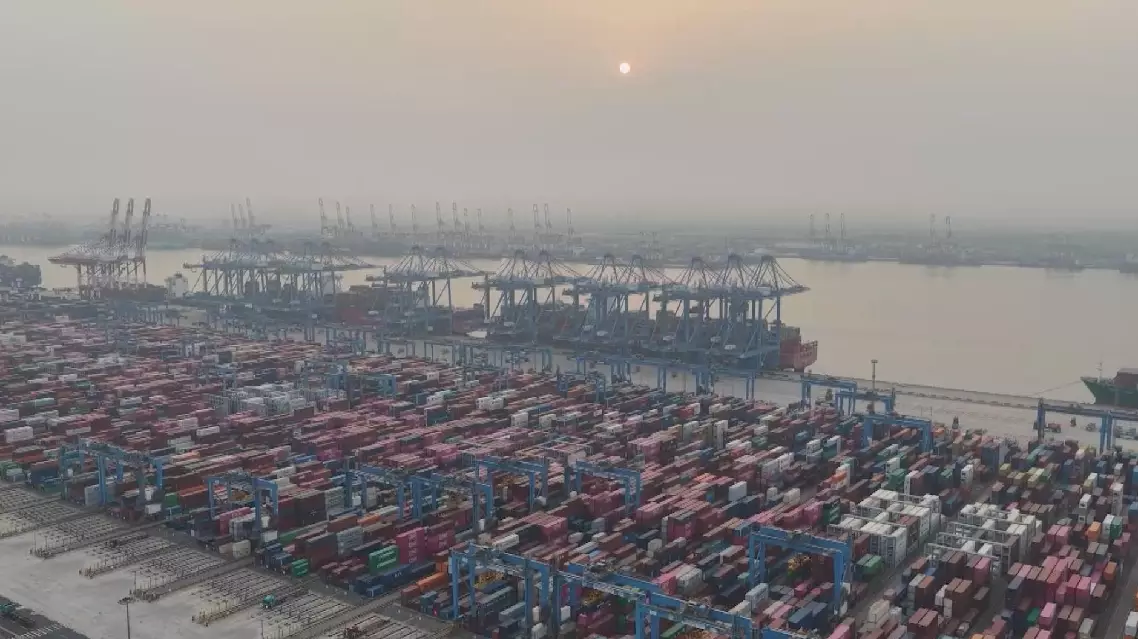
Multimodal transport center accelerates building of global transport network
China's first 500-kV cross-border alternating-current power interconnection project entered service Monday, creating the highest voltage grid tie between the two countries and advancing Belt and Road energy cooperation.
The project raises two-way power transfer capacity between the two countries from 50,000 kW to 1.5 million kW, enabling the annual transmission of about 3 billion kWh of clean electricity, roughly 30 times the capacity of previous lines, according to China Southern Power Grid.
As the largest cross-border grid project and the highest-voltage power link between China and Laos, it connects southwest China's Yunnan Province with Oudomxay and Luang Namtha provinces in northern Laos.
Cross-border electricity trading began as the project entered operation. About 4.81 million kWh of power from clean energy bases in northern Laos was transmitted to Yunnan through the new line, marking a more regular and institutionalized phase of power connectivity between the two countries.
It is also the first time an overseas new energy project has participated in China's electricity market, the company said. The power involved in the transaction came from a large mountain photovoltaic project in Laos, one of the core supporting power sources for the interconnection line.
"This project is the cross-border power grid project with the highest voltage level between China and Laos. Leveraging the China-Laos power grid interconnection and the power markets in southern China, surplus hydropower from Laos can be transmitted to China during the rainy season, while China can supply supplemental power to northern Laos during the dry season. This project represents yet another landmark achievement between China and Laos in deepening power cooperation and jointly advancing the high-quality development of the Belt and Road Initiative," said Li Jingru, general manager of Electricite du Laos Transmission Company Limited (EDL-T), a joint venture of China Southern Power Grid and Lao state-run Electricite du Laos.
The solar project has an average annual power generation capacity of about 1.65 billion kWh. In 2026, it is expected to transmit about 1.1 billion kWh of solar power across the border, supporting energy complementarity between the two countries.
"In the future, efforts will be made to further promote normalized cross-border electricity trading, meet the trading needs such as electricity transmission from Laos to China's Yunnan, from China's Yunnan to Laos, and from Laos to China's Guangdong, and facilitate the optimal allocation of energy resources in the Lancang-Mekong region," said Li Minhong, marketing director of China Southern Power Grid.
Construction of the interconnection project began in late February last year. Spanning a total length of 177.5 km, the transmission line includes a 145-km Chinese section and a 32.5-km Lao section.
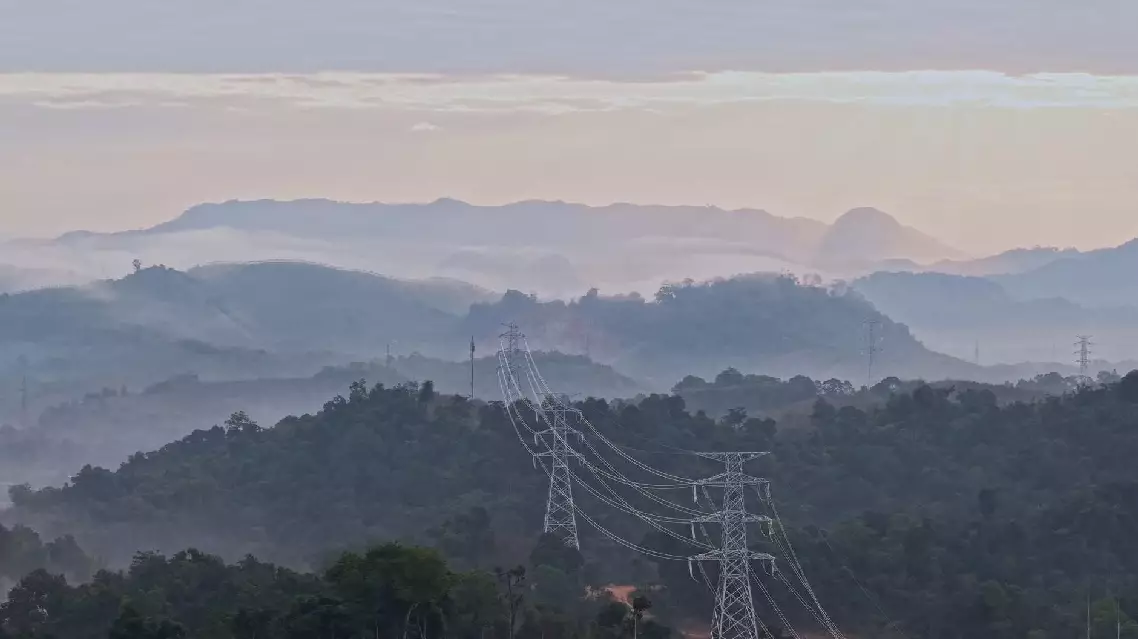
New China-Laos power link expands transfer capacity 30-fold, boosts electricity trading