WASHINGTON (AP) — Defense Secretary Pete Hegseth was met with sharp questions and criticism Tuesday by lawmakers who demanded details on his move to deploy troops to Los Angeles, and they expressed bipartisan frustration that Congress has not yet gotten a full defense budget from the Trump administration.
“Your tenure as secretary has been marked by endless chaos,” Rep. Rosa DeLauro, D-Conn., told Hegseth. Others, including Republican leaders, warned that massive spending projects such as President Donald Trump’s desire for a $175 billion Golden Dome missile defense system will get broad congressional scrutiny.
Click to Gallery
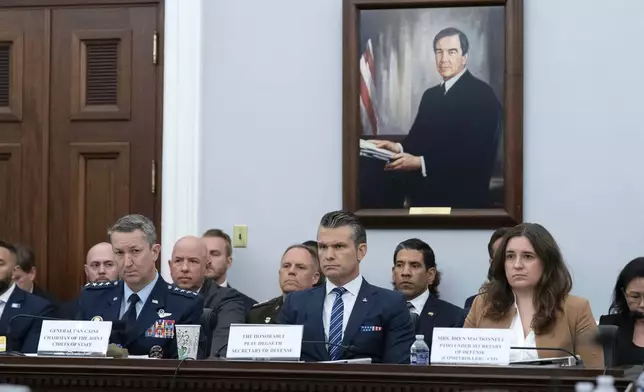
The Chairman of the Joint Chiefs of Staff General Dan Caine, left, Department of Defense Secretary Pete Hegseth and Bryn MacDonnell, Special Assistant to the Secretary of Defense, Performing the Duties of the Under Secretary of Defense and Chief Financial Officer, testify before the House Committee on Appropriations subcommittee oversight hearing on the Department of Defense, on Capitol Hill in Washington, Tuesday, June 10, 2025. (AP Photo/Jose Luis Magana)
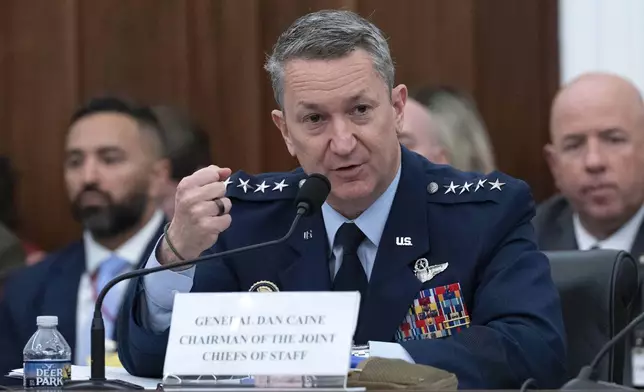
Chairman of the Joint Chiefs of Staff General Dan Caine testifies before the House Committee on Appropriations subcommittee oversight hearing on the Department of Defense, on Capitol Hill in Washington, Tuesday, June 10, 2025. (AP Photo/Jose Luis Magana)
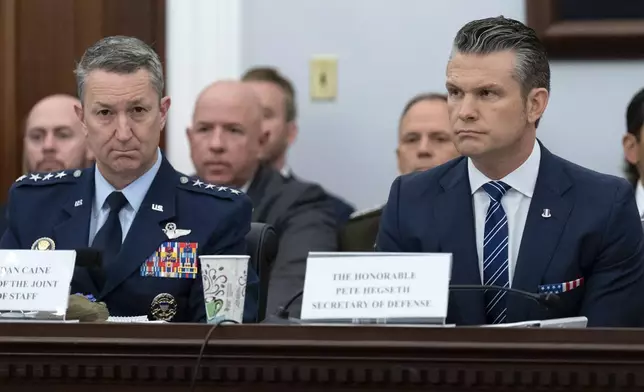
The Chairman of the Joint Chiefs of Staff General Dan Caine, left, and Department of Defense Secretary Pete Hegseth testify before the House Committee on Appropriations subcommittee oversight hearing on the Department of Defense, on Capitol Hill in Washington, Tuesday, June 10, 2025. (AP Photo/Jose Luis Magana)
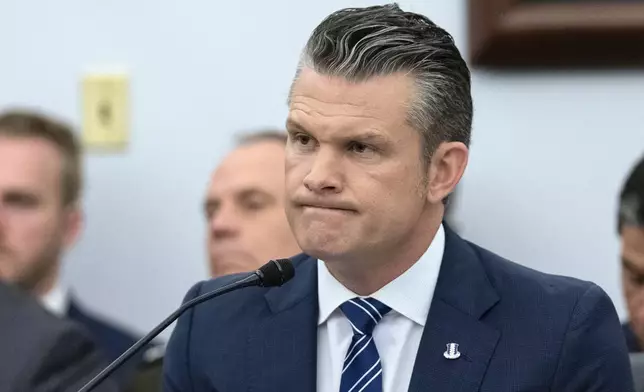
Department of Defense Secretary Pete Hegseth testifies before the House Committee on Appropriations subcommittee oversight hearing on the Department of Defense, on Capitol Hill in Washington, Tuesday, June 10, 2025. (AP Photo/Jose Luis Magana)
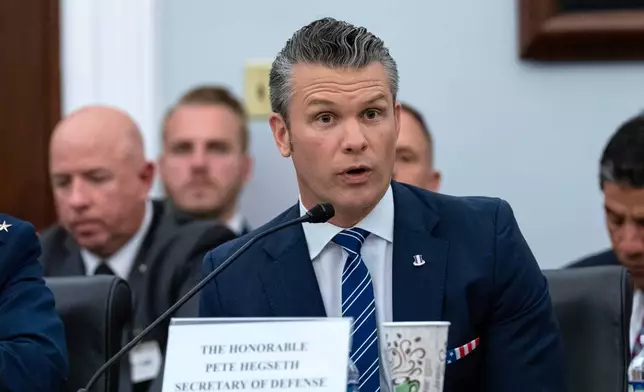
Department of Defense Secretary Pete Hegseth testifies before the House Committee on Appropriations subcommittee oversight hearing on the Department of Defense, on Capitol Hill in Washington, Tuesday, June 10, 2025. (AP Photo/Jose Luis Magana)

U.S. Defense Secretary Pete Hegseth delivers a speech during the international ceremony commemorating the 81st anniversary of the D-Day landings, Friday, June 6, 2025 on Utah Beach, Normandy. (AP Photo/Thomas Padilla)
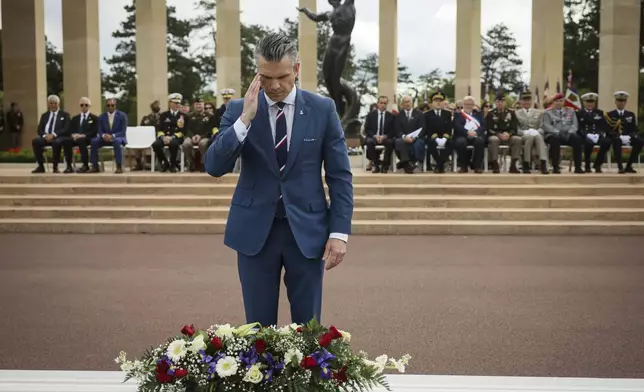
U.S. Defense Secretary Pete Hegseth lays a wreath of flowers during a ceremony at the US cemetery to commemorate the 81st anniversary of the D-Day landings, Friday, June 6, 2025 in Colleville-sur-Mer, Normandy. (AP Photo/Thomas Padilla)
The troop deployment triggered several fiery exchanges that at times devolved into shouting matches as House committee members and Hegseth yelled over one another.
After persistent questioning about the cost of sending National Guard members and Marines to Los Angeles in response to protests over immigration raids, Hegseth turned to his acting comptroller, Bryn Woollacott MacDonnell, who said it would cost $134 million. Hegseth defended Trump’s decision to send the troops, saying they are needed to protect federal agents as they do their jobs.
And he suggested that the use of troops inside the United States will continue to expand.
“I think we’re entering another phase, especially under President Trump with his focus on the homeland, where the National Guard and Reserves become a critical component of how we secure that homeland,” he said.
The hearing before the House Appropriations defense subcommittee was the first time lawmakers have been able to challenge Trump’s defense chief since he was confirmed. It is the first of three congressional hearings he will face this week.
Lawmakers complained widely that Congress hasn't yet gotten details of the administration’s first proposed defense budget, which Trump has said would total $1 trillion, a significant increase over the current spending level of more than $800 billion. And they said they are unhappy with the administration's efforts to go around Congress to push through changes.
Spending issues that have raised questions in recent weeks include plans to spend hundreds of millions of dollars on security upgrades to turn a Qatari jet into Air Force One and to pour as much as $45 million into a parade recently added to the Army's 250th birthday bash, which coincides with Trump's birthday Saturday.
Rep. Betty McCollum, D-Minn., quizzed Hegseth on the deployment of about 700 Marines to assist more than 4,100 National Guard troops in protecting federal buildings and personnel in LA.
She got into a testy back-and-forth with him over the costs of the operation. He evaded the questions but later turned to MacDonnell, who provided the estimate and said it covers the costs of travel, housing and food.
Hegseth said the 60-day deployment of troops is needed “because we want to ensure that those rioters, looters and thugs on the other side assaulting our police officers know that we’re not going anywhere."
Under the Posse Comitatus Act, troops are prohibited from policing U.S. citizens on American soil. Invoking the Insurrection Act, which allows troops to do that, is incredibly rare, but Trump has left open the possibility.
“If there’s an insurrection, I would certainly invoke it. We’ll see,” Trump told reporters in the Oval Office on Tuesday.
Asked how he would determine whether the unrest amounted to an insurrection, Trump offered little clarity. ”I mean, I could tell you there were certain areas of that, of Los Angeles last night, that you could have called it an insurrection.”
The commandant of the Marine Corps, Gen. Eric Smith, told lawmakers at a separate budget hearing Tuesday that the Marines in Los Angeles have not yet been called on to respond. When asked by Sen. Richard Blumenthal, D-Conn., about the danger Marines would use lethal force that could result in injuries and deaths, Smith said he is not concerned. "I have great faith in my Marines and their junior leaders and their more senior leaders to execute the lawful tasks that they are given.”
Committee members pressed Hegseth on Ukraine's surprise drone attack in early June that destroyed a large number of Russian bomber aircraft. And they questioned the administration's future funding for Kyiv.
Hegseth said the strikes caught the U.S. off guard and represented significant advances in drone warfare. The attack has the Pentagon rethinking drone defenses “so we are not vulnerable to a threat and an attack like that,” he said, adding that the department is learning from Ukraine and is focused on how to better defend its own military airfields.
He acknowledged, however, that funding for Ukraine military assistance, which has been robust for the past two years, will be reduced in the upcoming defense budget. That cut means that Kyiv will receive fewer of the weapons systems that have been key to countering Russia's onslaught.
“This administration takes a very different view of that conflict," he said. “We believe that a negotiated peaceful settlement is in the best interest of both parties and our nation’s interests.”
The U.S. to date has provided Ukraine more than $66 billion since Russia invaded in February 2022.
The panel zeroed in on funding issues, with only a few mentions of the other entanglements of Hegseth's early months. They touched only briefly on his moves to fire military leaders and purge diversity programs. And there was no discussion of his use of the Signal messaging app to discuss operational details of strikes in Yemen.
Hegseth has spent vast amounts of time promoting the social changes he's making at the Pentagon. He’s been far less visible in the administration’s more critical international security crises and negotiations involving Russia, Ukraine, Israel, Gaza and Iran.
He was on the international stage about a week ago, addressing a national security conference in Asia about threats from China. But a trip to NATO headquarters last week was quick and quiet, and he deliberately skipped a gathering of about 50 allies and partners where they discussed support for Ukraine.
Adriana Gomez Licon in Fort Lauderdale, Florida, contributed reporting.

The Chairman of the Joint Chiefs of Staff General Dan Caine, left, Department of Defense Secretary Pete Hegseth and Bryn MacDonnell, Special Assistant to the Secretary of Defense, Performing the Duties of the Under Secretary of Defense and Chief Financial Officer, testify before the House Committee on Appropriations subcommittee oversight hearing on the Department of Defense, on Capitol Hill in Washington, Tuesday, June 10, 2025. (AP Photo/Jose Luis Magana)

Chairman of the Joint Chiefs of Staff General Dan Caine testifies before the House Committee on Appropriations subcommittee oversight hearing on the Department of Defense, on Capitol Hill in Washington, Tuesday, June 10, 2025. (AP Photo/Jose Luis Magana)

The Chairman of the Joint Chiefs of Staff General Dan Caine, left, and Department of Defense Secretary Pete Hegseth testify before the House Committee on Appropriations subcommittee oversight hearing on the Department of Defense, on Capitol Hill in Washington, Tuesday, June 10, 2025. (AP Photo/Jose Luis Magana)

Department of Defense Secretary Pete Hegseth testifies before the House Committee on Appropriations subcommittee oversight hearing on the Department of Defense, on Capitol Hill in Washington, Tuesday, June 10, 2025. (AP Photo/Jose Luis Magana)

Department of Defense Secretary Pete Hegseth testifies before the House Committee on Appropriations subcommittee oversight hearing on the Department of Defense, on Capitol Hill in Washington, Tuesday, June 10, 2025. (AP Photo/Jose Luis Magana)
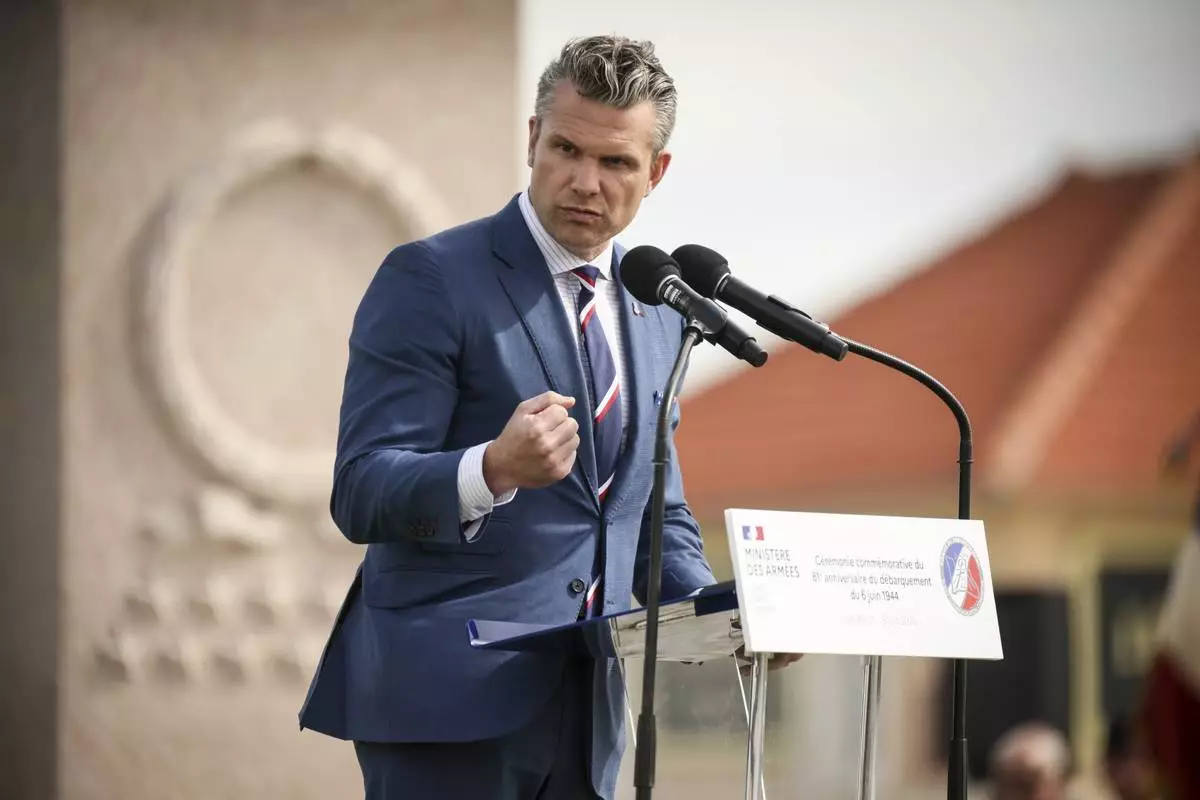
U.S. Defense Secretary Pete Hegseth delivers a speech during the international ceremony commemorating the 81st anniversary of the D-Day landings, Friday, June 6, 2025 on Utah Beach, Normandy. (AP Photo/Thomas Padilla)
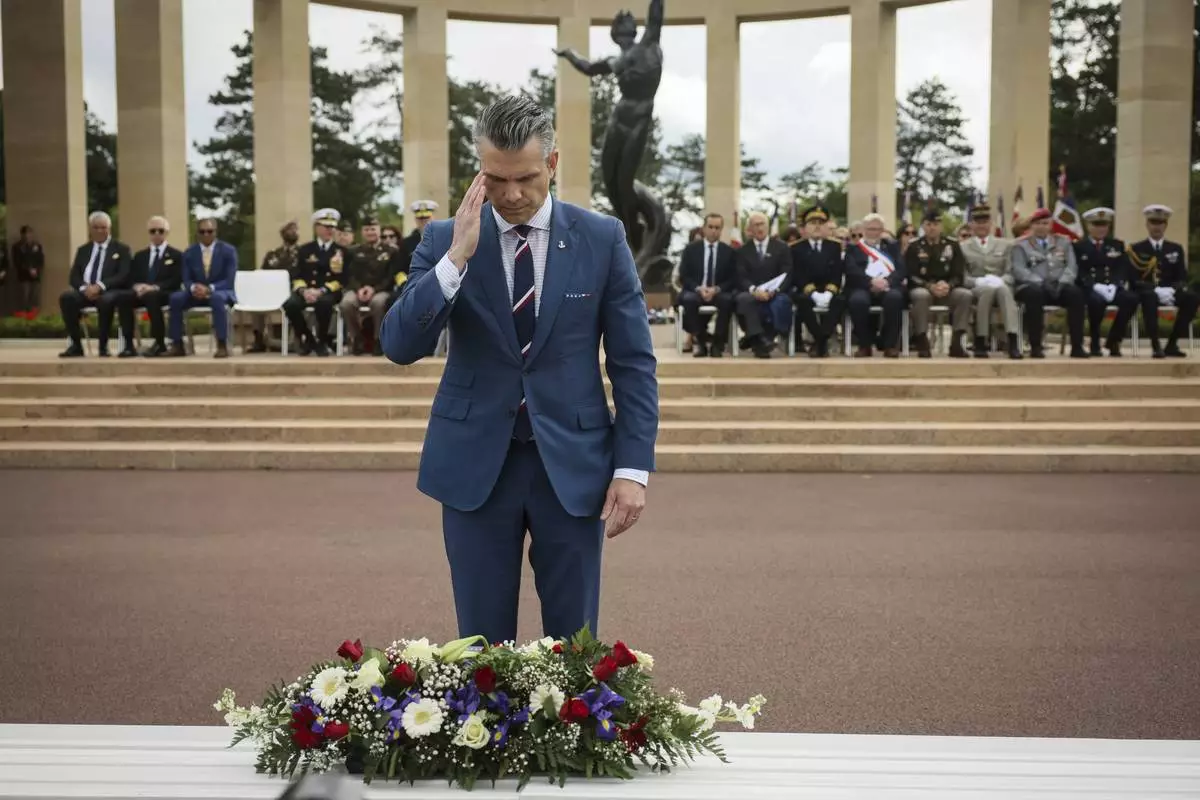
U.S. Defense Secretary Pete Hegseth lays a wreath of flowers during a ceremony at the US cemetery to commemorate the 81st anniversary of the D-Day landings, Friday, June 6, 2025 in Colleville-sur-Mer, Normandy. (AP Photo/Thomas Padilla)