The first nuclear power plant unit equipped with Hualong One, China's domestically designed third-generation nuclear reactors, in east China's Yangtze River Delta on Tuesday completed hot functional test, laying a solid foundation for the nuclear facility's subsequent construction and entry into operation, according to the China General Nuclear Power Corporation (CGN).
Located in Cangnan County, Wenzhou City of Zhejiang Province, the San'ao nuclear power plant is home to the first project equipped with Hualong One reactors in the Yangtze River Delta.
The CGN, constructor of the power plant, said on Tuesday that its Unit 1 has undergone the hot functional test involving a series of debugging, individual system verification and comprehensive performance evaluations.
The hot functional test is conducted before the loading of nuclear fuel. Its purpose is to comprehensively verify the reliability of the nuclear island and conventional island equipment and systems under conditions that closely simulate actual operating conditions of the nuclear power plant. This test serves as a significant assessment before the plant officially begins power generation, ensuring that all relevant parameters meet the design requirements.
"This test involves a series of debugging, individual system verification and comprehensive performance evaluations, fully validating the reliability and response levels of systems and equipment in both the nuclear island and conventional island. Moving forward, we will continue to advance according to plan, initiating fuel loading and connecting Unit 1 to the power grid," said Li Xinghua, manager of the operation department of CGN Cangnan Nuclear Power Co., Ltd.
Designed to house six Hualong One nuclear power generator sets, the San'ao nuclear power plant is expected to provide over 54 billion kilowatt-hours of clean energy annually for Zhejiang and even the entire Yangtze River Delta region upon completion.
The power plant will contribute to the reduction of standard coal consumption by more than 16 million tons and carbon emission by over 44 million tonnes each year, which is equivalent to afforestation of 110,000 hectares.
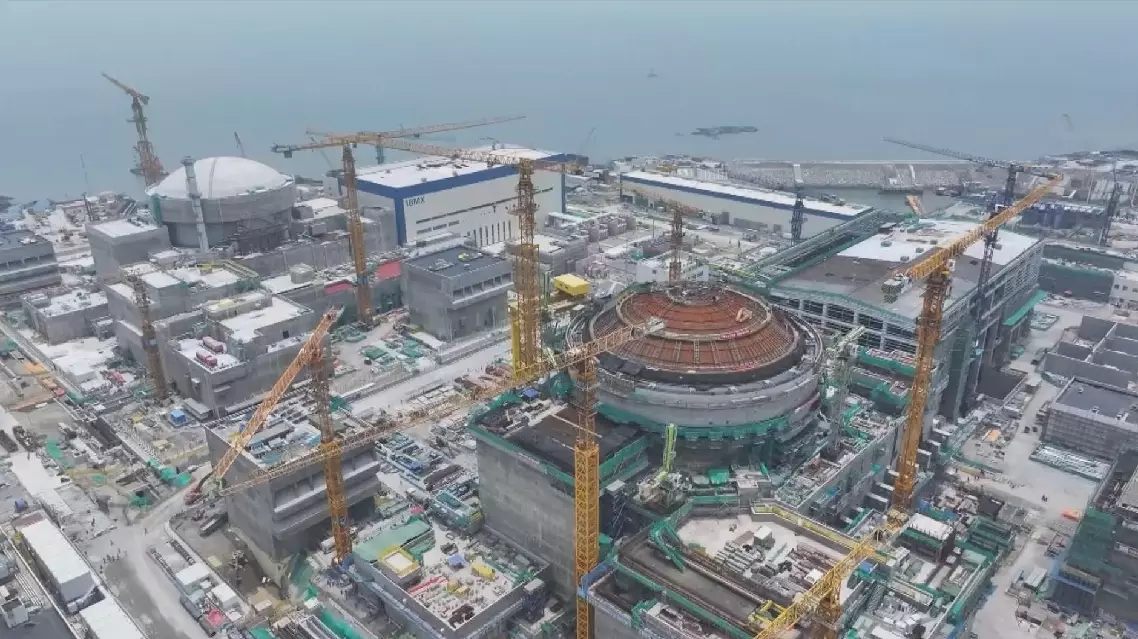
First nuclear plant unit using Hualong One reactor in Yangtze River Delta completes hot functional test

The hardcore technology of drones and de-icing robots has elevated the efficiency of clearing ice from power lines to a new level in east China's Anhui Province.
Deep in the Dabie Mountains of Anhui, four significant power transmission corridors are located. Their stable operation is vital for ensuring the electricity security of the entire Yangtze River Delta area.
A sudden cold wave hit the Dabie Mountains area before the this year's Spring Festival. To ensure smooth electricity supply during the holiday, more than 20 inspection teams assembled immediately and set out for power inspection.
Despite being only about 600 meters above sea level, the combination of rain, snow, humidity, and low temperatures in the deep mountains can easily lead to ice accumulation on the power lines.
The challenging terrain made it impossible for vehicles to navigate. The inspection workers had to carry their equipment, carefully advancing along the slippery mountain paths. Eventually, they reached a high-voltage tower. Standing over 60 meters tall, the tower nearly disappeared into the swirling mist.
A staff member skillfully operated a drone to begin their inspection of the tower. In less than five minutes, the drone captured over 20 close-up photos of the tower, demonstrating remarkable efficiency despite the low visibility conditions.
"What do we do if the fog is too thick and we can't see the tower? In such cases, we rely on our autonomous inspection method, allowing the drone to fly close to the tower on its own. This approach enables us to clearly capture images of many components, such as checking for ice or snow accumulation on the tower. The photos are then instantly transmitted back to our system, where the large model can annotate each image and identify any potential defects on the tower," said Lei Jiajie, a staff member from Unmanned Aerial Vehicle (UAV) Inspection Center, State Grid Anhui Electric Power Co., Ltd.
Airlifted by drone, a de-icing robot can clear ice from power lines efficiently while crews operate safely from the ground, keeping maintenance personnel safe in icy weather.
"This is our de-icing robot. It is placed on the ground wire and autonomously chips away at the ice. It is operated using a remote control," said Lei.
By using the robot, the entire 20-meter-long wire, covered in ice, was completely cleared in about one minute.
"In the past, we used to climb the tower and use a rod to strike the wire directly from above, causing it to vibrate down, and that was the traditional method. Today, these young people are incredible. They can operate everything with ease," said Bao Yuanchun, a high-voltage line maintenance technician from State Grid Lu'an Power Supply Company.
In the evening, the staff returned to the lab with over 400 photos captured by the drone. Within just five minutes, all potential line hazards were identified by artificial intelligence.
At this inspection center, young faces like Lei's are everywhere. This group of new power workers, with an average age of under 30, not only traverses mountains to assemble towers and lay power lines, but also operates drones and AI models to collect data and manage intelligent power dispatch.
These young power workers said that their next step is to refine their skills further, stay in step with the times, and advance alongside technological innovations.
Drone, robot take powerline de-icing efficiency to new level in China