LAS VEGAS (AP) — Nevada Republican Gov. Joe Lombardo unexpectedly vetoed a bill on Thursday that would have required voters in the swing state to show a photo ID at the polls — a conservative priority across the country and something that has long been on the governor’s legislative wish list.
The move brings a dramatic end to one of the legislative session’s most surprising outcomes: A bipartisan deal that combined the requirement for voter identification with a Democratic-backed measure to add more drop boxes for mail ballots that Lombardo had initially vetoed.
The bill came together in the final days of the session and passed mere minutes before the Democratic-controlled Legislature adjourned just after midnight on June 3. Lombardo had been expected to sign it.
In his veto message, Lombardo said he “wholeheartedly” supports voter ID laws but that he felt the bill fell short on addressing his concerns about ballots cast by mail, because such ballots could still be accepted “solely on the basis of a signature match" under the bill.
Because it “would apply voter ID requirements unequally between in-person and mail ballot voters and fails to sufficiently guarantee ballot security, I cannot support it,” he said.
The voter ID requirements in the bill mirrored a ballot initiative known as Question 7 that Nevada voters overwhelmingly approved last November. But voters would have to pass it again in 2026 to amend the state constitution. The requirement would then be in place by 2028.
Assembly Speaker Steve Yeager, the Democrat who brokered the deal with Lombardo, said when he introduced the legislation that voters seemed poised to give the final approval, and that enacting a voter ID law would have given the state a head start on ensuring a smooth rollout before the next presidential election.
In a scathing statement, Yeager called the governor's decision a “breach of trust," saying that he believes Lombardo gave in to pressure around him to veto the bill, designated Assembly Bill 499.
“Lombardo was for AB499 before he was against it, encouraging all legislative Republicans to support it, which they did,” Yeager said.
Voting rights groups condemned the legislation, saying it would have made it harder for some people to vote, including low-income or unhoused voters, people with disabilities and older voters.
Let Nevadans Vote, which describes itself as a nonpartisan coalition, said Thursday in a statement that the governor's veto only temporarily stops what it called “the misguided and ill-conceived implementation of voter ID in Nevada.”
“Come 2026, Question 7 will still be on the ballot," the group said while describing voter ID requirements as “strict regimes” that “decide who gets to exercise their constitutional right to vote and who cannot.”
Polls have shown that most Americans support voter ID laws, and that has been consistent over the years and across party lines. A 2024 Gallup poll found 84% of Americans were in favor of requirements for a photo ID at voting places, consistent with Gallup findings from 2022 and 2016. That includes about two-thirds of Democrats, according to the 2024 survey.
Voters are either required or requested to show ID when voting in person in 36 states, according to the National Conference of State Legislatures.
Not all states require photo ID, though. Some accept documents such as a bank statement, and some allow voters without ID to vote after signing an affidavit. A few states allow poll workers to vouch for voters without an ID.
Lombardo on Thursday also vetoed a bill that would have allowed the swing state’s nonpartisan voters to cast ballots in Republican or Democratic primary races.
The bill sought to include the more than 855,000 voters registered as nonpartisans — the state's largest voting bloc — in the process of nominating major-party candidates for congressional races and statewide offices.
A ballot initiative to open up primaries for all registered voters was rejected by voters last November. The sweeping measure, which also attempted to implement ranked choice voting, faced intense opposition from party leaders on both sides who said it was too broad and confusing.
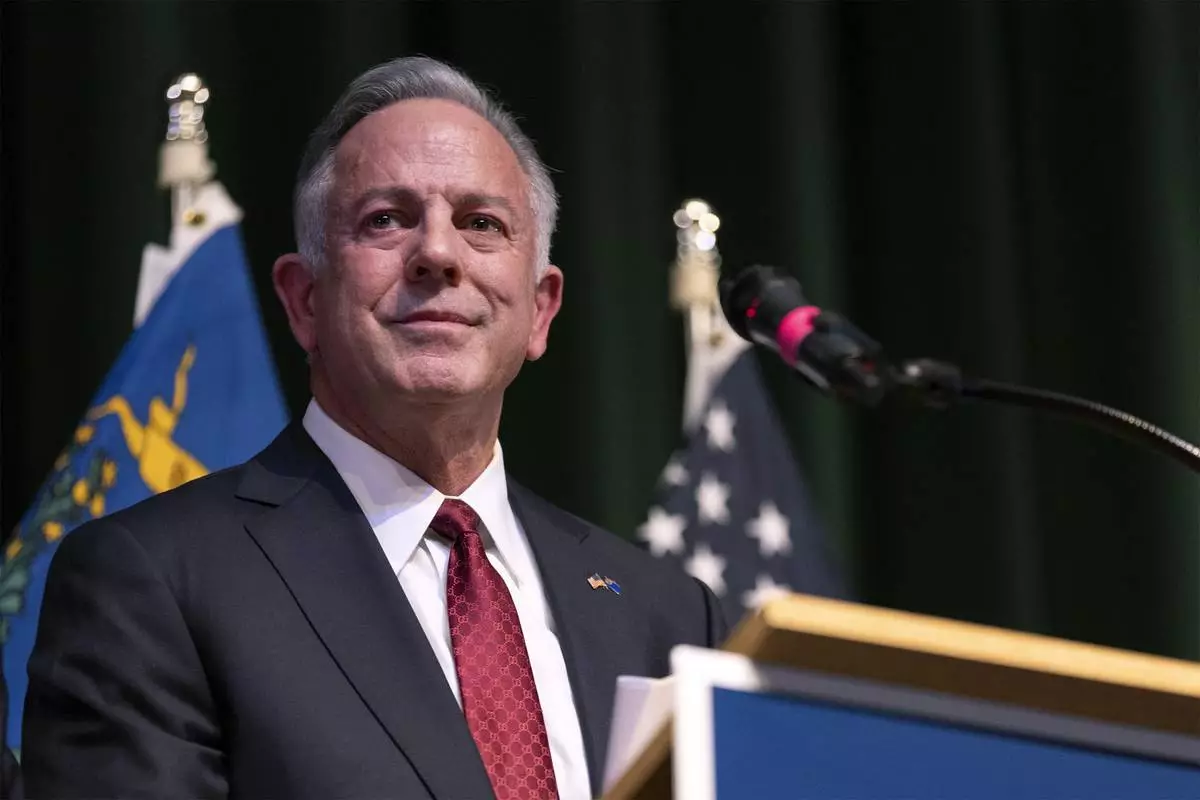
FILE - Clark County Sheriff and Nevada Gov.-elect Joe Lombardo gives a victory speech during a news conference, Nov. 14, 2022, in Las Vegas. (AP Photo/Ellen Schmidt, File)